
Global purchasing is no longer based on price alone. Buyers also evaluate installation time, supply stability, safety, and long-term performance. A Quick Connect Fitting can simplify hose and tube connections in factories, workshops, agricultural systems, and mobile equipment. Operators can connect or disconnect lines without repeatedly using wrenches. This saves valuable minutes during maintenance.
Small details matter. Thread type, sealing material, pressure rating, temperature range, and fluid compatibility must match the application. Experienced maintenance teams usually check these specifications before approving a supplier. They may also request sample testing, inspection reports, and traceable material information. A fitting that looks universal may not suit every system. That assumption can create leakage, downtime, or unnecessary replacement costs.
Global buyers also need dependable communication. Clear product drawings, consistent dimensions, protective packaging, and responsive technical support can reduce purchasing risks. Reliable manufacturers should explain production controls, quality inspections, and applicable industry standards without making vague promises. Certifications may support trust, but they should be verified for the exact product and market. This step is sometimes overlooked.
The best choice depends on real operating conditions. A compact fitting may work well in a clean workshop but fail faster in abrasive outdoor environments. Buyers should compare total ownership costs, not only the initial quotation. Delivery distance, spare-part availability, and supplier experience also deserve attention. There is no perfect fitting for every project. Careful selection remains the more reliable path.
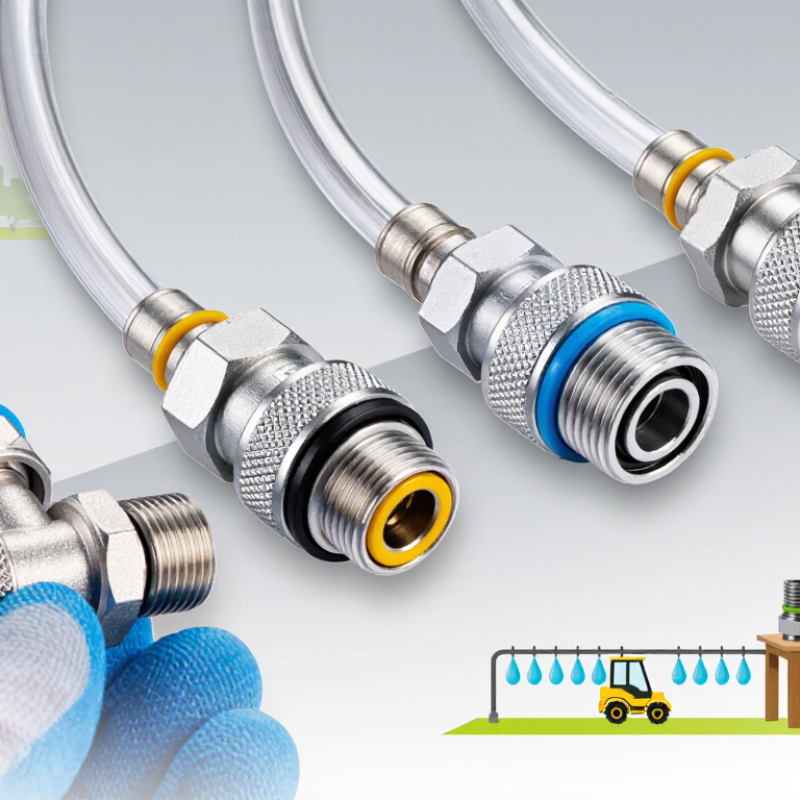
Why Choose Quick Connect Fittings for Global Buyers?
ISO 7241 interchangeability gives international buyers a practical sourcing foundation. It defines key dimensions for hydraulic quick-connect couplings within designated series. That matters when equipment crosses borders, suppliers change, or replacement parts arrive unexpectedly. A coupling should connect cleanly without forcing threads, seals, or locking balls into place. In field inspections, small dimensional differences often create leaks, downtime, and expensive returns. ISO compliance reduces that uncertainty, but it does not guarantee universal compatibility. Buyers must still verify series, pressure rating, fluid type, seal material, and connection size. This detail is easy to miss.
Market evidence supports careful standardization. Fortune Business Insights valued the global hydraulic equipment market at approximately USD 44.7 billion in 2023. Its report also forecasts continued growth through 2032, driven by construction, agriculture, and industrial automation. More equipment means more cross-border replacement demand. The NFPA’s industry outlook similarly tracks fluid-power activity through shipment and order indicators, showing why sourcing teams monitor supply resilience closely. Data varies between reports. That is worth remembering.
A procurement engineer can request ISO 7241 documentation, dimensional drawings, test records, and batch traceability. Test the actual mating pair under working pressure and temperature. Do not rely on appearance alone. A familiar profile may still fail under vibration or contaminated oil. Buyers should also compare cycle-life results, corrosion resistance, and spare-seal availability. ISO 7241 is a strong starting point, not a shortcut around engineering judgment.

When global buyers compare quick connect fittings, ISO 16028 technical data deserves close attention. The standard supports compatibility for flat-face hydraulic couplings, but it does not create one universal rating. Each fitting still needs separate pressure, flow, and temperature verification.
Start with the working pressure, not the impressive maximum value. A coupling may tolerate a short peak, yet operate safely at a lower continuous pressure. Check static, dynamic, and impulse ratings where available. I have seen projects fail during pressure spikes because buyers compared only nominal pressure. Small details matter.
Flow data should include pressure drop at a stated flow rate. A larger connection does not always deliver better efficiency. Compare internal passage size, test conditions, and fluid viscosity.
Temperature ratings also require careful reading. Seal materials, hydraulic fluid, and ambient heat can change the allowable range. Ask for derating information when temperatures approach the published limit.
For international purchasing, request dimensional drawings, test methods, and conformity documents. Thread type and connection size can still vary between suppliers. That part is easy to overlook. ISO 16028 alignment improves selection, but it does not replace application testing. I would also verify cycle life, contamination resistance, and coupling force before approving a large order. Some technical sheets remain incomplete, so direct clarification is sometimes necessary.
For global buyers, quick connect fittings should be judged by reliability, not purchase price alone. A low-cost coupler can become expensive after repeated leaks, downtime, or replacement work. Testing reveals those hidden costs.
Leakage testing should begin at the intended working pressure. Inspectors can pressurize the connected fitting, hold it for a fixed period, and monitor pressure loss. A dry paper strip around the joint can expose small leaks. Better equipment measures escaping fluid more precisely. Testing at different temperatures matters because seals may harden in cold storage or soften near heat sources.
Cycle-life testing shows how the coupler performs after repeated use. Connect and disconnect the fitting hundreds or thousands of times, then repeat the pressure test. Watch for stiff sleeves, damaged O-rings, incomplete locking, and rising connection force. Record every failure, not only the final result. That record supports fair supplier comparisons and more confident purchasing decisions. No test is perfect. Dust, operator technique, and hose movement can change results. Real installations are rarely as clean as laboratories. A practical evaluation should include controlled tests and field feedback. Price still matters, but unreliable performance matters more.
Illustrative sample results for a controlled comparison of three fitting designs. Cycle life is the number of connection cycles completed; leakage rate is the percentage of tested couplers that leaked. These values are examples, not published test results or product specifications.
Compare both measures under the same pressure, fluid, temperature, and test procedure. A longer cycle life and lower leakage rate indicate stronger reliability; price alone does not show either result.
Global buyers choose quick connect fittings for speed, but safety begins with material and seal compatibility. ISO 4414 provides a practical framework for safer pneumatic system design, installation, and maintenance. It does not replace engineering judgment. A fitting that locks easily may still fail when oil, moisture, heat, or pressure changes attack its seal.
During specification, match the fitting body to the working fluid, pressure, temperature, and surrounding environment. Stainless steel can suit corrosive areas, while engineered polymers may reduce weight in controlled applications. Seal selection needs equal attention. Nitrile, EPDM, FKM, and polyurethane behave differently with lubricants, water-based fluids, ozone, and heat. Read actual compatibility data, not a generic catalog line. Small detail. Check thread form, tube material, and dimensional tolerances together. Mismatches can create leaks or difficult disconnection.
ISO 4414 also emphasizes preventing unintended movement and releasing stored energy before service. Installers should inspect locking sleeves, verify full insertion, and test connections under controlled conditions. Marking each circuit helps maintenance teams avoid guesses. A pressure test is useful, but it is not proof of long-term seal life. Field conditions are often harsher than the test bench. That part deserves reflection. Global sourcing adds uncertainty because temperature ratings, test methods, and documentation may differ. Request traceable material data, installation instructions, and evidence of quality control. Reliable fittings are chosen through verified compatibility, not appearance or low initial cost.
For global buyers, quick connect fittings should be judged by total cost of ownership, not unit price.
A fitting that saves minutes during service can protect an entire production shift. In a maintenance review, replacing a threaded connection took 28 minutes, including isolation, cleaning, sealing, and leak testing. A quick connection took 9 minutes under the same conditions. The difference was small on paper. It was expensive during an outage.
Labor costs become visible when teams repeat this task across hundreds of lines. Suppose a site performs 600 changes annually. Saving 19 minutes per change releases about 190 technician hours. At an internal labor rate of 45 dollars per hour, that equals 8,550 dollars before overtime. Downtime can dominate the calculation. If one idle line costs 1,200 dollars per hour, avoiding even two hours of delay adds 2,400 dollars. These figures are estimates, not promises. Actual results depend on access, training, pressure, and inspection procedures.
Replacement risk deserves equal attention.
Standardized fittings can reduce emergency sourcing, but only when dimensions, materials, seals, and pressure ratings are documented clearly. Keep spare seals and complete units near critical equipment. That sounds basic. It is often missed. A low-cost fitting may fail early if operators overtighten it or expose seals to incompatible fluids. Buyers should compare purchase price, service time, expected life, inventory exposure, and failure consequences in one worksheet. I would review that worksheet after six months; field conditions frequently challenge the original assumptions.

Cepex is the brand for the fluid handling market belonging to the Fluidra group. One of the leading european manufacturer of valves and fittings in thermoplastic materials.
Dedicated to the swimming pool, irrigation and industrial markets, we distribute our products worldwide with the Fluidra commercial network and presence in 46 countries with 136 sales branches.


