
Why Choose UPVC Door Hinges for Your Project?
FLUID HANDLING EXPERTS

Blog, all our news

Why Choose UPVC Door Hinges for Your Project?

Choosing Upvc Door Hinges is a practical decision about fit, durability, and everyday performance. A door may look correctly installed, yet still scrape the threshold or leave an uneven gap. The hinges help control its movement and maintain alignment as the door opens and closes. Small parts matter. For installers and project buyers, the right choice depends on door weight, hinge adjustment range, fixing method, and exposure to moisture. These details should be checked against the door manufacturer’s specifications, not guessed from appearance alone.

The U.S. Department of Energy’s Energy Saver guidance estimates that heat gain and loss through windows account for about 25–30% of residential heating and cooling energy use. That figure concerns windows, not UPVC door hinges. It does, however, underline why building-envelope details deserve careful attention. A well-adjusted hinge can help a door sit evenly against its frame, but it cannot guarantee lower energy use or correct a poor seal. Standards such as EN 1935 also offer a framework for assessing hinge performance, including durability and corrosion resistance. Check the product documentation for the applicable classification and test conditions. There is no universal hinge for every door. That is easy to overlook. A careful specification, followed by a real fit check, is usually more reliable than choosing by price or appearance alone.
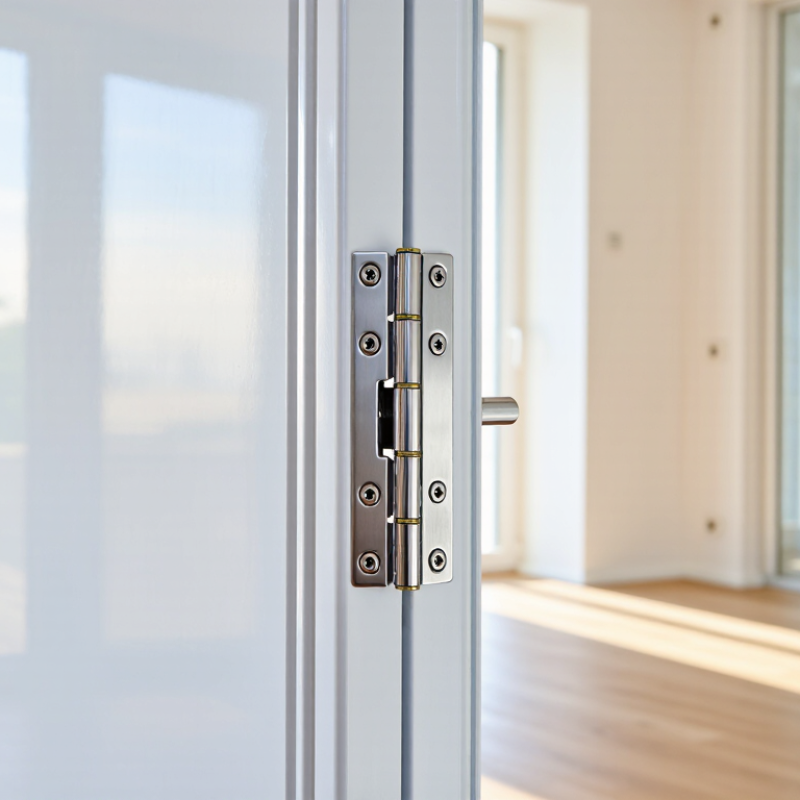
Why Choose UPVC Door Hinges for Your Project?

Understanding UPVC Door Hinges and Their Role

UPVC door hinges connect the sash to the frame and carry the door’s weight through every opening and closing cycle. They also help keep the sash aligned, so the lock engages cleanly and the door seals against weatherstripping. Small parts, important work.

Many hinges for UPVC doors offer adjustment in more than one direction. This can help correct a door that drops slightly or rubs the frame, though adjustment ranges vary by design. Check the hinge type, door weight, fixing points, and any reinforcement inside the profile before choosing a replacement. A hinge that looks similar may not fit or support the same load. That detail is easy to miss.

Good installation matters just as much as selection. Screws should engage sound material, and the sash should be supported while hinges are fitted or adjusted. Afterward, open and close the door slowly, checking for rubbing, uneven gaps, and a latch that catches. Do not force an adjustment to hide a deeper problem, such as loose fixings or a distorted frame. Hinges can improve alignment, but they cannot correct every fault. Regular checks help catch wear early.

Materials and Design Features of UPVC Door Hinges

UPVC door hinges are designed to support a door while keeping its edges aligned with the frame. The hinge body is commonly made from corrosion-resistant metal, such as stainless steel or coated steel, while pins and adjustment parts may use different metals. Materials vary by design. A smooth finish helps resist moisture, but appearance alone says little about long-term performance.

Look closely at the hinge’s load rating, fixing points, and adjustment range. A reinforced UPVC door can place considerable weight on its hinges, so screws need to reach suitable reinforcement rather than rely only on the outer plastic skin. Small adjustment screws let an installer correct sagging or uneven gaps. That matters when a door rubs near the threshold or lets in a cold draught. Check the manufacturer’s fitting instructions. Details differ.

Some hinges have covers that conceal fixings and give the door a cleaner look. Others prioritize quick access for adjustment. A neat cover is useful, but it can make inspection less convenient. I would not judge a hinge by finish alone; screw quality and accurate fitting matter just as much. Even a well-made hinge can become loose if the frame or fixing points are unsuitable.

Why Choose UPVC Door Hinges? Material Density at a Glance

Approximate density helps illustrate how hinge materials differ, but it does not determine strength or durability on its own. UPVC door hinges often combine a polymer frame with metal components; the best choice depends on load, corrosion exposure, and design.

Benefits for Durability, Security, and Weather Resistance

uPVC doors face rain, grit, temperature swings, and repeated opening. Their hinges carry the door’s weight while keeping the sash aligned against the frame. That alignment matters: a small drop can create rubbing, uneven seals, and an easier point of entry. A properly specified hinge helps maintain a close, consistent fit. Fit matters, too.

Durability can be assessed against EN 1935, the European standard for single-axis hinges. Its highest durability class covers 200,000 test cycles, a useful benchmark for frequently used doors. This is a test classification, not a guarantee that every hinge reaches it. Ask for the product’s tested class and load capacity, then match both to the door’s size and weight. More metal is not automatically better.

Weather resistance depends on the hinge material, protective finish, and maintenance. EN 1670 rates corrosion resistance; Grade 4 corresponds to 240 hours of salt-spray testing. That helps compare tested finishes, though real exposure varies with coastal air, standing water, and cleaning habits. For security, choose hinges that resist lifting and use fixings anchored into suitable door reinforcement. A strong hinge with weak screws can still fail. Check alignment after installation; small adjustments are easy to overlook.

Why Choose UPVC Door Hinges for Your Project? — Benefits for Durability, Security, and Weather Resistance

Project factor Potential benefit What to check when specifying Practical project consideration
Durability A hinge designed for the door’s weight and frequency of use can support reliable everyday operation. Confirm the manufacturer’s rated door weight, recommended number of hinges, material, and adjustment range. Door size, glazing weight, installation quality, and usage all affect service life; ratings vary by product.
Security Suitable hinge construction and secure fixing can help keep the door correctly supported and aligned. Check fixing requirements, hinge-side protection where needed, compatibility with the door profile, and applicable security test evidence. Hinges are one part of door security; the frame, locks, glazing, and installation also matter.
Weather resistance Corrosion-resistant materials or finishes can help hinges withstand exposure to moisture and outdoor conditions. Identify the hinge material and finish, and check whether the product is suitable for the project’s exposure conditions. Performance depends on material, finish, environment, and maintenance; coastal or highly exposed locations may need extra attention.
Door alignment Adjustable hinges can make it easier to correct door position during installation or routine servicing. Review the adjustment directions and range, access to adjustment points, and installation instructions. Correct adjustment helps the door close properly; it does not replace sound installation or a suitable frame.
Compatibility A hinge made for the specific uPVC door profile can provide a more suitable fit and fixing arrangement. Verify the profile, hinge position, fixing method, door configuration, and replacement-hinge dimensions. Hinges are not universally interchangeable; confirm compatibility before ordering or installation.
Maintenance Periodic inspection and care can help identify loose fixings, wear, or changes in door alignment. Follow the product’s cleaning, lubrication, and adjustment instructions; use only compatible products. Maintenance needs vary by hinge design and environment. Avoid assuming that every hinge is maintenance-free.

Note: Hinge capacity, materials, security features, and weather performance vary by product. Check current technical documentation and installation guidance for the specific door and project.

How to Choose Hinges for Your Door and Project

Choosing hinges starts with the door, not the catalogue. Record the leaf’s height, width, mass, opening direction, and expected daily use. Then check each hinge’s stated load capacity and whether the uPVC profile requires reinforcement. Small details matter. Confirm adjustment range, screw length, and clearance between the sash and frame. A hinge that fits the door but clashes with the frame is no good.

Use test evidence, not appearance alone. BS EN 1935:2002 classifies single-axis hinges by durability, door mass, and corrosion resistance. Its endurance classes extend to 200,000 test cycles. Treat that figure cautiously: it is a laboratory benchmark, not a promise of years in service. For coastal or frequently washed entrances, compare corrosion classifications as well as cycle figures. One easy-to-miss issue is profile reinforcement; even a high-rated hinge may loosen if its screws cannot grip securely. Ask for the hinge’s test classification and installation instructions, then check them against the actual door assembly.

Installation, Adjustment, and Routine Maintenance

A well-fitted UPVC door hinge should let the door move smoothly without rubbing the frame. During installation, support the door’s weight before removing or fitting a hinge. Align each hinge carefully, and use fixings suited to the hinge and door construction. Uneven gaps can point to poor alignment, even when the screws feel tight. Small changes matter.

Adjustment methods vary by hinge design, so check its instructions before turning any screws. Make small changes, then open and close the door to assess the result. Check that the latch engages and the seal contacts the frame evenly. A stiff hinge is not always a lubrication problem; misalignment can feel similar. Do not force the adjustment screw. Keep it gentle.

For routine maintenance, wipe hinges with a soft, damp cloth and dry them afterward. Check periodically for loose screws, visible wear, or movement around the fixing points. Tighten loose screws carefully, but avoid overtightening, which can damage the fixing or surrounding material. Lubricate only the points specified by the hinge instructions, using a suitable product. If the door continues to bind after careful adjustment, inspect its alignment rather than repeatedly turning the hinge screws.

Copyright 2025 Fluidra S.A. | Created by BCM Marketing Agencia Privacy Policy Legal note | Cookie policy |

Technical cookies are strictly necessary for our website to work and you can navigate through it. These types of cookies are those that, for example, allow us to identify you, give you access to certain restricted parts of the page if necessary, or remember different options or services already selected by you, such as your privacy preferences. Therefore, they are activated by default, your authorization not being necessary in this regard. Through the configuration of your browser, you can block or alert the presence of this type of cookies, although such blocking will affect the proper functioning of the different functionalities of our website.


The analysis cookies allow us to study the navigation of the users of our website in general (for example, which sections of the page are the most visited, which services are used most and if they work correctly, etc.). From the statistical information on navigation on our website, we can improve both the operation of the page itself and the different services it offers. Therefore, these cookies do not have an advertising purpose, but only serve to make our website work better, adapting to our users in general. By activating them you will contribute to this continuous improvement. You can enable or disable these cookies by checking the corresponding box, being disabled by default.


Functionality cookies allow us to remember your preferences, to personalize certain characteristics and general options of our website, every time you access it (for example, the language in which the information is presented to you, the sections marked as favorites, your browser type, etc.) Therefore, this type of cookies does not have an advertising purpose, but by activating them you will improve the functionality of the website (for example, adapting to your type of browser) and the customization of it based on your preferences (for example, by presenting the information in the language that you have chosen in previous occasions), which will contribute to the ease, usability and comfort of our page during your navigation. You can enable or disable these cookies by checking the corresponding box, being disabled by default.


Advertising cookies allow us to manage the advertising spaces included in our website based on criteria such as the content shown or the frequency in which the ads are displayed. For example, if you have been shown the same ad several times on our website, and you have not shown a personal interest by clicking on it, it will not appear again. In summary, by activating this type of cookies, the advertising shown on our website will be more useful and diverse, and less repetitive. You can enable or disable these cookies by checking the corresponding box, being disabled by default.


Behavioral advertising cookies allow us to obtain information based on the observation of your browsing habits and behaviors on the web, in order to show you advertising content that best suits your personal tastes and interests. To understand it in a very simple way, we will give you a fictitious example: if your last searches on the web were related to suspense literature, we would show you advertising about suspense books. Therefore, activating this type of cookies, the advertising that we show you on our website will not be generic, but will be oriented to your searches, tastes and interests, therefore adjusting exclusively to you. You can enable or disable these cookies by checking the corresponding box, being disabled by default.
To understand it in a very simple way, we will give you a fictitious example: if your last searches on the web were related to suspense literature, we would show you advertising about suspense books. Therefore, activating this type of cookies, the advertising that we show you on our website will not be generic, but will be oriented to your searches, tastes and interests, therefore adjusting exclusively to you. You can enable or disable these cookies by checking the corresponding box, being disabled by default.

SAVE

We use our own and third-party cookies to ensure the proper functioning of the website and to analyse our services, improve your experience on our website and show you advertisements related to your interests according to profiling based on your browsing habits (e.g. websites visited). You can accept all cookies by clicking "ACCEPT" or set or reject them by clicking here. If you would like to know more about the use of cookies, please see our COOKIE POLICY.


ACCEPT ALL
Reject no essentials


