
Why Choose Rock Wool Mineral Wool for Insulation?
FLUID HANDLING EXPERTS

Blog, all our news

Why Choose Rock Wool Mineral Wool for Insulation?

Why Choose Rock Wool Mineral Wool for Insulation? The answer begins with performance, not marketing. Made from volcanic rock or recycled mineral materials, Rock Wool Mineral Wool forms dense, resilient fibers that slow heat movement, soften noise, and resist high temperatures. In a wall cavity, it feels firm and springy. That physical stability can help reduce gaps during installation, although careless cutting still creates weak spots.

Jens Birger Sørensen, former chief executive of ROCKWOOL Group, described stone wool as “a unique material with many benefits for society.” His statement reflects the product’s wider value, but it should not replace measured building evidence. Real results depend on climate, thickness, air sealing, moisture control, and workmanship. Even excellent insulation performs poorly when compressed or fitted around pipes without care.

Rock Wool Mineral Wool also supports fire-resilient construction because its fibers can withstand very high temperatures. It does not make a building fireproof. That distinction matters. Its acoustic performance is useful in bedrooms, offices, and apartment partitions, where dense fibers can reduce airborne sound between rooms. I have found that the quietest installation is rarely the fastest one. Small gaps around outlets and edges remain easy to miss.

This guide examines thermal efficiency, fire behavior, sound control, durability, environmental considerations, and installation limits. It also questions common claims, because insulation choices should match the building—not simply follow a popular product label.
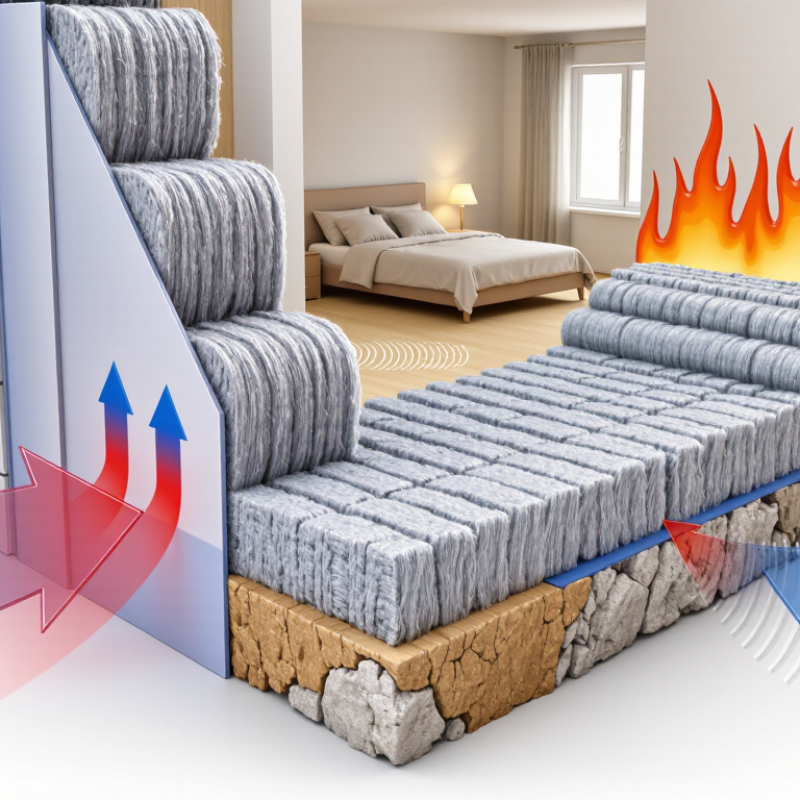
Why Choose Rock Wool Mineral Wool for Insulation?

What Is Rock Wool? Mineral Fibers, Density, and 0.034–0.040 W/m·K

Rock wool, also called mineral wool, is made by melting volcanic rock and other mineral materials. The liquid is spun into fine fibers, creating a springy, stone-based insulation layer. These fibers trap still air, which slows heat movement through walls, roofs, and floors. In technical data, thermal conductivity commonly falls between 0.034 and 0.040 W/m·K.

A lower number usually indicates better thermal resistance at the same thickness. However, density also matters. Higher-density boards can provide better stiffness, sound control, and resistance to airflow. They are not automatically more efficient for every building. Product structure, thickness, moisture level, and installation quality all affect results. Small gaps matter. During site inspections, poorly fitted corners often reduce performance more than expected. Compressing the material can also change its designed thickness and thermal behavior.

The stated 0.034–0.040 W/m·K range usually reflects controlled laboratory testing. Real walls face temperature changes, humidity, dust, and uneven workmanship. For dependable selection, compare declared values under the same test conditions. Check the intended application, density, fire classification, and water-repellent treatment. Follow the relevant installation guidance and wear suitable protective equipment when cutting fibers. Measure the fit. A carefully installed medium-density layer may outperform a denser layer with open joints. It is easy to focus on one impressive number, but insulation performance is a system result, not a label alone.

How Rock Wool Is Made: Mineral Melting Above 1,400°C

Why Choose Rock Wool Mineral Wool for Insulation?
How Rock Wool Is Made: Mineral Melting Above 1,400°C

Rock wool begins with volcanic rock and other mineral ingredients selected for stable performance. These materials enter a furnace and melt above 1,400°C. At this temperature, the solid mixture becomes a thick, glowing liquid. The process demands careful control of heat, chemistry, and production speed. Small changes can affect fiber thickness and insulation quality.

The molten mineral passes through a spinning system, creating fine fibers that resemble soft threads. Air movement separates and cools them quickly. A binder holds the fibers together, while controlled compression forms boards, blankets, or loose products. The finished structure traps still air, reducing heat transfer through walls, roofs, and equipment.

It also resists high temperatures because its main ingredients are mineral-based. This can support fire-resistant construction when the complete assembly is correctly designed and installed. Acoustic performance is another practical advantage, especially where dense fibers absorb unwanted sound. Yet rock wool is not automatically perfect. Moisture, gaps, poor cutting, and compression can reduce its effectiveness. It is tempting to focus only on the furnace temperature, but installation quality matters just as much. Good results require verified product data, suitable protective equipment, and careful fitting around joints and services.

Thermal Efficiency: R-Values Supported by 0.034–0.040 W/m·K

Rock wool mineral wool offers dependable thermal efficiency for walls, roofs, and floors. Its thermal conductivity commonly ranges from 0.034 to 0.040 W/m·K. Lower conductivity generally indicates better insulation performance at the same thickness. For example, 100 mm of material provides approximately R-2.94 at 0.034 W/m·K. At 0.040 W/m·K, the same thickness provides about R-2.50. These figures use the basic formula: R-value equals thickness divided by conductivity. Actual results depend on density, installation quality, temperature, and moisture conditions.

The rated number is only one part of the design. Field inspections often find small gaps around pipes, joints, and electrical boxes. Those gaps can reduce real-world efficiency. Compression also matters. A crushed section may not perform as expected. Thermal bridges through framing can further weaken the wall’s overall R-value. For this reason, I prefer reviewing the complete assembly, not just the insulation label. The calculation is clear, but buildings are rarely perfect. That limitation deserves honest attention.

Tips: Select thickness according to the local climate and assembly target. Install boards or batts tightly, without visible gaps. Keep the material dry during storage and fitting. Check corners and service penetrations carefully. If the project has unusual moisture or temperature demands, consult a qualified building professional.

Why Choose Rock Wool Mineral Wool for Insulation? - Thermal Efficiency: R-Values Supported by 0.034–0.040 W/m·K

Insulation Thickness Thermal Conductivity Range Thermal Resistance
(m²·K/W)
Approx. Imperial R-Value
(h·ft²·°F/Btu)
Typical Thermal Benefit
50 mm 0.034–0.040 W/m·K 1.25–1.47 7.10–8.35 Useful for space-limited retrofit applications
75 mm 0.034–0.040 W/m·K 1.88–2.21 10.65–12.52 Improved heat-flow reduction for walls and ceilings
100 mm 0.034–0.040 W/m·K 2.50–2.94 14.20–16.70 Common thickness for high-performance thermal envelopes
150 mm 0.034–0.040 W/m·K 3.75–4.41 21.29–25.05 Strong thermal protection for roofs and external walls
200 mm 0.034–0.040 W/m·K 5.00–5.88 28.39–33.40 Very high resistance for energy-efficient building designs

Calculations use R = thickness ÷ thermal conductivity. Imperial R-values are converted from RSI using 1 m²·K/W ≈ 5.678 h·ft²·°F/Btu. Actual performance may vary with installation quality, moisture, compression, joints, and thermal bridging.

Fire Resistance: Noncombustible Fibers Withstanding Above 1,000°C

Why Choose Rock Wool Mineral Wool for Insulation?

Rock wool mineral wool is valued for its strong fire resistance. Its inorganic fibers can withstand temperatures above 1,000°C without melting like many plastic-based insulation materials. This makes it suitable for walls, roofs, industrial enclosures, and service shafts where heat exposure is a serious concern. It does not provide fuel for a fire.

That matters during the first critical minutes. A properly installed layer can help slow heat transfer through a construction assembly. It may protect steel framing, reduce temperature rise, and support safer evacuation conditions. However, insulation alone cannot make a building fireproof. Performance depends on density, thickness, joints, facings, and the surrounding materials.

The fibers remain stable at extreme temperatures, but small amounts of binder may decompose earlier. This detail is easy to overlook. Product testing under standards such as EN 13501-1 or ASTM E136 can clarify the actual classification and behavior.

On site, tight joints and accurate cutting matter as much as the specification sheet. Gaps around pipes or compressed sections can create weak points. I have seen otherwise careful installations lose effectiveness through rushed detailing. Regular inspection and qualified installation remain necessary, especially near penetrations, chimneys, and high-temperature equipment. Safety claims should be checked against tested assemblies, not assumed from the material name alone.

Acoustic Control: Sound Absorption Ratings Reaching NRC 0.95

Rock wool mineral wool is often chosen for acoustic control because its dense, fibrous structure slows and absorbs airborne sound. In laboratory testing, some assemblies reach an NRC of 0.95, indicating very high average sound absorption across tested frequencies. That rating matters in offices, studios, classrooms, and plant rooms where speech, machinery, or reverberation becomes tiring.

The material works best when it fills wall, ceiling, or floor cavities without compression. Small gaps can create noticeable sound paths. During site inspections, installers often check around outlets, pipes, and door frames because these weak points may reduce the final result. A well-fitted layer can make a room feel calmer. Less echo. Clearer conversation.

NRC is useful, but it is not a promise of silence. The rating usually represents an average, not every frequency or installation condition. Low-frequency noise may still pass through lightweight walls. Surface finishes, framing, flanking paths, and workmanship also affect performance. This is where specifications deserve careful review. A high laboratory number can feel disappointing on site if the surrounding assembly is poorly designed. Choosing the correct thickness and density should follow measured acoustic needs, not habit alone.

Why Choose Rock Wool Mineral Wool for Insulation?

Acoustic control: representative sound absorption ratings reaching NRC 0.95.

Representative NRC values for approximately 50 mm porous insulation products under standardized laboratory testing. Mineral wool can achieve very high sound absorption because its dense, fibrous structure dissipates acoustic energy across a broad frequency range. Actual results depend on thickness, density, mounting method, air gaps, facing, and test conditions.

Copyright 2025 Fluidra S.A. | Created by BCM Marketing Agencia Privacy Policy Legal note | Cookie policy |

Technical cookies are strictly necessary for our website to work and you can navigate through it. These types of cookies are those that, for example, allow us to identify you, give you access to certain restricted parts of the page if necessary, or remember different options or services already selected by you, such as your privacy preferences. Therefore, they are activated by default, your authorization not being necessary in this regard. Through the configuration of your browser, you can block or alert the presence of this type of cookies, although such blocking will affect the proper functioning of the different functionalities of our website.


The analysis cookies allow us to study the navigation of the users of our website in general (for example, which sections of the page are the most visited, which services are used most and if they work correctly, etc.). From the statistical information on navigation on our website, we can improve both the operation of the page itself and the different services it offers. Therefore, these cookies do not have an advertising purpose, but only serve to make our website work better, adapting to our users in general. By activating them you will contribute to this continuous improvement. You can enable or disable these cookies by checking the corresponding box, being disabled by default.


Functionality cookies allow us to remember your preferences, to personalize certain characteristics and general options of our website, every time you access it (for example, the language in which the information is presented to you, the sections marked as favorites, your browser type, etc.) Therefore, this type of cookies does not have an advertising purpose, but by activating them you will improve the functionality of the website (for example, adapting to your type of browser) and the customization of it based on your preferences (for example, by presenting the information in the language that you have chosen in previous occasions), which will contribute to the ease, usability and comfort of our page during your navigation. You can enable or disable these cookies by checking the corresponding box, being disabled by default.


Advertising cookies allow us to manage the advertising spaces included in our website based on criteria such as the content shown or the frequency in which the ads are displayed. For example, if you have been shown the same ad several times on our website, and you have not shown a personal interest by clicking on it, it will not appear again. In summary, by activating this type of cookies, the advertising shown on our website will be more useful and diverse, and less repetitive. You can enable or disable these cookies by checking the corresponding box, being disabled by default.


Behavioral advertising cookies allow us to obtain information based on the observation of your browsing habits and behaviors on the web, in order to show you advertising content that best suits your personal tastes and interests. To understand it in a very simple way, we will give you a fictitious example: if your last searches on the web were related to suspense literature, we would show you advertising about suspense books. Therefore, activating this type of cookies, the advertising that we show you on our website will not be generic, but will be oriented to your searches, tastes and interests, therefore adjusting exclusively to you. You can enable or disable these cookies by checking the corresponding box, being disabled by default.
To understand it in a very simple way, we will give you a fictitious example: if your last searches on the web were related to suspense literature, we would show you advertising about suspense books. Therefore, activating this type of cookies, the advertising that we show you on our website will not be generic, but will be oriented to your searches, tastes and interests, therefore adjusting exclusively to you. You can enable or disable these cookies by checking the corresponding box, being disabled by default.

SAVE

We use our own and third-party cookies to ensure the proper functioning of the website and to analyse our services, improve your experience on our website and show you advertisements related to your interests according to profiling based on your browsing habits (e.g. websites visited). You can accept all cookies by clicking "ACCEPT" or set or reject them by clicking here. If you would like to know more about the use of cookies, please see our COOKIE POLICY.


ACCEPT ALL
Reject no essentials


