
Why Choose Acrylic Topcoat for Your Project?
FLUID HANDLING EXPERTS

Blog, all our news

Why Choose Acrylic Topcoat for Your Project?

Choosing an Acrylic Topcoat can help protect a project while preserving the look of its surface. Depending on the product, an acrylic finish may offer useful resistance to weathering, moisture, or everyday wear. It can also provide a clear or colored finish, with options for different sheen levels. These qualities make it worth considering for suitable wood, metal, masonry, and previously coated surfaces.

The right choice depends on more than the label. Surface preparation, existing coatings, application temperature, and drying conditions can all affect the result. Check the manufacturer’s technical data sheet for compatible substrates, recommended coverage, and curing times. A small test area is practical. It may reveal changes in color or sheen before the full surface is coated. That step is easy to skip.

An Acrylic Topcoat is not a universal fix for peeling paint, damp substrates, or poor preparation. Those problems need attention before application. Results also vary between formulations, so broad claims should be treated carefully. Consider the project’s exposure, expected maintenance, and desired appearance, then compare products against those needs. Even careful planning cannot remove every uncertainty. But it can reduce avoidable failures and help you decide whether an acrylic finish suits the work.
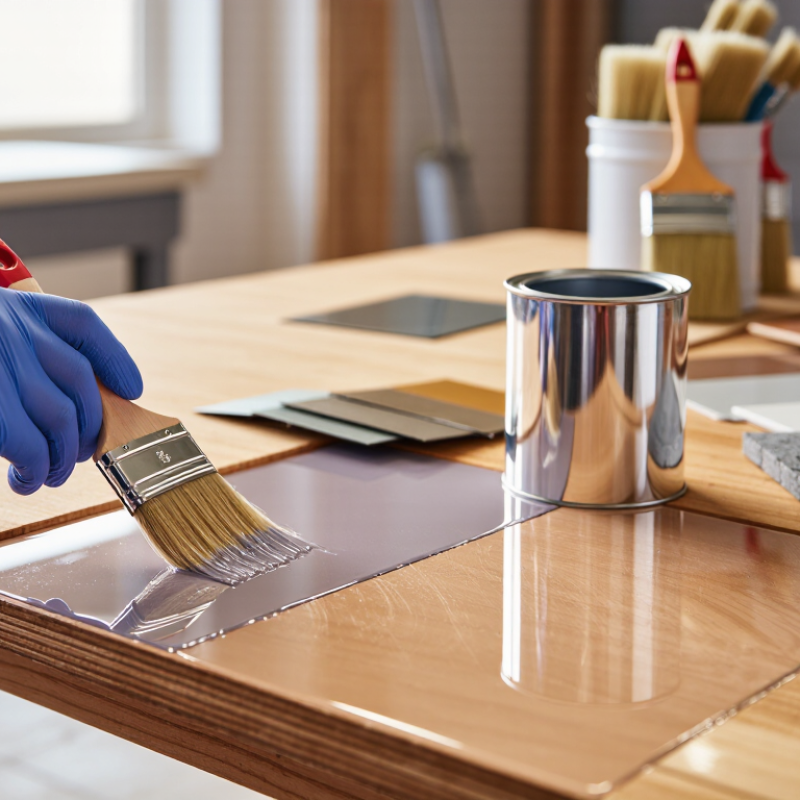
Why Choose Acrylic Topcoat for Your Project?

What Is an Acrylic Topcoat, and Where Is It Commonly Used?

An acrylic topcoat is the visible finishing layer applied over a prepared surface. It forms a protective film while adding a clear or colored finish. Many acrylic topcoats are water-based, though formulations vary. Some dry to a low-sheen look; others leave a noticeable gloss. Always check the product specifications rather than relying on the word “acrylic” alone.

These coatings are commonly used on interior walls, trim, doors, furniture, and exterior siding. A suitable formulation can help resist sunlight, moisture, and everyday scuffs. For example, a painted garden bench may need an exterior-rated topcoat, while a hallway wall usually needs a washable interior finish. Metal and previously coated surfaces may also be suitable, but they often require the right primer and careful surface preparation. Clean, dry surfaces matter. Dust left along a cabinet edge can show through the finish.

Application is usually straightforward with a brush, roller, or spray equipment, depending on the surface and coating instructions. Thin, even coats tend to level better than one heavy coat. It dries quickly, but dry to the touch does not always mean fully cured. That distinction is easy to miss. Acrylic finishes can also be less resistant to heat or abrasion than some specialized coatings, so they may not suit every countertop or heavily used floor. Check the intended use and allow the stated curing time before regular use.

How Do Waterborne and Solventborne Acrylic Topcoats Differ?

Why Choose Acrylic Topcoat for Your Project?

Acrylic topcoats are available in waterborne and solventborne formulas. Both can form a protective finish, but application feel and drying conditions differ. Waterborne products use water as their main carrier. They often have lower odor and clean up with water before curing. They can dry quickly, though cool rooms or high humidity may slow them down. Some may also raise the grain on bare wood, leaving a slightly rough feel.

Solventborne acrylics use organic solvents to carry the coating. They may flow and level well, which can help reduce brush marks on a smooth surface. Their odor can be stronger, and cleanup usually requires the specified solvent. Drying time and final clarity vary by product, so avoid assuming one formula always performs better. A small test area is worth the extra time. It can reveal issues your first coat might hide.

Tips: Apply thin, even coats and follow the product label for temperature, recoat time, and ventilation. Compare the finish under the room’s actual lighting. If the surface feels tacky or looks uneven, pause and check the conditions before adding another coat.

Why Choose Acrylic Topcoat for Your Project? — How Do Waterborne and Solventborne Acrylic Topcoats Differ?
Comparison Factor Waterborne Acrylic Topcoat Solventborne Acrylic Topcoat
Carrier Water is the primary liquid carrier; the coating also contains resin and other additives. Organic solvents are the primary liquid carrier for the acrylic resin.
VOC and odor Often formulated for lower VOC emissions and a milder application odor, but the exact VOC content varies by product and local regulations. Typically has a stronger solvent odor and may have higher VOC content; check the product data sheet and applicable limits.
Tool cleanup Tools can generally be cleaned with water while the coating is still wet; dried material may require a stronger cleaner. Usually requires the solvent specified by the manufacturer for cleaning tools and equipment.
Drying conditions Water evaporation and film formation are affected by temperature, humidity, airflow, and film thickness. High humidity or cool conditions can slow drying. Solvent evaporation and film formation are affected by temperature, airflow, and film thickness. Follow the specified application conditions.
Application environment Often a practical option for occupied or indoor spaces where reduced odor is preferred, provided ventilation and the product instructions are followed. Good ventilation is especially important during application because solvent vapors may accumulate in poorly ventilated areas.
Flammability and storage Generally presents a lower flammability concern than solventborne coatings, but the safety data sheet remains the authority for handling and storage. May contain flammable solvents. Keep away from ignition sources and follow the safety data sheet requirements.
Appearance and color retention Acrylic chemistry can provide good color and gloss retention, especially for exterior applications; performance depends on resin, pigments, and formulation. Can also provide good color and gloss retention. Results depend on the specific resin system and exposure conditions.
Adhesion and substrate preparation Requires a clean, sound, properly prepared surface. Primer selection and compatibility with the existing coating are important. Also requires a clean, sound, properly prepared surface. Solvent action may affect some existing coatings or plastics, so test compatibility first.
Best suited to Projects prioritizing easier water cleanup, lower odor, or reduced VOC content, subject to the coating's performance requirements. Projects where the specified solventborne system is compatible with the substrate and its application and performance requirements.
Selection guidance Neither type is automatically more durable in every situation. Compare the technical data sheets for adhesion, hardness, weathering, chemical resistance, coverage, recoat time, and approved substrates; test a small area when compatibility is uncertain.

How Does ASTM D3359 Rate Coating Adhesion on a 0B–5B Scale?

Acrylic topcoats are often chosen for their smooth finish and practical maintenance. But appearance alone cannot show whether a coating is firmly attached. ASTM International’s ASTM D3359-23 standard uses a tape test to assess coating adhesion. Method B reports results on a 0B–5B scale; Method A uses a different 0A–5A scale.

On the 5B end, no coating is removed from the cut area.

4B rating means less than 5% is detached;
3B indicates 5–15%,
2B indicates 15–35%.
At 1B, removal reaches 35–65%.
A 0B rating means more than 65% is removed.

Small cuts, clean tape application, and consistent removal matter. This is a comparative test, not a direct measurement of bond strength. A high rating also cannot guarantee performance after weathering or repeated cleaning.

Tips:

Test a representative, fully cured area. Check film thickness, surface preparation, and tape condition. Photograph the grid before and after removal. A neat result can still hide weak spots elsewhere; that part is easy to overlook. If the outcome seems inconsistent, repeat the test and record the conditions.

How Does ASTM D523 Measure Gloss at 20°, 60°, and 85°?

ASTM D523 measures specular gloss by directing light onto a surface and reading the reflected light at a matching angle. The result is reported in gloss units, or GU, for the chosen geometry. The three common angles serve different finishes: 20° helps distinguish very glossy coatings, 60° suits many general-purpose surfaces, and 85° is more sensitive to low-gloss finishes. Small details matter. A 60° reading alone may not clearly separate two highly glossy acrylic topcoats.

For a useful comparison, test fully cured, clean panels with a calibrated gloss meter. Keep the instrument flat, use the same measurement angle, and take readings at several spots; brush marks or orange peel can change the result across one panel. Record both the angle and GU value, since a 20° result cannot be compared directly with an 85° result.

Not quite a full finish assessment. Gloss readings do not show whether an acrylic topcoat resists abrasion, chemicals, or weathering. They do provide a repeatable way to check appearance, compare batches, and judge whether a sample matches the intended sheen. A small panel can still mislead if its surface differs from the actual project, so test representative material when possible.

How Does ASTM D4060 Evaluate Abrasion Resistance with Taber Testing?

ASTM D4060 evaluates coating abrasion with a Taber Abraser. A coated panel is mounted on a rotating turntable, while two abrasive wheels press against its surface under a specified load. As the panel turns, the wheels create circular wear tracks. The procedure uses defined wheel types, loads, and cycle counts, so these details must accompany any reported result.

For an acrylic topcoat, laboratories commonly record mass loss after a set number of cycles or calculate a wear index. Lower mass loss can indicate better resistance under those exact test conditions. Small details matter. Film thickness, curing, substrate preparation, and wheel condition can all influence the outcome. A controlled comparison should use matching panels and settings; otherwise, the numbers may mislead.

Taber results help compare formulations, but they do not reproduce every real-world abrasion source. Sand, footwear, cleaning tools, and repeated contact produce different wear patterns. A coating may retain its appearance while losing measurable material, or show visible damage before a large mass change appears. That is worth questioning. When reviewing data, note the wheel, load, cycles, conditioning, and endpoint—not just the final number.

Copyright 2025 Fluidra S.A. | Created by BCM Marketing Agencia Privacy Policy Legal note | Cookie policy |

Technical cookies are strictly necessary for our website to work and you can navigate through it. These types of cookies are those that, for example, allow us to identify you, give you access to certain restricted parts of the page if necessary, or remember different options or services already selected by you, such as your privacy preferences. Therefore, they are activated by default, your authorization not being necessary in this regard. Through the configuration of your browser, you can block or alert the presence of this type of cookies, although such blocking will affect the proper functioning of the different functionalities of our website.


The analysis cookies allow us to study the navigation of the users of our website in general (for example, which sections of the page are the most visited, which services are used most and if they work correctly, etc.). From the statistical information on navigation on our website, we can improve both the operation of the page itself and the different services it offers. Therefore, these cookies do not have an advertising purpose, but only serve to make our website work better, adapting to our users in general. By activating them you will contribute to this continuous improvement. You can enable or disable these cookies by checking the corresponding box, being disabled by default.


Functionality cookies allow us to remember your preferences, to personalize certain characteristics and general options of our website, every time you access it (for example, the language in which the information is presented to you, the sections marked as favorites, your browser type, etc.) Therefore, this type of cookies does not have an advertising purpose, but by activating them you will improve the functionality of the website (for example, adapting to your type of browser) and the customization of it based on your preferences (for example, by presenting the information in the language that you have chosen in previous occasions), which will contribute to the ease, usability and comfort of our page during your navigation. You can enable or disable these cookies by checking the corresponding box, being disabled by default.


Advertising cookies allow us to manage the advertising spaces included in our website based on criteria such as the content shown or the frequency in which the ads are displayed. For example, if you have been shown the same ad several times on our website, and you have not shown a personal interest by clicking on it, it will not appear again. In summary, by activating this type of cookies, the advertising shown on our website will be more useful and diverse, and less repetitive. You can enable or disable these cookies by checking the corresponding box, being disabled by default.


Behavioral advertising cookies allow us to obtain information based on the observation of your browsing habits and behaviors on the web, in order to show you advertising content that best suits your personal tastes and interests. To understand it in a very simple way, we will give you a fictitious example: if your last searches on the web were related to suspense literature, we would show you advertising about suspense books. Therefore, activating this type of cookies, the advertising that we show you on our website will not be generic, but will be oriented to your searches, tastes and interests, therefore adjusting exclusively to you. You can enable or disable these cookies by checking the corresponding box, being disabled by default.
To understand it in a very simple way, we will give you a fictitious example: if your last searches on the web were related to suspense literature, we would show you advertising about suspense books. Therefore, activating this type of cookies, the advertising that we show you on our website will not be generic, but will be oriented to your searches, tastes and interests, therefore adjusting exclusively to you. You can enable or disable these cookies by checking the corresponding box, being disabled by default.

SAVE

We use our own and third-party cookies to ensure the proper functioning of the website and to analyse our services, improve your experience on our website and show you advertisements related to your interests according to profiling based on your browsing habits (e.g. websites visited). You can accept all cookies by clicking "ACCEPT" or set or reject them by clicking here. If you would like to know more about the use of cookies, please see our COOKIE POLICY.


ACCEPT ALL
Reject no essentials


