
Why Choose a Machine Safety Door for Your Facility?
FLUID HANDLING EXPERTS

Blog, all our news

Why Choose a Machine Safety Door for Your Facility?

A fast production line can look controlled until a worker reaches toward a jammed part. A machine safety door helps create a physical boundary between people and hazardous motion. Its value is practical: it can limit access during operation while allowing planned inspection, loading, and maintenance. But a door alone is not a complete safety strategy.

Safety scholar Sidney Dekker’s principle is often expressed as, “Safety is the presence of capacities.” Applied to machinery, that means more than installing a barrier. The door must suit the machine, the task, and the way people actually work. Interlocks, hinges, handles, visibility panels, and stopping behavior all deserve careful review. Small details matter. A poorly positioned handle or an awkward opening can invite workarounds. That possibility is easy to overlook.

A well-selected Machine Safety Door can support safer routines and clearer separation around moving equipment. It may also reduce accidental access when paired with appropriate controls and regular checks. Still, no door can compensate for weak procedures, poor maintenance, or an unsuitable risk assessment. That is the uncomfortable part. Facilities should have a competent machinery-safety professional assess the hazards, confirm the design, and verify the installed system. Operators should be able to use the door without fighting it. The best choice is not always the heaviest or most elaborate model; it is the one that fits the real job and remains dependable over time.
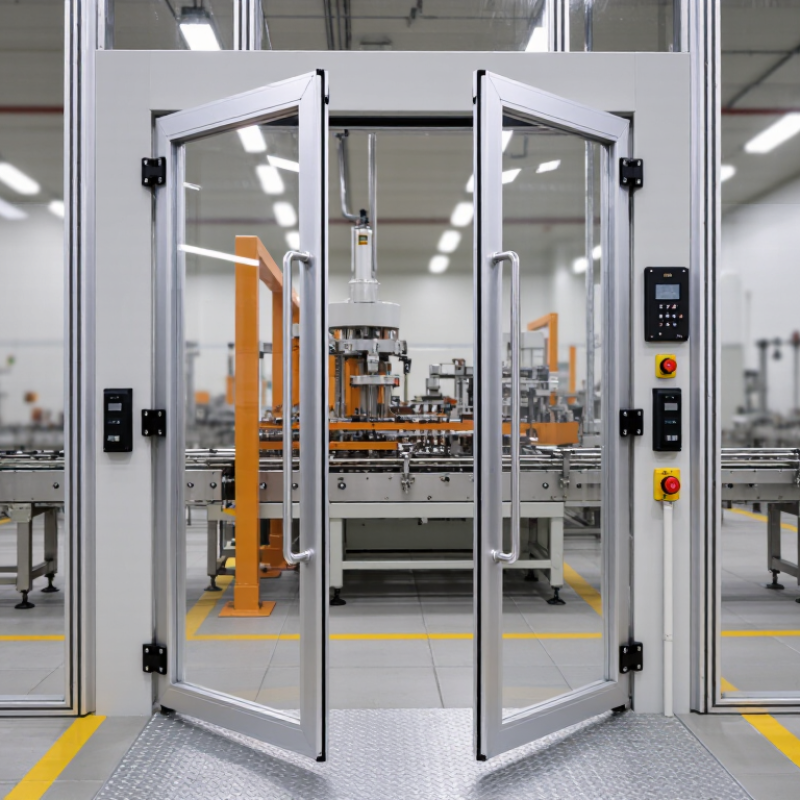
Why Choose a Machine Safety Door for Your Facility?

What a Machine Safety Door Is and How It Works

A machine safety door is a physical barrier around moving equipment, such as a sliding steel panel beside a press or a hinged enclosure around a robot cell. Its purpose is to keep people away from hazards during operation. An interlock links the door to the machine’s control system. If the door opens, the system prevents a cycle from starting or commands hazardous movement to stop. Where a machine takes time to coast down, a guard-locking device can keep the door shut until a monitored safe condition is reached. The details matter.

BLS recorded 738 fatal work injuries involving contact with objects and equipment in its 2023 Census of Fatal Occupational Injuries. This broad category includes more than machine incidents, but it shows why access to moving equipment deserves careful attention. BLS also counted 2.6 million nonfatal workplace injuries and illnesses in private industry in its 2023 Survey of Occupational Injuries and Illnesses; that figure is broad, too. A safety door is not a complete safety system. Its interlock, stopping time, and placement must suit the actual machine and task. A door that is easy to bypass, or opens before motion stops, can create false confidence. That deserves a second look.

How Safety Doors Control Access to Hazardous Machine Areas

A machine safety door creates a clear boundary around hazardous equipment, such as a fast-moving press or a robot cell. Its interlock can signal the machine to stop or prevent a hazardous cycle when the door opens. This helps control access during operation, rather than relying on warning signs alone. The door should also be positioned so workers can see the hazard and reach the exit without obstruction.

Effective protection depends on the full setup. A door that is misaligned, bypassed, or slow to close may not provide the intended control. During installation, assess stopping time, access points, and how operators handle jams or routine cleaning. Test the interlock and stopping function as part of scheduled inspections, and document faults. It is easy to assume a closed door means a safe machine. It does not; maintenance still needs suitable isolation procedures.

Tips: Keep the door and latch clear of debris. Check that opening the door triggers the expected response. Train staff to report damaged hinges or inconsistent stops. Small faults matter. Review the arrangement after equipment changes, since a new tool or workflow can create an access route that was not there before.

Key Benefits for Worker Protection and Facility Operations

Why Choose a Machine Safety Door for Your Facility?

Key Benefits for Worker Protection and Facility Operations

Machine safety doors help separate workers from moving equipment, hot surfaces, and flying debris. When a door is interlocked with a machine, opening it can stop hazardous motion before someone reaches into the work area. The right design depends on the machine’s risks, access needs, and operating cycle. This detail matters. A door that is awkward to use may tempt workers to leave it open, so involve operators when planning placement and access.

A well-planned door can support smoother facility operations, too. Clear panels let staff check a process without entering the guarded area. Durable hinges and properly aligned latches can reduce interruptions caused by misalignment or wear. Maintenance teams should be able to inspect the door and its safety devices without guesswork. Still, adding a door alone does not make a machine safe; the full setup needs a risk assessment, suitable safeguards, and trained users.

Tips: Check hinges, latches, and interlocks during routine inspections. Test the door’s stopping response according to the equipment’s procedures. Small details matter. Record recurring issues, even minor ones, and address them before they become workarounds.

Common Applications Across Industrial Environments

Machine safety doors are useful wherever people work close to moving equipment. In robotic cells, they separate operators from robot arms during automatic cycles. On CNC machines, doors help contain chips and coolant while limiting access to rotating tools. Packaging lines and conveyor transfer points also benefit, especially where jams invite workers to reach into moving parts. The details matter: a door that opens into a narrow aisle may create a new pinch point.

The U.S. Bureau of Labor Statistics reported 5,283 fatal work injuries across all industries in 2023. This broad figure does not measure incidents prevented by safety doors, but it underscores why facilities should assess hazards at each machine. A properly selected door, paired with suitable interlocking and stopping controls, can help manage access during operation. It still needs inspection, maintenance, and clear procedures. A door alone is not enough.

Tips: Map operator routes and maintenance access before choosing the door layout. Check sightlines, opening clearance, and how the machine stops when the door opens. Test the system during commissioning, then repeat checks after changes. One oversight is easy: production changes faster than the original risk assessment.

Factors to Consider When Choosing a Safety Door

Choosing a machine safety door starts with the hazard, not the catalogue. Map every operator position, moving part, and maintenance task around the machine. Measure stopping time and reach distance; a door that looks secure may still allow access before motion ends. Small details matter.

The U.S. Bureau of Labor Statistics reported 2.6 million nonfatal workplace injury and illness cases in private industry in 2023. This figure is not specific to machine doors, but it underscores why guarding decisions deserve careful review. Check whether the door needs an interlock, a locking device, or visibility panels. Confirm that the opening cannot expose a hand to the danger zone. Consider dust, coolant, cleaning chemicals, and repeated impacts when selecting materials. A clear panel helps operators observe a cycle, but scratches can obscure it over time.

Think about daily use, too. Can maintenance staff reach adjustment points without awkwardly leaning through the opening? Does the door swing into a walkway? Test the proposed layout with the people who operate and service the machine. Their feedback may reveal a snag that drawings miss. Recheck the design after installation, especially if production speed or tooling changes. A safety door is not a one-time decision.

Copyright 2025 Fluidra S.A. | Created by BCM Marketing Agencia Privacy Policy Legal note | Cookie policy |

Technical cookies are strictly necessary for our website to work and you can navigate through it. These types of cookies are those that, for example, allow us to identify you, give you access to certain restricted parts of the page if necessary, or remember different options or services already selected by you, such as your privacy preferences. Therefore, they are activated by default, your authorization not being necessary in this regard. Through the configuration of your browser, you can block or alert the presence of this type of cookies, although such blocking will affect the proper functioning of the different functionalities of our website.


The analysis cookies allow us to study the navigation of the users of our website in general (for example, which sections of the page are the most visited, which services are used most and if they work correctly, etc.). From the statistical information on navigation on our website, we can improve both the operation of the page itself and the different services it offers. Therefore, these cookies do not have an advertising purpose, but only serve to make our website work better, adapting to our users in general. By activating them you will contribute to this continuous improvement. You can enable or disable these cookies by checking the corresponding box, being disabled by default.


Functionality cookies allow us to remember your preferences, to personalize certain characteristics and general options of our website, every time you access it (for example, the language in which the information is presented to you, the sections marked as favorites, your browser type, etc.) Therefore, this type of cookies does not have an advertising purpose, but by activating them you will improve the functionality of the website (for example, adapting to your type of browser) and the customization of it based on your preferences (for example, by presenting the information in the language that you have chosen in previous occasions), which will contribute to the ease, usability and comfort of our page during your navigation. You can enable or disable these cookies by checking the corresponding box, being disabled by default.


Advertising cookies allow us to manage the advertising spaces included in our website based on criteria such as the content shown or the frequency in which the ads are displayed. For example, if you have been shown the same ad several times on our website, and you have not shown a personal interest by clicking on it, it will not appear again. In summary, by activating this type of cookies, the advertising shown on our website will be more useful and diverse, and less repetitive. You can enable or disable these cookies by checking the corresponding box, being disabled by default.


Behavioral advertising cookies allow us to obtain information based on the observation of your browsing habits and behaviors on the web, in order to show you advertising content that best suits your personal tastes and interests. To understand it in a very simple way, we will give you a fictitious example: if your last searches on the web were related to suspense literature, we would show you advertising about suspense books. Therefore, activating this type of cookies, the advertising that we show you on our website will not be generic, but will be oriented to your searches, tastes and interests, therefore adjusting exclusively to you. You can enable or disable these cookies by checking the corresponding box, being disabled by default.
To understand it in a very simple way, we will give you a fictitious example: if your last searches on the web were related to suspense literature, we would show you advertising about suspense books. Therefore, activating this type of cookies, the advertising that we show you on our website will not be generic, but will be oriented to your searches, tastes and interests, therefore adjusting exclusively to you. You can enable or disable these cookies by checking the corresponding box, being disabled by default.

SAVE

We use our own and third-party cookies to ensure the proper functioning of the website and to analyse our services, improve your experience on our website and show you advertisements related to your interests according to profiling based on your browsing habits (e.g. websites visited). You can accept all cookies by clicking "ACCEPT" or set or reject them by clicking here. If you would like to know more about the use of cookies, please see our COOKIE POLICY.


ACCEPT ALL
Reject no essentials


