
Global demand for disposable hygiene products continues to support investment in automated packaging. Grand View Research estimates that the global baby diapers market will expand steadily through 2030. Its analysis highlights rising urbanization, convenience needs, and organized retail growth. Euromonitor International also identifies premiumization and product variety as important category trends. These changes create more packaging formats, not merely higher volumes.
A High-speed diaper packing machine can process more packs within limited factory space. It can reduce manual handling around conveyors, sealing units, and carton stations. Modern systems may also support servo control, automatic counting, barcode inspection, and rapid size changes. PMMI industry reports consistently connect packaging automation with labor challenges, production consistency, and operational resilience. The practical benefit is visible on the factory floor. Fewer operators repeatedly lift soft packs. Sealed bundles leave the line at predictable intervals.
Speed alone is not enough. Poorly adjusted sensors can cause false rejects, while weak film tension can create open seals. Manufacturers should compare actual output, changeover time, energy use, maintenance access, and after-sales support. Reported market figures vary because research firms use different definitions and regions. That limitation deserves attention. A machine that looks impressive in a demonstration may perform differently with humid air, mixed pack sizes, or unstable materials. Buyers should request factory trials, documented test results, and references from comparable plants. The best decision balances throughput with hygiene, safety, reliability, and long-term operating cost. That is less dramatic, but usually more valuable.
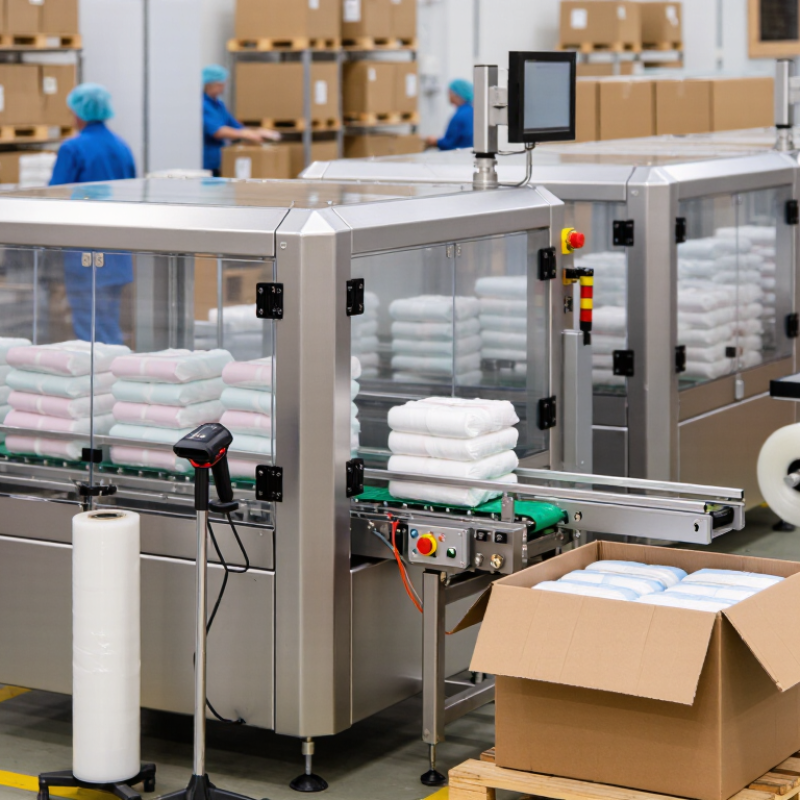
Why Choose a High Speed Diaper Packing Machine?
What Is a High-Speed Diaper Packing Machine?
A high-speed diaper packing machine automatically counts, arranges, compresses, and seals diapers in prepared bags. It connects several operations within one controlled production line. Sensors detect product position, while servo-driven mechanisms adjust timing with fine accuracy. The machine can handle changing diaper sizes, pack quantities, and bag dimensions through programmed settings.
In practical production, speed is only one measure. Stable feeding, accurate counting, clean sealing, and gentle compression matter equally. A reliable system reduces manual handling and keeps package appearance consistent. It may also record output, stoppages, and rejected packs for routine quality checks. However, faster operation can reveal weak film, poor alignment, or inconsistent diaper thickness. That is where real adjustment experience becomes valuable. No machine performs perfectly without regular inspection.
Tips: Check sealing temperature, film tension, and sensor alignment every shift. Test several packs after changing sizes. Keep guides clean and inspect moving parts before production. Operators should compare actual output with the machine display, because small counting errors can become expensive. Leave enough space around the line for safe maintenance.

Why Choose a High Speed Diaper Packing Machine?
How Does a High-Speed Diaper Packing Machine Work?
A high-speed diaper packing machine starts with a controlled conveyor flow. Diapers arrive in rows or stacks, depending on the package design. Photoelectric sensors detect product position and spacing. Servo-driven pushers then align each stack with consistent pressure. A programmable control system coordinates feeding, counting, folding, and transfer. Small timing errors can create large disruptions.
The selected film unwinds through tension rollers before entering the forming section. The machine shapes the film around each stack and seals the edges with controlled heat. A cross-sealing unit closes the package and cuts it into separate bags. Sensors check film marks, seal position, and product presence. Faulty packs can be diverted for manual inspection. The process is fast, but speed alone does not ensure quality.
Tips: Keep sensors clean and inspect sealing jaws during every shift. Test seal strength with actual production materials. Record rejected packs and investigate repeated patterns. Operators should adjust speed gradually, not chase the highest number. In real production, film thickness, humidity, and diaper size affect performance. A stable setting may still need correction tomorrow. That is an easy detail to overlook. Regular maintenance, verified measurements, and trained operators make the system more dependable.
A high-speed diaper packing machine automatically feeds, counts, stacks, compresses, bags, seals, and discharges products in a continuous process. As the number of diapers per pack increases, the achievable pack output normally decreases because each cycle handles more products. Actual performance depends on diaper size, pack configuration, compression ratio, film material, and machine setup.
A high speed diaper packing machine can increase output without expanding the production floor. Servo-driven feeding systems keep products aligned at steady speeds. Sensors detect missing or misplaced diapers before sealing. This reduces rejected packs and protects material costs. On a busy line, consistent motion matters more than impressive peak speed.
The machine can also shorten packing cycles and reduce manual handling. Operators may load film, monitor alarms, and adjust pack settings instead of repeating heavy movements. Automatic counting helps maintain accurate quantities in every bag. Quick format changes can support different diaper sizes and pack counts. Less downtime means more usable production hours.
Still, speed is not everything. Poor film quality can create wrinkles, jams, or weak seals. A fast machine exposes small setup errors quickly. Production teams should track changeover time, reject rates, energy use, and actual output. These figures provide a more reliable view than advertised capacity. Regular cleaning and planned maintenance also protect performance. One overlooked sensor can stop the whole line. That detail is easy to underestimate.
A practical system should match product dimensions, packaging materials, labor skills, and factory space. It should offer clear controls and accessible safety features. Training remains necessary, even with automation. Efficiency improves when people understand the machine, not when they simply run it faster.
A high speed diaper packing machine is valuable only when speed does not damage product presentation. In daily production, operators need servo-driven sealing, stable film tension, and accurate bag counting. These features keep diaper stacks square and reduce loose edges. Sensors can detect missing products before a package reaches the carton. That small check prevents rework and protects customer trust.
Packaging quality improves when the machine supports adjustable compression and controlled sealing temperature. Different diaper sizes require different stack heights, film widths, and sealing times. Tool-free guides and recipe storage make these changes faster and more repeatable. A clear touchscreen helps operators verify settings, while access doors simplify cleaning and inspection. Good guarding matters too. It protects workers and supports consistent operation.
Flexibility also depends on the infeed design. A gentle conveyor can handle soft, absorbent products without crushing them. Automatic film splicing reduces downtime during long runs. Data records can show seal temperatures, stoppages, and rejected packs, giving maintenance teams useful evidence. Still, no machine corrects poor material or careless setup. I have seen fast lines create uneven bags after a minor guide shift. Regular checks remain necessary, although they can feel inconvenient during urgent orders. That weakness deserves honest attention.
| Performance Dimension | Typical High-Speed Capability | Feature Supporting the Result | Quality and Flexibility Benefit | Practical Verification Method |
|---|---|---|---|---|
| Packing speed | Approximately 80–180 packs per minute, depending on pack size, count, and machine configuration | Servo-driven film feeding, synchronized infeed, and automated product grouping | Improves throughput while maintaining accurate product positioning at high production rates | Record sustained output over a defined production run and compare it with the target rate |
| Pack-count accuracy | Typically controlled to the specified count with automated counting and product detection | Photoelectric sensors, encoder feedback, and recipe-based counting logic | Reduces missing or extra diapers in each retail pack and supports repeatable production | Inspect a statistically representative sample and verify the count in every pack |
| Film registration | Registration maintained through continuous web tracking and print-mark detection when printed film is used | Automatic film-position correction and electronic registration control | Improves artwork alignment, barcode placement, and the visual consistency of finished packs | Check print-to-cut position and barcode location across multiple film rolls |
| Seal consistency | Stable longitudinal and end seals within the validated temperature, pressure, and dwell-time range | Independent temperature control, servo-controlled sealing jaws, and pressure adjustment | Helps prevent open seals, wrinkles, leakage paths, and damage caused by excessive heat | Perform visual inspection, seal-strength testing, and periodic leak or burst testing |
| Format flexibility | Supports multiple diaper sizes, pack counts, film widths, and bag dimensions within the machine design range | Recipe storage, adjustable guides, modular forming parts, and servo-based settings | Allows one line to serve different products and reduces the need for dedicated equipment | Run at least two approved formats and confirm dimensions, count, seal quality, and speed |
| Changeover time | Often reduced to approximately 15–45 minutes for standard size or pack-count changes, depending on configuration | Tool-less adjustment points, digital setup instructions, and stored machine recipes | Reduces downtime and makes shorter production batches more economical | Measure the time from the last good pack of one format to the first good pack of the next format |
| Material compatibility | Commonly configured for polyethylene and multilayer flexible packaging films within validated thickness ranges | Adjustable film tension, controlled unwind, and sealing parameters matched to film structure | Supports different packaging materials while reducing film stretch, tracking errors, and seal defects | Validate each film structure through tension, sealing, appearance, and transport trials |
| Reject handling | Automatic removal of packs with count, position, seal, film, or sensor-related faults | In-line inspection sensors, reject confirmation, and fault-history logging | Prevents nonconforming packs from reaching downstream equipment or shipment | Introduce controlled test faults and confirm reliable detection, rejection, and alarm recording |
| Machine availability | Designed for continuous operation with planned cleaning, inspection, and material replenishment intervals | Automatic lubrication options, accessible components, alarm diagnostics, and preventive-maintenance prompts | Reduces unplanned stoppages and makes maintenance activities easier to schedule | Track uptime, stoppage duration, mean time between failures, and mean time to repair |
| Operator control | Recipe-driven operation with real-time display of speed, temperature, alarms, and production counts | PLC and HMI control, user access levels, multilingual interfaces, and electronic batch records | Improves setup repeatability, reduces manual-entry errors, and supports production traceability | Review change logs, alarm history, user permissions, and batch records during a validation run |
| Packaging appearance | Consistent bag shape, controlled film tension, centered seals, and reduced wrinkling when correctly set | Stable product compression, guided film forming, and synchronized cutting and sealing | Creates a cleaner retail presentation and improves carton or case-packing efficiency | Use visual standards and dimensional checks for bag length, width, seal position, and wrinkles |
| Data and traceability | Production counts, alarms, downtime events, and recipe parameters can be recorded electronically | Industrial communication interfaces, historian connectivity, and batch-data export | Supports root-cause analysis, quality audits, preventive maintenance, and continuous improvement | Verify timestamp accuracy, data completeness, user access control, and report retrieval |
Note: The figures shown are representative engineering ranges for high-speed diaper packing applications. Actual performance depends on diaper dimensions, pack count, film structure, machine configuration, product stability, and validated operating conditions.
Selecting a high-speed diaper packing machine requires more than checking its advertised packs per minute. Grand View Research valued the global baby diaper market at about USD 83.32 billion in 2023, with projected growth of 5.7% annually through 2030. That scale increases pressure on uptime, consistency, and labor efficiency.
Start with verified production data. Compare rated speed with actual output using the target diaper size, pack count, film type, and carton format. A machine running at 180 packs per minute may deliver less after film changes and minor stoppages. Ask for factory acceptance testing with your materials. Measure overall equipment effectiveness, reject rates, changeover time, and compressed-air consumption. Small gaps become expensive across three shifts.
Seal quality deserves equal attention. Check temperature control, film tracking, sensor accuracy, and protection against underfilled packs. PMMI’s packaging machinery research repeatedly identifies uptime, technical support, and total cost of ownership as major buying factors. Request maintenance intervals, spare-parts availability, training plans, and remote diagnostic capabilities. Operators should reach controls safely, even during a rushed changeover.
Do not overvalue speed.
A practical evaluation should also examine energy use and future flexibility. Can the system handle multiple diaper sizes without extensive mechanical adjustment? Can it connect with production and quality records? Some suppliers provide impressive demonstrations, but demonstrations rarely show dusty floors, tired operators, or unstable film. That is where equipment decisions become less certain—and where a carefully documented trial can prevent an expensive mistake.

Cepex is the brand for the fluid handling market belonging to the Fluidra group. One of the leading european manufacturer of valves and fittings in thermoplastic materials.
Dedicated to the swimming pool, irrigation and industrial markets, we distribute our products worldwide with the Fluidra commercial network and presence in 46 countries with 136 sales branches.


