
What Is the Best Single Gauge Manifold?
FLUID HANDLING EXPERTS

Blog, all our news

What Is the Best Single Gauge Manifold?

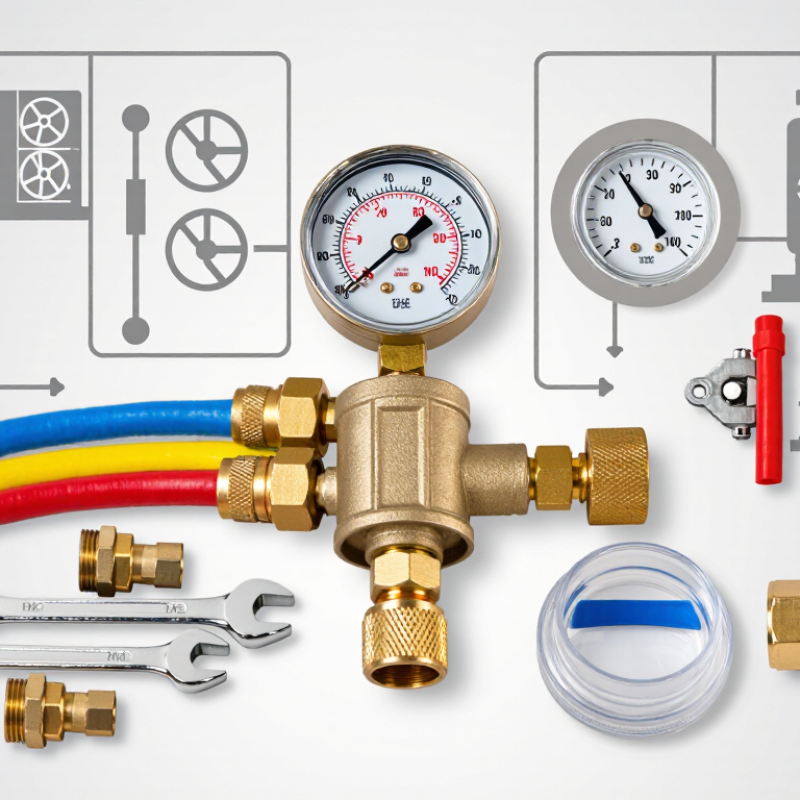
Choosing the best Single Gauge Manifold begins with the system, not the product label. In field service, technicians often compare brass bodies, valve layouts, hose ratings, and gauge readability. A manifold that feels solid on a bench may become awkward inside a cramped service panel. Pressure range matters. So does accuracy. For refrigeration, HVAC, laboratory, and industrial work, the correct choice depends on compatible refrigerants, expected pressures, connection standards, and measurement conditions. A clear scale can prevent a rushed reading. A durable sight glass can reveal movement, contamination, or an unexpected pressure change. These details connect specifications with real use.

This guide evaluates Single Gauge Manifold designs through practical selection criteria and manufacturer documentation. It considers gauge accuracy, calibration information, material compatibility, hose quality, valve control, temperature limits, and service support. Independent standards and verified technical data deserve more trust than glossy claims. Still, no single model suits every technician or application. That is the uncomfortable part. A low-cost unit may work well for occasional maintenance, while frequent field use may justify stronger valves and replaceable hoses. We should also admit that published accuracy can change with impact, heat, age, and poor handling. Careful users check the zero position before connection and compare readings against known conditions when possible. The goal is not to declare a universal winner. It is to identify the safest, clearest, and most dependable fit for the work ahead.
What Is the Best Single Gauge Manifold?

Single Gauge Manifold Basics: Two-Valve Isolation and Bleed Functions

What Is the Best Single Gauge Manifold?

Single Gauge Manifold Basics: Two-Valve Isolation and Bleed Functions

The best single gauge manifold depends on pressure, temperature, fluid compatibility, and maintenance needs. A two-valve design usually combines an isolation valve with a bleed valve. The isolation valve separates the gauge from the process line. The bleed valve releases trapped pressure from the gauge side.

This arrangement makes inspection and replacement more controlled. Close the isolation valve before loosening any gauge connection. Then open the bleed valve only after confirming the gauge side is safe to vent. Never assume a closed valve has stopped all pressure. Verify it.

Small details matter. A technician should check the body material, seal material, pressure rating, port size, and temperature range. Stainless steel may suit demanding environments, but compatibility still requires review.

The gauge connection should remain aligned and properly supported. Strain can damage threads or create leaks.

A clear valve label helps. So does a visible vent path. Bleed outlets should point away from people and sensitive equipment. In real installations, access is sometimes treated as an afterthought. That is a mistake. A compact manifold can save space, yet poor access can slow maintenance and increase handling errors. Regular leak checks and calibration records support reliable readings over time.

Pressure Selection: Comparing 3,000 and 6,000 psi Ratings

What Is the Best Single Gauge Manifold?
Pressure Selection: Comparing 3,000 and 6,000 psi Ratings

Choosing between a 3,000 psi and 6,000 psi single gauge manifold starts with the system’s normal working pressure. A 3,000 psi model usually offers easier reading for moderate-pressure applications. Its scale gives more useful spacing between markings. That matters when a small pressure change affects diagnosis. A 6,000 psi model suits higher-pressure testing, compact hydraulic equipment, or systems with demanding pressure cycles. More capacity does not automatically mean better accuracy.

The gauge rating must exceed the highest expected pressure, including temporary spikes. Check the manifold body, hoses, fittings, seals, and relief components together. The weakest part controls the safe working limit. I have seen selection errors caused by focusing only on the dial. A 6,000 psi gauge connected to lower-rated hoses creates a false sense of security. The simple rule has exceptions. Temperature, fluid type, vibration, and pulsation can change real-world performance. Always follow the equipment maker’s pressure limits and calibration guidance.

Tips: Choose the narrowest suitable pressure range. Confirm every component’s rating. Inspect the lens, needle, and fittings before use. If readings seem unstable, stop and investigate. A 3,000 psi gauge may be clearer for routine measurements, while 6,000 psi provides valuable headroom during controlled high-pressure work. Oversizing can reduce readability, so more pressure capacity is not always the smarter choice.

What Is the Best Single Gauge Manifold? - Pressure Selection: Comparing 3,000 and 6,000 psi Ratings

Selection Factor 3,000 psi Single Gauge Manifold 6,000 psi Single Gauge Manifold Practical Selection Guidance
Maximum rated working pressure 3,000 psi (206.84 bar; 20.68 MPa) 6,000 psi (413.69 bar; 41.37 MPa) Select a rating above the highest pressure the manifold can experience, including foreseeable pressure spikes.
Pressure capacity relative to the other option Baseline rating Twice the nominal pressure rating of a 3,000 psi unit A higher rating does not increase the allowable pressure of connected tubing, valves, gauges, or fittings.
Typical application range General hydraulic, pneumatic, test, and instrumentation systems operating below 3,000 psi High-pressure hydraulic, gas, laboratory, and test systems operating above 3,000 psi and up to 6,000 psi Confirm that the application media, temperature, and connection type are compatible with the selected assembly.
Pressure measurement suitability Usually provides more useful gauge resolution when the operating pressure is well below 3,000 psi Provides the required range for higher-pressure systems, but may offer less readable resolution at low pressures if paired with a broad-range gauge Choose a gauge range that places normal operating pressure near the middle portion of the scale without exceeding the rated limit.
Size and weight considerations Often more compact and lighter, depending on port size and construction May require thicker pressure-containing components and can be heavier, depending on design Check installation space, support requirements, and the load that connected tubing can place on the manifold.
Cost consideration Generally lower when equivalent materials, ports, seals, and features are used Generally higher because of pressure-rated materials, machining, sealing, and testing requirements Avoid paying for a higher pressure rating when the complete system does not require it.
Safety margin Suitable only when the complete pressure boundary remains within the 3,000 psi rating Offers a higher rated limit, but is not a substitute for a documented design safety factor Use the manufacturer’s stated working, proof, and burst ratings; do not infer them from the nominal pressure alone.
Temperature effect The 3,000 psi rating may be reduced at temperatures outside the specified rating conditions The 6,000 psi rating may also be reduced at elevated or low temperatures Always apply the pressure-temperature rating for the body material, seals, gauge, and connections.
Media compatibility Compatibility depends on the body, wetted parts, seals, and process fluid Compatibility depends on the body, wetted parts, seals, and process fluid Verify suitability for liquids, gases, corrosive fluids, oxygen service, or other special media before installation.
Connection and component limit The lowest-rated component determines the safe assembly limit The lowest-rated component still determines the safe assembly limit Match the manifold rating with the gauge, adapter, hose, tubing, valve, and fitting ratings.
Best choice when The maximum system pressure is safely below 3,000 psi and a compact, economical solution is preferred The system can exceed 3,000 psi or requires a rated limit up to 6,000 psi Choose the lowest pressure rating that safely exceeds the complete system requirement and complies with applicable specifications.

Note: Pressure ratings are nominal maximum working ratings and may vary with temperature, materials, seals, connection type, fluid, and applicable design standards. The complete assembly must be limited by its lowest-rated component.

Material Choices: 316 Stainless Steel for Corrosive Service

What Is the Best Single Gauge Manifold?

For corrosive service, 316 stainless steel is a practical starting point for a single gauge manifold. Its molybdenum content, normally about 2–3% under ASTM A240, improves resistance to chloride attack compared with 304 stainless steel. That difference matters around salt spray, wet process lines, and coastal installations. Small pits can become serious leaks.

The economics are also significant. NACE’s IMPACT study estimated global corrosion costs at about US$2.5 trillion annually, equal to roughly 3.4% of global GDP.

Material selection cannot prevent every failure, but it can reduce avoidable maintenance. In field work, clean threads, proper drainage, and compatible seals often matter as much as alloy selection. This is easy to underestimate.

316 stainless steel is not automatically the best choice. Concentrated chlorides, stagnant water, high temperatures, or acidic chemicals can still cause pitting and crevice corrosion. For hydrogen sulfide environments, material decisions should follow NACE MR0175/ISO 15156 requirements, not habit. A gauge manifold should also match the system pressure, temperature, connection standard, and required isolation function. I have seen corrosion blamed on the metal when trapped moisture was the real cause. Surface contamination from carbon-steel tools can create another weak point. Check the actual fluid chemistry before specifying the assembly.

Leakage Testing: Applying ISO 5208 Tightness Requirements

What Is the Best Single Gauge Manifold?

Leakage Testing: Applying ISO 5208 Tightness Requirements

A single-gauge manifold can make valve testing simpler and easier to monitor. It provides one clear pressure reading during the test. However, it does not prove tightness by itself. The gauge must be suitable for the test range, correctly installed, and recently calibrated. A clean connection matters too. One small thread leak can look like valve leakage.

ISO 5208 provides methods for evaluating industrial valve tightness under defined test conditions. The required procedure depends on the valve design, test direction, pressure, medium, and acceptance rate. Before testing, confirm the applicable leakage class and test duration. Do not guess from an old worksheet. Standards, project specifications, and purchase requirements may not match.

During a practical test, stabilize the pressure before recording results. Watch the gauge for movement, but do not rely on eyesight alone. Measure the collected leakage when the procedure requires it. Temperature changes can also affect pressure readings. This detail is often underestimated. A stable reading is not always a leak-free result.

The manifold should isolate the valve safely and allow controlled pressurization. Operators should inspect hoses, fittings, vents, and drains before applying pressure. A failed connection can create a dangerous release. Record the test medium, pressure, duration, gauge identification, and observed leakage. Good records support repeatability and technical review. They also expose weak habits. Sometimes the best improvement is admitting that the setup was convenient, but not sufficiently verified.

Best-Choice Matrix: Port Size, Cv, Mounting, and 1/4-Inch NPT Connections

What Is the Best Single Gauge Manifold?

The best single gauge manifold depends on pressure range, fluid behavior, and installation access. For a compact instrument line, 1/4-inch NPT connections usually balance availability and space. However, a smaller port does not automatically mean lower performance. The deciding factor is pressure loss across the manifold.

ISA 75.01.01 defines Cv as the water flow rate, in U.S. gallons per minute, producing a 1 psi pressure drop at 60°F. Use that reference when comparing flow capacity, not port size alone.

A practical choice matrix looks like this:

Choose 1/4-inch NPT for standard gauge connections and limited panel space; select a higher Cv when impulse lines are long or pressure must stabilize quickly.

Consider 1/2-inch ports for dirtier service or higher flow demand.

ASME B40.100 provides widely used requirements for pressure gauge performance, accuracy, and safety.

The mounting decision matters too. Bottom mounting suits vertical panels, while back mounting can reduce tubing bends and improve readability. Keep the gauge visible.

Field installation exposes the weak points. A compact manifold may fit perfectly but leave no room for a wrench. That is easy to miss. Thread sealant can also contaminate small passages if applied carelessly.

A 2023 industrial maintenance survey reported that poor installation and alignment remain frequent causes of instrument problems.

The selection is not perfect. Review access, Cv, thread compatibility, and calibration space before ordering.

Copyright 2025 Fluidra S.A. | Created by BCM Marketing Agencia Privacy Policy Legal note | Cookie policy |

Technical cookies are strictly necessary for our website to work and you can navigate through it. These types of cookies are those that, for example, allow us to identify you, give you access to certain restricted parts of the page if necessary, or remember different options or services already selected by you, such as your privacy preferences. Therefore, they are activated by default, your authorization not being necessary in this regard. Through the configuration of your browser, you can block or alert the presence of this type of cookies, although such blocking will affect the proper functioning of the different functionalities of our website.


The analysis cookies allow us to study the navigation of the users of our website in general (for example, which sections of the page are the most visited, which services are used most and if they work correctly, etc.). From the statistical information on navigation on our website, we can improve both the operation of the page itself and the different services it offers. Therefore, these cookies do not have an advertising purpose, but only serve to make our website work better, adapting to our users in general. By activating them you will contribute to this continuous improvement. You can enable or disable these cookies by checking the corresponding box, being disabled by default.


Functionality cookies allow us to remember your preferences, to personalize certain characteristics and general options of our website, every time you access it (for example, the language in which the information is presented to you, the sections marked as favorites, your browser type, etc.) Therefore, this type of cookies does not have an advertising purpose, but by activating them you will improve the functionality of the website (for example, adapting to your type of browser) and the customization of it based on your preferences (for example, by presenting the information in the language that you have chosen in previous occasions), which will contribute to the ease, usability and comfort of our page during your navigation. You can enable or disable these cookies by checking the corresponding box, being disabled by default.


Advertising cookies allow us to manage the advertising spaces included in our website based on criteria such as the content shown or the frequency in which the ads are displayed. For example, if you have been shown the same ad several times on our website, and you have not shown a personal interest by clicking on it, it will not appear again. In summary, by activating this type of cookies, the advertising shown on our website will be more useful and diverse, and less repetitive. You can enable or disable these cookies by checking the corresponding box, being disabled by default.


Behavioral advertising cookies allow us to obtain information based on the observation of your browsing habits and behaviors on the web, in order to show you advertising content that best suits your personal tastes and interests. To understand it in a very simple way, we will give you a fictitious example: if your last searches on the web were related to suspense literature, we would show you advertising about suspense books. Therefore, activating this type of cookies, the advertising that we show you on our website will not be generic, but will be oriented to your searches, tastes and interests, therefore adjusting exclusively to you. You can enable or disable these cookies by checking the corresponding box, being disabled by default.
To understand it in a very simple way, we will give you a fictitious example: if your last searches on the web were related to suspense literature, we would show you advertising about suspense books. Therefore, activating this type of cookies, the advertising that we show you on our website will not be generic, but will be oriented to your searches, tastes and interests, therefore adjusting exclusively to you. You can enable or disable these cookies by checking the corresponding box, being disabled by default.

SAVE

We use our own and third-party cookies to ensure the proper functioning of the website and to analyse our services, improve your experience on our website and show you advertisements related to your interests according to profiling based on your browsing habits (e.g. websites visited). You can accept all cookies by clicking "ACCEPT" or set or reject them by clicking here. If you would like to know more about the use of cookies, please see our COOKIE POLICY.


ACCEPT ALL
Reject no essentials


