Radio remains a familiar way to deliver local audio, even as listening habits shift toward streaming. Nielsen’s 2024 Audio Today report estimated that AM/FM radio reached about 91% of U.S. adults in an average week. Edison Research and Triton Digital’s 2024 Infinite Dial report also found that 70% of Americans aged 12 and older listened to online audio weekly. These figures describe different listening channels, but they show why radio technology still matters.
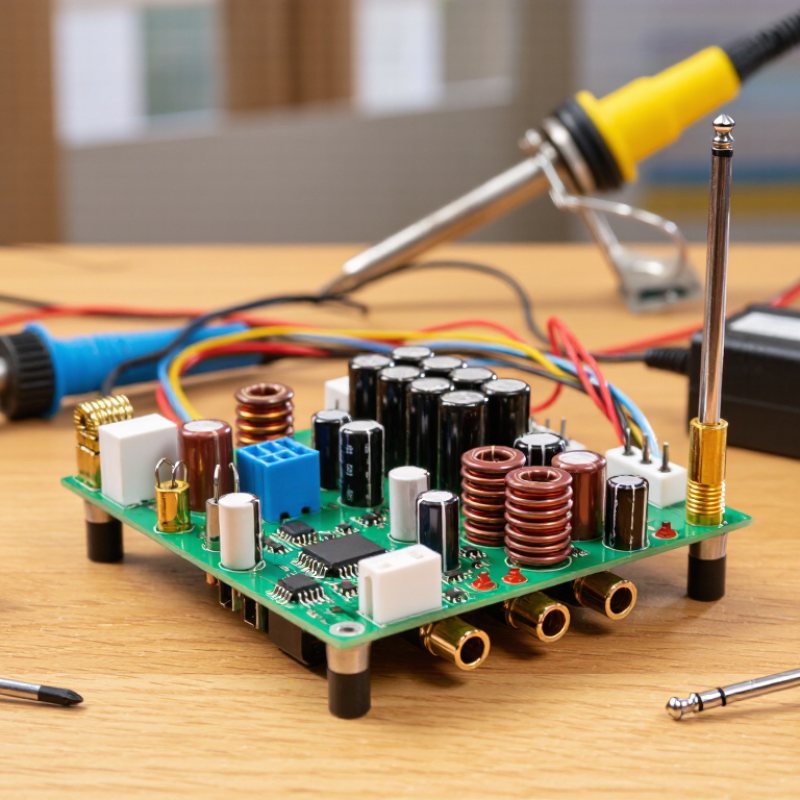
A Fm Radio Transmitter Kit is a compact electronics set designed to send an audio signal over FM radio waves. Typical parts include a circuit board, an audio input, a power connection, and an antenna connection. Some kits add a case or basic assembly instructions. At a workbench, a user might connect a small audio source, check the wiring, and listen for the signal on a nearby receiver. Simple in appearance. Yet the result depends on careful assembly and testing.
A kit is not a complete broadcast station. That distinction matters. Sound quality and signal stability can vary with component quality, power supply noise, antenna placement, and the surrounding environment. Product specifications should explain these limits clearly. Practical use should also follow applicable technical requirements and take place in an authorized setting. One detail deserves reflection: a neat circuit diagram cannot guarantee a clean result. Understanding the signal path—and documenting what changes during testing—helps users evaluate the kit with greater care.
Definition and Purpose of an FM Radio Transmitter Kit
An FM radio transmitter kit is a compact set of electronic parts. It converts sound from a phone, microphone, or small mixer into a radio-frequency signal. A nearby FM receiver can then play that signal through its speaker. Typical parts include an audio input, modulator or oscillator, power supply, and antenna.
Not quite magic. Range and sound quality depend on antenna placement, interference, and circuit design. On a desk, a short wire antenna may work differently beside a wall or window. That practical variation is easy to underestimate.
The purpose is to connect audio equipment to FM receivers without a direct cable. Small venues, classrooms, and hobby demonstrations may use kits for controlled, nearby audio distribution.
Ofcom’s Media Nations 2024 report estimates weekly radio reach at about 87% among UK adults. That helps explain why FM receivers remain familiar.
A kit does not create a broadcast service by itself. Frequency stability, output strength, and local rules still matter. Use only equipment and settings permitted in your region. Kit specifications can be incomplete, so treat claimed range as an estimate, not a promise.
Main Components and Their Functions
An FM radio transmitter kit turns an audio signal into a frequency-modulated radio signal through several connected stages. The oscillator generates the carrier frequency; the modulator shifts it in step with the audio. An audio input stage prepares sound from a microphone or line source. Small parts matter. The power regulator supplies steady voltage, while the circuit board holds components and connects their paths. A loose ground wire can add hum, so tidy assembly is more than cosmetic.
The RF buffer or amplifier strengthens the signal, and an output-matching network helps transfer energy toward the antenna. The antenna then radiates the signal; its shape and placement affect performance. ITU-R Recommendation BS.450-4 specifies FM broadcasting characteristics, including a peak deviation of up to 75 kHz in Region 2. That figure shows why modulation control matters. Ofcom’s 2023 Communications Market Report reported weekly radio listening among about 88% of UK adults, underscoring radio’s continued reach. A kit’s actual performance still depends on its design, components, and setup. Neat diagrams can mislead: real wiring and component tolerances may change results.
How an FM Radio Transmitter Kit Works
An FM radio transmitter kit is a small set of electronic parts that sends audio over a nearby FM signal. It commonly includes a circuit board, an oscillator, an audio input, a power connection, and an antenna. The oscillator creates a radio-frequency carrier. Audio from a microphone or player changes the carrier’s frequency, a process called frequency modulation. That change carries the sound information.
When powered, the circuit sends the modulated signal through its antenna. A nearby FM receiver picks up the signal and demodulates it, turning those frequency changes back into sound. Clear output depends on factors such as component values, wiring, audio level, and antenna position. A loose connection can add noise. Too much input volume can cause distortion. In practice, range is not fixed; walls and other obstacles matter. Small kits can be useful for learning, though performance may vary. A bench test may not match a room.
Tips: Keep audio leads short and check polarity before switching on. Start with low input volume, then listen for hiss or distortion. Use an appropriate antenna and check local radio requirements before transmitting. Change one setting at a time; results may still be imperfect.
Common Kit Types and Technical Features
FM radio transmitter kits come in several forms, from simple learning boards to more capable, frequency-stable assemblies. A basic kit usually uses an oscillator circuit, a small circuit board, and a short antenna connection. It helps learners see how audio changes a radio-frequency signal. Component values and soldering quality can affect stability.
More advanced kits may include a phase-locked loop, which helps keep the selected frequency steady, or a stereo encoder for left- and right-channel audio. Some arrive as bare components; others have key parts preassembled. Check the listed tuning range, frequency step size, input type, and stated output level before choosing. These details determine whether a kit suits a classroom demonstration, a bench experiment, or another permitted use. Small details matter.
A useful kit also provides a clear schematic and test points for checking power and signal behavior. A frequency display can make adjustments easier, though it does not guarantee accurate output. In practical testing, a loose wire or weak power supply may cause drift or unwanted noise. That can be frustrating. Keep tests within locally authorized frequencies and power limits, and use appropriate measurement equipment when available. A kit’s advertised range is only a starting point; real performance depends on setup, components, and surroundings.
Typical Uses and Radio Regulations
An FM radio transmitter kit can send audio to a nearby FM receiver, making it useful for demonstrations, classroom experiments, and listening to a personal audio source on an older radio. In a small workshop, for example, a learner might compare how placement affects reception across the room. Keep the setup modest. Walls, electrical noise, and receiver quality can all change the result, so advertised range is not a guarantee.
Radio rules matter even for low-power projects. Requirements differ by country and may cover permitted frequencies, output power, antenna design, equipment approval, and licensing. Check the current guidance from your national communications regulator before transmitting; do not assume a kit is automatically exempt. A frequency that sounds quiet on one radio may still be assigned to a licensed service. That detail is easy to miss. For a school or public demonstration, confirm the setup with the responsible organizer and use only an authorized configuration. Regulations can be less intuitive than the circuit itself, and a quick check is worth the time.
Cepex is the brand for the fluid handling market belonging to the Fluidra group. One of the leading european manufacturer of valves and fittings in thermoplastic materials.
Dedicated to the swimming pool, irrigation and industrial markets, we distribute our products worldwide with the Fluidra commercial network and presence in 46 countries with 136 sales branches.
Your data will be processed by CEPEX S.A., with address at C. Lluís Companys, 51-53, 08400, Granollers (Barcelona), and C.I.F. nº A-08928707, to send you communications about our products based on your interests. You can consult more information about the processing of your data and how to exercise your rights as described in the Privacy Policy.
Technical cookies are strictly necessary for our website to work and you can navigate through it. These types of cookies are those that, for example, allow us to identify you, give you access to certain restricted parts of the page if necessary, or remember different options or services already selected by you, such as your privacy preferences. Therefore, they are activated by default, your authorization not being necessary in this regard. Through the configuration of your browser, you can block or alert the presence of this type of cookies, although such blocking will affect the proper functioning of the different functionalities of our website.
The analysis cookies allow us to study the navigation of the users of our website in general (for example, which sections of the page are the most visited, which services are used most and if they work correctly, etc.). From the statistical information on navigation on our website, we can improve both the operation of the page itself and the different services it offers. Therefore, these cookies do not have an advertising purpose, but only serve to make our website work better, adapting to our users in general. By activating them you will contribute to this continuous improvement. You can enable or disable these cookies by checking the corresponding box, being disabled by default.
Functionality cookies allow us to remember your preferences, to personalize certain characteristics and general options of our website, every time you access it (for example, the language in which the information is presented to you, the sections marked as favorites, your browser type, etc.) Therefore, this type of cookies does not have an advertising purpose, but by activating them you will improve the functionality of the website (for example, adapting to your type of browser) and the customization of it based on your preferences (for example, by presenting the information in the language that you have chosen in previous occasions), which will contribute to the ease, usability and comfort of our page during your navigation. You can enable or disable these cookies by checking the corresponding box, being disabled by default.
Advertising cookies allow us to manage the advertising spaces included in our website based on criteria such as the content shown or the frequency in which the ads are displayed. For example, if you have been shown the same ad several times on our website, and you have not shown a personal interest by clicking on it, it will not appear again. In summary, by activating this type of cookies, the advertising shown on our website will be more useful and diverse, and less repetitive. You can enable or disable these cookies by checking the corresponding box, being disabled by default.
Behavioral advertising cookies allow us to obtain information based on the observation of your browsing habits and behaviors on the web, in order to show you advertising content that best suits your personal tastes and interests. To understand it in a very simple way, we will give you a fictitious example: if your last searches on the web were related to suspense literature, we would show you advertising about suspense books. Therefore, activating this type of cookies, the advertising that we show you on our website will not be generic, but will be oriented to your searches, tastes and interests, therefore adjusting exclusively to you. You can enable or disable these cookies by checking the corresponding box, being disabled by default. To understand it in a very simple way, we will give you a fictitious example: if your last searches on the web were related to suspense literature, we would show you advertising about suspense books. Therefore, activating this type of cookies, the advertising that we show you on our website will not be generic, but will be oriented to your searches, tastes and interests, therefore adjusting exclusively to you. You can enable or disable these cookies by checking the corresponding box, being disabled by default.
We use our own and third-party cookies to ensure the proper functioning of the website and to analyse our services, improve your experience on our website and show you advertisements related to your interests according to profiling based on your browsing habits (e.g. websites visited). You can accept all cookies by clicking "ACCEPT" or set or reject them by clicking here. If you would like to know more about the use of cookies, please see our COOKIE POLICY.