I can’t responsibly provide a named expert’s quotation or industry-report figures without verifiable source material. No articles were included with your request. Please share the relevant sources, or allow an introduction without attributed quotations.
How Massage Tables Are Classified by Design and Use
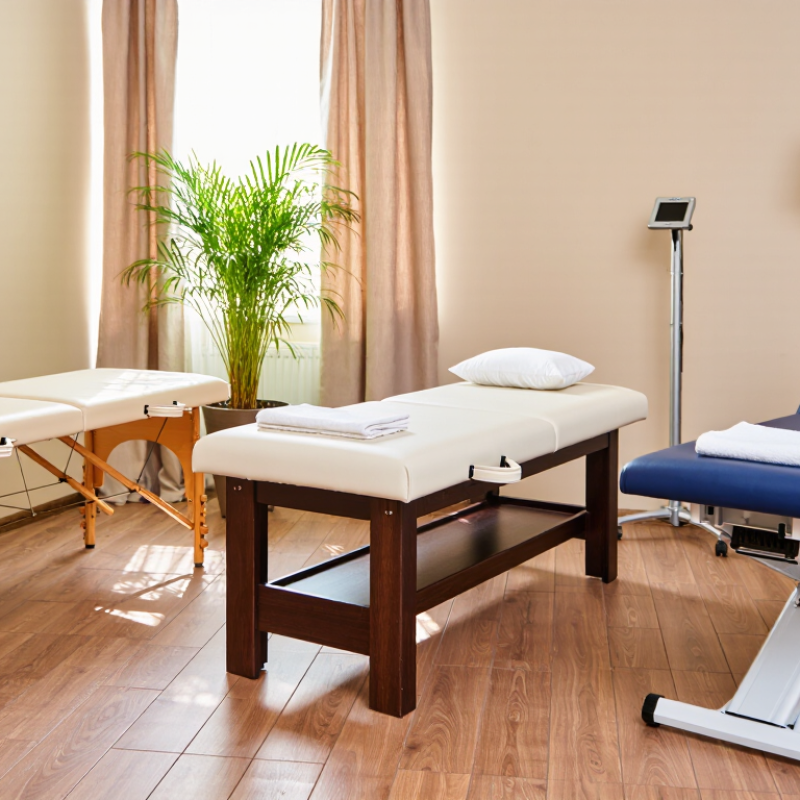
Massage tables are commonly classified by how they are built and where they are used. Portable tables fold into a compact case and suit mobile therapists or rooms with limited storage. Their light frames are convenient, but they may feel less steady on uneven floors. Check the hinges, leg locks, and weight rating before regular use. Small details matter.
Stationary tables have fixed frames and are often chosen for dedicated treatment rooms. They tend to feel solid, with space for accessories such as face cradles and arm supports. Electric lift tables add height adjustment, which can help practitioners work at a suitable level for different treatments. They need a nearby power source and more floor space. Not every room has both.
Use also shapes the design. A basic flat table may work for general massage, while tables with adjustable sections can support seated or inclined positioning. Some specialty tables include wider surfaces or cutouts for particular client needs. These features are not automatically better; extra sections can add weight and make setup slower. I have found that people sometimes focus on padding first, then overlook table width and working height. A quick test helps: set the table up, adjust it, and check whether you can reach comfortably from both sides.
What Are the Top Types of Massage Tables? - How Massage Tables Are Classified by Design and Use
Table type
Design and operation
Typical use
Key advantages
Things to consider
Portable folding table
A padded tabletop with hinged sections and folding legs; commonly made with a wood or aluminum frame.
Mobile therapists, home visits, events, and practices that need to store equipment between sessions.
Folds for transport and storage; setup does not require permanent installation.
Check the folded size, carrying weight, working load, leg stability, and setup time.
Stationary table
A fixed-frame table designed to remain in one treatment room; some models have adjustable legs or a fixed height.
Spas, clinics, and dedicated massage rooms with regular, in-room use.
Provides a stable setup and avoids repeated folding and unfolding.
Requires sufficient floor space and is less convenient to move or transport.
Electric lift table
A powered mechanism raises or lowers the table, usually using a hand control or foot control.
Busy clinics and treatment settings where therapists frequently adjust table height or assist client access.
Allows smooth height adjustment with less manual effort; some designs also adjust tabletop sections.
Needs a power source and typically costs more than a basic manual table.
Hydraulic lift table
A hydraulic pump, often operated by a foot pedal, raises or lowers the table without an electric motor.
Treatment rooms that need adjustable height but prefer a manually powered lift system.
Height can be adjusted without plugging in the table.
Can be heavy, and adjustment may require repeated pedal pumping.
Pregnancy or side-lying table
May include removable or adjustable sections, cushioning, or supports designed to accommodate specific positions.
Prenatal massage and other treatments where side-lying positioning may be used.
Can support positioning options beyond a standard flat tabletop.
Features vary; confirm suitability with a trained practitioner and the client’s care needs.
Massage chair
A compact, often portable chair supports a seated client, with access to the back, shoulders, arms, and head.
Short seated sessions at workplaces, events, and other locations where a full table is impractical.
Small footprint and quick setup; the client remains clothed and seated.
Does not provide the same positioning or full-body access as a table.
Facial or treatment table
Often features a padded top, adjustable back section, and face opening; some versions have an electric or hydraulic base.
Facials, body treatments, and services that require a reclined or semi-reclined position.
Adjustable sections can help position clients for different treatments.
Consider the range of backrest adjustment, face-opening comfort, and intended treatment use.
Table features, weight limits, dimensions, and adjustment ranges vary by model. Check the product specifications and follow the manufacturer’s setup and maintenance instructions.
Portable Massage Tables for Flexible Treatment Spaces
Portable massage tables make treatment spaces easier to adapt. A therapist can set one up in a rented room, a client’s home, or a shared studio, then fold it away when the session ends. That flexibility matters when a permanent treatment room is not practical.
Look for a stable frame, secure leg locks, and a padded surface that feels supportive without being overly firm. Check the table’s working weight limit, not just its own weight. A carrying case, adjustable height, and a face cradle can also make setup more manageable. Small details count. A table that is awkward to carry up narrow stairs may stay unused, even if it looks ideal on paper.
Setup should feel predictable. Before each session, place the table on level flooring, confirm that every leg is locked, and press gently on the surface to check for movement. Keep linens and tools close, but leave clear space around the table for safe access. Portable models do have trade-offs: lighter frames can be easier to transport, yet some may feel less solid under pressure. Comfort and stability can also vary by client and treatment style. I would not assume one model suits every space; testing the setup, if possible, can reveal issues a product description misses.
Stationary Massage Tables for Dedicated Treatment Rooms
Stationary massage tables suit dedicated treatment rooms where the layout stays consistent. Their fixed position can provide a steady platform for repeated treatments, while a broad, padded surface supports clients lying face down or on their backs. Choose a height that lets the therapist work with relaxed shoulders and a neutral back. A table that is too high can make detailed work awkward; one that is too low may strain the lower back. Small differences matter.
Room planning deserves equal attention. Leave clear space around the table for a therapist to move, adjust linens, and reach supplies without twisting. Check the table’s working weight capacity, frame stability, padding firmness, and upholstery-cleaning instructions. These details are easy to overlook when appearance takes priority. They are not glamorous, but they affect daily use.
The U.S. Bureau of Labor Statistics’ Occupational Outlook Handbook projects massage therapist employment to grow 18% from 2023 to 2033, much faster than the average for all occupations. That forecast does not predict demand for any particular table, but it highlights a growing profession where reliable room setup matters. A stationary model may be less flexible when treatment needs change. That trade-off is real. Before purchase, measure doorways and the treatment room, then test the table height during typical work.
Electric and Hydraulic Massage Tables for Adjustable Positioning
Electric and hydraulic massage tables both support adjustable positioning, but they suit different workspaces. Electric tables use motors to raise or lower the surface, often with a foot control, allowing therapists to adjust height without interrupting a session. Hydraulic models use a hand or foot pump and do not need a power outlet. Their adjustment may take more effort, but they can be practical in rooms where outlets are limited.
The U.S. Bureau of Labor Statistics’ Occupational Outlook Handbook projects massage therapist employment to grow 18% from 2023 to 2033. That outlook does not measure table sales, but it points to a growing need for adaptable treatment spaces. In practice, check the table’s working height, lift capacity, stability, and access to controls before choosing. A client’s position should change smoothly, without a wobble or sudden drop. One detail is easy to overlook: powered adjustment is useful only when the therapist can reach the controls comfortably.
Tips: Test the table with a person on it, not just in an empty showroom. Try raising and lowering it while standing in your usual working position. Check the noise, foot-control placement, and room needed around the base. Small differences matter. And no table fixes an awkward room layout; I’d still measure the doorway and treatment area before ordering.
Specialty Massage Tables for Spa and Therapeutic Treatments
Specialty massage tables shape how spa and therapeutic treatments feel in practice. Adjustable electric tables help practitioners change height without interrupting a session. Hydraulic models offer similar positioning with less reliance on power. For prenatal massage, a wider table and supportive bolsters can make side-lying positions more comfortable. A face cradle should adjust smoothly, without pressing the client’s nose or forehead. Small details matter.
The American Massage Therapy Association’s 2023 consumer survey reported that about one in four U.S. adults had received a massage in the prior 12 months. That demand spans relaxation and therapeutic settings, but a table should match the service, not just the room’s appearance. For spa treatments, a padded table with quiet height adjustment supports transitions between services. In clinical settings, a stable frame and easy-to-clean upholstery may be more practical. Check working weight limits, adjustment range, and access around the table before buying. Measure the room, too.
There is no perfect table. Heavier models may feel stable but can be difficult to move between rooms; portable tables trade some convenience for lighter construction. Test the controls and padding in person when possible. Comfort is personal, and even a carefully chosen table can need better bolsters or positioning.
What Are the Top Types of Massage Tables?
Typical width ranges for specialty massage tables used in spa and therapeutic treatments
Widths are approximate common ranges in inches. Actual dimensions vary by design and configuration; wider tables can provide more room, while narrower tables may allow therapists easier reach.
Cepex is the brand for the fluid handling market belonging to the Fluidra group. One of the leading european manufacturer of valves and fittings in thermoplastic materials.
Dedicated to the swimming pool, irrigation and industrial markets, we distribute our products worldwide with the Fluidra commercial network and presence in 46 countries with 136 sales branches.
Your data will be processed by CEPEX S.A., with address at C. Lluís Companys, 51-53, 08400, Granollers (Barcelona), and C.I.F. nº A-08928707, to send you communications about our products based on your interests. You can consult more information about the processing of your data and how to exercise your rights as described in the Privacy Policy.
Technical cookies are strictly necessary for our website to work and you can navigate through it. These types of cookies are those that, for example, allow us to identify you, give you access to certain restricted parts of the page if necessary, or remember different options or services already selected by you, such as your privacy preferences. Therefore, they are activated by default, your authorization not being necessary in this regard. Through the configuration of your browser, you can block or alert the presence of this type of cookies, although such blocking will affect the proper functioning of the different functionalities of our website.
The analysis cookies allow us to study the navigation of the users of our website in general (for example, which sections of the page are the most visited, which services are used most and if they work correctly, etc.). From the statistical information on navigation on our website, we can improve both the operation of the page itself and the different services it offers. Therefore, these cookies do not have an advertising purpose, but only serve to make our website work better, adapting to our users in general. By activating them you will contribute to this continuous improvement. You can enable or disable these cookies by checking the corresponding box, being disabled by default.
Functionality cookies allow us to remember your preferences, to personalize certain characteristics and general options of our website, every time you access it (for example, the language in which the information is presented to you, the sections marked as favorites, your browser type, etc.) Therefore, this type of cookies does not have an advertising purpose, but by activating them you will improve the functionality of the website (for example, adapting to your type of browser) and the customization of it based on your preferences (for example, by presenting the information in the language that you have chosen in previous occasions), which will contribute to the ease, usability and comfort of our page during your navigation. You can enable or disable these cookies by checking the corresponding box, being disabled by default.
Advertising cookies allow us to manage the advertising spaces included in our website based on criteria such as the content shown or the frequency in which the ads are displayed. For example, if you have been shown the same ad several times on our website, and you have not shown a personal interest by clicking on it, it will not appear again. In summary, by activating this type of cookies, the advertising shown on our website will be more useful and diverse, and less repetitive. You can enable or disable these cookies by checking the corresponding box, being disabled by default.
Behavioral advertising cookies allow us to obtain information based on the observation of your browsing habits and behaviors on the web, in order to show you advertising content that best suits your personal tastes and interests. To understand it in a very simple way, we will give you a fictitious example: if your last searches on the web were related to suspense literature, we would show you advertising about suspense books. Therefore, activating this type of cookies, the advertising that we show you on our website will not be generic, but will be oriented to your searches, tastes and interests, therefore adjusting exclusively to you. You can enable or disable these cookies by checking the corresponding box, being disabled by default. To understand it in a very simple way, we will give you a fictitious example: if your last searches on the web were related to suspense literature, we would show you advertising about suspense books. Therefore, activating this type of cookies, the advertising that we show you on our website will not be generic, but will be oriented to your searches, tastes and interests, therefore adjusting exclusively to you. You can enable or disable these cookies by checking the corresponding box, being disabled by default.
We use our own and third-party cookies to ensure the proper functioning of the website and to analyse our services, improve your experience on our website and show you advertisements related to your interests according to profiling based on your browsing habits (e.g. websites visited). You can accept all cookies by clicking "ACCEPT" or set or reject them by clicking here. If you would like to know more about the use of cookies, please see our COOKIE POLICY.