
What Is a Water Cooler Evaporator and How Does It Work?
FLUID HANDLING EXPERTS

Blog, all our news

What Is a Water Cooler Evaporator and How Does It Work?

A Water Cooler Evaporator is the component that removes heat from water, making cooling possible inside a dispenser or commercial hydration system. It works through a controlled refrigeration cycle. Refrigerant enters the evaporator as a cold, low-pressure fluid. Heat then moves from the warmer water into the refrigerant. The water cools. The refrigerant changes into vapor and travels toward the compressor.

The process seems simple, but small details matter. A copper or stainless-steel heat-transfer surface sits near the water circuit. Its design affects cooling speed, energy use, hygiene, and maintenance. Poor contact can create slow cooling. Excessive moisture may encourage corrosion or insulation problems. Real systems are less perfect than diagrams suggest.

Willis H. Carrier, a leading figure in refrigeration and air-conditioning engineering, stated, “The fundamental reason for air conditioning is to control the temperature and humidity of air.” His principle also helps explain evaporator operation: heat must move in a predictable direction. In a Water Cooler Evaporator, that direction runs from the water toward the colder refrigerant.

This guide examines the main parts, cooling sequence, efficiency factors, and common service concerns. It also considers practical observations, such as uneven water temperature, unusual compressor noise, and frost on nearby tubing. These signs do not always identify one fault. Diagnosis requires measurement.

That is the important limitation. A basic explanation helps, but it cannot replace pressure readings, temperature checks, and safe professional inspection.
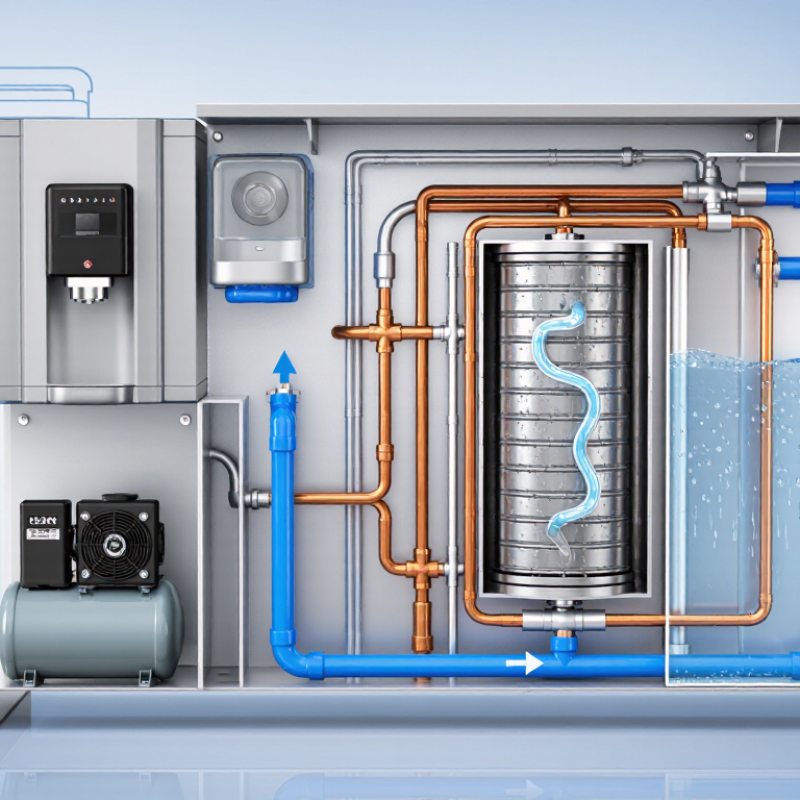
What Is a Water Cooler Evaporator and How Does It Work?

What Is a Water Cooler Evaporator?

A water cooler evaporator is the heat-transfer component that removes heat from circulating water. It sits inside a water chiller, not in a household drinking cooler. Chilled water flows through tubes or plates. Refrigerant moves on the opposite side at low pressure and boils as it absorbs heat. The refrigerant changes from liquid to vapor.

That phase change is the key. It transfers heat efficiently while keeping the water circuit separated from the refrigerant circuit. A compressor then pulls the vapor away, allowing the cycle to continue.

Common designs include shell-and-tube and brazed-plate evaporators. Their performance depends on water flow, refrigerant control, surface cleanliness, and the temperature difference between entering and leaving water.

Small details matter. Field technicians often check approach temperature, pressure, superheat, and flow stability. Fouling can act like a thin blanket, reducing heat transfer before users notice weaker cooling. The International Energy Agency projects global space-cooling demand could more than triple by 2050 without stronger efficiency measures. The U.S. Department of Energy also reports that air conditioning uses about 6% of U.S. electricity. These figures explain why evaporator design deserves attention.

It is not an evaporative air cooler. That distinction is easy to miss. An evaporator in a water chiller removes heat through refrigerant boiling, while an evaporative cooler uses water evaporation directly in an airstream. In practice, real systems are less perfect than diagrams suggest. Poor water treatment, unstable flow, or incorrect controls can quietly waste capacity.

The Main Components of a Water Cooler Evaporator

What Is a Water Cooler Evaporator and How Does It Work?

The Main Components of a Water Cooler Evaporator

A water cooler evaporator transfers heat from circulating water into a cold refrigerant. The cooled water then returns to the process loop or drinking-water system. In many designs, water flows through tubes while refrigerant surrounds them inside a shell. Other systems reverse this arrangement. The choice affects heat transfer, cleaning, and leakage risks.

The evaporator shell or plate pack forms the heat-transfer body. Tubes or plates provide the contact surface. Refrigerant enters after the expansion device, where its pressure and temperature fall sharply. It absorbs heat and boils inside the evaporator. The compressor then draws away the vapor. Small changes matter.

A water circuit also needs an inlet, outlet, pump, strainer, flow switch, and temperature sensors. Insulation around the vessel limits condensation and unwanted heat gain.

Service technicians usually inspect flow stability, pressure difference, fouling, and refrigerant superheat. A clean surface can still perform poorly when flow is uneven.

The ASHRAE Handbook describes chilled-water systems commonly operating near 6.7°C supply temperature, although actual settings depend on the application. The International Energy Agency’s Future of Cooling report projects global cooling energy demand could more than triple by 2050. That trend increases pressure for efficient evaporator design and control. However, published efficiency figures can mislead. Real performance changes with water quality, load patterns, ambient conditions, and maintenance quality.

How the Evaporation and Cooling Process Works

What Is a Water Cooler Evaporator and How Does It Work?

A water cooler evaporator is the component where heat leaves the water circuit. It does not create cold directly. Instead, it transfers heat to a low-pressure refrigerant flowing through separate passages.

Warm water enters the evaporator through an inlet pipe. Refrigerant surrounds or passes beside the water tubes, depending on the equipment design. As the refrigerant absorbs heat, it changes from a liquid into a vapor. This phase change is the key cooling event. The chilled water then returns to the building or dispenser, often several degrees cooler.

Pressure controls the process. Lower refrigerant pressure creates a lower boiling temperature. Heat naturally moves from the warmer water toward the colder refrigerant. The compressor later pulls vapor from the evaporator and keeps circulation moving. A technician checks water flow, refrigerant pressure, temperature difference, and unusual frost patterns. These readings reveal problems more clearly than temperature alone.

It sounds simple.

Tips: Keep the water side clean and maintain the recommended flow rate. Poor flow can reduce heat transfer and cause unstable temperatures. Insulation also matters because exposed pipes gain heat from surrounding air. A common oversight is ignoring scale buildup inside tubes. Even a thin layer can act like a blanket. In practice, real systems rarely perform perfectly, and readings may change with outdoor temperature, load, or trapped air. Regular measurements are wiser than relying on one cold-water test.

How Refrigerant Circulates Through the System

A water cooler evaporator is the heat-transfer section that removes warmth from circulating water. It does not mix refrigerant with water. Instead, refrigerant moves through separate passages inside a heat exchanger. As cold, low-pressure refrigerant enters the evaporator, it absorbs heat from the warmer water around it. The refrigerant boils and becomes vapor.

The compressor draws this vapor from the evaporator and raises its pressure. The hot vapor then travels to the condenser, where air or water removes its heat. It changes back into a high-pressure liquid. That liquid reaches a metering device, which sharply reduces its pressure. Pressure drops quickly. The refrigerant becomes colder and partly evaporates before returning to the evaporator. This repeated cycle keeps the water temperature stable.

In field inspections, technicians often check suction pressure, discharge pressure, and water temperature together. A frosted suction pipe may suggest low airflow, restricted flow, or an incorrect refrigerant charge. Frost alone proves very little. Water flow matters too. If the pump moves too slowly, the evaporator may freeze even when the refrigeration circuit works normally. This explanation simplifies real systems, because sensors and control valves can change refrigerant flow during operation. Small measurement errors can also mislead a diagnosis.

Key Factors Affecting Evaporator Performance

A water-cooled chiller evaporator transfers heat from chilled water into refrigerant. The refrigerant boils at low pressure inside the tubes. The chilled water then leaves colder, often near 6–7°C in comfort-cooling systems. Evaporator performance depends heavily on temperature difference, water flow, surface cleanliness, and refrigerant control.

The approach temperature matters. A rising approach usually signals fouling, poor flow, or low refrigerant performance. ASHRAE Handbook—HVAC Systems and Equipment identifies water-side fouling as a key design concern, with common fouling allowances near 0.0001–0.00025 hr·ft²·°F/Btu. That thin layer can still reduce heat transfer. AHRI Standard 550/590-2023 also evaluates chillers under defined entering-water temperatures, flow conditions, and part-load points. Field results can differ. Real systems are less tidy.

Water flow creates another trade-off. Excessive flow increases pump energy and may cause erosion. Insufficient flow reduces heat transfer and can create unstable leaving-water temperatures. Refrigerant superheat, expansion-valve response, tube cleanliness, and sensor accuracy also affect evaporator stability. The IEA’s The Future of Cooling report projects cooling electricity demand could more than triple by 2050, making small efficiency losses increasingly important.

Tips: Record entering and leaving water temperatures weekly. Check the temperature difference against the design value. Inspect strainers and tubes before changing refrigerant settings. A practical review should compare kW per cooling ton, flow rate, and approach temperature together. One reading alone can mislead.

What Is a Water Cooler Evaporator and How Does It Work?

Typical overall heat-transfer coefficients for common evaporator configurations

A water cooler evaporator absorbs heat from circulating chilled water as the refrigerant boils at low pressure. The overall heat-transfer coefficient indicates how effectively heat moves through the evaporator surface. Higher values generally support greater cooling capacity with a smaller heat-transfer area. Actual performance is affected by refrigerant selection, water flow rate, temperature difference, surface fouling, and evaporator design. The values shown are representative engineering reference points and are not tied to any manufacturer or brand.

Copyright 2025 Fluidra S.A. | Created by BCM Marketing Agencia Privacy Policy Legal note | Cookie policy |

Technical cookies are strictly necessary for our website to work and you can navigate through it. These types of cookies are those that, for example, allow us to identify you, give you access to certain restricted parts of the page if necessary, or remember different options or services already selected by you, such as your privacy preferences. Therefore, they are activated by default, your authorization not being necessary in this regard. Through the configuration of your browser, you can block or alert the presence of this type of cookies, although such blocking will affect the proper functioning of the different functionalities of our website.


The analysis cookies allow us to study the navigation of the users of our website in general (for example, which sections of the page are the most visited, which services are used most and if they work correctly, etc.). From the statistical information on navigation on our website, we can improve both the operation of the page itself and the different services it offers. Therefore, these cookies do not have an advertising purpose, but only serve to make our website work better, adapting to our users in general. By activating them you will contribute to this continuous improvement. You can enable or disable these cookies by checking the corresponding box, being disabled by default.


Functionality cookies allow us to remember your preferences, to personalize certain characteristics and general options of our website, every time you access it (for example, the language in which the information is presented to you, the sections marked as favorites, your browser type, etc.) Therefore, this type of cookies does not have an advertising purpose, but by activating them you will improve the functionality of the website (for example, adapting to your type of browser) and the customization of it based on your preferences (for example, by presenting the information in the language that you have chosen in previous occasions), which will contribute to the ease, usability and comfort of our page during your navigation. You can enable or disable these cookies by checking the corresponding box, being disabled by default.


Advertising cookies allow us to manage the advertising spaces included in our website based on criteria such as the content shown or the frequency in which the ads are displayed. For example, if you have been shown the same ad several times on our website, and you have not shown a personal interest by clicking on it, it will not appear again. In summary, by activating this type of cookies, the advertising shown on our website will be more useful and diverse, and less repetitive. You can enable or disable these cookies by checking the corresponding box, being disabled by default.


Behavioral advertising cookies allow us to obtain information based on the observation of your browsing habits and behaviors on the web, in order to show you advertising content that best suits your personal tastes and interests. To understand it in a very simple way, we will give you a fictitious example: if your last searches on the web were related to suspense literature, we would show you advertising about suspense books. Therefore, activating this type of cookies, the advertising that we show you on our website will not be generic, but will be oriented to your searches, tastes and interests, therefore adjusting exclusively to you. You can enable or disable these cookies by checking the corresponding box, being disabled by default.
To understand it in a very simple way, we will give you a fictitious example: if your last searches on the web were related to suspense literature, we would show you advertising about suspense books. Therefore, activating this type of cookies, the advertising that we show you on our website will not be generic, but will be oriented to your searches, tastes and interests, therefore adjusting exclusively to you. You can enable or disable these cookies by checking the corresponding box, being disabled by default.

SAVE

We use our own and third-party cookies to ensure the proper functioning of the website and to analyse our services, improve your experience on our website and show you advertisements related to your interests according to profiling based on your browsing habits (e.g. websites visited). You can accept all cookies by clicking "ACCEPT" or set or reject them by clicking here. If you would like to know more about the use of cookies, please see our COOKIE POLICY.


ACCEPT ALL
Reject no essentials


