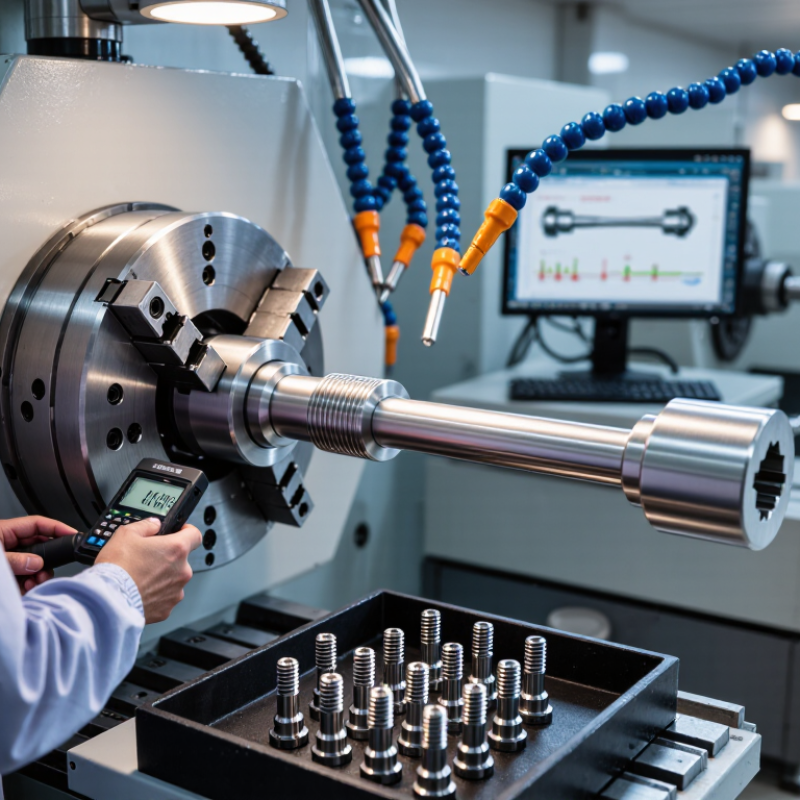
2026 Top Swiss Turning Services for Titanium Bone Screws
Titanium bone screws demand more than attractive tolerances. They require stable cutting, disciplined inspection, and evidence that every production decision protects patient safety. In 2026, Swiss Turning Services For Titanium Bone Screws are attracting attention because Swiss-type machines can control slender diameters, fine threads, and complex features with remarkable consistency.
The work begins with the material. Titanium resists heat transfer, so improper speeds can create built-up edges, burrs, or damaged threads. A skilled supplier manages coolant delivery, tool geometry, chip evacuation, and tool-life records. Tiny details matter. A flawed thread can compromise assembly.
W. Edwards Deming, a respected manufacturing quality authority, stated, “Quality comes not from inspection, but from the improvement of the production process.” That principle fits medical machining closely. Inspection cannot repair a poorly controlled process. Strong providers combine validated workflows, calibrated equipment, traceability, and experienced operators.
This article reviews leading 2026 capabilities for titanium bone screws. It considers Swiss turning accuracy, surface finish, prototype flexibility, batch consistency, documentation, and quality-system maturity. ISO 13485 alignment may support medical-device production, but certification alone proves little. Actual process evidence matters more.
Some supplier claims sound impressive. Look closer. Ask how they measure thread pitch, monitor tool wear, and control contamination. Ask for material certificates and inspection examples. Perfection is not automatic. Even advanced machining programs can expose weak assumptions during scale-up.
The best partner understands both metal behavior and clinical consequences. That combination separates a capable subcontractor from a dependable medical manufacturing resource.
Swiss Turning Services for Titanium Bone Screws: Industry Overview
Swiss Turning Services for Titanium Bone Screws: Industry Overview
Swiss turning is becoming important for titanium bone screw production as implant designs grow smaller and more complex. Fortune Business Insights’ 2024 orthopedic devices report estimates the global market will expand from about USD 47 billion in 2023 to more than USD 72 billion by 2032. This growth increases pressure on machining suppliers to deliver repeatable threads, clean surfaces, and documented process control.
Titanium alloy demands patience. Its low thermal conductivity traps heat near the cutting edge. A Swiss-type machine can support stable bar feeding, short tool engagement, and precise thread machining. Operators commonly monitor cutting forces, coolant flow, burr formation, and tool wear during production. For Ti-6Al-4V ELI, ASTM F136 remains a key material reference for surgical implants. Dimensional inspection may include optical measurement, thread gauging, and sampling under an ISO 13485 quality system.
Small details matter. A damaged thread can affect assembly torque. Excessive polishing can also remove critical geometry. Service providers should connect machining records with material certificates, inspection results, and lot traceability. That evidence supports technical reviews and regulatory submissions.
Cycle time is not everything. Faster production may increase heat, burrs, or tool instability. This is where many evaluations become too optimistic. A practical supplier tests the full process, not only the first successful parts. Titanium machining still rewards experience, careful inspection, and a willingness to revise assumptions.
Titanium Grades and Their Role in Bone Screw Manufacturing
2026 Top Swiss Turning Services for Titanium Bone Screws
Titanium grade selection shapes every stage of bone screw manufacturing. Commercially pure titanium, especially Grades 2 and 4, offers strong corrosion resistance and useful biocompatibility. Grade 4 provides higher strength for demanding screw designs. Ti-6Al-4V, commonly known as Grade 5, supports higher mechanical loads. Its extra strength can improve thread durability. However, strength alone should not decide the material.
Ti-6Al-4V ELI, or Grade 23, offers reduced interstitial elements and is widely considered for implant applications. Swiss turning can produce precise threads, drive recesses, and narrow shafts from titanium bar stock. Controlled cutting speeds help reduce heat at the tool edge. Sharp, suitable tooling also limits burrs around the thread crest. Engineers should verify material certificates, lot traceability, dimensional reports, and surface requirements. Tiny errors matter.
Tips: Match the grade to load, anatomy, and design requirements. Confirm the final condition, including annealed or stress-relieved material. Inspect thread dimensions with calibrated gauges. Avoid assuming Grade 5 always performs best. A perfect grade choice does not exist. Design reviews should question fatigue data, machining behavior, and sterilization effects. Sometimes, a cheaper process creates more risk later.
Swiss Turning Processes for Precision Bone Screw Components
2026 Top Swiss Turning Services for Titanium Bone Screws
Swiss turning gives titanium bone screw components controlled geometry and repeatable production for demanding medical applications. For small diameters, guide bushings and balanced workholding limit deflection during threading and drilling. The bar remains supported close to the cutting zone. This stability helps maintain concentricity across the shank, thread, and drive recess. Thread profiles, undercuts, and end features require carefully programmed tool paths. Small details matter.
In practical production, tooling choice should reflect titanium’s strength, heat sensitivity, and tendency to form built-up edges. Sharp, rigid tools reduce burr formation and protect the thread crest. Yet titanium can generate heat and cling to a cutting edge. Controlled coolant delivery, conservative cutting parameters, and scheduled tool checks help protect the surface. I would not treat one successful batch as proof of process capability. That gap matters. Capability studies, first article inspection, and in-process gauging should support every critical feature.
Reliable production also depends on traceability beyond the machine. Material certificates, lot records, dimensional reports, and cleaning controls create an auditable history. For medical components, measurement systems need calibration, while operators need documented training. Visual inspection alone can miss torn threads, tiny burrs, or subtle concentricity errors. Optical measurement and targeted cross-sectional checks can reveal problems earlier. A useful review asks whether inspection results are changing the process. Not every defect is obvious at first. Swiss turning is precise, but precision is maintained through disciplined feedback, not machine speed.
2026 Top Swiss Turning Services for Titanium Bone Screws - Swiss Turning Processes for Precision Bone Screw Components
Process Area
Recommended Practice for Titanium Bone Screws
Typical Control Point
Why It Matters
Material Selection
Use implant-grade titanium alloy bar stock, commonly Ti-6Al-4V ELI, with material certification and traceable heat or lot identification.
Chemical composition, mechanical properties, diameter, straightness, and certificate traceability.
Supports biocompatibility, strength, fatigue resistance, and controlled production records.
Swiss-Type Turning
Guide-bushing turning keeps the cutting zone close to the bushing, helping control slender shafts, pilot sections, and small-diameter features.
Bar support, tool overhang, concentricity, runout, and dimensional stability during the batch.
Reduces deflection and improves repeatability on miniature orthopedic components.
Cutting Strategy
Apply sharp, rigid tooling with controlled cutting parameters, effective chip evacuation, and coolant suited to titanium machining.
Produce bone-screw threads by controlled single-point turning, thread whirling, or another qualified method selected for the thread form and size.
Thread pitch, major diameter, minor diameter, flank profile, lead, crest condition, and thread gauge results.
Accurate thread geometry supports insertion performance and compatibility with the mating bone or instrument interface.
Head and Drive Features
Machine the screw head, recess, socket, or drive interface in a controlled sequence to maintain alignment with the screw axis.
Head diameter, seating surface, drive depth, angular alignment, and tool engagement.
Helps reduce insertion-tool slippage and maintains consistent seating behavior.
Burr and Edge Control
Use controlled deburring, brushing, micro-blasting, or other validated finishing methods without altering functional thread geometry.
Burr presence, edge condition, thread crest integrity, and visual cleanliness under magnification.
Prevents loose particles and sharp unintended edges that may affect handling or use.
Surface Finish
Specify surface texture by drawing or product requirement and verify non-threaded functional surfaces using a calibrated roughness instrument.
Ra or other specified roughness value, surface defects, discoloration, and machining marks.
Controlled surfaces support cleaning, coating or passivation steps, and consistent product performance.
Dimensional Inspection
Inspect critical dimensions with calibrated micrometers, optical measurement systems, thread gauges, form gauges, or coordinate measurement equipment.
Overall length, thread length, diameters, head geometry, concentricity, runout, and feature location.
Provides objective evidence that the component conforms to the approved drawing and tolerances.
Cleaning and Handling
Use a validated cleaning process to remove machining fluids, chips, particles, and residues before packaging.
Particle inspection, residue evaluation, drying effectiveness, and handling controls.
Reduces contamination risk and protects the finished surface during transfer and storage.
Surface Treatment
If specified, apply a qualified treatment such as anodizing or passivation-compatible processing without compromising thread and drive dimensions.
Treatment coverage, color or appearance where applicable, dimensional change, and process records.
Maintains the intended surface characteristics while preserving functional interfaces.
Mechanical Verification
Perform product-specific verification such as insertion torque, removal torque, torsional strength, or fatigue testing when required by the design and risk assessment.
Test method, fixture alignment, torque values, failure mode, sample quantity, and acceptance criteria.
Confirms that the finished screw meets its defined functional and mechanical requirements.
Quality Documentation
Maintain approved drawings, inspection records, material certificates, calibration status, nonconformance records, and batch traceability.
Document revision, lot number, inspection status, equipment identification, and reviewer authorization.
Creates a traceable manufacturing history for regulated medical-device production.
Applicable Quality Framework
Use a documented quality system appropriate for medical-device manufacturing, with risk-based process controls and validated special processes where applicable.
Training, process validation, supplier control, corrective action, internal audits, and record retention.
Supports consistent production, regulatory readiness, and control of product and process risks.
Note: Exact tolerances, surface-finish limits, inspection frequency, sterilization requirements, and mechanical acceptance criteria should be defined by the approved product drawing, risk assessment, and applicable regulatory requirements.
Quality Standards and Inspection Requirements in Switzerland
2026 Top Swiss Turning Services for Titanium Bone Screws
Swiss turning services for titanium bone screws must connect machining accuracy with medical-device quality controls. A capable supplier should operate under a documented quality system, commonly aligned with ISO 13485. Risk management should follow ISO 14971 principles. Material certificates must identify titanium grade, heat number, supplier, and receiving records. Traceability matters.
Inspection begins with the drawing and intended clinical use. Critical dimensions include thread form, pitch diameter, head geometry, cannulation, and tip profile. Coordinate measuring machines can verify complex features. Optical systems help inspect small threads and burrs. Surface roughness testing is also important. Cleanliness cannot be treated as cosmetic.
Swiss production records should show approved procedures, calibrated equipment, operator qualifications, and nonconformance decisions. Sampling plans may support routine production, but critical features often require stronger controls. Final inspection should confirm dimensions, markings, packaging condition, and batch identity. Biological evaluation, sterilization, and packaging validation may also apply, depending on the finished device and its market pathway.
A practical concern remains. Automated inspection can miss damage hidden inside a narrow cannulation. Human review still has value, especially during setup changes or tool wear. Inspection plans should be challenged regularly, not copied from older parts. Small process weaknesses can become serious clinical risks. That deserves attention.
Selecting a Swiss Turning Partner for Titanium Bone Screws
2026 Top Swiss Turning Services for Titanium Bone Screws
Selecting a Swiss Turning Partner for Titanium Bone Screws
Selecting a Swiss turning partner requires more than polished photos. Titanium bone screws demand stable cutting, sharp tooling, controlled heat, and clean thread formation. During supplier reviews, examine how operators manage thin heads, cannulation, and tiny drive features. Ask for measured samples, not promises. A capable shop should explain tolerance limits, inspection equipment, and methods for preventing burrs around thread crests. Small defects can affect assembly and clinical performance.
A reliable partner provides material certificates, lot traceability, process records, and inspection results linked to each batch. Look for documented calibration and validation of turning, deburring, cleaning, and packaging steps. Swiss precision is valuable, but geography alone does not prove capability. Request evidence from comparable titanium components. Review first-article data carefully. One attractive prototype can hide unstable production. That lesson is uncomfortable, but it protects long-term decisions.
Tips: Confirm the titanium grade, screw geometry, surface-finish limits, and annual volume before requesting a quotation. Ask how tools are replaced and how chips are controlled. Clarify whether inspection includes thread gauges, optical measurement, and torque-related checks. Keep technical communication written. A short pilot run may reveal more than a confident presentation. Leave room for redesign; early assumptions are often wrong.
Cepex is the brand for the fluid handling market belonging to the Fluidra group. One of the leading european manufacturer of valves and fittings in thermoplastic materials.
Dedicated to the swimming pool, irrigation and industrial markets, we distribute our products worldwide with the Fluidra commercial network and presence in 46 countries with 136 sales branches.
Your data will be processed by CEPEX S.A., with address at C. Lluís Companys, 51-53, 08400, Granollers (Barcelona), and C.I.F. nº A-08928707, to send you communications about our products based on your interests. You can consult more information about the processing of your data and how to exercise your rights as described in the Privacy Policy.
Technical cookies are strictly necessary for our website to work and you can navigate through it. These types of cookies are those that, for example, allow us to identify you, give you access to certain restricted parts of the page if necessary, or remember different options or services already selected by you, such as your privacy preferences. Therefore, they are activated by default, your authorization not being necessary in this regard. Through the configuration of your browser, you can block or alert the presence of this type of cookies, although such blocking will affect the proper functioning of the different functionalities of our website.
The analysis cookies allow us to study the navigation of the users of our website in general (for example, which sections of the page are the most visited, which services are used most and if they work correctly, etc.). From the statistical information on navigation on our website, we can improve both the operation of the page itself and the different services it offers. Therefore, these cookies do not have an advertising purpose, but only serve to make our website work better, adapting to our users in general. By activating them you will contribute to this continuous improvement. You can enable or disable these cookies by checking the corresponding box, being disabled by default.
Functionality cookies allow us to remember your preferences, to personalize certain characteristics and general options of our website, every time you access it (for example, the language in which the information is presented to you, the sections marked as favorites, your browser type, etc.) Therefore, this type of cookies does not have an advertising purpose, but by activating them you will improve the functionality of the website (for example, adapting to your type of browser) and the customization of it based on your preferences (for example, by presenting the information in the language that you have chosen in previous occasions), which will contribute to the ease, usability and comfort of our page during your navigation. You can enable or disable these cookies by checking the corresponding box, being disabled by default.
Advertising cookies allow us to manage the advertising spaces included in our website based on criteria such as the content shown or the frequency in which the ads are displayed. For example, if you have been shown the same ad several times on our website, and you have not shown a personal interest by clicking on it, it will not appear again. In summary, by activating this type of cookies, the advertising shown on our website will be more useful and diverse, and less repetitive. You can enable or disable these cookies by checking the corresponding box, being disabled by default.
Behavioral advertising cookies allow us to obtain information based on the observation of your browsing habits and behaviors on the web, in order to show you advertising content that best suits your personal tastes and interests. To understand it in a very simple way, we will give you a fictitious example: if your last searches on the web were related to suspense literature, we would show you advertising about suspense books. Therefore, activating this type of cookies, the advertising that we show you on our website will not be generic, but will be oriented to your searches, tastes and interests, therefore adjusting exclusively to you. You can enable or disable these cookies by checking the corresponding box, being disabled by default. To understand it in a very simple way, we will give you a fictitious example: if your last searches on the web were related to suspense literature, we would show you advertising about suspense books. Therefore, activating this type of cookies, the advertising that we show you on our website will not be generic, but will be oriented to your searches, tastes and interests, therefore adjusting exclusively to you. You can enable or disable these cookies by checking the corresponding box, being disabled by default.
We use our own and third-party cookies to ensure the proper functioning of the website and to analyse our services, improve your experience on our website and show you advertisements related to your interests according to profiling based on your browsing habits (e.g. websites visited). You can accept all cookies by clicking "ACCEPT" or set or reject them by clicking here. If you would like to know more about the use of cookies, please see our COOKIE POLICY.