
What Are the Top Silica Tubing Manufacturers in China?
FLUID HANDLING EXPERTS

Blog, all our news

What Are the Top Silica Tubing Manufacturers in China?

Choosing a Silica Tubing manufacturer in China requires more than comparing prices. Buyers must examine material purity, dimensional control, thermal performance, and consistency between production batches. A tube may look clear under factory lights, yet still vary in wall thickness or contain surface defects that matter in a demanding application. Small details count.

Glass scientist Arun K. Varshneya’s work offers a useful principle, paraphrased here rather than presented as a direct quotation: “A glass product’s performance depends on both its composition and its processing history.” That distinction matters when evaluating Silica Tubing. Ask suppliers for clear specifications, inspection methods, and evidence that reported tolerances reflect routine production—not only selected samples. Requesting a representative sample can also reveal finish quality and handling practices.

This guide introduces leading Chinese manufacturers and the factors that separate a dependable supplier from a polished sales page. It considers product range, technical documentation, customization, quality controls, and communication. No single company is best for every project. A laboratory needing narrow-diameter tubing may value different capabilities than a process-equipment buyer ordering long production runs. And public information can be incomplete; a confident claim is not the same as independently verified performance. The comparisons ahead are a starting point, not a substitute for checking current specifications and requesting application-specific data. Look closely. A small mismatch can matter.
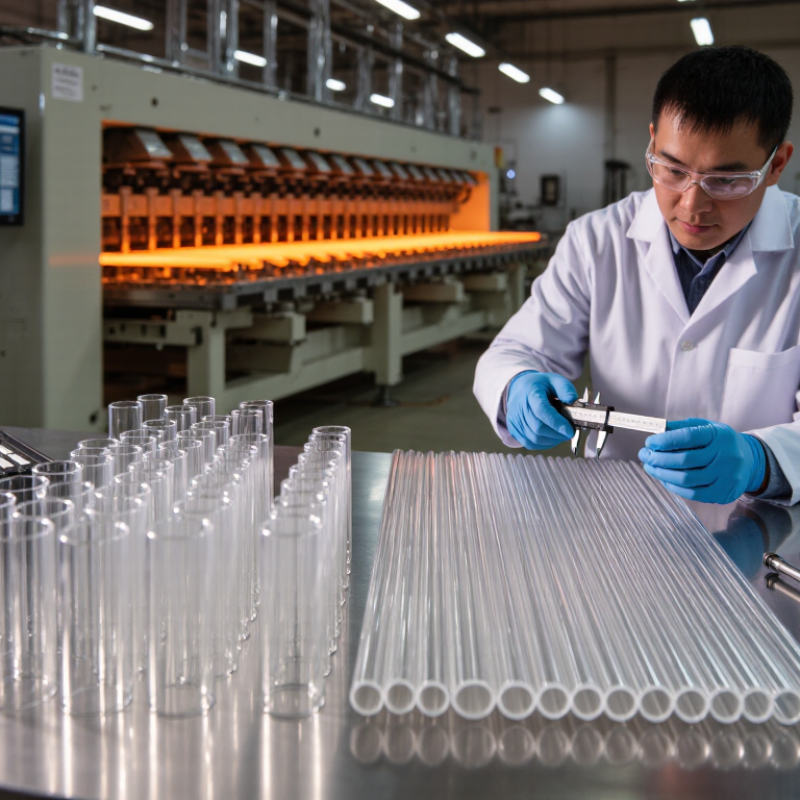
What Are the Top Silica Tubing Manufacturers in China?

Silica Tubing Basics: ≥99.99% SiO₂ Purity and Fused-Silica Grades

Silica tubing is often specified at ≥99.99% SiO₂, but that figure is only a starting point. It describes chemical purity, not every property that affects performance. That distinction matters. A tube with low metallic contamination may still contain bubbles, striae, or uneven wall thickness. These defects can affect optical transmission, thermal behavior, or the reliability of a heated assembly.

Fused-silica grades differ in feedstock, manufacturing route, and residual hydroxyl content. For high-temperature use, ask a Chinese manufacturer for the grade’s stated temperature range and supporting test data. For optical or analytical work, check transmission at the wavelengths you need.

Request a certificate of analysis, dimensional tolerances, and inspection details for inner and outer diameters. Small details matter. A narrow bore variation can complicate a fitting, even when the purity claim looks excellent.

Compare samples under your actual operating conditions, not just against a catalog description. One caveat: published purity values may use different test methods, so ask how the number was measured. A clear answer is useful evidence of process control, though it is not a substitute for testing the delivered tubing.

China’s Major Manufacturers: Pacific Quartz, Feilihua, and Other Suppliers

China’s silica-tubing supply base includes large quartz-glass producers and specialist tube processors. Their capabilities differ: some melt and draw tubing in-house, while others focus on cutting, polishing, and custom dimensions. The USGS Mineral Commodity Summaries 2024 estimates U.S. industrial sand and gravel production at about 120 million metric tons in 2023. That figure covers broad industrial uses, not silica tubing, but it shows the scale of the upstream raw-material sector. Small details matter. Buyers should request the silica grade, hydroxyl content, dimensional tolerances, and batch traceability rather than relying on a general “high-purity” claim.

Supplier comparisons are most useful when based on measurable performance. Ask for sample tubes and check outside diameter, wall thickness, straightness, and surface defects under consistent lighting. For thermal or optical applications, request test data at the intended operating conditions; a specification sheet alone may not predict real performance. Larger manufacturers may offer stable capacity and documented quality systems, while smaller processors can sometimes handle short runs or unusual dimensions more flexibly. Not interchangeable. One limitation is that public industry reports rarely separate tubing output from broader quartz-glass production, so capacity claims can be difficult to verify. I would treat published figures as a starting point, then confirm lead times, inspection methods, and rejection procedures directly with each supplier.

Compare Technical Data: 0.55 × 10⁻⁶ K⁻¹ Expansion and Tube Tolerances

For silica tubing, a quoted expansion coefficient of 0.55 × 10⁻⁶ K⁻¹ is a useful benchmark, not a complete specification. Touloukian and colleagues’ Thermophysical Properties of Matter compiles fused-silica expansion data in this range; the measured value still depends on temperature and glass composition. Ask suppliers for the tested temperature interval and method. ASTM E228-22 describes dilatometry for measuring linear thermal expansion. Small numbers matter.

Dimensional tolerances deserve equal scrutiny. A tube listed as 10 mm outside diameter with a 1 mm wall has a nominal 8 mm inside diameter, but wall variation changes the usable bore. Request guaranteed limits for outside diameter, inside diameter or wall thickness, ovality, straightness, and cut length. A single “±” value can hide which dimension it covers. Check whether tolerances apply to every tube or only a sample.

Compare Chinese manufacturers using the same drawing and inspection conditions. Ask for recent inspection records, measurement-tool resolution, and the sampling plan—not just catalogue values. A supplier may report tight outside-diameter control yet leave wall concentricity unspecified. That gap is easy to miss. For high-temperature assemblies, compare expansion data across the operating range, then test a short production sample before approving volume orders.

Evaluate Quality: OH Content, UV Transmission, Bubbles, and Traceability

When comparing silica tubing manufacturers in China, look beyond a polished quotation. Ask for OH content, UV transmission data, bubble limits, and lot-level traceability. The numbers should match the tubing’s dimensions and intended wavelength range. OH content can influence absorption, especially in infrared applications, while UV performance also depends on impurities, wall thickness, and surface condition. Check how each value was measured.

A chart alone is not enough. Request test methods, sample details, and recent inspection records. For UV transmission, confirm the test wavelength and tubing wall thickness; otherwise, comparisons may mislead. Bubbles and inclusions should be assessed across the tube, not just in one attractive sample. Small defects can scatter light or affect consistency. A clean certificate can still leave an awkward question: was the tested sample from the same production lot? Ask for batch numbers that connect raw material, inspection results, and shipment records. That link matters. It is easy to overlook. If a supplier cannot explain a measurement clearly, pause and verify it with a trial order or independent testing. No single figure proves quality, and even careful checks may miss variation between batches.

What Are the Top Silica Tubing Manufacturers in China? - Evaluate Quality: OH Content, UV Transmission, Bubbles, and Traceability

Supplier-neutral evaluation framework. Request actual lot-specific test results; acceptance limits depend on the silica grade, tube dimensions, application, and agreed specification.

Quality dimension Data to request How to compare fairly Evaluation note
OH content Measured hydroxyl (OH) content in ppm; test method; sample identification; report date. Compare results only for the specified material grade and test method. Request a lot-specific measurement, commonly determined using infrared spectroscopy. OH content varies by silica type and production route. There is no single universal OH limit for all tubing applications.
UV transmission Transmission (%) at the application wavelength; tube wall thickness; measurement setup; material grade. Compare measurements at the same wavelength and equivalent optical path length. For UV applications, specify the intended wavelength, such as 185 nm, 193 nm, or 254 nm, where relevant. Transmission depends on wavelength, thickness, surface condition, and measurement geometry. A percentage without test conditions is not directly comparable.
Bubbles and inclusions Inspection method; observed size and count; inspection area or length; applicable acceptance specification. Ask for documented inspection results against the agreed drawing or specification. ISO 10110-3 provides a notation system for bubbles and inclusions in optical elements. Acceptance depends on intended use and viewing or inspection conditions. Confirm how defects are counted and what tube region was inspected.
Traceability Unique lot or batch number; material grade; production date; certificate of analysis; linked inspection and test records. Check that the identifiers on the tubing, packaging, certificate, and test reports match, and that records can be retrieved for the delivered lot. A general company certificate does not establish the properties of a specific shipment; request documentation tied to the actual lot.
Dimensions and tolerances Outside diameter, inside diameter, wall thickness, length, straightness, and stated tolerances. Compare measured values with the same drawing revision and tolerance definitions. Confirm the measurement method and sampling plan. For tubing, wall thickness and concentricity can affect fit and optical path; evaluate them against the application requirements.
Surface and cleanliness Surface condition; cleaning or packaging process; visible contamination inspection; handling and storage instructions. Specify whether the inner surface, outer surface, or both must meet the requirement, and agree on inspection and packaging conditions. Cleanliness requirements vary by use, especially for fluid-contact, vacuum, and optical applications.
Recommended comparison record: Use one row per supplier quotation and enter the actual measured value, test conditions, lot number, document reference, and pass/fail result against your own written specification. Do not rank suppliers using unmatched samples or undisclosed test conditions.

Match Suppliers to Semiconductor, Optical, Laboratory, and High-Temperature Uses

What Are the Top Silica Tubing Manufacturers in China?

Match Suppliers to Semiconductor, Optical, Laboratory, and High-Temperature Uses

The right supplier depends on how the tubing will perform in your process. For semiconductor equipment, ask about purity controls, trace-metal testing, dimensional consistency, and clean packaging. A smooth-looking tube is not enough. Request inspection records for the actual production lot, not just a general product sheet.

Optical applications need attention to transmission range, hydroxyl content, bubbles, and inclusions. These properties can affect performance, especially in ultraviolet systems.

For laboratory use, check chemical compatibility, inner-wall finish, and how the tube handles repeated heating and cooling. A small sample can reveal handling or fit problems early. It is worth checking.

High-temperature assemblies call for stable wall thickness, clear temperature limits, and data on thermal cycling or deformation. Ask how test conditions compare with your operating environment; a stated maximum temperature alone may tell you little. Compare suppliers using the same drawing, test criteria, and sample dimensions. Certificates help, but they do not replace incoming inspection. Even careful specifications can miss a detail that matters on the production floor.

Article Source:

Copyright 2025 Fluidra S.A. | Created by BCM Marketing Agencia Privacy Policy Legal note | Cookie policy |

Technical cookies are strictly necessary for our website to work and you can navigate through it. These types of cookies are those that, for example, allow us to identify you, give you access to certain restricted parts of the page if necessary, or remember different options or services already selected by you, such as your privacy preferences. Therefore, they are activated by default, your authorization not being necessary in this regard. Through the configuration of your browser, you can block or alert the presence of this type of cookies, although such blocking will affect the proper functioning of the different functionalities of our website.


The analysis cookies allow us to study the navigation of the users of our website in general (for example, which sections of the page are the most visited, which services are used most and if they work correctly, etc.). From the statistical information on navigation on our website, we can improve both the operation of the page itself and the different services it offers. Therefore, these cookies do not have an advertising purpose, but only serve to make our website work better, adapting to our users in general. By activating them you will contribute to this continuous improvement. You can enable or disable these cookies by checking the corresponding box, being disabled by default.


Functionality cookies allow us to remember your preferences, to personalize certain characteristics and general options of our website, every time you access it (for example, the language in which the information is presented to you, the sections marked as favorites, your browser type, etc.) Therefore, this type of cookies does not have an advertising purpose, but by activating them you will improve the functionality of the website (for example, adapting to your type of browser) and the customization of it based on your preferences (for example, by presenting the information in the language that you have chosen in previous occasions), which will contribute to the ease, usability and comfort of our page during your navigation. You can enable or disable these cookies by checking the corresponding box, being disabled by default.


Advertising cookies allow us to manage the advertising spaces included in our website based on criteria such as the content shown or the frequency in which the ads are displayed. For example, if you have been shown the same ad several times on our website, and you have not shown a personal interest by clicking on it, it will not appear again. In summary, by activating this type of cookies, the advertising shown on our website will be more useful and diverse, and less repetitive. You can enable or disable these cookies by checking the corresponding box, being disabled by default.


Behavioral advertising cookies allow us to obtain information based on the observation of your browsing habits and behaviors on the web, in order to show you advertising content that best suits your personal tastes and interests. To understand it in a very simple way, we will give you a fictitious example: if your last searches on the web were related to suspense literature, we would show you advertising about suspense books. Therefore, activating this type of cookies, the advertising that we show you on our website will not be generic, but will be oriented to your searches, tastes and interests, therefore adjusting exclusively to you. You can enable or disable these cookies by checking the corresponding box, being disabled by default.
To understand it in a very simple way, we will give you a fictitious example: if your last searches on the web were related to suspense literature, we would show you advertising about suspense books. Therefore, activating this type of cookies, the advertising that we show you on our website will not be generic, but will be oriented to your searches, tastes and interests, therefore adjusting exclusively to you. You can enable or disable these cookies by checking the corresponding box, being disabled by default.

SAVE

We use our own and third-party cookies to ensure the proper functioning of the website and to analyse our services, improve your experience on our website and show you advertisements related to your interests according to profiling based on your browsing habits (e.g. websites visited). You can accept all cookies by clicking "ACCEPT" or set or reject them by clicking here. If you would like to know more about the use of cookies, please see our COOKIE POLICY.


ACCEPT ALL
Reject no essentials


