
Top POY Spinning Line Manufacturers for Global Buyers
FLUID HANDLING EXPERTS

Blog, all our news

Top POY Spinning Line Manufacturers for Global Buyers

Selecting among the top POY Spinning Line manufacturers requires more than comparing machine prices. Global buyers must examine engineering depth, production stability, and after-sales support. A polished brochure is not enough.

A dependable POY Spinning Line should maintain stable spinning speed, yarn denier, and winding tension across long production runs. Buyers should inspect the extruder, metering pumps, spinnerets, godets, interlacing units, and automatic winders. Small temperature changes can affect yarn quality. Visible details matter. Look for clean control cabinets, accessible service points, and clear alarm records.

Georg Stausberg, former CEO of Oerlikon Manmade Fibers, has stated, “Technology only creates value when it performs reliably in the customer’s plant.” This principle guides the manufacturers discussed in this article. Their real strength appears in factory trials, energy consumption, commissioning support, and spare-parts response. A supplier may offer impressive output figures, yet unstable operation can create waste, downtime, and customer complaints.

Experience matters.

The best manufacturers usually provide process design, operator training, remote diagnostics, and practical maintenance documentation. They also adapt equipment to local power conditions, climate, labor skills, and product requirements. However, no ranking is perfect. A supplier that performs well for fine-denier polyester may not suit high-speed industrial yarn production. Buyers should request reference visits, verified test data, and a detailed total-cost analysis before signing a contract. This introduction compares leading options with a practical and cautious perspective, because equipment decisions should survive real factory conditions, not only sales presentations.
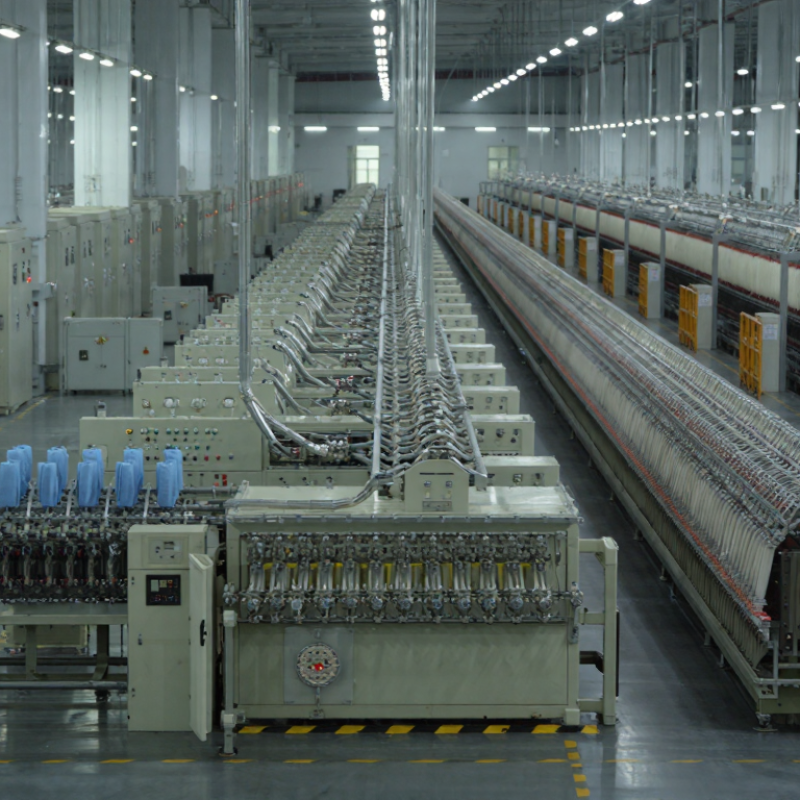
Top POY Spinning Line Manufacturers for Global Buyers

POY Spinning Lines: Definition, Process, and Core Functions

POY spinning lines manufacture partially oriented yarn, usually from polyester chips. The yarn is not fully drawn, so it retains controlled stretch for later texturing or fabric production. A complete line includes chip drying, extrusion, melt filtration, spinning, cooling, and winding. Each section affects yarn uniformity.

The process begins when dried chips enter an extruder. Heat turns them into a stable polymer melt. A metering pump sends the melt through a spinneret with many fine holes. Air cools the fresh filaments below the spinning beam. Godets then control speed and tension. Finally, a precision winder forms packages for transport or downstream processing.

Core functions include accurate temperature control, continuous pressure monitoring, stable quenching, and tension management. Automatic alarms can detect broken filaments, diameter changes, or winding defects. For global buyers, experienced manufacturers should provide output data, energy estimates, maintenance access, and operator training. These details matter on the factory floor. A line may look advanced, yet poor filtration can create frequent breaks. That is an easy mistake to overlook. I would also question promised capacity without testing conditions, because polymer quality, ambient humidity, and operator skill influence results. No specification replaces a practical trial.

POY Spinning Lines: Definition, Process, and Core Functions

Typical PET POY operating temperatures across key production stages

A POY spinning line converts dried PET chips into partially oriented yarn through polymer melting, filtration, extrusion, quenching, and high-speed winding. The values shown are representative engineering references; actual settings vary by polymer grade, denier, equipment design, and production conditions.

Key Equipment Used in Modern POY Spinning Systems

A modern POY spinning line begins with stable polymer preparation.

Chips are dried in controlled air to reduce moisture before melting. The extruder then delivers a uniform polymer melt through a heated pipe system. Temperature sensors must remain accurate. Small details matter.

Metering pumps regulate melt flow to each spinning position. Their precision directly affects filament denier and cross-sectional consistency.

The spinneret shapes the melt into fine filaments. Below it, a quench chamber cools the filaments with carefully balanced air.

Uneven airflow can create luster changes, weak spots, or irregular dye uptake.

Godet rollers control filament speed and tension during drawing and orientation. Their surfaces need clean contact and stable rotation. An interlace unit adds moderate filament cohesion, helping packages unwind during later processing. The winding machine then forms compact POY packages at high speed. Automatic doffing reduces handling damage, but it cannot correct poor tension settings.

A reliable control system links temperature, pressure, speed, and alarm data.

Operators should review trends, not only react to alarms. In production checks, package hardness often reveals problems before laboratory results do.

The equipment layout may look efficient on paper, yet maintenance access is sometimes underestimated. That is a costly imperfection.

Good lines leave space for cleaning, filter changes, and safe inspection. This practical detail supports consistent output and more dependable operation for global buyers.

How to Evaluate Global POY Spinning Line Manufacturers

When evaluating global POY spinning line manufacturers, start with verified production evidence, not glossy brochures. Textile Exchange’s Materials Market Report 2024 estimates global fiber output reached 124 million tonnes in 2023. Polyester represented about 57% of that volume. This scale makes stable POY performance commercially important.

Ask manufacturers for factory references using similar polymer grades, denier ranges, and annual output. Request measured data for spinning speed, energy use per kilogram, first-pass yield, and winding package quality. A line may promise 98% uptime, but maintenance logs reveal more than a sales presentation. Check whether the supplier can control polymer temperature within a narrow range. Small variations can create uneven denier, frequent filament breaks, and rejected packages.

Look closely at engineering support. Can technicians reach the site quickly? Are critical heaters, pumps, sensors, and control modules locally available? A lower purchase price may hide expensive downtime. It happens. Require acceptance testing with your own raw material and target products. Independent testing of tensile strength, elongation, shrinkage, and oil content improves reliability. Energy performance also deserves scrutiny; ask for operating measurements rather than theoretical ratings. The International Energy Agency repeatedly identifies industrial efficiency as a major route to lower energy demand, yet actual savings depend on disciplined operation. One weakness remains easy to miss: software training. Operators need practical fault diagnosis, not only manuals. Evaluate documentation, cybersecurity controls, worker safety features, and compliance records before comparing final offers.

Top POY Spinning Line Manufacturers for Global Buyers - How to Evaluate Global POY Spinning Line Manufacturers

Global POY Spinning Line Manufacturer Evaluation Matrix
Evaluation Dimension Suggested Weight Typical Industry Benchmark What Global Buyers Should Verify Recommended Rating Standard
Product Range 10% POY production commonly covers fine, medium, and coarse denier products, depending on spinneret and winding configuration. Confirm supported polymer grades, total denier range, filament count, luster options, intermingling requirements, and the ability to produce semi-dull or bright yarn. 5 = Meets all target specifications; 3 = Requires configuration changes; 1 = Limited product compatibility.
Production Speed 12% Commercial POY lines generally operate at several thousand meters per minute, with actual speed depending on yarn type, polymer, and process stability. Request guaranteed operating speed for each target product rather than relying only on the maximum mechanical speed. 5 = Guaranteed speed meets the business plan with operating margin; 3 = Meets the minimum target; 1 = Speed is mainly theoretical.
Output and Line Configuration 12% Output depends on the number of spinning positions, filaments per position, denier, throughput, and winding package size. Compare positions per machine, production capacity per day, package weight, layout requirements, and expansion provisions. 5 = Capacity matches forecast demand and future expansion; 3 = Suitable for current demand only; 1 = Capacity is unclear.
Yarn Quality Consistency 15% Key quality indicators include denier variation, tensile strength, elongation, shrinkage, intermingling, oil content, and package build. Ask for laboratory reports, production samples, control limits, inspection procedures, and quality records from comparable installations. 5 = Stable results within agreed specifications; 3 = Acceptable average quality with variation; 1 = Insufficient quality evidence.
Energy Efficiency 10% Energy consumption is affected by polymer melt preparation, extrusion, spinning, cooling, drives, air systems, and winding. Require a utility-consumption estimate based on the buyer's polymer, product mix, operating hours, and local utility conditions. 5 = Measured or contractually documented consumption; 3 = Engineering estimate; 1 = No comparable data.
Automation and Process Control 10% Modern lines may include PLC or DCS control, recipe management, alarm recording, temperature monitoring, tension control, and production data logging. Check data export functions, remote diagnostics, cybersecurity practices, language options, operator access levels, and integration with factory systems. 5 = Fully integrated and traceable; 3 = Partial automation; 1 = Primarily manual operation.
Reliability and Availability 12% Line availability is influenced by component quality, preventive maintenance, spare-parts planning, process stability, and response time. Request reference-site operating records, planned maintenance intervals, critical-component lists, warranty terms, and escalation procedures. 5 = Proven stable operation with documented uptime; 3 = Limited operating history; 1 = No verifiable references.
Installation and Commissioning 8% A complete project normally includes equipment supply, layout support, installation guidance, commissioning, trial production, and operator training. Confirm the scope split between supplier and buyer, site requirements, commissioning schedule, acceptance testing, and training hours. 5 = Clearly defined turnkey responsibility; 3 = Multiple buyer-managed interfaces; 1 = Major scope gaps.
After-Sales Service 8% Effective support normally includes technical documentation, troubleshooting, spare parts, remote assistance, and field-service availability. Evaluate response-time commitments, local service coverage, spare-parts lead times, service languages, and support availability across time zones. 5 = Contractual global support; 3 = Remote support with limited field service; 1 = Informal support only.
Total Cost of Ownership 8% Total cost includes purchase price, freight, duties, installation, utilities, labor, consumables, maintenance, spare parts, and downtime. Use a five- to ten-year model covering capital expenditure, operating expenditure, expected output, energy use, maintenance, and residual value. 5 = Transparent and competitive lifecycle cost; 3 = Acceptable initial price with incomplete lifecycle data; 1 = Lowest price without cost evidence.
Compliance and Export Readiness 5% International projects may require electrical, safety, pressure-system, environmental, customs, and documentation compliance. Verify conformity documents, packing standards, export experience, technical drawings, manuals, certificates, and destination-country requirements. 5 = Complete destination-ready documentation; 3 = Documents require adaptation; 1 = Significant compliance uncertainty.
Total Evaluation Weight 100% Use a weighted score from 1 to 5 for each dimension and request documentary evidence before final supplier selection.

Note: Benchmark ranges and evaluation factors vary according to polymer grade, yarn specification, production scale, local utilities, and project scope. Final guarantees should be confirmed in the technical offer, acceptance-test protocol, and supply contract.

Regional Supplier Strengths and Export Capabilities

Regional strength matters when selecting a POY spinning line manufacturer. Textile Exchange’s Materials Market Report 2024 estimates polyester represented about 57% of global fiber production in 2023. This concentration supports strong supplier ecosystems across East Asia, where component access, engineering labor, and commissioning experience are widely available. Suppliers in this region often provide high-throughput systems, automated winding, and rapid spare-part coordination. Factory visits reveal practical differences.

European suppliers generally compete through process control, energy optimization, and detailed documentation. Their equipment may suit buyers requiring stable denier control, lower waste, and strict validation procedures. The ITMF Global Textile Industry Survey 2024 also shows that investment confidence differs sharply by region. Therefore, buyers should assess local service capacity, not only machine specifications. A low quotation can become expensive.

Export capability requires more than shipping a complete line. UN Comtrade trade data shows that textile machinery flows remain concentrated among major manufacturing and engineering economies. Experienced exporters usually offer installation supervision, operator training, multilingual manuals, and remote diagnostics. They also understand container planning and customs classification. However, service promises can remain vague. Buyers should request commissioning timelines, spare-part lists, acceptance-test criteria, and references from comparable plants. Regional proximity helps, but proven execution matters more.

Purchasing, Installation, and After-Sales Considerations

Top POY Spinning Line Manufacturers for Global Buyers

Purchasing a POY spinning line requires more than comparing machine prices. Buyers should review output capacity, polymer compatibility, energy consumption, and spare-parts availability. Ask manufacturers for verified production data from similar facilities. A factory visit can reveal practical details, including yarn breakage rates, maintenance space, and operator safety procedures. Technical drawings should match local power standards and building conditions. Small mismatches can cause expensive delays.

Installation quality strongly affects long-term performance. Experienced suppliers usually provide foundation drawings, commissioning support, training, and operating manuals. Confirm who handles alignment, temperature calibration, and trial production.

During installation, record each test result and keep photographs of cable connections. These records help resolve disputes later. Still, planning is never perfect. Unexpected humidity, transport damage, or limited technician experience may affect the schedule.

Tips:

Request a complete delivery list before signing. Clarify response times for remote support and on-site service. Check whether critical heaters, sensors, filters, and control components can be replaced locally. A written warranty should define coverage, exclusions, and labor costs. Ask for preventive-maintenance schedules with actual intervals, not vague promises. Operators also need practical training on spinneret cleaning, winding tension, and alarm handling. A low purchase price may look attractive, but weak after-sales support can stop production for several days. Reliability is measured during those difficult hours.

Copyright 2025 Fluidra S.A. | Created by BCM Marketing Agencia Privacy Policy Legal note | Cookie policy |

Technical cookies are strictly necessary for our website to work and you can navigate through it. These types of cookies are those that, for example, allow us to identify you, give you access to certain restricted parts of the page if necessary, or remember different options or services already selected by you, such as your privacy preferences. Therefore, they are activated by default, your authorization not being necessary in this regard. Through the configuration of your browser, you can block or alert the presence of this type of cookies, although such blocking will affect the proper functioning of the different functionalities of our website.


The analysis cookies allow us to study the navigation of the users of our website in general (for example, which sections of the page are the most visited, which services are used most and if they work correctly, etc.). From the statistical information on navigation on our website, we can improve both the operation of the page itself and the different services it offers. Therefore, these cookies do not have an advertising purpose, but only serve to make our website work better, adapting to our users in general. By activating them you will contribute to this continuous improvement. You can enable or disable these cookies by checking the corresponding box, being disabled by default.


Functionality cookies allow us to remember your preferences, to personalize certain characteristics and general options of our website, every time you access it (for example, the language in which the information is presented to you, the sections marked as favorites, your browser type, etc.) Therefore, this type of cookies does not have an advertising purpose, but by activating them you will improve the functionality of the website (for example, adapting to your type of browser) and the customization of it based on your preferences (for example, by presenting the information in the language that you have chosen in previous occasions), which will contribute to the ease, usability and comfort of our page during your navigation. You can enable or disable these cookies by checking the corresponding box, being disabled by default.


Advertising cookies allow us to manage the advertising spaces included in our website based on criteria such as the content shown or the frequency in which the ads are displayed. For example, if you have been shown the same ad several times on our website, and you have not shown a personal interest by clicking on it, it will not appear again. In summary, by activating this type of cookies, the advertising shown on our website will be more useful and diverse, and less repetitive. You can enable or disable these cookies by checking the corresponding box, being disabled by default.


Behavioral advertising cookies allow us to obtain information based on the observation of your browsing habits and behaviors on the web, in order to show you advertising content that best suits your personal tastes and interests. To understand it in a very simple way, we will give you a fictitious example: if your last searches on the web were related to suspense literature, we would show you advertising about suspense books. Therefore, activating this type of cookies, the advertising that we show you on our website will not be generic, but will be oriented to your searches, tastes and interests, therefore adjusting exclusively to you. You can enable or disable these cookies by checking the corresponding box, being disabled by default.
To understand it in a very simple way, we will give you a fictitious example: if your last searches on the web were related to suspense literature, we would show you advertising about suspense books. Therefore, activating this type of cookies, the advertising that we show you on our website will not be generic, but will be oriented to your searches, tastes and interests, therefore adjusting exclusively to you. You can enable or disable these cookies by checking the corresponding box, being disabled by default.

SAVE

We use our own and third-party cookies to ensure the proper functioning of the website and to analyse our services, improve your experience on our website and show you advertisements related to your interests according to profiling based on your browsing habits (e.g. websites visited). You can accept all cookies by clicking "ACCEPT" or set or reject them by clicking here. If you would like to know more about the use of cookies, please see our COOKIE POLICY.


ACCEPT ALL
Reject no essentials


