
2026 Top Mining Dredge Types Which Is Best?
FLUID HANDLING EXPERTS

Blog, all our news

2026 Top Mining Dredge Types Which Is Best?

Choosing the right Mining Dredge starts with the deposit, not the machine’s headline capacity. A cutter suction dredge can loosen compacted material, while a plain suction dredge may suit softer, uniform deposits. Bucket-ladder designs can handle demanding excavation, but they bring more moving parts to inspect. Each option has trade-offs. None is best everywhere.

This guide compares common dredge types by material, water depth, access, production needs, and maintenance demands. A narrow pond with fine sand presents a different challenge from a broad river channel with gravel. Hose length matters. So does the distance to the discharge point. Even a powerful pump can underperform when the layout is wrong. Check manufacturer specifications against site measurements and operating records, rather than relying on a single capacity figure. Field conditions can change that number.

The comparison also considers crew requirements, fuel use, wear components, and the practical effort of moving equipment between sites. Small details count. A worn suction line or frequent cutter-head blockage can erase expected gains. No table can replace a site assessment, and available information may leave uncertainty. That is worth admitting. The strongest choice is usually the dredge that matches the deposit and can be operated and maintained reliably, not simply the largest one.
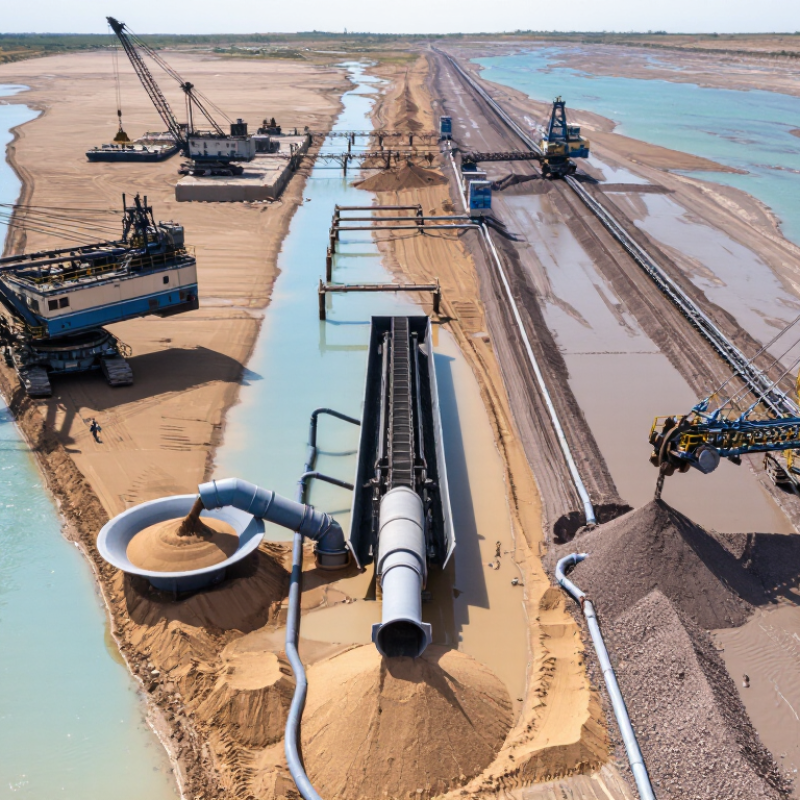
2026 Top Mining Dredge Types Which Is Best?

Define Mining Dredge Types by Excavation Method and Material-Handling System

Mining dredge types are best defined by two linked choices: how the deposit is excavated and how the material moves. A bucket-ladder dredge cuts and lifts dense or layered deposits mechanically. A cutter-suction dredge loosens material with a rotating head, then pumps it as slurry through a pipeline. For loose sand, a suction dredge may collect material directly; a hopper system can carry it away onboard. The distinction matters.

Mechanical excavation A bucket-ladder dredge cuts and lifts dense or layered deposits mechanically.

Hydraulic handling A cutter-suction dredge loosens material with a rotating head, then pumps it as slurry through a pipeline.

The U.S. Geological Survey’s Mineral Commodity Summaries 2025 estimates U.S. construction sand and gravel production at about

960 million tons in 2024.

That scale makes throughput, water availability, and discharge distance practical selection factors, not fine print. A pipeline suits steady production near shore, but long runs can increase pumping demands. Hopper handling adds mobility, though vessel capacity and unloading access may constrain output.

For abrasive, coarse feed, bucket systems can offer controlled excavation; for fine, pumpable deposits, hydraulic handling may move more material continuously.

No type wins everywhere.

I would test grain size, clay content, and slurry behavior before choosing; a neat classification still hides site-specific surprises. These distinctions align with USACE dredging guidance, while the USGS figure describes the market context, not dredge performance.

Compare Cutter Suction, Bucket Ladder, and Plain Suction Dredges

2026 Top Mining Dredge Types: Which Is Best?
Compare Cutter Suction, Bucket Ladder, and Plain Suction Dredges

A cutter suction dredge uses a rotating cutter to loosen compacted sediment before pumping it through a discharge line. It can suit mixed deposits and sustained production, but the cutter and pump need regular inspection. A bucket ladder dredge lifts material mechanically in a continuous chain of buckets. It can handle coarse gravel and firmer deposits, though its moving parts face wear and its platform needs stable operating conditions. Plain suction dredges rely on water flow and suction, making them a practical choice for loose sand or silt. They are less effective when material is compacted or contains large stones. No type wins every site.

Tips: Check sediment samples, water depth, target output, and discharge distance before choosing. A short pump test can reveal whether loose material flows steadily or clogs the line. Compare maintenance access, too. It is easy to underestimate downtime, and early production estimates may be imperfect.

For example, a shallow site with loose sand may favor plain suction, while a compacted layer may require cutter action. Bucket ladders can make sense where coarse material must be lifted directly, but their slower handling may affect output. Match the dredge to the deposit, not just the headline capacity. A site survey and trial run help validate the plan.

2026 Top Mining Dredge Types: Which Is Best? Compare Cutter Suction, Bucket Ladder, and Plain Suction Dredges

Comparison factor Cutter Suction Dredge Bucket Ladder Dredge Plain Suction Dredge
How it excavates A rotating cutter loosens the seabed or riverbed; a centrifugal pump conveys the material as slurry through a pipeline. Moving buckets on a ladder mechanically excavate material and discharge it to a barge, conveyor, or processing system. A suction mouth and pump draw loose material into a pipeline without a rotating cutter.
Best-suited material Sand, gravel, clay, and compacted or partly cemented deposits that need mechanical loosening. A broad range of materials, including gravel, clay, and deposits that benefit from controlled mechanical excavation. Loose, unconsolidated sand, silt, and similar deposits that can flow readily into the suction intake.
Material loosening High: the cutter actively breaks up material before it enters the suction system. High: the buckets cut and lift material mechanically. Low: relies mainly on natural looseness, water flow, or other site conditions.
Typical mining use Continuous excavation of submerged deposits, with slurry pumped to shore, a plant, or a disposal area. Precise, mechanical recovery of deposits, often where controlled excavation or handling of coarser material is important. Recovery of loose deposits where a simple suction-and-pipeline system is suitable.
Material transport Hydraulic transport as slurry through a pipeline; the route and pumping arrangement affect achievable distance and output. Mechanical lifting and transfer; material is commonly handled in a relatively concentrated form before processing. Hydraulic transport as slurry through a pipeline; performance depends on material, pump arrangement, and pipeline conditions.
Excavation control Can excavate in controlled passes, but cutter operation and pipeline flow need to be coordinated. Offers direct mechanical excavation and can support controlled removal of defined areas or layers. Works well on loose, reasonably uniform deposits; excavation can be less effective where material is cohesive or unevenly compacted.
Main strengths Versatile hydraulic production; cutter action helps handle deposits that plain suction cannot readily mobilize. Mechanical excavation; effective handling of a wide range of deposit conditions without relying solely on slurry formation. Simple excavation concept and a direct pipeline route for loose, pumpable material.
Main limitations Requires cutter and pump maintenance; pipeline setup, slurry management, and sediment control can be significant considerations. Moving mechanical components require maintenance; operating and material-transfer arrangements can be more complex than a simple suction system. Limited ability to break up compacted or cohesive deposits; unsuitable material can cause poor intake or unstable pipeline flow.
Choose it when… The deposit needs active loosening and hydraulic transport to a processing or placement point. Mechanical excavation and controlled handling are priorities, or deposit conditions vary across the work area. The deposit is loose and readily pumpable, and a straightforward suction pipeline arrangement meets the project needs.

Selection note: The best dredge depends on deposit strength and particle size, water depth, required excavation control, transport distance, processing method, and environmental constraints. Output and suitability should be confirmed through site investigation and equipment-specific design.

Assess Rated Flow (m³/h), Pump Head (m), and Slurry Solids (%)

2026 Top Mining Dredge Types: Which Is Best?

Choosing a mining dredge starts with the material and the site, not a headline capacity. A cutter suction dredge can loosen compacted deposits, while a bucket-ladder dredge suits controlled excavation in some conditions. Each type still needs to match the required slurry flow, lift, and solids concentration. Numbers need context.

Rated flow in m³/h is usually a reference point, not a promise of field output. A long discharge line, bends, and changing sediment can reduce delivered flow. Pump head in meters should cover vertical lift and pipeline resistance; a pump that falls short may struggle to move slurry steadily. Check whether solids percentage means volume or mass. They are not interchangeable. Ask for performance data at your expected head and solids level, rather than comparing maximum ratings alone.

Tips: Confirm pipe diameter, route length, and elevation before selecting equipment. Measure the deposit’s grain size and estimate solids concentration with a consistent method. Leave room for operating variation; field estimates are rarely perfect. I would also verify how the supplier defines rated conditions, because that detail is easy to overlook. Not on paper.

Match Dredge Type to Deposit Grain Size, Water Depth, and Site Conditions

2026 Top Mining Dredge Types: Which Is Best?

The best dredge depends on what lies beneath the water, not just the project label. Begin with a representative sediment sample and note its grain sizes, layering, and debris. Loose sand and silt often suit a suction dredge, which can move material efficiently when the deposit needs little loosening. A cutter suction dredge adds a rotating head for compacted or mixed layers. Bucket-ladder dredges can handle coarse gravel and some harder deposits, but their mechanical setup needs room to operate. Small samples can mislead. A few buried cobbles may change the choice.

Depth matters, too. Check the dredge’s working-depth range, pump capacity, and pipeline distance; a deep cut can increase lift and reduce production. At shallow sites, limited draft or uneven bottoms may constrain access. Strong currents, waves, floating debris, and a narrow work area also affect stability and output. Field crews should compare expected production with the time needed to reposition, clear blockages, and manage discharge. Those details are easy to underestimate. Grain size can vary across a short reach, so one machine may not perform consistently throughout the site. Recheck the plan after trial excavation, even when the first sample looks convincing.

Select the Best 2026 Option by Recovery Rate, Operating Cost, and Mobility

2026 Top Mining Dredge Types: Which Is Best?

Select by recovery rate, operating cost, and mobility—not by nameplate capacity alone. A suction dredge can move quickly in loose, shallow deposits, but coarse gravel, roots, and changing water levels can reduce effective recovery. A cutter-suction dredge handles compact material better, though its anchors, pipeline, and power supply limit rapid relocation. Bucket dredges offer steady feeding in suitable deposits, but their larger crews and maintenance needs can raise operating costs. The USACE Dredging Operations Technical Support guidance identifies material, transport distance, and downtime as key production variables. That matters more than a brochure’s peak rate. The USGS Mineral Commodity Summaries 2025 estimates 2024 world gold mine output at 3,300 metric tons; this is market context, not a dredge-recovery benchmark.

Compare recovery using measured feed and concentrate samples across representative shifts. Track fuel per recovered tonne, labor hours, unscheduled stops, and time needed to move between cuts. A small unit may win when deposits are scattered; a high-capacity system may perform better in a continuous, well-characterized deposit. These estimates are imperfect. Field conditions change fast.

Tips: Ask operators for recovery and fuel records from comparable sediment, not just rated capacity. Test a short production run before committing. If water depth, grain size, or access is uncertain, budget for slower output and one extra relocation day.

Copyright 2025 Fluidra S.A. | Created by BCM Marketing Agencia Privacy Policy Legal note | Cookie policy |

Technical cookies are strictly necessary for our website to work and you can navigate through it. These types of cookies are those that, for example, allow us to identify you, give you access to certain restricted parts of the page if necessary, or remember different options or services already selected by you, such as your privacy preferences. Therefore, they are activated by default, your authorization not being necessary in this regard. Through the configuration of your browser, you can block or alert the presence of this type of cookies, although such blocking will affect the proper functioning of the different functionalities of our website.


The analysis cookies allow us to study the navigation of the users of our website in general (for example, which sections of the page are the most visited, which services are used most and if they work correctly, etc.). From the statistical information on navigation on our website, we can improve both the operation of the page itself and the different services it offers. Therefore, these cookies do not have an advertising purpose, but only serve to make our website work better, adapting to our users in general. By activating them you will contribute to this continuous improvement. You can enable or disable these cookies by checking the corresponding box, being disabled by default.


Functionality cookies allow us to remember your preferences, to personalize certain characteristics and general options of our website, every time you access it (for example, the language in which the information is presented to you, the sections marked as favorites, your browser type, etc.) Therefore, this type of cookies does not have an advertising purpose, but by activating them you will improve the functionality of the website (for example, adapting to your type of browser) and the customization of it based on your preferences (for example, by presenting the information in the language that you have chosen in previous occasions), which will contribute to the ease, usability and comfort of our page during your navigation. You can enable or disable these cookies by checking the corresponding box, being disabled by default.


Advertising cookies allow us to manage the advertising spaces included in our website based on criteria such as the content shown or the frequency in which the ads are displayed. For example, if you have been shown the same ad several times on our website, and you have not shown a personal interest by clicking on it, it will not appear again. In summary, by activating this type of cookies, the advertising shown on our website will be more useful and diverse, and less repetitive. You can enable or disable these cookies by checking the corresponding box, being disabled by default.


Behavioral advertising cookies allow us to obtain information based on the observation of your browsing habits and behaviors on the web, in order to show you advertising content that best suits your personal tastes and interests. To understand it in a very simple way, we will give you a fictitious example: if your last searches on the web were related to suspense literature, we would show you advertising about suspense books. Therefore, activating this type of cookies, the advertising that we show you on our website will not be generic, but will be oriented to your searches, tastes and interests, therefore adjusting exclusively to you. You can enable or disable these cookies by checking the corresponding box, being disabled by default.
To understand it in a very simple way, we will give you a fictitious example: if your last searches on the web were related to suspense literature, we would show you advertising about suspense books. Therefore, activating this type of cookies, the advertising that we show you on our website will not be generic, but will be oriented to your searches, tastes and interests, therefore adjusting exclusively to you. You can enable or disable these cookies by checking the corresponding box, being disabled by default.

SAVE

We use our own and third-party cookies to ensure the proper functioning of the website and to analyse our services, improve your experience on our website and show you advertisements related to your interests according to profiling based on your browsing habits (e.g. websites visited). You can accept all cookies by clicking "ACCEPT" or set or reject them by clicking here. If you would like to know more about the use of cookies, please see our COOKIE POLICY.


ACCEPT ALL
Reject no essentials


