
Top Industrial Power Supply Manufacturers Worldwide
FLUID HANDLING EXPERTS

Blog, all our news

Top Industrial Power Supply Manufacturers Worldwide

Industrial Power Supply manufacturers sit behind the machines that keep factories, data centers, and process lines running. Their products convert and regulate power, often inside hot cabinets, beside vibrating motors, and under continuous load. Small design differences matter. A stable output can protect control systems; poor thermal design may shorten service life.

The International Energy Agency’s Electricity 2024 report projects global electricity demand will grow by an average of 3.4% annually through 2026. That broader trend raises the stakes for efficient, dependable power conversion. IEA Executive Director Fatih Birol has described the wider shift as the “Age of Electricity.” It is a useful lens, though not a direct forecast for industrial power supply sales. Market boundaries differ, too. Some reports group industrial units with broader power-conversion products, so headline market figures need careful reading.

This guide compares leading manufacturers through practical criteria: output range, efficiency, protection features, certifications, customization, and regional service. A datasheet can look convincing. The harder test is performance after years of heat, dust, and load changes. No ranking can replace application-specific engineering review. That caveat matters. Readers should verify current specifications and support terms before selecting a supplier, especially for critical equipment. The strongest manufacturers combine proven product design with clear documentation and responsive technical support. Still, even reputable brands can be a poor fit when voltage, mounting, or environmental requirements are overlooked.
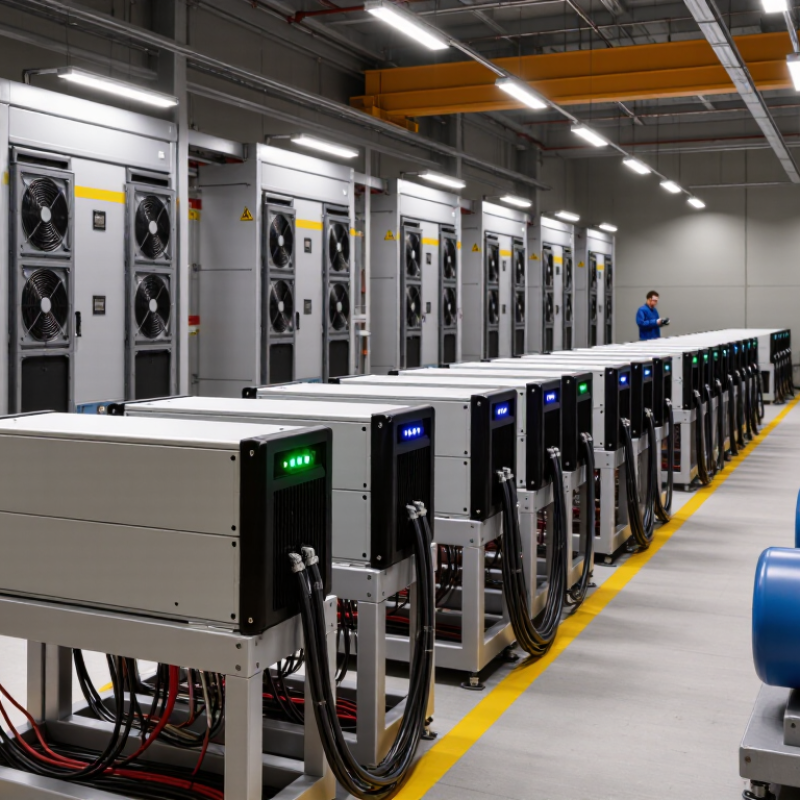
Top Industrial Power Supply Manufacturers Worldwide

Industrial Power Supplies: AC–DC Conversion and the Common 24 VDC Output

Industrial power supplies convert incoming AC into regulated DC for control panels, sensors, relays, and other equipment. Inside the unit, rectification and switching circuits transform the input, while regulation keeps the output within specified limits. A 24 VDC output is common because it suits many industrial control devices and simplifies wiring across a panel. It is not universal.

A label marked 24 V does not tell the whole story. Engineers also check available current, ripple, overload behavior, and the permitted input range. For example, a supply feeding a controller and several valves must handle their combined demand, including brief startup surges. Leave practical headroom. Then check the equipment manuals and the supply’s datasheet; ratings can vary with temperature and installation conditions. Hot enclosures matter.

Mounting and wiring affect real-world performance, too. Keep ventilation openings clear, secure conductors in the terminals, and separate power wiring from sensitive signal cables where practical. Measure the output under load, not only with disconnected equipment. A meter reading can look fine at idle. One detail is easy to miss: long cable runs can cause voltage drop at the device. I would recheck that at the far end, especially when loads switch on. Manufacturers publish specifications, but the panel’s actual heat, wiring, and load pattern still deserve attention.

Top Industrial Power Supply Manufacturers Worldwide - Industrial Power Supplies: AC–DC Conversion and the Common 24 VDC Output

Comparison Dimension Typical Industrial Power Supply Information Practical Significance
Conversion function Converts alternating-current (AC) input into regulated direct-current (DC) output. Provides a DC supply for control equipment and other loads in industrial systems.
Common DC output 24 VDC is widely used in industrial control systems. Commonly supplies devices such as sensors, relays, controllers, and other 24 V equipment; compatibility must be checked for each load.
AC input voltage Many models are designed for nominal 100–240 VAC input. Some specify an operating range such as 85–264 VAC. Input limits and permitted frequency vary by model. Confirm the product rating against the site’s supply voltage.
Input frequency 50/60 Hz is a common mains-frequency specification. Check the nameplate or datasheet, especially for installations with non-standard power sources.
60 W output class At 24 VDC: 2.5 A maximum nominal output current (60 W ÷ 24 V). Suitable only when the connected load’s continuous and peak demand fit within the supply’s ratings.
120 W output class At 24 VDC: 5 A maximum nominal output current (120 W ÷ 24 V). Allow for load variation, startup current, and any required engineering margin.
240 W output class At 24 VDC: 10 A maximum nominal output current (240 W ÷ 24 V). Check wiring, terminal ratings, ambient temperature, and mounting conditions at the intended current.
480 W output class At 24 VDC: 20 A maximum nominal output current (480 W ÷ 24 V). Higher-current installations may need careful conductor sizing and distribution planning.
Output-current calculation Current (A) = output power (W) ÷ output voltage (V). For a 24 V output, a 240 W supply has a nominal rated current of 10 A.
Common protection features Overload, overvoltage, and short-circuit protection are commonly offered, but features and behavior differ by model. Review the datasheet to confirm protection thresholds, recovery behavior, and any required system-level protection.
Efficiency and heat Efficiency is model- and load-dependent; the manufacturer’s datasheet gives the rated values and test conditions. Efficiency affects input power, heat dissipation, and enclosure thermal design.
Installation and environment DIN-rail and panel-mount formats are common. Permitted ambient temperature and derating vary by product. Verify mounting method, ventilation, temperature limits, and derating before installation.

Note: Output-current figures above are calculated from the stated power and 24 V output. Input ranges, protections, efficiency, and environmental ratings are product-specific; consult the relevant datasheet before selection or installation.

Worldwide Manufacturers: Mean Well, Siemens, TDK-Lambda, and PULS

Industrial power supply manufacturers serve different needs, even when their products share familiar voltage ratings. Some focus on compact, cost-conscious units for control panels; others offer broad portfolios, rugged construction, or configurable systems. Compare the actual operating range, not just the headline specifications.

A useful review starts with load behavior. Check startup current, peak demand, ripple tolerance, and expected ambient temperature. Then inspect derating curves, short-circuit response, and protection features. In a cabinet, a few degrees of extra heat can matter. So can a loose terminal. Bench tests help, but evaluate the supply alongside the equipment it will run. The difference is real.

Worldwide suppliers vary in regional support, documentation quality, lead times, and product longevity. Ask for lifecycle notices and application guidance, especially when equipment must operate for years. Review independent test records and relevant safety approvals for the intended market. A polished datasheet is useful, but it cannot predict every installation. I still leave room for uncertainty: wiring habits and ventilation are often less controlled than design plans suggest.

Product Types: DIN-Rail, Enclosed, Open-Frame, and Modular Supplies

Industrial power supplies should be chosen for their installation conditions, not wattage alone. DIN-rail units clip onto control-cabinet rails and suit PLCs, sensors, and compact machine controls. Enclosed supplies protect internal components, but their ventilation and ingress ratings still matter. Open-frame designs fit tightly inside larger equipment; exposed circuitry needs guarded mounting. Modular supplies allow engineers to add or replace output modules as loads change. Flexibility helps. Yet it can complicate sizing.

The International Federation of Robotics’ World Robotics 2024 report recorded 4,281,585 industrial robots operating worldwide in 2023, a 10% increase from 2022. This expanding automation footprint highlights the need for dependable power in production systems, though it does not predict demand for any specific supply type. Compare output voltage, peak load, operating temperature, and expected service access. A supply that fits today’s cabinet may become awkward after a control upgrade.

Tips: Check the heat. Measure cabinet clearance and airflow at full load, then verify derating against the manufacturer’s datasheet. For open-frame units, plan touch protection and mounting space before assembly. For modular systems, confirm that replacement modules match the required output and load profile. Don’t size by watts alone.

Key Ratings: Output Voltage, Rated Power, Efficiency, and Thermal Derating

Top Industrial Power Supply Manufacturers Worldwide

Industrial power supplies should be compared by more than their headline wattage. Output voltage must match the load, while acceptable tolerance and ripple depend on the equipment being powered. Rated power describes the unit’s specified capacity under stated conditions, not necessarily its capacity inside a hot, crowded enclosure. Efficiency matters too: at 90 percent efficiency, a 240-watt output requires more input power, and the difference becomes heat. Small details add up.

For a 24-volt load drawing 8 amps, the required output is 192 watts. A 240-watt supply appears to provide a useful margin, but ambient temperature, installation orientation, and airflow can reduce its available power. Check the manufacturer’s thermal derating curve at the expected cabinet temperature. Heat changes the answer. A tidy specification table cannot replace a realistic assessment of wiring, ventilation, and peak demand; those conditions are easy to underestimate.

Tips: Compare voltage tolerance, rated power, efficiency at your typical load, and derating data side by side. Check whether the stated rating assumes free airflow or a specific mounting position. Leave practical headroom for startup surges and temperature changes, then verify the choice under representative operating conditions. One uncomfortable question remains: will the cabinet still run cool after years of dust and routine maintenance?

EMC Compliance: IEC 61000-3-2 Applies to Equipment up to 16 A per Phase

For industrial power supply manufacturers, IEC 61000-3-2 sets a clear EMC boundary: it covers equipment drawing up to and including 16 A per phase from public low-voltage systems. The IEC 61000-3-2:2018 edition and its amendments define harmonic-current limits by equipment class. This matters because a compact DIN-rail supply and a larger cabinet unit may face different test conditions, even when their power ratings appear similar. The 16 A figure is a scope threshold, not a compliance result.

Harmonic testing measures current components at multiples of the supply frequency. A distorted waveform can affect nearby equipment and complicate system-level performance. Designers should check the correct equipment class, input voltage, and operating mode before testing. A common trap is treating a passing result at one load as proof for every configuration. It is not. Records should link the tested sample to its circuit design and production controls.

Tips: Verify the phase-current rating and intended connection type early. Test realistic load conditions, including low-load operation. Keep the test report and configuration details together; small changes to input filtering can alter harmonic results.

Copyright 2025 Fluidra S.A. | Created by BCM Marketing Agencia Privacy Policy Legal note | Cookie policy |

Technical cookies are strictly necessary for our website to work and you can navigate through it. These types of cookies are those that, for example, allow us to identify you, give you access to certain restricted parts of the page if necessary, or remember different options or services already selected by you, such as your privacy preferences. Therefore, they are activated by default, your authorization not being necessary in this regard. Through the configuration of your browser, you can block or alert the presence of this type of cookies, although such blocking will affect the proper functioning of the different functionalities of our website.


The analysis cookies allow us to study the navigation of the users of our website in general (for example, which sections of the page are the most visited, which services are used most and if they work correctly, etc.). From the statistical information on navigation on our website, we can improve both the operation of the page itself and the different services it offers. Therefore, these cookies do not have an advertising purpose, but only serve to make our website work better, adapting to our users in general. By activating them you will contribute to this continuous improvement. You can enable or disable these cookies by checking the corresponding box, being disabled by default.


Functionality cookies allow us to remember your preferences, to personalize certain characteristics and general options of our website, every time you access it (for example, the language in which the information is presented to you, the sections marked as favorites, your browser type, etc.) Therefore, this type of cookies does not have an advertising purpose, but by activating them you will improve the functionality of the website (for example, adapting to your type of browser) and the customization of it based on your preferences (for example, by presenting the information in the language that you have chosen in previous occasions), which will contribute to the ease, usability and comfort of our page during your navigation. You can enable or disable these cookies by checking the corresponding box, being disabled by default.


Advertising cookies allow us to manage the advertising spaces included in our website based on criteria such as the content shown or the frequency in which the ads are displayed. For example, if you have been shown the same ad several times on our website, and you have not shown a personal interest by clicking on it, it will not appear again. In summary, by activating this type of cookies, the advertising shown on our website will be more useful and diverse, and less repetitive. You can enable or disable these cookies by checking the corresponding box, being disabled by default.


Behavioral advertising cookies allow us to obtain information based on the observation of your browsing habits and behaviors on the web, in order to show you advertising content that best suits your personal tastes and interests. To understand it in a very simple way, we will give you a fictitious example: if your last searches on the web were related to suspense literature, we would show you advertising about suspense books. Therefore, activating this type of cookies, the advertising that we show you on our website will not be generic, but will be oriented to your searches, tastes and interests, therefore adjusting exclusively to you. You can enable or disable these cookies by checking the corresponding box, being disabled by default.
To understand it in a very simple way, we will give you a fictitious example: if your last searches on the web were related to suspense literature, we would show you advertising about suspense books. Therefore, activating this type of cookies, the advertising that we show you on our website will not be generic, but will be oriented to your searches, tastes and interests, therefore adjusting exclusively to you. You can enable or disable these cookies by checking the corresponding box, being disabled by default.

SAVE

We use our own and third-party cookies to ensure the proper functioning of the website and to analyse our services, improve your experience on our website and show you advertisements related to your interests according to profiling based on your browsing habits (e.g. websites visited). You can accept all cookies by clicking "ACCEPT" or set or reject them by clicking here. If you would like to know more about the use of cookies, please see our COOKIE POLICY.


ACCEPT ALL
Reject no essentials


