
5 Best High Mast Lighting Manufacturers for Global Buyers
FLUID HANDLING EXPERTS

Blog, all our news

5 Best High Mast Lighting Manufacturers for Global Buyers

Choosing a high mast lighting manufacturer is not a simple matter of comparing wattage or product prices. Global buyers must examine engineering depth, manufacturing consistency, certification records, and after-sales support. A supplier may offer impressive specifications, yet perform poorly under coastal salt, desert dust, heavy rain, or strong wind loads.

Lighting researcher Mark S. Rea once stated, “Good lighting is not simply more light; it is light placed where it is needed.” This principle matters on highways, ports, airports, sports grounds, and industrial yards. A reliable high mast system should deliver uniform illumination across wide areas without creating excessive glare or wasted energy. Buyers should review photometric files, pole height calculations, LED lifetime data, surge protection, and access mechanisms before signing a contract.

This guide examines five high mast lighting manufacturers serving international markets. The comparison considers product design, optical performance, customization, quality control, delivery capability, and technical assistance. It also considers practical details, including galvanized steel finishes, inspection platforms, lowering systems, and replacement access. These details often decide whether maintenance takes minutes or requires costly equipment.

No manufacturer is perfect for every project. Regional standards, climate conditions, budget limits, and installation skills can change the final choice. That is where this review remains cautious. Some suppliers may excel in engineering but lack local service. Others may provide competitive pricing but limited customization. Careful buyers should verify every claim, request project references, and test assumptions before making a long-term investment.
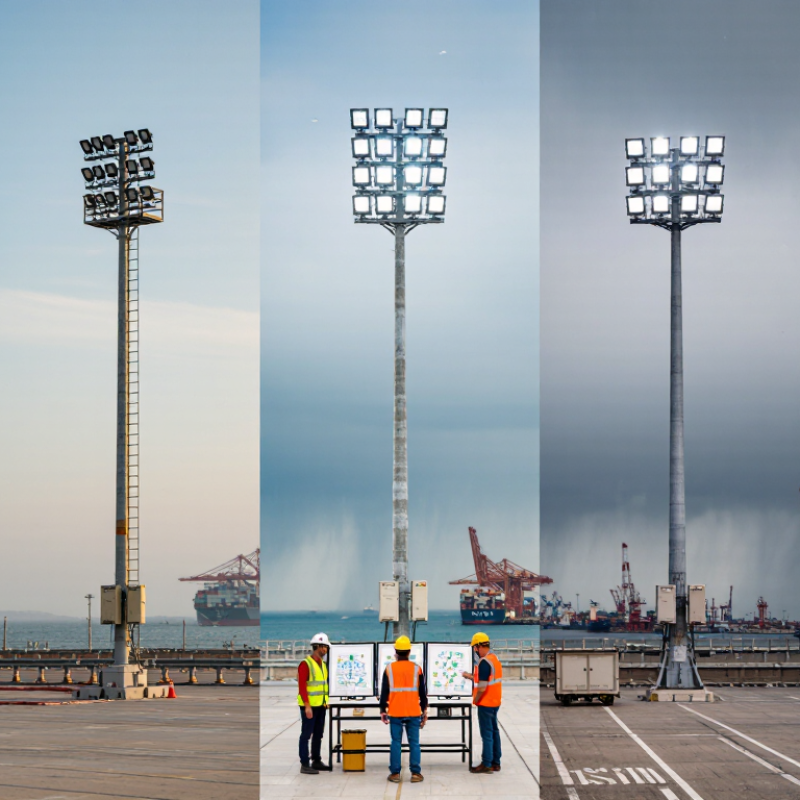
5 Best High Mast Lighting Manufacturers for Global Buyers

What High Mast Lighting Is and Where It Is Used

High mast lighting uses tall poles with powerful luminaires mounted near the top. These systems spread light across large outdoor areas. Typical poles range from 20 to 40 meters, depending on the site and lighting target. Narrow or wide beam optics shape the coverage below. This reduces the number of poles needed across open land.

It is commonly used at ports, airports, container yards, highways, railway terminals, and large industrial sites. A port may need strong light between stacked containers and moving cranes. An airport requires controlled glare near runways and service roads. Highway interchanges benefit from fewer obstacles at ground level. Sports grounds and public squares may also use high mast systems for broad, even illumination.

Good design starts with a photometric study, not a guess based on pole height. Engineers review mounting loads, wind exposure, maintenance access, glare, and emergency lighting needs. LED fixtures can lower energy use, but poor aiming still creates dark zones. That mistake is easy to miss on a computer model. Field testing remains valuable, especially near water, dust, or heavy traffic. In practice, maintenance planning often receives too little attention. Lowering systems, service platforms, and corrosion-resistant hardware can reduce future risk. Local electrical and structural requirements must also guide the final specification.

Key Criteria for Comparing High Mast Lighting Manufacturers

When comparing high mast lighting manufacturers, assess performance beyond advertised lumen output. The U.S. Department of Energy’s 2023 Solid-State Lighting R&D Opportunities report recorded laboratory LED efficacy above 200 lumens per watt. Commercial systems may perform lower. Ask for verified photometric files, delivered lumens, glare control, and maintained performance after depreciation. A reliable manufacturer should provide LM-80 and TM-21 data, thermal test results, and clear warranty conditions. Check whether the warranty covers drivers, controls, and labor.

Tips: Request a simulated layout for your actual pole height, spacing, roadway width, and target illuminance. Compare uniformity, not only brightness. Inspect a sample fixture before ordering. Small details matter, including cable glands, lifting points, surge protection, and access for maintenance. IEC 60598 testing and suitable IP and IK ratings can support safer comparisons, but certificates should be traceable and current.

Energy performance also deserves careful review. The International Energy Agency’s Energy Efficiency 2024 report identifies efficient lighting as a practical route to reducing electricity demand. Ask manufacturers to separate fixture wattage from system wattage, including control losses. Review color temperature, flicker, power factor, and dimming compatibility. A low price can hide frequent driver replacement or difficult servicing. I would not trust a polished brochure alone. Field references, measured installation data, and documented factory quality procedures reveal more. Some comparisons remain imperfect because weather, dust, mounting height, and maintenance habits change real results.

Five Leading High Mast Lighting Manufacturers for Global Buyers

Five Leading High Mast Lighting Manufacturers for Global Buyers

Global buyers usually compare five manufacturer profiles: roadway specialists, sports-lighting engineers, port and airport suppliers, industrial tower producers, and control-system integrators. Each profile serves a different risk. A highway project needs uniformity and glare control. A port requires corrosion resistance. An airport demands precise photometric documentation. The U.S. Department of Energy reports that LED systems can use at least 75% less energy than incandescent lighting, but high-mast buyers should compare LEDs with existing discharge lamps, not unsuitable baselines. Small errors matter.

Look for manufacturers that provide LM-80 and TM-21 lifetime evidence, IEC 60598 compliance, ISO 9001 quality systems, and independent photometric files. IP66 protection is useful in dust and rain, yet sealing alone does not prove long-term reliability. Check thermal testing, surge protection, driver replacement, and spare-part availability. The International Energy Agency estimates lighting uses about 15% of global electricity, making efficiency a practical procurement issue rather than a marketing phrase. Ask for measured data.

Five suppliers may appear equal on paper. They are not. One may offer stronger optics but weaker local service. Another may promise a 100,000-hour life without explaining operating temperature or lumen-maintenance assumptions. That gap deserves scrutiny. Field experience also shows that installation height, wind loading, and maintenance access can change total cost dramatically. A spreadsheet can still lie. Global buyers should request comparable test conditions, realistic warranty exclusions, and a pilot installation before approving a large tower project.

5 Best High Mast Lighting Manufacturers for Global Buyers - Five Leading High Mast Lighting Manufacturers for Global Buyers

Market Position Representative Manufacturer Profile Typical Mast Height Typical LED Power Range Typical System Efficacy Ingress Protection Optical Options Control Compatibility Common Applications Global-Buyer Suitability
1 Profile A
Infrastructure-grade high mast specialist
20–40 m 600–1,200 W per luminaire Up to approximately 160 lm/W IP66; IK08–IK10 options Asymmetric roadway, area, and sports optics DALI-2, 0–10 V, photocell, and smart-control gateways Ports, airports, highways, logistics yards, and large industrial sites ★★★★★
Best for large-scale infrastructure projects
2 Profile B
Heavy-duty modular floodlight manufacturer
18–35 m 300–1,000 W per luminaire Approximately 135–155 lm/W IP66; IK08 standard Narrow, medium, wide, and extra-wide beam distributions 0–10 V, DALI, astronomical timer, and central management systems Container terminals, mining areas, freight depots, and construction zones ★★★★★
Best for demanding industrial environments
3 Profile C
Energy-efficiency focused LED manufacturer
15–30 m 200–800 W per luminaire Approximately 145–175 lm/W IP65–IP66; IK08 Roadway, parking-area, and low-glare asymmetric optics Photocell, Zhaga-compatible controls, DALI-2, and wireless nodes Parking facilities, campuses, municipal roads, and commercial sites ★★★★☆
Best for energy-saving retrofit programs
4 Profile D
Custom-project and sports-lighting manufacturer
20–45 m 400–1,500 W per luminaire Approximately 125–150 lm/W IP66; IK09–IK10 options Precision narrow-beam, anti-glare, and sports floodlight optics DALI-2, DMX, 0–10 V, and programmable lighting controls Stadiums, outdoor arenas, exhibition grounds, and high-bay yards ★★★★☆
Best for customized lighting calculations
5 Profile E
Value-oriented international project supplier
15–30 m 150–600 W per luminaire Approximately 120–150 lm/W IP65–IP66; IK08 Standard symmetric and asymmetric area-lighting optics Photocell, timer, 0–10 V, and basic wireless controls Municipal spaces, warehouses, parking areas, and regional infrastructure ★★★★☆
Best for cost-sensitive international tenders
Buyer evaluation note: Actual performance depends on the selected luminaire, pole height, mounting arrangement, climate, wind-load requirements, photometric design, local electrical standards, and control strategy. Buyers should request photometric files, IEC test documentation, LM-80/TM-21 data where applicable, surge-protection details, warranty terms, and project-specific lighting calculations before procurement.

Product Features, Certifications, and Customization Options

5 Best High Mast Lighting Manufacturers for Global Buyers

When comparing five leading high mast lighting manufacturers, buyers should examine more than lumen output. The International Energy Agency reports that lighting uses about 15% of global electricity. Efficient LED systems can reduce this burden, but only with accurate photometric design. The U.S. Department of Energy states that LED products may use at least 75% less energy than incandescent lighting and last up to 25 times longer. High mast products should therefore offer tested efficacy, stable thermal management, and replaceable drivers.

Certifications reveal manufacturing discipline. Look for IEC 60598-1 compliance, regional safety marks, and documented LM-79 photometric testing. ISO 9001 supports process control, although it does not guarantee field performance. For ports, airports, and industrial yards, IP66 protection, corrosion-resistant housings, and suitable impact ratings matter. A common oversight remains wind-load calculation. The pole, bracket, and luminaire must be assessed together.

Customization can include 6,000–12,000 lumen modules, asymmetric optics, dimming controls, remote monitoring, and 220–240V input. Some projects need warmer color temperatures to reduce glare near residential areas. Others require narrow beams across a 40-meter yard. Request IES files and a sample lighting simulation. It exposes weak claims quickly. One limitation deserves attention: laboratory figures may not reflect dust, salt spray, or driver aging. Buyers should request maintenance data from comparable installations, not only attractive brochures.

How to Choose the Right Manufacturer for Your Project

Choosing among the five best high mast lighting manufacturers requires more than comparing prices. Start with project evidence. Ask for photometric files, wind-load calculations, corrosion protection details, and tested LED performance. A reliable manufacturer should explain these documents clearly, not hide behind marketing language. Check whether the design suits your road, port, airport, stadium, or industrial site.

Experience matters in difficult environments. Review completed projects with similar pole heights, climate conditions, and maintenance limits. Ask about LED drivers, surge protection, control systems, spare parts, and installation support. A strong warranty is useful, but its exclusions matter more. Read every condition carefully. I have seen impressive specifications fail because the selected driver was poorly matched to local temperatures. That oversight can become an expensive lesson.

Tips: Request a sample or pilot installation before a large order. Compare actual light levels with the proposed simulation. Verify certificates through independent records when possible. Ask for references you can contact directly. Do not choose the lowest bid automatically; a cheaper pole may require more maintenance, stronger foundations, or earlier replacement. Also, leave room for honest uncertainty. Weather data, soil conditions, and future traffic patterns are not always predictable, so the manufacturer should discuss risks openly.

Article Source:

Copyright 2025 Fluidra S.A. | Created by BCM Marketing Agencia Privacy Policy Legal note | Cookie policy |

Technical cookies are strictly necessary for our website to work and you can navigate through it. These types of cookies are those that, for example, allow us to identify you, give you access to certain restricted parts of the page if necessary, or remember different options or services already selected by you, such as your privacy preferences. Therefore, they are activated by default, your authorization not being necessary in this regard. Through the configuration of your browser, you can block or alert the presence of this type of cookies, although such blocking will affect the proper functioning of the different functionalities of our website.


The analysis cookies allow us to study the navigation of the users of our website in general (for example, which sections of the page are the most visited, which services are used most and if they work correctly, etc.). From the statistical information on navigation on our website, we can improve both the operation of the page itself and the different services it offers. Therefore, these cookies do not have an advertising purpose, but only serve to make our website work better, adapting to our users in general. By activating them you will contribute to this continuous improvement. You can enable or disable these cookies by checking the corresponding box, being disabled by default.


Functionality cookies allow us to remember your preferences, to personalize certain characteristics and general options of our website, every time you access it (for example, the language in which the information is presented to you, the sections marked as favorites, your browser type, etc.) Therefore, this type of cookies does not have an advertising purpose, but by activating them you will improve the functionality of the website (for example, adapting to your type of browser) and the customization of it based on your preferences (for example, by presenting the information in the language that you have chosen in previous occasions), which will contribute to the ease, usability and comfort of our page during your navigation. You can enable or disable these cookies by checking the corresponding box, being disabled by default.


Advertising cookies allow us to manage the advertising spaces included in our website based on criteria such as the content shown or the frequency in which the ads are displayed. For example, if you have been shown the same ad several times on our website, and you have not shown a personal interest by clicking on it, it will not appear again. In summary, by activating this type of cookies, the advertising shown on our website will be more useful and diverse, and less repetitive. You can enable or disable these cookies by checking the corresponding box, being disabled by default.


Behavioral advertising cookies allow us to obtain information based on the observation of your browsing habits and behaviors on the web, in order to show you advertising content that best suits your personal tastes and interests. To understand it in a very simple way, we will give you a fictitious example: if your last searches on the web were related to suspense literature, we would show you advertising about suspense books. Therefore, activating this type of cookies, the advertising that we show you on our website will not be generic, but will be oriented to your searches, tastes and interests, therefore adjusting exclusively to you. You can enable or disable these cookies by checking the corresponding box, being disabled by default.
To understand it in a very simple way, we will give you a fictitious example: if your last searches on the web were related to suspense literature, we would show you advertising about suspense books. Therefore, activating this type of cookies, the advertising that we show you on our website will not be generic, but will be oriented to your searches, tastes and interests, therefore adjusting exclusively to you. You can enable or disable these cookies by checking the corresponding box, being disabled by default.

SAVE

We use our own and third-party cookies to ensure the proper functioning of the website and to analyse our services, improve your experience on our website and show you advertisements related to your interests according to profiling based on your browsing habits (e.g. websites visited). You can accept all cookies by clicking "ACCEPT" or set or reject them by clicking here. If you would like to know more about the use of cookies, please see our COOKIE POLICY.


ACCEPT ALL
Reject no essentials


