
Top Suppliers of Cylinder Seal Kits for Global Buyers?
FLUID HANDLING EXPERTS

Blog, all our news

Top Suppliers of Cylinder Seal Kits for Global Buyers?

Cylinder Seal Kits help maintain hydraulic and pneumatic equipment by replacing worn seals before leaks disrupt operation. For global buyers, choosing a supplier involves more than comparing prices. A kit must match the cylinder’s dimensions, operating pressure, temperature range, and working fluid. Even a small mismatch can cause premature wear or downtime. Fit matters.

This guide explores how to assess suppliers through product range, material options, quality controls, documentation, and export support. Buyers can ask for dimensional drawings, material specifications, batch traceability, and clear guidance on cross-referencing existing parts. A practical review should also cover sample availability, minimum order quantities, lead times, packaging, and after-sales communication. A catalog can look complete and still leave a buyer guessing. Supplier claims deserve verification, especially when specifications are unclear or test information is missing. Regional availability and shipping arrangements may affect delivery, but they do not replace technical checks. The best choice depends on the machine, service conditions, and support required—not a single ranking. This overview offers a careful starting point, while recognizing that supplier information and product suitability should be confirmed for each application. Even careful buyers can miss a detail.
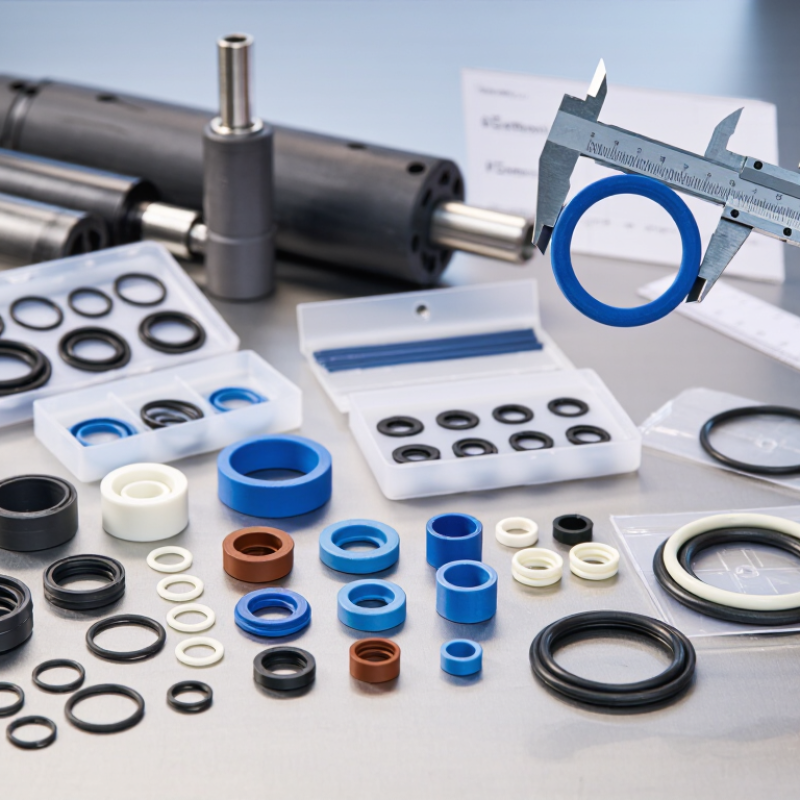
Top Suppliers of Cylinder Seal Kits for Global Buyers?

What Cylinder Seal Kits Are and How They Function

A cylinder seal kit contains the seals and supporting rings that control fluid movement inside a hydraulic cylinder. Typical parts include a piston seal, rod seal, wiper, and static O-rings. The piston seal separates pressure chambers, helping convert hydraulic pressure into controlled movement. The rod seal limits fluid escaping along the moving rod. Outside, the wiper scrapes away dust and moisture before they enter the cylinder.

Small parts. Big consequences.

A damaged wiper can let grit score the rod, while a twisted seal may leak even when its dimensions appear correct.

Seal design depends on pressure, temperature, speed, fluid, and cylinder geometry. ISO 3601-1:2012 specifies dimensions and tolerances for O-rings, a useful reference when checking static seals. Clean fluid matters too: ISO 4406:2021 classifies hydraulic-fluid cleanliness through particle counts at ≥4, ≥6, and ≥14 μm(c). These measurements help maintenance teams discuss contamination consistently, though they do not predict every failure.

A replacement kit should match the cylinder’s groove dimensions and operating conditions, not just its outside diameter. Even careful selection has limits; worn grooves or a scratched rod can defeat new seals.

Common Applications Across Hydraulic and Pneumatic Equipment

Cylinder seal kits are used in hydraulic cylinders on excavators, agricultural equipment, presses, and material-handling machines. They typically contain seals for the piston and rod, plus wipers that help keep dust and grit outside the cylinder. A worn rod seal may leave a thin oil trail; a damaged wiper can let workshop debris score the rod. Small parts, costly downtime.

Pneumatic cylinders use seals too, but their operating conditions differ. They are common in packaging lines, machine tools, and automated handling systems, where compressed air drives repeated short strokes. Seal materials and profiles must suit the pressure, temperature, speed, and working fluid. A hydraulic kit should not be assumed suitable for an air cylinder. Fit matters.

Before replacement, technicians can check the cylinder model, bore, rod diameter, and seal arrangement. Clean measurement is important: a caliper used over dirt or a burr can give a misleading reading. Even experienced workers can overlook a scored rod or a distorted groove; replacing seals alone may not stop leakage. That is worth checking twice. Reassembly also calls for clean surfaces and careful lubrication, following the equipment maker’s service guidance. A kit solves wear, not every cause of failure.

Top Suppliers of Cylinder Seal Kits for Global Buyers? - Common Applications Across Hydraulic and Pneumatic Equipment

Supplier categories below describe common sourcing channels, not a ranked list of companies. Kit contents and material suitability vary by cylinder design, operating conditions, and equipment specifications.

Supplier Category Common Products and Kit Components Typical Equipment Applications Common Seal Materials Buyer Checks
Hydraulic seal manufacturers Rod seals, piston seals, wiper seals, wear rings, O-rings, and backup rings Mobile machinery, agricultural equipment, construction equipment, and industrial hydraulic cylinders Polyurethane, nitrile rubber (NBR), fluorocarbon rubber (FKM), and polytetrafluoroethylene (PTFE), selected according to service conditions Confirm cylinder dimensions, pressure and temperature limits, fluid compatibility, and whether the kit includes all required components
Cylinder and equipment service-parts suppliers Application-specific repair kits, often including seals and wear components for a particular cylinder configuration Hydraulic cylinders used in presses, material-handling systems, machine tools, and off-highway equipment Material varies by the original cylinder specification and the hydraulic fluid and temperature range Match the cylinder model or part reference; verify rod and bore sizes, seal orientation, and kit contents before ordering
Industrial fluid-power distributors Standard and application-selected hydraulic or pneumatic seals, O-rings, wipers, and repair-kit components Factory automation, maintenance and repair operations, packaging machinery, and general industrial equipment NBR and polyurethane are common options; PTFE and other materials may be specified for particular operating conditions Check local stock, technical support, dimensional availability, and compatibility with the cylinder and working medium
Custom seal converters and kit assemblers Cut-to-size or assembled kits for non-standard dimensions, obsolete cylinders, and maintenance requirements Special-purpose hydraulic cylinders, legacy machinery, and equipment with non-standard seal arrangements Material is selected to suit the application; options may include elastomers, polyurethane, and PTFE-based sealing components Provide accurate drawings or measurements, operating conditions, fluid details, and required tolerances
Pneumatic seal suppliers Rod and piston seals, cushioning seals, wipers, and O-rings designed for pneumatic cylinders Air cylinders used in automation, assembly lines, conveying systems, and packaging equipment NBR and polyurethane are commonly used; material choice depends on air quality, lubrication, temperature, and duty cycle Confirm cylinder bore and rod sizes, seal profile, expected cycle rate, and whether the system uses lubricated or non-lubricated air

How to Evaluate Cylinder Seal Kit Suppliers

A reliable cylinder seal kit supplier should do more than quote a low price. Ask how seal materials are matched to hydraulic fluid, operating temperature, pressure, and cylinder dimensions. A kit that looks correct on a workbench may swell or wear quickly if its elastomer is unsuitable. Details matter. Request dimensional drawings, material specifications, and batch traceability, then compare them with your maintenance records. Clear answers are useful; vague assurances are not. If a supplier cannot explain tolerances or identify the kit’s contents, treat that as a practical warning.

Check quality controls and delivery capability before placing a large order. Ask whether finished kits are inspected for dimensions and visible defects, and whether inspection records can be shared. A small sample order can help verify fit, packaging, and labeling under real workshop conditions. It may not predict long-term service life, though, so avoid treating one successful installation as proof. Review lead times, minimum order quantities, and how replacement parts are handled when specifications change. Price matters, but consistency matters more when equipment is down. It is easy to overlook packaging; seals exposed to dust, heat, or sharp edges may arrive damaged. Evaluate the supplier’s evidence, not just its confidence.

Top Suppliers of Cylinder Seal Kits: Compare Typical Seal Material Temperature Ranges

Temperature capability is one useful screening factor when evaluating cylinder seal kit suppliers. These are representative ranges, not universal limits: actual performance depends on the compound, fluid, pressure, and operating conditions. Ask suppliers for material data sheets and application-specific compatibility confirmation.

Notable Suppliers Serving Global Buyers

Notable suppliers serving global buyers include hydraulic-seal manufacturers, specialist kit assemblers, and regional industrial distributors. Strong suppliers document material grades, dimensions, operating-temperature limits, and fluid compatibility. Buyers should request a parts list and confirm whether the kit matches the cylinder’s make, model, and serial range. A neatly labeled pouch helps, but it cannot replace a verified fit. Fit comes first.

Grand View Research estimated the global hydraulic seals market at USD 3.1 billion in 2022 and forecast a 4.8% compound annual growth rate from 2023 to 2030. This points to sustained demand, but market growth alone does not prove supplier quality. Ask for inspection records, traceable batch details, and clear guidance on storage and installation. For cross-border orders, check packaging, lead times, and replacement-part availability before approving a shipment. Small details matter. Some buyers still overlook them. That is worth reconsidering: a low-priced kit can cost more if its seals arrive poorly identified or do not match the cylinder’s working conditions.

How to Compare Products, Lead Times, and After-Sales Support

When comparing cylinder seal kits, start with fit and material—not the lowest quote. Check dimensions, seal profile, operating temperature, fluid compatibility, and pressure range against your cylinder specifications. Ask for inspection records and batch traceability; a neat catalog cannot prove compound consistency. Small details matter. Compare lead times by asking what is in stock, what must be produced, and whether shipping time is included. Request a sample schedule in writing.

After-sales support should be measurable. Ask how quickly the supplier answers technical questions, handles a dimensional mismatch, and provides replacement parts. MHI’s 2024 Annual Industry Report found that 55% of surveyed supply-chain leaders planned to increase technology investment. This is not seal-specific data, but it highlights why searchable order records and clear shipment updates matter. A low quote can still disappoint when a machine is idle and no one owns the problem.

Tips: Send suppliers the same drawing, operating conditions, and annual volume. Compare written quotations line by line. Ask for a named technical contact and a realistic dispatch date, not just “available.” Keep one caveat in mind: no checklist removes every risk. Verify the first delivery before standardizing a kit across your fleet.

Copyright 2025 Fluidra S.A. | Created by BCM Marketing Agencia Privacy Policy Legal note | Cookie policy |

Technical cookies are strictly necessary for our website to work and you can navigate through it. These types of cookies are those that, for example, allow us to identify you, give you access to certain restricted parts of the page if necessary, or remember different options or services already selected by you, such as your privacy preferences. Therefore, they are activated by default, your authorization not being necessary in this regard. Through the configuration of your browser, you can block or alert the presence of this type of cookies, although such blocking will affect the proper functioning of the different functionalities of our website.


The analysis cookies allow us to study the navigation of the users of our website in general (for example, which sections of the page are the most visited, which services are used most and if they work correctly, etc.). From the statistical information on navigation on our website, we can improve both the operation of the page itself and the different services it offers. Therefore, these cookies do not have an advertising purpose, but only serve to make our website work better, adapting to our users in general. By activating them you will contribute to this continuous improvement. You can enable or disable these cookies by checking the corresponding box, being disabled by default.


Functionality cookies allow us to remember your preferences, to personalize certain characteristics and general options of our website, every time you access it (for example, the language in which the information is presented to you, the sections marked as favorites, your browser type, etc.) Therefore, this type of cookies does not have an advertising purpose, but by activating them you will improve the functionality of the website (for example, adapting to your type of browser) and the customization of it based on your preferences (for example, by presenting the information in the language that you have chosen in previous occasions), which will contribute to the ease, usability and comfort of our page during your navigation. You can enable or disable these cookies by checking the corresponding box, being disabled by default.


Advertising cookies allow us to manage the advertising spaces included in our website based on criteria such as the content shown or the frequency in which the ads are displayed. For example, if you have been shown the same ad several times on our website, and you have not shown a personal interest by clicking on it, it will not appear again. In summary, by activating this type of cookies, the advertising shown on our website will be more useful and diverse, and less repetitive. You can enable or disable these cookies by checking the corresponding box, being disabled by default.


Behavioral advertising cookies allow us to obtain information based on the observation of your browsing habits and behaviors on the web, in order to show you advertising content that best suits your personal tastes and interests. To understand it in a very simple way, we will give you a fictitious example: if your last searches on the web were related to suspense literature, we would show you advertising about suspense books. Therefore, activating this type of cookies, the advertising that we show you on our website will not be generic, but will be oriented to your searches, tastes and interests, therefore adjusting exclusively to you. You can enable or disable these cookies by checking the corresponding box, being disabled by default.
To understand it in a very simple way, we will give you a fictitious example: if your last searches on the web were related to suspense literature, we would show you advertising about suspense books. Therefore, activating this type of cookies, the advertising that we show you on our website will not be generic, but will be oriented to your searches, tastes and interests, therefore adjusting exclusively to you. You can enable or disable these cookies by checking the corresponding box, being disabled by default.

SAVE

We use our own and third-party cookies to ensure the proper functioning of the website and to analyse our services, improve your experience on our website and show you advertisements related to your interests according to profiling based on your browsing habits (e.g. websites visited). You can accept all cookies by clicking "ACCEPT" or set or reject them by clicking here. If you would like to know more about the use of cookies, please see our COOKIE POLICY.


ACCEPT ALL
Reject no essentials


