
Top 10 Fiber Disc Suppliers for Global Buyers
FLUID HANDLING EXPERTS

Blog, all our news

Top 10 Fiber Disc Suppliers for Global Buyers

Choosing a Fiber Disc supplier is about more than comparing catalog prices. Buyers need consistent abrasive performance, dependable delivery, clear specifications, and responsive technical support. A disc that cuts quickly on a weld seam may wear unevenly on stainless steel or leave a finish that needs extra work.

Dr. Stephen Malkin, a recognized researcher in grinding technology, offers a useful principle for evaluating abrasive products. A buyer-focused paraphrase of his work is: “Match the abrasive to the material, operation, and finish target.” That sounds obvious. In practice, it is easy to overlook when a quote lists only grit and diameter.

This guide compares ten suppliers for global buyers. It considers product range, abrasive grain, backing, grit options, available sizes, quality documentation, sample access, and export support. These details can help buyers shortlist vendors for production trials, rather than relying on polished product claims alone. Ask how a disc performs under your actual pressure, tool speed, and workpiece conditions. Request consistent batch specifications, too. Small differences matter.

A low price can be useful. But it is not the whole story. Supplier pages may not answer every question, and published performance figures may not match your shop floor. Treat this list as a starting point, then verify fit through samples, technical discussions, and measured results. The best choice may not be the most famous brand.
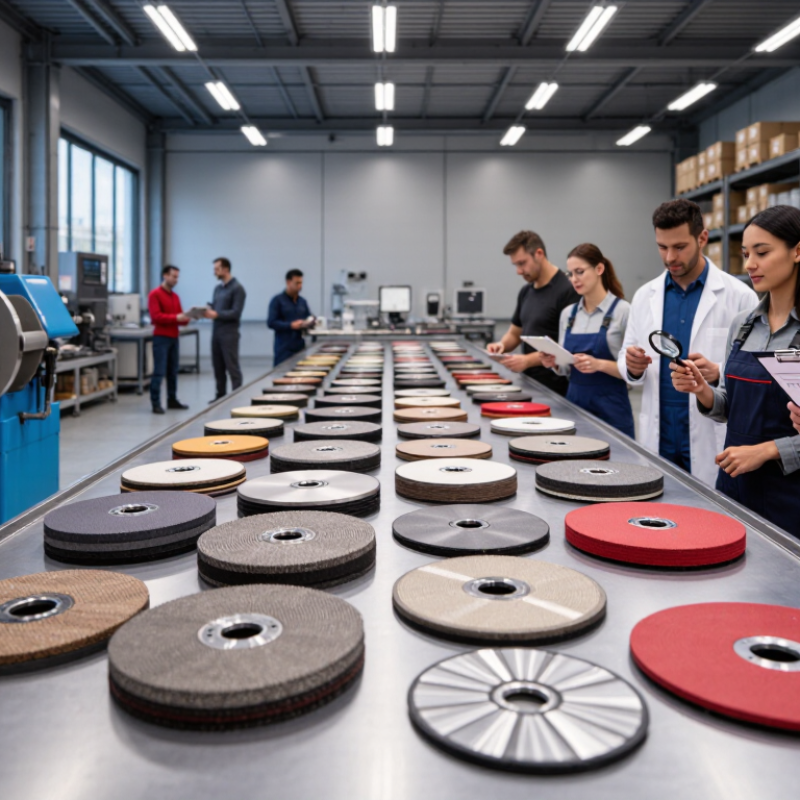
Top 10 Fiber Disc Suppliers for Global Buyers

Understanding Fiber Discs and Their Industrial Uses

Fiber discs are abrasive discs bonded to a stiff fiber backing and fitted to a compatible backing pad. They are commonly used with angle grinders for weld blending, rust removal, deburring, and smoothing metal edges.

Aluminum oxide suits many general-purpose jobs; zirconia and ceramic grains can be useful on demanding metals. The right choice depends on the workpiece, required finish, and pressure. More pressure is not always faster. It can build heat, load the disc, and leave visible scratches.

Look closely at the disc before use. Check its maximum speed and diameter against the tool, and replace discs with cracks or damaged edges. Keep the work area clear, use suitable eye and respiratory protection, and follow the tool and disc makers’ instructions. Small details matter.

The U.S. Bureau of Labor Statistics recorded 2.8 million nonfatal workplace injuries and illnesses in private industry in 2022; this figure is not specific to abrasive work, but it underscores why routine controls matter.

A disc can also wear unevenly when held at an inconsistent angle. Not magic. Test a small area first, since the best grit on paper may still leave a finish that needs another pass.

How to Evaluate Fiber Disc Suppliers for Global Sourcing

Top 10 Fiber Disc Suppliers for Global Buyers

How to Evaluate Fiber Disc Suppliers for Global Sourcing

Choosing a fiber disc supplier takes more than comparing unit prices. Buyers should check grit consistency, disc diameter, backing strength, hole pattern, and maximum operating speed against their actual tools and materials. Grand View Research estimated the global abrasives market at USD 44.21 billion in 2023, with projected growth through 2030. That market estimate signals broad demand, not supplier quality. Request batch-level specifications and confirm that test methods are clearly documented.

For global sourcing, assess sample performance on the same metal, grinder, and workload used in production. Record cutting speed, disc life, edge wear, and heat marks; a short test may not predict a full shift. Also review lead-time history, packaging protection, minimum order quantities, and lot traceability. A quality certificate is useful, but it does not prove that every shipment performs consistently. Even a detailed scorecard has limits.

Tips: Ask for samples from more than one production batch. Compare results before committing to a large order. Check that labels state grit, dimensions, and speed limits clearly. Keep the test conditions consistent. Cheap discs can cost more in downtime, though that trade-off deserves measurement—not assumption.

Profiles of Ten Leading Fiber Disc Suppliers

Global buyers often compare fiber disc suppliers by more than price. These ten profiles represent different strengths, not a ranked list. Large-scale abrasive manufacturers typically offer broad grit ranges and steady production. Regional converters may provide quicker lead times and custom sizes. Private-label specialists focus on packaging and consistent specifications. Some suppliers excel at resin-bonded discs for demanding metalwork. Others serve general-purpose grinding with flexible minimum orders. Fit matters.

Technical depth varies. A supplier with clear backing, bond, and grit documentation makes product checks easier. Export-focused distributors may simplify consolidated shipments, while factory-direct sellers can offer closer production oversight. Some manufacturers support sample trials and application guidance. Others rely on buyers to define the specification. Ask for current product data, batch traceability, and realistic delivery estimates. A polished catalog is not proof of performance.

The remaining profiles include suppliers known for coated-abrasive conversions, metal-fabrication applications, high-volume procurement, and tailored packaging. Compare discs on the same grinder and workpiece. Note heat, finish, wear, and operator feedback. Test first. Results can vary with pressure, tool speed, and material, so one trial may mislead. A dependable supplier answers technical questions plainly and flags limits instead of promising every disc suits every job.

Comparing Product Range, Quality, and Market Reach

Top 10 Fiber Disc Suppliers for Global Buyers

Comparing Product Range, Quality, and Market Reach

Choosing a fiber disc supplier takes more than comparing catalog size. Check whether the range covers common diameters, grit levels, backing materials, and disc types for your tools and workpieces. A broad selection can simplify purchasing, but it does not guarantee consistent performance. Ask for technical data, batch traceability, and samples suited to your actual grinding conditions. That matters. Test how discs cut, wear, and handle heat on the materials you use most.

Quality comparisons should include more than a polished product sheet. Review published specifications and ask how the supplier checks dimensions, bond consistency, and abrasive distribution. Confirm packaging protects discs from moisture and crushing during shipment. Market reach also affects delivery times, minimum order quantities, and support across time zones. A supplier serving several regions may offer useful logistics, though local stock and clear communication still deserve checking. I would not treat a long export list as proof of dependable service; real lead-time records are more useful.

Tips: Compare the same grit and disc size across suppliers. Request samples and written lead times. Keep notes on cut rate, disc life, and finish quality.

Key Considerations for Selecting a Supplier by Application

Selecting a fiber disc supplier should begin with the job. Stainless steel weld blending, paint removal, and edge deburring place different demands on abrasive grain and grit. Coarser grits remove stock quickly but can leave deeper scratches. Finer grits produce a smoother finish, though they may take longer. Check the disc diameter, arbor-hole fit, backing strength, and rated operating speed against your tool. Small details matter.

Ask suppliers for technical data and samples suited to your material and process. Test them under consistent pressure and speed, then compare cut rate, finish, disc wear, and heat buildup. On thin sheet, excess heat can distort an edge; on a heavy weld, a disc that cuts slowly can raise labor costs. A practical test beats a broad performance claim. Check lot consistency, packaging protection, available specifications, and realistic lead times. A low unit price can be tempting, but frequent disc changes may erase the savings. I would still question any test that uses only one operator or one workpiece; shop conditions vary, and the result may not hold up across a full production run.

Top 10 Fiber Disc Suppliers for Global Buyers - Key Considerations for Selecting a Supplier by Application Application-based sourcing checklist — supplier names and brands intentionally omitted
Application Typical Workpiece Abrasive to Consider Typical Starting Grit Supplier Selection Checks
Heavy weld and scale removal Carbon steel welds, mill scale, and rough surfaces Zirconia alumina or ceramic alumina 24–36 for aggressive stock removal Check removal rate, disc life, backing strength, and availability of compatible backing pads.
General-purpose steel grinding Mild steel parts and fabrication work Aluminum oxide or zirconia alumina 36–60, depending on the amount of material to remove Compare performance across the intended grinder, work pressure, and production volume.
Stainless steel finishing Stainless components, seams, and weld areas Zirconia alumina or ceramic alumina; confirm suitability for stainless steel 40–80 for blending and intermediate finishing Ask about heat management, contamination controls, and whether the product is designated for stainless steel.
Aluminum and other soft nonferrous metals Aluminum, brass, and similar metals prone to loading Aluminum oxide or a product specifically designed for nonferrous metals 36–80, selected to match the finish required Check loading resistance and request guidance on avoiding excessive pressure and heat buildup.
Paint and coating removal Painted or coated metal surfaces Aluminum oxide or another abrasive specified for coating removal 40–80; confirm the coating and substrate requirements Verify that the disc is intended for the coating-removal task and ask about surface-damage risk.
Rust and corrosion cleanup Rusty steel and corroded metal surfaces Aluminum oxide or zirconia alumina 36–60 for cleanup; finer grits may be used for subsequent blending Compare usable life and finish consistency, and confirm the disc is suitable for the substrate.
Fine blending and surface preparation Ground steel or stainless steel before a finer finishing step Aluminum oxide, zirconia alumina, or ceramic alumina 60–120, depending on the desired surface finish Request sample discs and assess scratch pattern, finish consistency, and grit progression.
Cast iron grinding Castings, parting lines, and casting defects Aluminum oxide or ceramic alumina 24–60, matched to the defect and removal target Check disc durability under the intended workload and confirm the recommended backing pad.
Stone, masonry, or glass-related work Mineral-based materials, where the disc is specifically rated for the task Silicon carbide may be suitable for certain mineral materials Choose according to the material, process, and required finish Confirm the product’s stated material application; do not assume a metalworking disc is suitable.
High-volume production grinding Repeated metal-removal operations on a defined production line Ceramic alumina or zirconia alumina, selected through application trials Set by the removal target and downstream finish requirements Evaluate cost per part, lot-to-lot consistency, lead time, quality documentation, and supply continuity.
Grit ranges are general starting points, not a substitute for application testing. Confirm disc diameter, arbor fit, backing-pad compatibility, material suitability, and the maximum operating speed marked on the disc. Use the disc only with compatible equipment and follow the manufacturer’s safety instructions.
Copyright 2025 Fluidra S.A. | Created by BCM Marketing Agencia Privacy Policy Legal note | Cookie policy |

Technical cookies are strictly necessary for our website to work and you can navigate through it. These types of cookies are those that, for example, allow us to identify you, give you access to certain restricted parts of the page if necessary, or remember different options or services already selected by you, such as your privacy preferences. Therefore, they are activated by default, your authorization not being necessary in this regard. Through the configuration of your browser, you can block or alert the presence of this type of cookies, although such blocking will affect the proper functioning of the different functionalities of our website.


The analysis cookies allow us to study the navigation of the users of our website in general (for example, which sections of the page are the most visited, which services are used most and if they work correctly, etc.). From the statistical information on navigation on our website, we can improve both the operation of the page itself and the different services it offers. Therefore, these cookies do not have an advertising purpose, but only serve to make our website work better, adapting to our users in general. By activating them you will contribute to this continuous improvement. You can enable or disable these cookies by checking the corresponding box, being disabled by default.


Functionality cookies allow us to remember your preferences, to personalize certain characteristics and general options of our website, every time you access it (for example, the language in which the information is presented to you, the sections marked as favorites, your browser type, etc.) Therefore, this type of cookies does not have an advertising purpose, but by activating them you will improve the functionality of the website (for example, adapting to your type of browser) and the customization of it based on your preferences (for example, by presenting the information in the language that you have chosen in previous occasions), which will contribute to the ease, usability and comfort of our page during your navigation. You can enable or disable these cookies by checking the corresponding box, being disabled by default.


Advertising cookies allow us to manage the advertising spaces included in our website based on criteria such as the content shown or the frequency in which the ads are displayed. For example, if you have been shown the same ad several times on our website, and you have not shown a personal interest by clicking on it, it will not appear again. In summary, by activating this type of cookies, the advertising shown on our website will be more useful and diverse, and less repetitive. You can enable or disable these cookies by checking the corresponding box, being disabled by default.


Behavioral advertising cookies allow us to obtain information based on the observation of your browsing habits and behaviors on the web, in order to show you advertising content that best suits your personal tastes and interests. To understand it in a very simple way, we will give you a fictitious example: if your last searches on the web were related to suspense literature, we would show you advertising about suspense books. Therefore, activating this type of cookies, the advertising that we show you on our website will not be generic, but will be oriented to your searches, tastes and interests, therefore adjusting exclusively to you. You can enable or disable these cookies by checking the corresponding box, being disabled by default.
To understand it in a very simple way, we will give you a fictitious example: if your last searches on the web were related to suspense literature, we would show you advertising about suspense books. Therefore, activating this type of cookies, the advertising that we show you on our website will not be generic, but will be oriented to your searches, tastes and interests, therefore adjusting exclusively to you. You can enable or disable these cookies by checking the corresponding box, being disabled by default.

SAVE

We use our own and third-party cookies to ensure the proper functioning of the website and to analyse our services, improve your experience on our website and show you advertisements related to your interests according to profiling based on your browsing habits (e.g. websites visited). You can accept all cookies by clicking "ACCEPT" or set or reject them by clicking here. If you would like to know more about the use of cookies, please see our COOKIE POLICY.


ACCEPT ALL
Reject no essentials


