
Top 10 Coil Transfer Cart Manufacturers Worldwide
FLUID HANDLING EXPERTS

Blog, all our news

Top 10 Coil Transfer Cart Manufacturers Worldwide

Moving steel coils across a plant floor demands more than a powerful motor. A Coil Transfer Cart must carry heavy loads safely, align with production equipment, and operate reliably through repeated shifts. In a busy mill, the route may cross uneven joints, narrow aisles, or areas exposed to heat and metal dust. Small design choices matter.

This guide introduces ten manufacturers serving coil-handling operations around the world. Their carts may differ in drive systems, steering, power supply, load capacity, and control options. Some models use rail guidance; others travel freely across the floor. The right choice depends on the coil dimensions, travel distance, floor condition, and how the cart connects with cranes or processing lines. Details matter. A catalog rarely tells the whole story.

When comparing suppliers, buyers should examine documented load ratings, safety features, customization capabilities, service coverage, and relevant project experience. Ask for technical drawings and clear operating limits, then verify that proposed specifications match the actual site. Published product information can vary in detail, and manufacturer claims are not always directly comparable. Not always. This overview is a starting point, not a universal ranking or a substitute for engineering review. Even experienced teams can overlook a turning radius or charging constraint. A careful comparison helps identify manufacturers worth contacting and questions worth asking before a Coil Transfer Cart enters service.
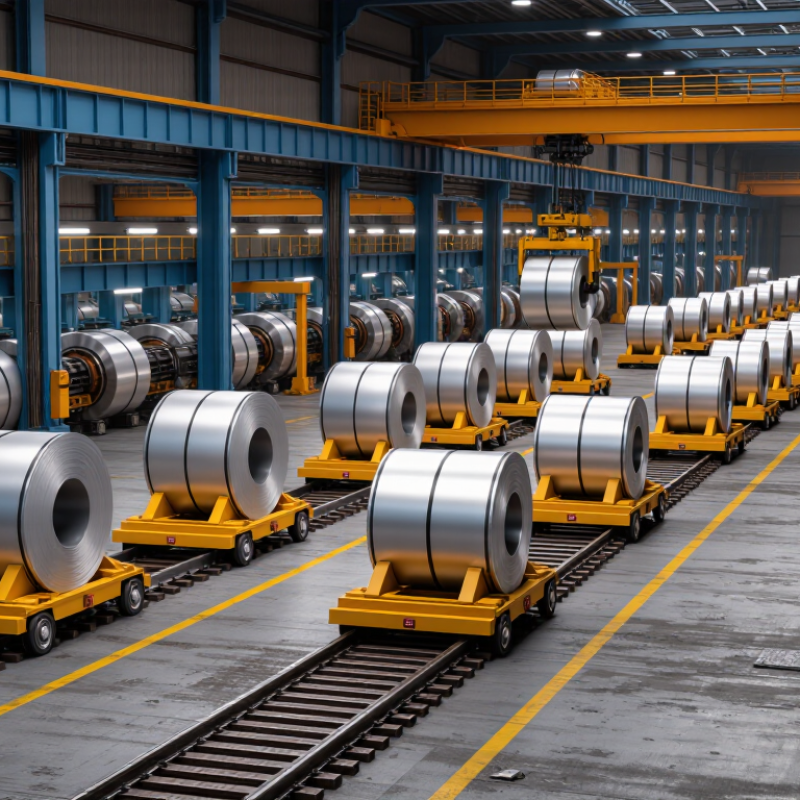
Top 10 Coil Transfer Cart Manufacturers Worldwide

What Coil Transfer Carts Are and How They Work

A coil transfer cart moves heavy steel or aluminum coils between production stations, storage areas, and loading points. Unlike a standard flatbed cart, it has a shaped cradle that helps keep the round load from rolling. The cradle may be lined with steel, rubber, or other wear-resistant material, depending on the coil and operating conditions. Stability matters.

Most carts run on rails or use wheels on a prepared floor. A battery-powered drive, cable system, or manual tow can provide movement. The operator positions the coil with a crane or lifting device, checks that it sits securely, then moves the cart along its route. Controls may include speed adjustment, braking, and emergency stops. Exact features vary by load capacity and site layout.

Good operation depends on more than the cart’s rated capacity. Coil dimensions, floor condition, turning space, and travel distance all affect performance. A low speed can improve control, but it may slow production. That trade-off is easy to overlook. Before choosing equipment, teams should confirm the load’s weight and center of gravity, then review the route with operators and maintenance staff. Real sites are rarely perfect, so a practical trial can reveal problems that a drawing misses.

Top 10 Coil Transfer Cart Manufacturers Worldwide – What Coil Transfer Carts Are and How They Work

Coil transfer carts are industrial vehicles designed to move heavy steel, aluminum, or other wound-material coils between work areas. The table below summarizes ten practical design and operating criteria for evaluating coil-cart equipment; it does not rank or identify manufacturers. Actual capacities and configurations depend on the load, route, duty cycle, and site conditions.

No. Evaluation dimension Relevant design data How it works What to verify
1 Rated load capacity Specified as a maximum working load; capacity is selected for the actual coil mass and handling arrangement. The chassis, wheels, drive system, and supporting structure carry the coil and cart during travel. Confirm the cart rating covers the heaviest coil, any fixture, and the required operating conditions.
2 Coil support and restraint A shaped saddle or cradle supports the coil; the required geometry depends on coil diameter, width, and orientation. The cradle distributes contact forces and helps keep the coil from rolling while the cart moves. Check coil dimensions, contact surfaces, restraints, and whether the eye is horizontal or vertical.
3 Travel path Carts can be designed for rails or for travel on a prepared floor, depending on the application. Rail-guided wheels follow a fixed route; floor-running carts use steering and wheel systems suited to the site surface. Assess route length, turns, floor condition, gradients, crossings, and required positioning accuracy.
4 Power supply Common options include onboard batteries and site-fed systems such as cable reels or conductor arrangements. Electrical power drives the traction motors and, where fitted, the controls and auxiliary equipment. Compare operating distance, charging or supply infrastructure, duty cycle, and maintenance access.
5 Drive and steering Drive layout and steering configuration are selected to suit the cart size, load, route, and required maneuverability. The drive system turns the wheels; steering may be fixed for a straight route or configured to support turning on the site. Review turning space, wheel loads, travel speed, and whether the route requires straight-line or multidirectional movement.
6 Loading and unloading interface The transfer height and support layout must match the crane, forklift, coil car, or production equipment used at each station. A coil is placed onto or removed from the cart using compatible material-handling equipment or an integrated lifting feature. Check clearances, alignment, lift points, transfer height, and the sequence of handoffs.
7 Control method Control may be operator-driven, remote-controlled, or integrated with site automation, depending on the system design. Commands regulate starting, stopping, direction, and, where supported, route or position functions. Confirm operator visibility, communication method, emergency-stop access, and compatibility with plant controls.
8 Braking and stopping Braking is designed for the cart’s load, speed, route, and operating environment; the specific arrangement varies by model. The braking system slows or holds the cart when commanded and may also engage under defined fault conditions. Request stopping-distance and holding-capability information for the intended load and route.
9 Safety provisions Risk controls may include emergency stops, warning devices, guarding, interlocks, and obstacle-detection features where specified. Safety devices alert people, stop motion, or prevent certain movements when configured conditions are detected. Evaluate the site risk assessment, pedestrian interaction, visibility, and applicable local requirements.
10 Duty cycle and maintenance Service needs depend on operating frequency, environment, power system, wheel and rail conditions, and component design. Routine inspection helps keep the drive, brakes, wheels, electrical equipment, and coil-support surfaces in working condition. Ask for the recommended inspection schedule, wear-part list, service access, and expected operating duty.

Note: The listed options describe common engineering considerations, not specifications for a particular manufacturer or model. Confirm final ratings and safety requirements with the equipment supplier and a qualified site engineer.

Key Features and Applications of Coil Transfer Carts

Coil transfer carts move heavy steel coils between storage, processing lines, and shipping areas. Their low decks and wide support cradles help keep loads stable, while V-shaped saddles can reduce rolling during travel. Some systems use battery power; others draw power from cable reels or conductor rails. Choose according to route length, charging access, and floor conditions. Small details matter.

The World Steel Association’s World Steel in Figures 2024 reports that global crude steel production reached 1,888.2 million tonnes in 2023. That scale helps explain why reliable internal coil handling matters across mills and service centers. Useful features include variable-speed controls, emergency stops, overload protection, and sensors that detect obstacles. A cart may also need to turn within narrow aisles or align precisely with a slitting line. Capacity should account for the coil’s weight and dimensions, not just a typical load. Real floors are rarely perfect.

Tips: Check the coil’s center of gravity and cradle fit before specifying a cart. Test braking and turning with a representative load, then review the route for joints, slopes, and blind corners. Don’t overlook operator visibility. A technically suitable cart can still create delays if loading points are awkward.

How to Evaluate Coil Transfer Cart Manufacturers

Evaluating a coil transfer cart manufacturer begins with the actual load, not a standard brochure. Share coil weight, diameter, aisle width, floor condition, and daily travel distance. Ask how these details shape wheel selection, frame design, braking, and steering. The cart should match your operating cycle, including starts, stops, and tight turns. Small details matter.

Request engineering drawings, load calculations, and test records for a comparable configuration. Ask whether the manufacturer can demonstrate the cart carrying a representative load, with stopping and steering checks included. Inspect weld quality, cable routing, guards, and access to routine service points. A neat finish helps, but it does not prove reliable performance. Ask for evidence.

Compare commissioning support, operator training, spare-parts availability, and response times. Clarify what the quoted price excludes, such as site preparation or integration with existing equipment. References from facilities handling similar coils can help, though no two plants are identical. A checklist may still miss a local floor or workflow issue; an on-site review can catch details that drawings cannot.

Profiles of Ten Leading Manufacturers Worldwide

Profiles of Ten Leading Manufacturers Worldwide

World Steel Association’s World Steel in Figures 2024 reports 1,892.2 million tonnes of crude steel production in 2023. That scale helps explain demand for reliable coil handling, but it does not prove one cart design suits every mill. These ten capability-based profiles offer a practical way to compare manufacturers without relying on brand claims. One focuses on mill-integrated transfer systems. Another specializes in heavy-load frames. A third builds compact carts for narrow aisles. Others emphasize rail-guided travel, battery power, automated navigation, or precision positioning. The remaining profiles center on custom coil saddles, safety controls, and maintenance support. Each addresses a different operating constraint.

Look beyond rated capacity. Ask manufacturers for load-test records, braking performance, turning clearances, and service intervals. A cart may carry the coil yet still damage its edge during a sharp turn. Published specifications also rarely show performance on uneven floors. That gap matters.

Tips: Share coil diameter, width, mass, route drawings, and shift frequency before requesting a quote. Ask for a witnessed site trial. Small details matter. A good supplier should explain trade-offs, not just promise a fit.

How to Choose a Manufacturer for Your Operation

Choosing a coil transfer cart manufacturer starts with the load, not the catalogue. Record coil weight, diameter, width, and the way loads are placed on the cart. Then map the route, including floor joints, ramps, tight turns, and stopping points. A cart that fits the coil may still fail on a rough aisle. Ask for rated capacity, braking performance, turning clearance, and test documentation. Request a drawing of your actual layout, not just a standard product sheet.

Check how the manufacturer handles controls, maintenance, and operator training. MHI’s 2024 Annual Industry Report found that 55% of surveyed supply-chain professionals expected to increase technology investment. That figure is not specific to coil carts, but it signals why integration and service matter. Ask whether the cart can connect with existing workflows and how faults are diagnosed. Get realistic lead times for parts, too. A polished demonstration is useful, but it cannot replace a site trial with representative coils. That sounds obvious. It is often skipped. Finally, compare total operating costs, including charging, inspections, downtime, and floor modifications. One detail deserves a second look: payload ratings may not describe uneven or off-center loading. Share those conditions openly and ask the supplier to explain its assumptions in writing.

Top 10 Coil Transfer Cart Manufacturers Worldwide — How to Choose a Manufacturer for Your Operation

Compare manufacturers against the factors that matter most to your site. The scores below are an illustrative buyer-planning example, not market research or a manufacturer ranking. Adjust the priorities to match your coil weights, route, and operating environment.

Before choosing a supplier, confirm rated payload with an appropriate safety margin, coil restraint and loading arrangements, travel distance and floor conditions, duty cycle, power supply, safety features, and after-sales support.

Copyright 2025 Fluidra S.A. | Created by BCM Marketing Agencia Privacy Policy Legal note | Cookie policy |

Technical cookies are strictly necessary for our website to work and you can navigate through it. These types of cookies are those that, for example, allow us to identify you, give you access to certain restricted parts of the page if necessary, or remember different options or services already selected by you, such as your privacy preferences. Therefore, they are activated by default, your authorization not being necessary in this regard. Through the configuration of your browser, you can block or alert the presence of this type of cookies, although such blocking will affect the proper functioning of the different functionalities of our website.


The analysis cookies allow us to study the navigation of the users of our website in general (for example, which sections of the page are the most visited, which services are used most and if they work correctly, etc.). From the statistical information on navigation on our website, we can improve both the operation of the page itself and the different services it offers. Therefore, these cookies do not have an advertising purpose, but only serve to make our website work better, adapting to our users in general. By activating them you will contribute to this continuous improvement. You can enable or disable these cookies by checking the corresponding box, being disabled by default.


Functionality cookies allow us to remember your preferences, to personalize certain characteristics and general options of our website, every time you access it (for example, the language in which the information is presented to you, the sections marked as favorites, your browser type, etc.) Therefore, this type of cookies does not have an advertising purpose, but by activating them you will improve the functionality of the website (for example, adapting to your type of browser) and the customization of it based on your preferences (for example, by presenting the information in the language that you have chosen in previous occasions), which will contribute to the ease, usability and comfort of our page during your navigation. You can enable or disable these cookies by checking the corresponding box, being disabled by default.


Advertising cookies allow us to manage the advertising spaces included in our website based on criteria such as the content shown or the frequency in which the ads are displayed. For example, if you have been shown the same ad several times on our website, and you have not shown a personal interest by clicking on it, it will not appear again. In summary, by activating this type of cookies, the advertising shown on our website will be more useful and diverse, and less repetitive. You can enable or disable these cookies by checking the corresponding box, being disabled by default.


Behavioral advertising cookies allow us to obtain information based on the observation of your browsing habits and behaviors on the web, in order to show you advertising content that best suits your personal tastes and interests. To understand it in a very simple way, we will give you a fictitious example: if your last searches on the web were related to suspense literature, we would show you advertising about suspense books. Therefore, activating this type of cookies, the advertising that we show you on our website will not be generic, but will be oriented to your searches, tastes and interests, therefore adjusting exclusively to you. You can enable or disable these cookies by checking the corresponding box, being disabled by default.
To understand it in a very simple way, we will give you a fictitious example: if your last searches on the web were related to suspense literature, we would show you advertising about suspense books. Therefore, activating this type of cookies, the advertising that we show you on our website will not be generic, but will be oriented to your searches, tastes and interests, therefore adjusting exclusively to you. You can enable or disable these cookies by checking the corresponding box, being disabled by default.

SAVE

We use our own and third-party cookies to ensure the proper functioning of the website and to analyse our services, improve your experience on our website and show you advertisements related to your interests according to profiling based on your browsing habits (e.g. websites visited). You can accept all cookies by clicking "ACCEPT" or set or reject them by clicking here. If you would like to know more about the use of cookies, please see our COOKIE POLICY.


ACCEPT ALL
Reject no essentials


