
Top 10 Chocolate Bar Production Line Manufacturers?
FLUID HANDLING EXPERTS

Blog, all our news

Top 10 Chocolate Bar Production Line Manufacturers?

Choosing the right Chocolate Bar Production Line manufacturer can shape product quality, operating costs, and long-term growth. A reliable supplier should understand more than machinery specifications. It should understand chocolate behavior, factory workflow, sanitation, and daily production pressure.

This guide introduces ten manufacturers worth evaluating for different production needs. The comparison considers tempering accuracy, molding performance, cooling stability, enrobing options, automation, and production capacity. It also examines installation support, spare-parts availability, operator training, and after-sales responsiveness. These details matter when a cooling tunnel stops during a busy shift.

Small details reveal expertise. A well-designed line should manage chocolate temperature consistently, reduce waste, and allow practical cleaning between batches. It should also support recipe changes without creating unnecessary downtime. Some manufacturers focus on compact lines for emerging brands, while others build high-output systems for established factories. Neither approach is automatically better.

Factory visits, technical drawings, test runs, and customer references can provide stronger evidence than polished brochures. Certification and documented quality procedures also deserve careful review. However, no ranking is perfect. A manufacturer with excellent engineering may offer slower communication, while a smaller supplier may provide more attentive service but fewer global resources.

The companies discussed here are assessed through a practical, evidence-based lens. Their suitability depends on product type, bar size, coating method, budget, and expected output. Readers should confirm specifications directly before making a purchase. Machines are expensive. A careful decision is worth the extra questions.
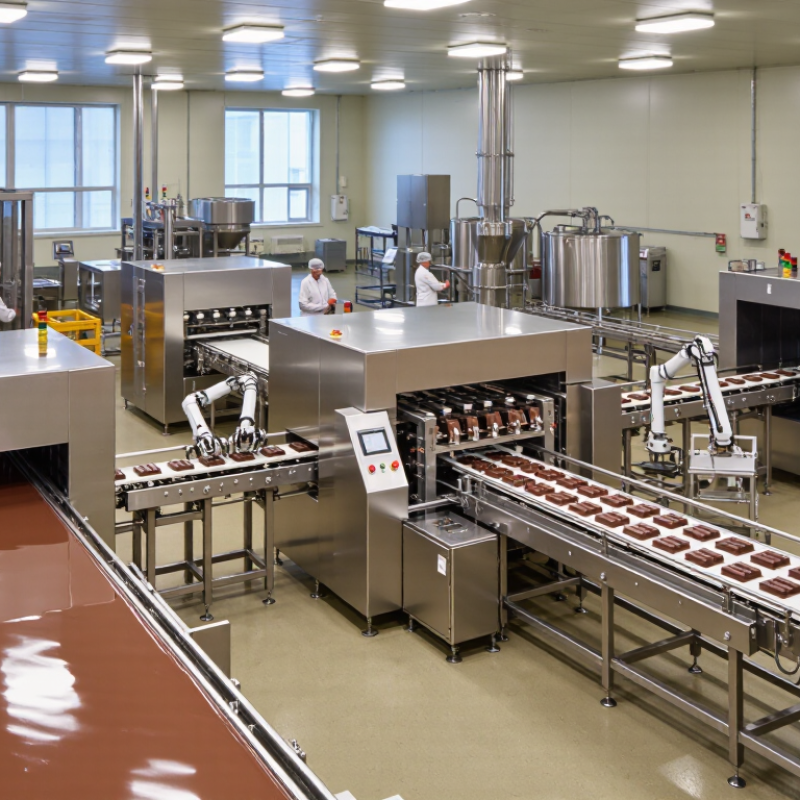
Top 10 Chocolate Bar Production Line Manufacturers?

Chocolate Bar Production Lines: Market Scope and Global Output Data from 2024

Top 10 Chocolate Bar Production Line Manufacturers?

Chocolate bar production expanded with premium, filled, and reduced-sugar products during 2024. However, reliable global output data remains difficult to isolate. Most public reports combine chocolate bars with other chocolate confectionery. Definitions also vary between factory output, installed capacity, and retail sales.

A practical top-ten assessment should examine forming accuracy, cooling stability, mould changeover time, energy use, and after-sales support. Leading equipment manufacturers typically supply tempering units, depositing systems, cooling tunnels, moulding equipment, wrapping machines, and complete line integration. A medium line may produce hundreds of kilograms per hour, while large facilities can exceed several tonnes hourly. Actual output depends on recipe viscosity, bar weight, operating shifts, and seasonal demand.

Tips: Compare verified production trials, not catalogue speed. Request hourly output records for your exact mould and recipe. Check cleaning access around pumps, conveyors, and cooling tunnels. Ask about spare-part availability in your region. A cheap line may become expensive during repeated stoppages.

The global market remains concentrated in major industrial regions, but regional factories are investing in flexible lines. This supports smaller batches and faster product changes. My ranking would remain provisional because 2024 capacity figures are rarely audited independently. Equipment quality matters, yet operator training and maintenance often decide real performance. Chocolate is sensitive. Small temperature errors can damage gloss, texture, and release.

Top 10 Chocolate Bar Production Line Manufacturers? — Global Output Context, 2024

This chart shows the estimated regional share of global cocoa bean production for the 2023/24 cocoa season, used as an upstream indicator of chocolate bar production-line demand. Africa remained the largest production region, followed by Asia & Oceania and the Americas. Data are rounded estimates based on ICCO 2023/24 cocoa production statistics; the chart does not rank individual manufacturers or brands.

Source: International Cocoa Organization (ICCO), 2023/24 Annual Report and cocoa production estimates.

Core Production Stages: Mixing, Refining, Conching, Tempering at 28–32°C

Top 10 Chocolate Bar Production Line Manufacturers?

When comparing the top ten chocolate bar production line manufacturers, examine the complete process, not only machine speed. A reliable line controls ingredient flow, temperature, particle size, and residence time. During mixing, cocoa mass, sugar, milk powder, and fats must combine evenly. Load cells and jacketed vessels help maintain a stable texture. Small changes matter.

Refining reduces coarse particles that create a gritty mouthfeel. Experienced operators commonly check particle size with laboratory testing rather than relying on appearance. Conching then develops aroma and removes unwanted moisture or acidity. Time, airflow, and heat need careful adjustment. Over-conching can flatten delicate cocoa notes. That mistake still appears in rushed production trials.

Tempering is the most sensitive stage for finished bars. The chocolate is cooled and reheated within a controlled 28–32°C working range, depending on its recipe. Dark chocolate often requires a higher working temperature, while milk and white chocolate usually need lower settings. A continuous tempering unit should provide steady agitation and accurate sensors. Operators can verify crystal formation with a temper meter and a short cooling test. Shiny surfaces, clean gloss, and a sharp snap indicate better control. However, a good result at one temperature does not guarantee stable performance across every batch. Manufacturers should offer pilot testing, cleaning access, recipe support, and documented quality checks before installation.

Top 10 Manufacturers Compared by 100–2,000 kg/h Capacity and Automation

Top 10 Chocolate Bar Production Line Manufacturers?

Comparing ten leading manufacturers requires more than reading advertised output. Grand View Research valued the global chocolate market at USD 119.39 billion in 2023. This growth increases pressure for stable, scalable production equipment. The most useful comparison spans 100–2,000 kg/h, covering pilot batches, regional factories, and high-volume plants.

At 100–300 kg/h, compact moulding lines often suit seasonal products and frequent recipe changes. At 500–1,000 kg/h, continuous tempering, cooling tunnels, and automatic dosing become more valuable. Lines near 2,000 kg/h need balanced conveyors, robotic packing, and strong heat control. Small temperature shifts can affect gloss, snap, and demoulding. Throughput alone is not enough.

Automation separates capable suppliers from impressive brochures. Buyers should check PLC integration, recipe storage, metal detection, cleaning access, and real-time production records. PMMI industry reports repeatedly identify labor shortages and flexible automation as major packaging investment drivers. Factory acceptance testing should verify actual chocolate, not only water trials. That detail matters.

Reported capacity may change with bar size, cocoa viscosity, cooling time, and packaging format. The comparison should therefore include energy use, changeover minutes, service response, and spare-part availability. Some specifications remain difficult to verify publicly. That is an uncomfortable weakness. A reliable evaluation combines factory audits, trial production, documented validation, and operator feedback before selecting a 100–2,000 kg/h solution.

Manufacturer Profiles: Equipment Range, Certifications, Regions, and Service

Top 10 Chocolate Bar Production Line Manufacturers

Selecting the top ten manufacturers requires more than comparing machine prices. A reliable supplier should offer complete production lines, not only attractive individual machines. Typical equipment includes mixers, refiners, conches, tempering units, moulding systems, cooling tunnels, and packaging machines. Each profile should explain production capacity, automation level, and suitable chocolate formats.

Certifications provide useful evidence of quality control. Look for documented food-safety systems, electrical compliance, factory testing, and traceable materials. Regional experience also matters. A supplier serving European, Asian, African, or American facilities may understand different utility standards and installation conditions. Service quality deserves equal attention. Ask about remote diagnostics, spare-part availability, operator training, and response times. Factory visits can reveal details that brochures hide, including wiring quality and cleaning access. A perfect ranking is impossible. Some manufacturers publish impressive specifications but provide limited after-sales support.

Tips: Request a sample layout for your actual workshop. Check floor space, drainage, power load, and cooling-water requirements. Ask for running-speed data with your recipe, not a generic product. Confirm whether technicians can support commissioning in your region. Small details matter. Also, review warranty exclusions carefully. One overlooked point is future expansion. A modular line may cost more initially, yet it can reduce disruption when demand increases. During evaluation, record every promise in the quotation. Verbal assurances can disappear later.

Buyer Criteria: HACCP, ISO 22000, Energy Use, Lead Times, and ROI

Choosing among the top ten chocolate bar production line manufacturers requires more than comparing glossy output figures. Start with HACCP documentation, hazard-control records, allergen changeover procedures, and traceability tests. A factory should show evidence, not promises. The ISO Survey 2023 reported more than 50,000 ISO 22000 certificates worldwide, but certification alone does not prove strong daily execution.

Ask for measured energy consumption per tonne of finished bars. The International Energy Agency reports that industry uses about 37% of global final energy, making efficient tempering, cooling, and compressed-air systems commercially important. Request factory acceptance test data, standby-load readings, and cleaning-cycle consumption. Small losses accumulate. An efficient line may reduce operating costs, yet overly complex automation can increase maintenance and training expenses. The calculation is often less perfect than the sales presentation.

Lead time deserves equal scrutiny. PMMI industry research has repeatedly identified supply-chain disruption, component shortages, and commissioning delays as packaging-equipment risks. Require a written schedule covering design approval, fabrication, installation, validation, spare parts, and operator training. For ROI, compare sale price with throughput, waste, labor, energy, downtime, and expected service life. Use your own production records where possible. A three-year payback can look attractive, but seasonal demand may weaken it. Visit a running installation if permitted. Listen for unstable conveyors, inspect chocolate buildup, and ask operators what they would redesign. Their answers may be uncomfortable, but they often reveal more than a brochure.

Copyright 2025 Fluidra S.A. | Created by BCM Marketing Agencia Privacy Policy Legal note | Cookie policy |

Technical cookies are strictly necessary for our website to work and you can navigate through it. These types of cookies are those that, for example, allow us to identify you, give you access to certain restricted parts of the page if necessary, or remember different options or services already selected by you, such as your privacy preferences. Therefore, they are activated by default, your authorization not being necessary in this regard. Through the configuration of your browser, you can block or alert the presence of this type of cookies, although such blocking will affect the proper functioning of the different functionalities of our website.


The analysis cookies allow us to study the navigation of the users of our website in general (for example, which sections of the page are the most visited, which services are used most and if they work correctly, etc.). From the statistical information on navigation on our website, we can improve both the operation of the page itself and the different services it offers. Therefore, these cookies do not have an advertising purpose, but only serve to make our website work better, adapting to our users in general. By activating them you will contribute to this continuous improvement. You can enable or disable these cookies by checking the corresponding box, being disabled by default.


Functionality cookies allow us to remember your preferences, to personalize certain characteristics and general options of our website, every time you access it (for example, the language in which the information is presented to you, the sections marked as favorites, your browser type, etc.) Therefore, this type of cookies does not have an advertising purpose, but by activating them you will improve the functionality of the website (for example, adapting to your type of browser) and the customization of it based on your preferences (for example, by presenting the information in the language that you have chosen in previous occasions), which will contribute to the ease, usability and comfort of our page during your navigation. You can enable or disable these cookies by checking the corresponding box, being disabled by default.


Advertising cookies allow us to manage the advertising spaces included in our website based on criteria such as the content shown or the frequency in which the ads are displayed. For example, if you have been shown the same ad several times on our website, and you have not shown a personal interest by clicking on it, it will not appear again. In summary, by activating this type of cookies, the advertising shown on our website will be more useful and diverse, and less repetitive. You can enable or disable these cookies by checking the corresponding box, being disabled by default.


Behavioral advertising cookies allow us to obtain information based on the observation of your browsing habits and behaviors on the web, in order to show you advertising content that best suits your personal tastes and interests. To understand it in a very simple way, we will give you a fictitious example: if your last searches on the web were related to suspense literature, we would show you advertising about suspense books. Therefore, activating this type of cookies, the advertising that we show you on our website will not be generic, but will be oriented to your searches, tastes and interests, therefore adjusting exclusively to you. You can enable or disable these cookies by checking the corresponding box, being disabled by default.
To understand it in a very simple way, we will give you a fictitious example: if your last searches on the web were related to suspense literature, we would show you advertising about suspense books. Therefore, activating this type of cookies, the advertising that we show you on our website will not be generic, but will be oriented to your searches, tastes and interests, therefore adjusting exclusively to you. You can enable or disable these cookies by checking the corresponding box, being disabled by default.

SAVE

We use our own and third-party cookies to ensure the proper functioning of the website and to analyse our services, improve your experience on our website and show you advertisements related to your interests according to profiling based on your browsing habits (e.g. websites visited). You can accept all cookies by clicking "ACCEPT" or set or reject them by clicking here. If you would like to know more about the use of cookies, please see our COOKIE POLICY.


ACCEPT ALL
Reject no essentials


