
China Top 4x4 HDMI Matrix Switcher Manufacturers?
FLUID HANDLING EXPERTS

Blog, all our news

China Top 4x4 HDMI Matrix Switcher Manufacturers?

A 4x4 Hdmi Matrix Switcher can route four sources to four displays, but the right model depends on more than port count. In a meeting room, one laptop may feed a wall display while a second source serves a confidence monitor. At home, a game console, streaming player, and receiver may need flexible routing without visible signal drops. Resolution support, HDCP compatibility, EDID management, audio handling, control options, and warranty terms all deserve close attention.

A practical engineering principle is: “Test the complete signal path, not just the matrix.” This is an editorially written guideline, not a verified quotation from a named industry expert. A reliable expert attribution needs a source, and none was provided with the request. That detail matters: a made-up quotation would weaken a manufacturer comparison rather than strengthen it.

This guide examines China’s leading 4x4 HDMI Matrix Switcher manufacturers through product capability, integration support, quality control, and communication with buyers. Manufacturer pages can look impressive. The real test is whether a unit switches cleanly between actual sources and displays, including the older screen tucked into a control room. Specifications help, but they do not answer every question. Readers should confirm exact model features, firmware support, and test conditions directly with each supplier before making a shortlist.
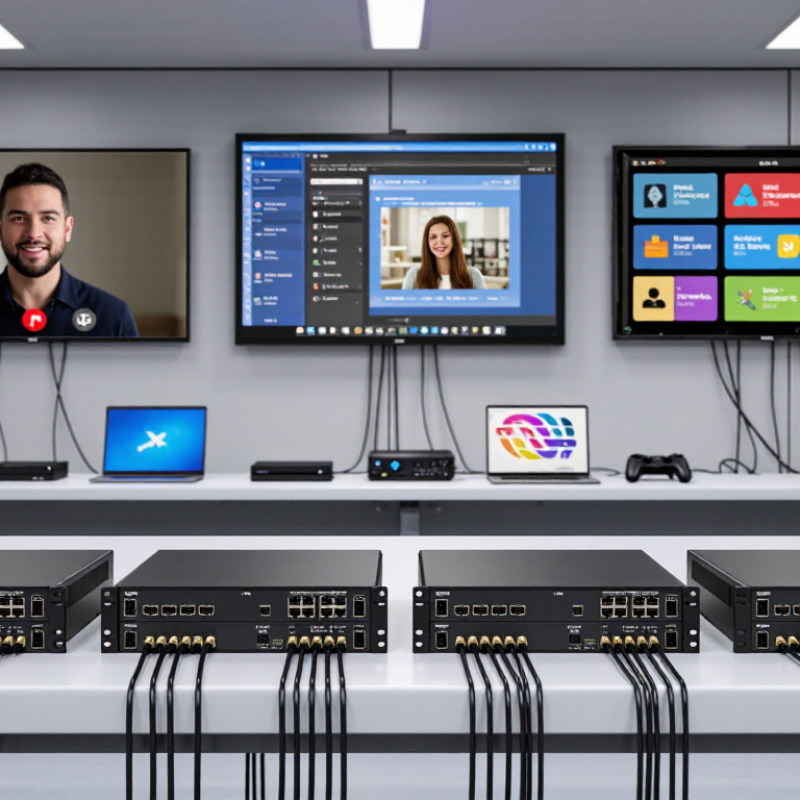
China Top 4x4 HDMI Matrix Switcher Manufacturers?

4×4 HDMI Matrix Switchers: Four Inputs Routed to Four Independent Displays

A 4×4 HDMI matrix switcher sends four input sources to four independent displays. Each screen can show a different source, or several screens can share one. In a control room, that might mean a laptop on display one, a camera feed on display two, and signage on the others. AVIXA’s 2023 Industry Outlook and Trends Analysis estimated global professional audiovisual revenue at $263 billion in 2023, forecasting $325 billion by 2028. The report tracks the wider AV market, not matrix-switcher sales, but its growth points to expanding multi-display needs.

Capacity matters. The HDMI Forum’s HDMI 2.0 specification supports up to 18 Gbps; HDMI 2.1 can reach 48 Gbps. A higher number alone does not guarantee stable 4K or HDR across every output. Check the switcher’s supported resolution, refresh rate, HDCP, and EDID behavior against every source and display. One overlooked detail: long cable runs can weaken a signal. That assumption is shaky. Test the actual setup, especially when displays have different capabilities. A matrix can route signals independently, but it cannot make incompatible devices agree.

China Top 4x4 HDMI Matrix Switcher Manufacturers? - 4×4 HDMI Matrix Switchers: Four Inputs Routed to Four Independent Displays

A specification guide to common 4×4 HDMI matrix switcher configurations. Each unit routes any of four HDMI sources to any of four displays, subject to its supported features.

Specification HDMI 1.4 Class HDMI 2.0 Class HDMI 2.0 with HDBaseT Extension HDMI 2.0 with Audio Breakout
Input / output layout 4 HDMI inputs; 4 HDMI outputs 4 HDMI inputs; 4 HDMI outputs 4 HDMI inputs; 4 receiver-linked display outputs 4 HDMI inputs; 4 HDMI outputs
Routing behavior Each output can select an input independently Each output can select an input independently Each output can select an input independently; extension requires compatible receivers Each output can select an input independently
Typical maximum video format Up to 4K at 30 Hz, depending on color format and device support Up to 4K at 60 Hz; supported color depth and chroma format depend on bandwidth Up to 4K at 60 Hz in supported configurations; format and distance depend on the extender system Up to 4K at 60 Hz; supported color depth and chroma format depend on bandwidth
HDMI bandwidth class Up to 10.2 Gbit/s for HDMI 1.4-class signaling Up to 18 Gbit/s for HDMI 2.0-class signaling HDMI source bandwidth is typically up to 18 Gbit/s; extension capability varies by system Up to 18 Gbit/s for HDMI 2.0-class signaling
Copy protection HDCP support varies by unit; check source and display compatibility HDCP 2.2 support is commonly required for protected 4K content; verify the complete signal path HDCP support must be maintained across the matrix, transmitter, receiver, and display HDCP support varies; audio extraction does not remove source content protection
Audio handling Embedded HDMI audio pass-through; supported formats vary Embedded HDMI audio pass-through; supported formats vary Audio is carried through the compatible extension link; format support varies Embedded audio pass-through plus separate audio outputs on models that provide them
EDID management May include fixed or selectable EDID modes Commonly includes selectable EDID or display-copy modes EDID management may be available; connected receivers and displays affect negotiation Selectable EDID can help coordinate video and extracted audio formats
Typical control options Front-panel buttons; some models add an infrared remote Front panel, infrared remote, and/or RS-232; network control varies Front panel, RS-232, and/or network control; options vary Front panel, infrared remote, RS-232, and/or network control
Common installation use Small rooms with nearby sources and displays Meeting rooms, classrooms, and control rooms using 4K displays Installations where displays are farther from the equipment rack Systems that need separate audio feeds for amplifiers or sound systems

Note: These are general interface classes, not specifications for individual products. Actual resolution, refresh rate, cable distance, HDCP behavior, audio formats, and control features depend on the specific matrix switcher and connected equipment.

HDMI 2.0 vs. 2.1: 18 Gbps and 48 Gbps Bandwidth Benchmarks

A 4x4 HDMI matrix routes four sources to four displays, but its bandwidth limit can shape every viewing choice. HDMI 2.0 supports up to 18 Gbps. In practical terms, that generally accommodates 4K at 60 Hz with 8-bit, 4:4:4 color, depending on the signal timing. HDR or higher color depth may require a different format, such as chroma subsampling. The number on the specification sheet is only part of the story.

HDMI 2.1 can support up to 48 Gbps and enables higher data rates, including 4K at 120 Hz or 8K at 60 Hz in suitable configurations. There is a catch. The source, matrix input and output, cable, and display must all support the chosen format. One older display can also affect routing options if the matrix manages shared EDID settings across outputs. Check the specifications for each port, not just the product’s headline bandwidth. Then test the actual source-to-display combination at its intended resolution, refresh rate, and color depth. A menu showing “4K” is not enough; confirm the refresh rate and chroma format too. Small details matter. Even careful setups can need a second pass.

HDMI 2.0 vs. HDMI 2.1: Maximum Link Bandwidth

A comparison of the specified maximum bandwidth for each HDMI standard.

HDMI 2.0 supports up to 18 Gbps, while HDMI 2.1 supports up to 48 Gbps. These are maximum link bandwidth figures; actual video capabilities depend on the source, display, cable, and supported format.

Key Features to Compare: 4K60, 4K120, HDCP, EDID, and HDR Support

A 4x4 HDMI matrix routes four sources to four displays, but headline resolution alone rarely predicts a reliable installation. For 4K60 systems, check the supported chroma format and color depth, not just “4K” on the specification sheet. For gaming or high-refresh signage, verify 4K120 input and output behavior on every port, including bandwidth requirements and recommended cable lengths. Small details matter.

HDCP compatibility should match connected sources and displays; mixed versions can cause blank screens or reduced output. EDID controls how a source reads display capabilities, so useful presets and copy modes can prevent unexpected resolution changes. Ask whether settings persist after power loss and can be configured per output. A source may feed a 4K television and an older projector at once, and one EDID choice may affect both. Check the chain.

HDR support needs specifics. Confirm HDR10 or HLG passthrough, supported color formats, and whether scaling affects HDR. When comparing manufacturers in China, request port-by-port specifications, compatibility notes, and test results using your source devices, displays, and cable lengths. This test is not perfect; real installations can expose handshake issues that a lab setup misses. Ask how firmware updates are delivered and what technical support covers after installation.

China’s 4×4 HDMI Matrix Manufacturers: Product Range and Technical Capabilities

China’s 4×4 HDMI matrix manufacturers offer products for meeting rooms, classrooms, control centers, and home installations. A 4×4 unit routes any of four sources to any of four displays, independently or in matching groups. Common options include 4K at 60 Hz, HDR pass-through, audio extraction, and selectable EDID settings. Capabilities vary by model, so check the supported bandwidth and HDCP version rather than relying on “4K” alone. Small details matter.

Higher-specification models may support 8K signals, scaling, or separate audio outputs, while compact units often focus on straightforward switching. Control methods typically include front-panel buttons, infrared, RS-232, and Ethernet. For installers, stable switching and predictable behavior after a source change can matter more than a long feature list. Ask for test results with the intended cable length and display combination. A specification sheet cannot reveal every compatibility issue. Some listings also leave key details unclear, which deserves a closer look before purchase. Make sure the matrix’s input and output formats match the actual equipment, including refresh rate, color depth, and audio requirements.

How to Verify Manufacturers: Compliance Testing, Warranty, and After-Sales Support

When comparing China’s 4x4 HDMI matrix switcher manufacturers, verify the exact model, not just the factory’s general testing claims. Ask for recent test reports that identify the unit, firmware version, input format, and operating conditions. Paperwork is not proof. Confirm that reported HDMI and HDCP performance matches your installation requirements, including the resolutions and refresh rates you use.

Request a sample and test switching between four active sources and displays. Check whether the picture returns reliably after a source change, and whether EDID settings behave as described. Small details matter. Ask how the manufacturer handles firmware updates and what troubleshooting records it keeps. A clear warranty should state its duration, covered parts, exclusions, and repair or replacement process. Test the details. Before ordering, ask who pays shipping for a faulty unit and how quickly support responds across time zones. A technically capable factory may still offer slow after-sales service. I would also ask for a named support contact and a written escalation path. No supplier can promise that every installation will be trouble-free; cable length, display settings, and source devices can all affect results. Record the answers and compare them against your own setup, not only a sales sheet.

Copyright 2025 Fluidra S.A. | Created by BCM Marketing Agencia Privacy Policy Legal note | Cookie policy |

Technical cookies are strictly necessary for our website to work and you can navigate through it. These types of cookies are those that, for example, allow us to identify you, give you access to certain restricted parts of the page if necessary, or remember different options or services already selected by you, such as your privacy preferences. Therefore, they are activated by default, your authorization not being necessary in this regard. Through the configuration of your browser, you can block or alert the presence of this type of cookies, although such blocking will affect the proper functioning of the different functionalities of our website.


The analysis cookies allow us to study the navigation of the users of our website in general (for example, which sections of the page are the most visited, which services are used most and if they work correctly, etc.). From the statistical information on navigation on our website, we can improve both the operation of the page itself and the different services it offers. Therefore, these cookies do not have an advertising purpose, but only serve to make our website work better, adapting to our users in general. By activating them you will contribute to this continuous improvement. You can enable or disable these cookies by checking the corresponding box, being disabled by default.


Functionality cookies allow us to remember your preferences, to personalize certain characteristics and general options of our website, every time you access it (for example, the language in which the information is presented to you, the sections marked as favorites, your browser type, etc.) Therefore, this type of cookies does not have an advertising purpose, but by activating them you will improve the functionality of the website (for example, adapting to your type of browser) and the customization of it based on your preferences (for example, by presenting the information in the language that you have chosen in previous occasions), which will contribute to the ease, usability and comfort of our page during your navigation. You can enable or disable these cookies by checking the corresponding box, being disabled by default.


Advertising cookies allow us to manage the advertising spaces included in our website based on criteria such as the content shown or the frequency in which the ads are displayed. For example, if you have been shown the same ad several times on our website, and you have not shown a personal interest by clicking on it, it will not appear again. In summary, by activating this type of cookies, the advertising shown on our website will be more useful and diverse, and less repetitive. You can enable or disable these cookies by checking the corresponding box, being disabled by default.


Behavioral advertising cookies allow us to obtain information based on the observation of your browsing habits and behaviors on the web, in order to show you advertising content that best suits your personal tastes and interests. To understand it in a very simple way, we will give you a fictitious example: if your last searches on the web were related to suspense literature, we would show you advertising about suspense books. Therefore, activating this type of cookies, the advertising that we show you on our website will not be generic, but will be oriented to your searches, tastes and interests, therefore adjusting exclusively to you. You can enable or disable these cookies by checking the corresponding box, being disabled by default.
To understand it in a very simple way, we will give you a fictitious example: if your last searches on the web were related to suspense literature, we would show you advertising about suspense books. Therefore, activating this type of cookies, the advertising that we show you on our website will not be generic, but will be oriented to your searches, tastes and interests, therefore adjusting exclusively to you. You can enable or disable these cookies by checking the corresponding box, being disabled by default.

SAVE

We use our own and third-party cookies to ensure the proper functioning of the website and to analyse our services, improve your experience on our website and show you advertisements related to your interests according to profiling based on your browsing habits (e.g. websites visited). You can accept all cookies by clicking "ACCEPT" or set or reject them by clicking here. If you would like to know more about the use of cookies, please see our COOKIE POLICY.


ACCEPT ALL
Reject no essentials


