
Top 10 3.5t Forklift Types for Global Buyers?
FLUID HANDLING EXPERTS

Blog, all our news

Top 10 3.5t Forklift Types for Global Buyers?

A 3.5t Forklift sits between warehouse agility and heavy-duty material handling. It can move palletized goods, steel coils, building materials, and loaded containers across demanding sites. Yet “3.5-ton” does not describe one universal machine. Mast design, fuel type, tire construction, lift height, and operating environment can change performance significantly.

The World Industrial Truck Statistics (WITS) reports that global industrial truck shipments remain above two million units annually, although market volume varies by region and product category. This trend reflects continued investment in logistics, manufacturing, construction, and port operations. However, shipment data should not be treated as a direct measure of local demand. Classification methods differ, and regional reporting is not perfectly consistent.

Safety and operating conditions deserve equal attention. OSHA highlights struck-by incidents, unstable loads, and poor operator visibility as recurring forklift risks. ISO 3691-1 also emphasizes stability, braking, visibility, and control-system requirements for industrial trucks. In practical evaluations, a diesel model may handle rough yards well, while an electric version can reduce indoor emissions and noise. LPG may offer flexible refueling, but ventilation remains important. Small details matter: a 4.5-meter rack, a sloped loading dock, or a wet concrete floor can change the buying decision.

This guide compares ten 3.5t Forklift types for global buyers. It considers capacity, application fit, energy source, maintenance, safety, and total ownership cost. No type wins everywhere. That is the difficult part. Procurement teams should verify local standards, attachments, duty cycles, and after-sales support before choosing.
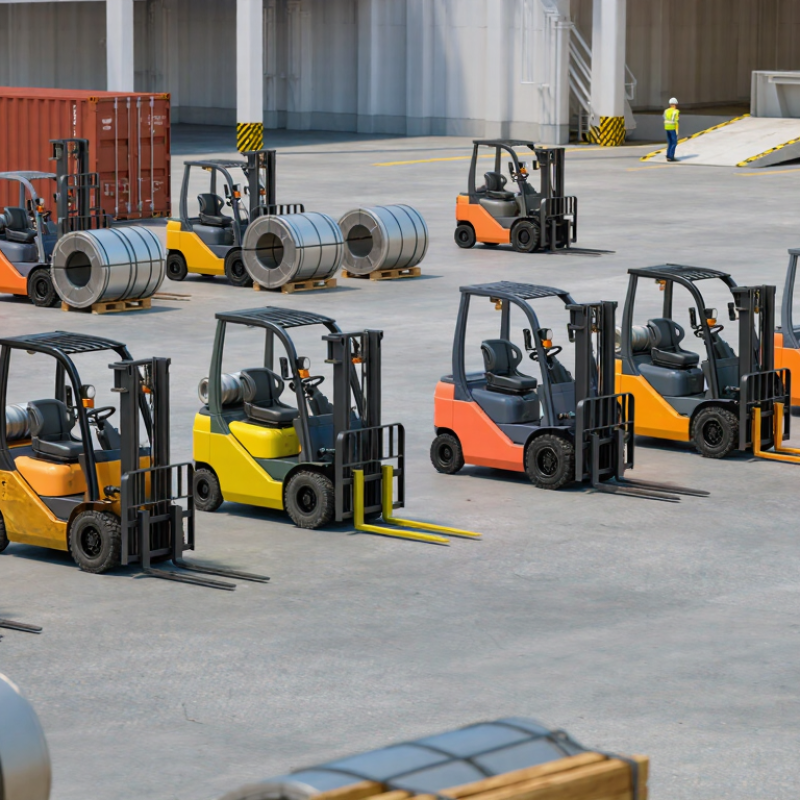
Top 10 3.5t Forklift Types for Global Buyers?

What Defines a 3.5-Ton Forklift?

A 3.5-ton forklift is rated to lift up to 3,500 kilograms under specific conditions. The rating is not a universal promise. It usually depends on a defined load center, often 500 millimeters from the fork face. The load must also remain stable, centered, and within the approved lift height.

That number is conditional. The capacity plate is the controlling reference. It shows how capacity changes with mast height, load center, and attachments. A rotating clamp, longer forks, or side-shift carriage can reduce usable capacity. For example, a dense steel coil may weigh less than 3,500 kilograms but still exceed the permitted load moment. Shape matters.

Counterbalance design is another key feature. A heavy rear frame offsets the lifted load, while the front axle acts as a pivot. Tire choice, wheelbase, mast type, and turning radius affect performance on concrete floors or uneven yards. Electric, diesel, and gas-powered models can all reach this capacity, but operating conditions differ. Indoor work may demand low noise and zero tailpipe emissions. Outdoor work may require stronger traction and weather protection.

A careful buyer checks more than the headline rating. Review the data plate, attachment certificate, floor capacity, aisle width, and local operator rules. Real sites are rarely perfect. A slightly sloped floor, an off-center pallet, or rushed handling can change the risk quickly. A 3.5-ton forklift lifts safely only within its complete rated configuration.

Top 10 3.5t Forklift Types for Global Buyers

Typical maximum lift heights of forklift types commonly configured around a 3.5-tonne rated capacity.

A 3.5-ton forklift is defined by its rated capacity of approximately 3,500 kg under specified load-centre, lift-height, and operating conditions. Lift height varies by mast design, chassis configuration, attachment, and application. The figures shown are representative industry ranges rather than manufacturer specifications.

Counterbalance Forklift Types for General Warehouse Work

A 3.5-ton counterbalance forklift suits many warehouse tasks, but its rated capacity needs careful checking. Capacity depends on the load center, mast height, attachments, and pallet condition. A standard electric model works well indoors, especially on smooth concrete floors. Cushion tires offer tight turning in narrow warehouse areas. Pneumatic tires handle uneven yards and mixed indoor-outdoor routes better. Internal combustion models can provide long operating shifts, but ventilation and fuel storage require more planning.

Tips: Check the capacity plate before every demanding lift. Keep heavy loads low and centered. Measure aisle width with the mast raised. Battery charging space also matters. Floor condition matters. Operators should receive practical training, not only classroom instruction.

In real warehouse inspections, I often find that buyers focus too much on maximum capacity. A 3.5-ton forklift may lift that weight only at a specific load center. A longer pallet can reduce safe capacity quickly.

Electric forklifts are quieter, but charging delays may affect busy shifts. Pneumatic tires are versatile, yet they can mark sensitive floors. I would not choose a forklift from the capacity number alone. My own preference can be wrong when the warehouse layout changes. Check traffic flow, rack height, turning space, and daily shift length before selecting the counterbalance type.

Rough-Terrain Forklifts for Outdoor and Construction Sites

Rough-terrain forklifts give outdoor crews stable lifting power where paved-surface machines struggle. A 3.5-ton model can handle pallets, pipes, and construction materials across uneven ground. Large pneumatic tires absorb ruts better than solid industrial tires. High ground clearance also protects the chassis from rocks and mud.

Four-wheel drive improves traction on slopes, loose gravel, and wet soil. However, traction does not remove rollover risks. Operators still need the rated load chart, a clear travel path, and controlled speeds. On a muddy site, I would test braking and steering before lifting. Small details matter. A tilted load can shift quickly.

Buyers should inspect the mast, carriage, forks, and hydraulic hoses before purchase. Check whether the machine supports attachments used at the site. Side-shifting forks may save time, but they can reduce remaining capacity. Confirm that capacity at reach, not only the headline rating. This is where some buying decisions become too optimistic.

Cab protection, lighting, mirrors, and weather-resistant controls support safer outdoor work. Diesel power often suits long shifts, while other power options may fit emission-sensitive areas. Service access also deserves attention. A machine that waits weeks for a filter or tire becomes expensive, even if its initial price looks attractive. Local safety rules, operator training, and terrain conditions should guide the final specification.

Electric, Diesel, LPG, and Hybrid Power Options

Top 10 3.5t Forklift Types for Global Buyers

Electric, Diesel, LPG, and Hybrid Power Options

A 3.5-ton forklift is not defined by lifting capacity alone. Power choice changes operating cost, noise, maintenance, and site suitability. Electric models fit warehouses, food facilities, and indoor production areas with strict emission limits. They offer quiet movement and precise control. Battery charging space remains essential. A neglected charging plan can stop a shift.

Diesel forklifts suit rough yards, ports, construction sites, and long outdoor cycles. Their strong torque handles uneven ground and heavy attachments, but fuel storage and exhaust management need careful planning. LPG forklifts provide cleaner indoor operation than diesel and allow quick cylinder changes. Ventilation is still important. LPG safety training must be practical, not just paperwork.

Hybrid 3.5-ton forklifts combine an engine with electric assistance during lifting or braking. They may reduce fuel use in repetitive cycles, although results depend on load patterns and maintenance quality. Within these power groups, buyers can compare cushion-tire, pneumatic-tire, rough-terrain, narrow-aisle, counterbalance, reach, side-loading, container-duty, cold-store, and attachment-ready configurations. Not every hybrid delivers the same benefit. Ask for measured fuel data, duty-cycle testing, service access, battery life, and operator feedback. A short trial on the real floor often reveals more than a polished specification sheet.

How Global Buyers Choose the Right 3.5-Ton Forklift

Global buyers compare more than lifting capacity when selecting a 3.5-ton forklift. The practical choice may be an electric counterbalance, diesel, LPG, rough-terrain, narrow-aisle, reach, side-loader, three-wheel, four-wheel, or telehandler configuration. Each suits different work. Warehouse floors favor compact electric models, while construction yards demand ground clearance, traction, and weather protection. According to World Industrial Truck Statistics, global industrial truck shipments exceeded two million units in 2023. That volume shows strong demand, but it does not make every configuration suitable.

Measure the job, not the brochure. Buyers should record pallet dimensions, average load weight, lift height, aisle width, floor condition, daily operating hours, and charging or refueling access. The Industrial Truck Association recommends matching capacity to the load center, because a 3.5-ton rating can fall sharply when loads extend forward. Energy choice also matters. A 2024 report from the European Industrial Truck Association highlights continuing growth in electric truck adoption, supported by quieter operation and lower local emissions. Yet charging space, battery replacement, and shift coverage can create hidden costs. I would recheck these assumptions during a site trial. A smooth indoor floor can hide poor traction near loading docks. Total cost should include tires, maintenance, operator training, downtime, residual value, and safety equipment. The cheapest quote is often incomplete.

Article Source:

Copyright 2025 Fluidra S.A. | Created by BCM Marketing Agencia Privacy Policy Legal note | Cookie policy |

Technical cookies are strictly necessary for our website to work and you can navigate through it. These types of cookies are those that, for example, allow us to identify you, give you access to certain restricted parts of the page if necessary, or remember different options or services already selected by you, such as your privacy preferences. Therefore, they are activated by default, your authorization not being necessary in this regard. Through the configuration of your browser, you can block or alert the presence of this type of cookies, although such blocking will affect the proper functioning of the different functionalities of our website.


The analysis cookies allow us to study the navigation of the users of our website in general (for example, which sections of the page are the most visited, which services are used most and if they work correctly, etc.). From the statistical information on navigation on our website, we can improve both the operation of the page itself and the different services it offers. Therefore, these cookies do not have an advertising purpose, but only serve to make our website work better, adapting to our users in general. By activating them you will contribute to this continuous improvement. You can enable or disable these cookies by checking the corresponding box, being disabled by default.


Functionality cookies allow us to remember your preferences, to personalize certain characteristics and general options of our website, every time you access it (for example, the language in which the information is presented to you, the sections marked as favorites, your browser type, etc.) Therefore, this type of cookies does not have an advertising purpose, but by activating them you will improve the functionality of the website (for example, adapting to your type of browser) and the customization of it based on your preferences (for example, by presenting the information in the language that you have chosen in previous occasions), which will contribute to the ease, usability and comfort of our page during your navigation. You can enable or disable these cookies by checking the corresponding box, being disabled by default.


Advertising cookies allow us to manage the advertising spaces included in our website based on criteria such as the content shown or the frequency in which the ads are displayed. For example, if you have been shown the same ad several times on our website, and you have not shown a personal interest by clicking on it, it will not appear again. In summary, by activating this type of cookies, the advertising shown on our website will be more useful and diverse, and less repetitive. You can enable or disable these cookies by checking the corresponding box, being disabled by default.


Behavioral advertising cookies allow us to obtain information based on the observation of your browsing habits and behaviors on the web, in order to show you advertising content that best suits your personal tastes and interests. To understand it in a very simple way, we will give you a fictitious example: if your last searches on the web were related to suspense literature, we would show you advertising about suspense books. Therefore, activating this type of cookies, the advertising that we show you on our website will not be generic, but will be oriented to your searches, tastes and interests, therefore adjusting exclusively to you. You can enable or disable these cookies by checking the corresponding box, being disabled by default.
To understand it in a very simple way, we will give you a fictitious example: if your last searches on the web were related to suspense literature, we would show you advertising about suspense books. Therefore, activating this type of cookies, the advertising that we show you on our website will not be generic, but will be oriented to your searches, tastes and interests, therefore adjusting exclusively to you. You can enable or disable these cookies by checking the corresponding box, being disabled by default.

SAVE

We use our own and third-party cookies to ensure the proper functioning of the website and to analyse our services, improve your experience on our website and show you advertisements related to your interests according to profiling based on your browsing habits (e.g. websites visited). You can accept all cookies by clicking "ACCEPT" or set or reject them by clicking here. If you would like to know more about the use of cookies, please see our COOKIE POLICY.


ACCEPT ALL
Reject no essentials


