
Turbo Intercooler manufacturers help keep compressed intake air cooler, supporting consistent engine performance under demanding conditions. Their products range from compact air-to-air cores to liquid-cooled systems for specialized applications. Design details matter. Core dimensions, fin density, pressure drop, and weld quality can all affect fit and performance. A large-looking unit is not automatically the best choice.
This guide introduces ten manufacturers with a worldwide presence and considers what buyers should examine beyond brand recognition. It looks at product range, engineering capabilities, manufacturing experience, quality controls, and technical support. These factors can help readers compare suppliers for different vehicles and operating needs. Specifications still require careful checking. A listed temperature reduction or flow rating may depend on test conditions, installation, and surrounding airflow. That can be easy to overlook. Company information and product lines also change, so this overview should be treated as a starting point, not a final verdict. The most suitable manufacturer is the one whose documented specifications, application guidance, and support match the real installation. Even then, comparisons are imperfect; published information may not reveal every difference in testing or long-term service.
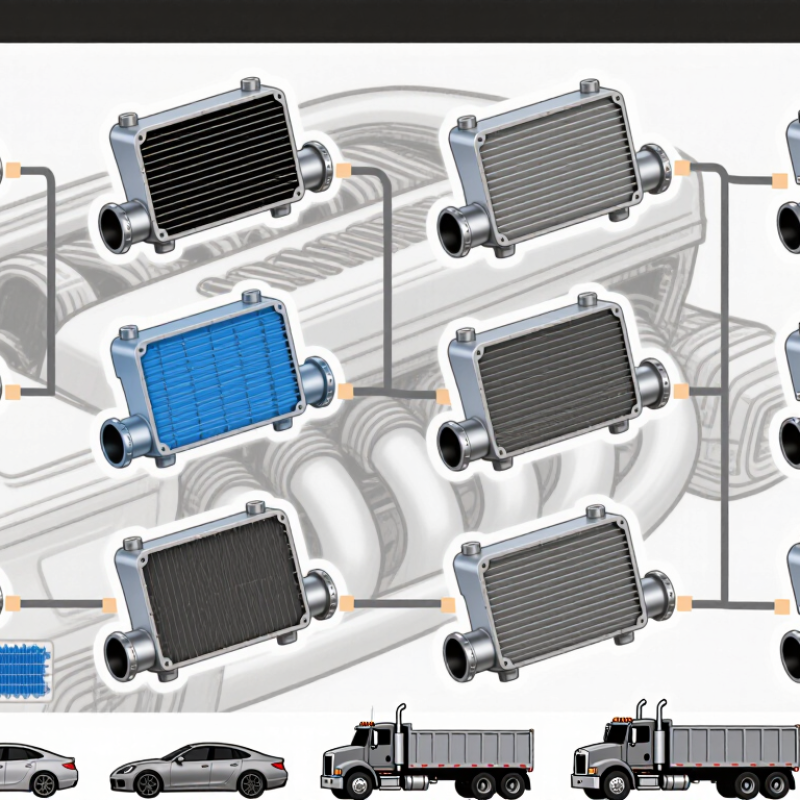
A turbocharger compresses incoming air, and compression also raises its temperature. Hot air is less dense, so each cylinder may receive less oxygen by volume. An intercooler removes some of that heat before the charge reaches the engine. In an air-to-air system, outside air passes across the core’s fins and tubes; in a liquid-to-air design, coolant carries heat away. The details vary.
On a warm day, after a hard pull, the intercooler’s core can feel hot to the touch. Cooling the charge can improve air density and help the engine maintain consistent output. It may also reduce the chance of knock in spark-ignition engines, depending on the engine’s calibration and operating conditions. More power is not automatic. Core size, airflow, heat soak, and pressure drop all matter. Not quite simple. A restrictive core can reduce pressure at the intake, while a poorly placed one may receive little cooling air. Leaks and blocked fins can quietly undermine performance. Comparing intake temperatures before and after a pull can reveal useful patterns, but one test rarely tells the whole story. Real results depend on the complete setup.

Comparing turbo intercooler manufacturers requires matched test conditions, not catalog claims. Record charge-air temperature before and after the core, pressure drop, ambient temperature, and airflow. SAE International’s J1349 engine-power test code offers a recognized framework for repeatable engine measurements, while published SAE charge-air-cooling studies commonly assess thermal performance alongside pressure loss. Ask suppliers for test methods and raw readings.
Consider a bench example: air enters at 150°C and leaves at 60°C, with ambient air at 25°C. The calculated cooling effectiveness is 72 percent. That figure is illustrative, not a universal benchmark; airflow, humidity, and fan setup can change results. Check pressure loss at the engine’s expected flow, too. A cooler that lowers outlet temperature but restricts flow may reduce real-world benefit.
Build quality deserves inspection. Look for even fin spacing, sound welds, consistent core dimensions, and pressure-test records. Ask whether results come from a complete assembly or a bare core. Small details matter. A polished sample can still hide uneven production; batch-level test records offer stronger evidence. Compare warranty terms, material specifications, and delivery consistency, then weigh them against measured performance rather than headline cooling claims.
This is a manufacturer-neutral comparison framework, not a ranked list of companies. Compare suppliers using documented test conditions and application requirements; intercooler performance depends on the vehicle, engine, airflow, and installation.
| No. | Comparison criterion | Evidence or data to request | Useful units or verification method | Why it matters |
|---|---|---|---|---|
| 1 | Thermal performance | Inlet and outlet air temperatures, test ambient temperature, airflow, and test setup for the stated application. | °C; airflow in kg/s or m³/h; documented test conditions | Temperature reduction is meaningful only when the test conditions and airflow are also reported. |
| 2 | Pressure drop | Pressure measured before and after the core at specified airflow and operating conditions. | kPa or bar; paired pressure readings | A restriction through the core can reduce the pressure available to the engine. Comparisons require equivalent test conditions. |
| 3 | Pressure integrity | Proof-pressure or pressure-cycle test method, test pressure, hold time, and acceptance criteria. | kPa or bar; test report or documented procedure | Documented pressure testing helps assess whether the assembly is suitable for its intended boost-pressure application. |
| 4 | Leak testing | Leak-test method, tested assembly configuration, and permitted leakage or pass/fail criteria. | Pressure-decay, immersion, or other stated test method | Leaks at the core, tanks, or joints can impair charge-air delivery and may be difficult to identify after installation. |
| 5 | Core construction and materials | Core type, fin and tube construction, tank material, joining method, and material specifications. | Material grade; construction drawings or product specifications | Construction and materials affect heat transfer, strength, weight, repairability, and compatibility with the intended environment. |
| 6 | Dimensions and fitment | Core dimensions, inlet and outlet sizes and positions, mounting points, and installation clearances. | mm; dimensional drawing or verified vehicle fitment data | Correct dimensions and connection locations help prevent installation conflicts and unsuitable hose routing. |
| 7 | Airflow and connection sizing | Specified airflow range, connection internal diameter, and the conditions used for any flow-capacity claims. | kg/s, m³/h, or L/min; mm for connection diameter | Capacity figures should be assessed against the engine and system requirements, not compared without their test basis. |
| 8 | Durability and corrosion resistance | Environmental or corrosion-test method, coating details where applicable, and durability or pressure-cycle results. | Named test method, exposure conditions, and reported results | Road debris, moisture, salt, vibration, and temperature cycling can affect service life; test details make durability claims more assessable. |
| 9 | Quality management and traceability | Quality-system documentation, inspection records, production traceability, and nonconformance handling process. | Current certificate scope and supporting quality records | A quality-system certificate, such as ISO 9001, concerns a management system; it does not by itself prove a specific intercooler's performance. |
| 10 | Warranty, support, and technical documentation | Written warranty terms, installation guidance, operating limits, replacement-parts availability, and technical support process. | Published terms, manuals, drawings, and response or service arrangements | Clear documentation and support help buyers check application suitability, install the product correctly, and resolve issues. |
The turbo intercooler industry includes manufacturers with very different roots. Some grew from long-running original-equipment supply programs, where repeatable production and strict leak testing matter most. Others began in motorsport fabrication, building compact cores for tight engine bays. Several radiator specialists extended their aluminum-welding skills into charge-air cooling. These backgrounds shape what each maker does well.
Other common profiles include heavy-truck suppliers focused on durability, agricultural-equipment makers serving dusty, high-load conditions, and aftermarket firms designing compact units for passenger cars. Core producers may specialize in bar-and-plate construction, while others favor tube-and-fin layouts. Custom workshops handle low-volume builds and unusual pipe connections. These are ten useful industry profiles, not verified rankings of named companies; without names, a precise company history cannot be checked.
When comparing manufacturers, look beyond origin stories. Ask for pressure-drop data, heat-rejection test conditions, core dimensions, and evidence of production leak checks. A polished weld is useful, but it does not prove performance under repeated heat cycles. Public specifications can also omit testing details. That distinction is easy to miss. I may be giving test documentation more weight than brand history, but for a working vehicle, measurable fit and cooling results are harder to replace.
Turbo intercooler manufacturers differ less by appearance than by how they balance cooling, pressure loss, and installation space. Some prioritize dense fin packs for strong heat transfer at moderate airflow. Others use wider cores and larger passages to reduce restriction in high-output systems. Core material, fin shape, and end-tank design all affect performance. Aluminum is common because it is lightweight and transfers heat well. The trade-off is that a poorly designed core can add unwanted pressure drop. Fit matters most.
Applications shape these choices. A daily-driven car may need a compact intercooler that cools reliably in stop-and-go traffic. A track vehicle faces repeated heat buildup, so airflow and recovery between laps matter. Heavy-duty equipment may need a larger core that tolerates long operating hours and vibration. Manufacturers with strong engineering practices test for leaks, pressure limits, and thermal cycling. Not always.
When comparing options, look beyond core size. Check dimensions, inlet and outlet layout, stated pressure drop, and test conditions. Ask whether performance figures reflect a complete system or only the core. Real-world results depend on ambient temperature, vehicle airflow, and installation quality. A larger intercooler can still perform poorly if airflow bypasses its face. Published figures are not always directly comparable, so treat them as evidence, not a guarantee.
This chart compares representative room-temperature thermal conductivity values for three metals used in heat-exchanger engineering. Aluminum alloys are common in intercooler cores because they balance heat transfer with low weight and manufacturability. Material conductivity alone does not determine intercooler performance: core geometry, airflow, pressure drop, and construction also matter. These are material-property values, not manufacturer rankings.
Choosing a turbo intercooler manufacturer starts with fit, airflow, and reliable testing—not a polished product sheet. Ask whether the core dimensions match your vehicle and available mounting space. A core that looks suitable online may interfere with the radiator, crash bar, or piping once installed. Request pressure-drop and heat-transfer data at operating conditions similar to yours. Numbers without test conditions are hard to compare.
Check the manufacturer’s material specifications, weld quality controls, and inspection process. Consistent fin spacing and sound end-tank joints can affect durability under repeated heat cycles. Ask how products are tested for leaks and pressure resistance, and whether replacement parts are available. Clear technical answers matter. Delivery times, documentation, and responsive support also deserve attention. I have found that these details are easy to overlook when comparing prices, and a low quote can leave important questions unanswered.
Tips: Share your engine setup, target power, and typical driving conditions before requesting a recommendation. Compare like-for-like test data, not just core size. If possible, inspect a sample or installation photos. A small mismatch can mean extra fabrication, even when the intercooler itself is well made.

Cepex is the brand for the fluid handling market belonging to the Fluidra group. One of the leading european manufacturer of valves and fittings in thermoplastic materials.
Dedicated to the swimming pool, irrigation and industrial markets, we distribute our products worldwide with the Fluidra commercial network and presence in 46 countries with 136 sales branches.


