
China’s rubber timing belt industry has moved beyond basic rubber molding.
Many Chinese manufacturers now combine compound development, precision tooth forming, and automated inspection.
Their products serve automobiles, packaging machines, textile equipment, and compact industrial drives.
However, factory size alone does not prove manufacturing strength.
Material consistency matters more.
As belt-drive engineer Dr. Michael S. Kossler explains, “A timing belt performs only as well as its complete drive system.”
This principle deserves attention when comparing China’s leading Rubber Timing Belts manufacturers.
A belt may look flawless on a clean display shelf.
Under heat, oil mist, repeated bending, or sudden load changes, weaknesses become visible.
Tooth profile, tensile cords, backing fabric, and rubber hardness all influence service life.
So do pulley alignment and installation accuracy.
This guide examines ten notable Chinese manufacturers through practical and technical criteria.
It considers production experience, certification practices, testing equipment, export capability, and customer support.
It also reviews whether suppliers provide traceable materials and application-specific designs.
Some companies appear impressive online but reveal limited evidence during technical discussions.
That gap deserves honest reflection.
The selected manufacturers are not ranked by advertising volume alone.
Their strengths may differ widely.
One may excel in automotive replacement belts.
Another may specialize in polyurethane belts or custom industrial profiles.
Buyers should still verify current certificates, samples, tolerances, and warranty terms before ordering.
This article offers a useful starting point, not a substitute for engineering validation.
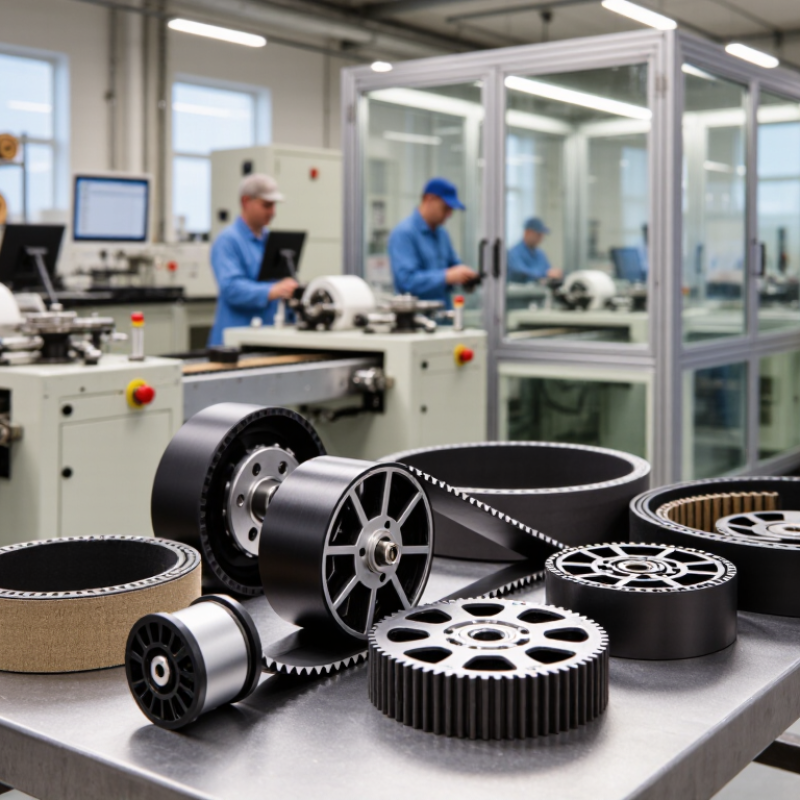
Rubber timing belts are toothed power-transmission components designed to keep shafts synchronized. Their molded teeth engage with matching pulley grooves, preventing normal slip. Unlike smooth belts, they transfer accurate motion through an elastomer body and tensile cords. Common materials include neoprene, polyurethane, fiberglass, aramid, and hydrogenated nitrile rubber. The belt stays quiet.
These belts operate inside vehicle engines, where they coordinate crankshaft and camshaft rotation. They also drive robotic arms, packaging machines, textile equipment, conveyors, compressors, and medical pumps. A 2024 Grand View Research analysis estimated the global automotive timing belt market at about USD 7.1 billion in 2023. It also projected growth near 4% annually through 2030. This demand reflects the need for compact, efficient, and controlled power transmission.
When comparing manufacturers, technical evidence matters more than catalogue appearance. Buyers should check pitch, tooth profile, temperature range, oil resistance, minimum pulley diameter, tensile strength, and tested service life. In workshop practice, incorrect tension often creates noise, tooth wear, or premature cord fatigue. The belt may look perfect. That detail matters. Replacement intervals are not universal, because heat, contamination, load cycles, and pulley alignment change real performance. Industry reports provide useful market direction, but they cannot replace application testing. This is where many supplier comparisons remain incomplete, including some professional-looking lists.

China Top 10 Rubber Timing Belts Manufacturers?
Evaluating China’s leading rubber timing belt manufacturers requires more than comparing online catalogs. Examine their production experience, material controls, and testing procedures. A reliable supplier should explain rubber compounds, tensile cords, tooth profiles, and operating temperature ranges clearly. Factory photos help, but they are not proof. An on-site audit or verified video inspection provides stronger evidence. Ask for batch records, inspection reports, and sample measurements before placing a large order.
Product consistency matters most.
Request samples from different production batches. Check tooth accuracy, belt width, surface finish, and flexibility after repeated bending. Manufacturers with professional laboratories may conduct tensile, aging, and fatigue tests. However, a test report without traceable methods has limited value. Confirm the testing standard, equipment details, and report date. I have found that communication quality often reveals production discipline. Slow or vague answers may indicate weak technical support, though this is not always conclusive.
Tips: Compare at least three suppliers using the same specifications. Ask about mold maintenance, minimum order quantities, replacement policies, and delivery records. Verify whether the factory produces belts directly or mainly trades them. Consider a small trial order before approving regular supply. Price should remain important, but unusually low pricing can hide thinner materials or inconsistent reinforcement. My own evaluation criteria would still need adjustment for special applications, such as high-speed drives or severe temperature changes. A practical decision should combine documents, samples, factory evidence, and after-sales responsiveness.
China’s top 10 rubber timing belt manufacturers are gaining attention as vehicle production and industrial automation expand. The China Association of Automobile Manufacturers reported 31.28 million vehicles produced in 2024. That scale creates steady demand for durable timing systems. MarketsandMarkets projects the global timing belt market to grow from about USD 7.5 billion in 2023 to USD 10.1 billion by 2028. The estimate suggests continued purchasing pressure, but market growth alone does not prove factory quality.
A practical review of China’s top 10 manufacturers should examine rubber formulation, tooth accuracy, tensile-cord strength, and aging resistance. Experienced buyers often request ISO 9001 certification, batch traceability, and test records for heat, oil, and fatigue performance. Some factories offer neoprene belts for general machinery, while others develop high-temperature hydrogenated rubber compounds. Ask for samples. Measure them.
Production scale also matters. China’s dense automotive and machinery supply chains can shorten lead times and support custom molds. However, published catalogs may hide differences in inspection depth, tooling maintenance, and compound consistency. I would compare dimensional reports, warranty terms, and independent test results before ranking suppliers. A low price can become expensive when a belt fails near a hot engine pulley. These manufacturers deserve evaluation through evidence, not promotional claims.
China’s leading ten rubber timing-belt manufacturers usually provide more than finished belts. Their product ranges include automotive timing belts, industrial synchronous belts, double-sided belts, and custom profiles. Common materials include neoprene, HNBR, fiberglass cords, and aramid reinforcement. These choices improve resistance to heat, oil, stretching, and tooth wear.
A 2024 Smithers rubber-industry report estimates global rubber consumption at more than 30 million tonnes annually. That scale increases pressure for stable quality and traceable production. Reliable suppliers normally offer mold development, drawing review, sample production, and batch testing. Testing may cover tensile strength, tooth shear, dimensional accuracy, aging, and temperature resistance. Some factories also provide OEM packaging, private labeling, export documentation, and technical support. Service quality varies, though. A polished catalog does not prove long-term belt performance.
Tips: Ask for test reports, material specifications, production dates, and a clear warranty. Request samples before placing a large order. Check whether the supplier can match tooth pitch, width, length, and cord structure. ISO 5296 and ISO 1813 references can support better specification control. Yet standards alone are not enough. Installation conditions, pulley alignment, tension, and storage can still cause early failure.
Many manufacturers support small trial orders and customized tooling. This helps buyers test fitment before committing to volume production. Stronger suppliers may also provide failure analysis, replacement guidance, and inventory planning. However, after-sales response is often less visible than factory capacity. Buyers should evaluate communication speed, corrective-action records, and inspection consistency. That practical evidence matters.
Choosing among China’s top rubber timing belt manufacturers requires more than comparing catalog prices. The wider automotive belts market was valued at about USD 7.5 billion in 2023, according to Fortune Business Insights, with steady growth expected through 2032. This growth attracts capable factories, but also weaker suppliers. Request ISO 9001 and IATF 16949 certificates, then verify their validity and production scope. A certificate alone proves little.
Ask for measurable details. Check rubber compound specifications, tensile strength, tooth shear resistance, temperature range, and aging results. Request batch-level inspection records, not only a polished sample. A reliable supplier should explain its fiberglass cord, tooth fabric, mold control, and packaging process clearly. Grand View Research identifies material performance and durability as major factors in industrial belt demand. Therefore, ask for test data under heat, oil exposure, and repeated loading.
Test samples in your own application.
Do not choose from a brochure alone. Compare three suppliers using identical drawings, tolerances, and testing conditions. Review lead times, mold ownership, minimum order quantities, and corrective-action procedures. An on-site audit can reveal practical details, such as dusty storage areas or unlabeled compounds. Those details matter. A low quotation may hide unstable materials or inconsistent tooth geometry. Still, even a careful audit is imperfect. Supplier selection should include a small trial order, documented feedback, and a second evaluation after production begins.
Before comparing suppliers, confirm that they can manufacture the required standardized metric pitch and provide matching dimensional, material, and quality documentation.
How to use this chart: The metric pitch sizes shown are commonly specified in synchronous belt systems and are included in the ISO 13050 metric pitch series. When evaluating a Chinese supplier, verify the pitch, tooth profile, belt width, rubber compound, tensile member, dimensional tolerance, test reports, traceability, minimum order quantity, and lead time.

Cepex is the brand for the fluid handling market belonging to the Fluidra group. One of the leading european manufacturer of valves and fittings in thermoplastic materials.
Dedicated to the swimming pool, irrigation and industrial markets, we distribute our products worldwide with the Fluidra commercial network and presence in 46 countries with 136 sales branches.


