
Top 10 Plastic Enclosure Manufacturers Worldwide?
FLUID HANDLING EXPERTS

Blog, all our news

Top 10 Plastic Enclosure Manufacturers Worldwide?

Plastic Enclosures protect sensitive electronics from dust, moisture, impact, heat, and daily handling. They also influence assembly speed, maintenance, product weight, and brand perception. That makes manufacturer selection more than a price comparison.

MarketsandMarkets’ Electrical Enclosures Market report identifies industrial automation, energy infrastructure, and electronics production as major demand drivers. Grand View Research also reports continued growth in global plastics consumption, supported by lightweight design and manufacturing efficiency. However, these reports combine several enclosure materials and applications. Their figures should not be treated as exact Plastic Enclosures sales data.

Standards matter. IEC 60529 defines IP protection ratings, while UL 50E addresses environmental considerations for electrical equipment enclosures. A strong supplier should explain testing, resin selection, flame performance, tolerances, and customization clearly. Vague claims are warning signs.

As Phoenix Contact technology leader Dr. Michael Weinhold puts it, “Protection, connectivity, and serviceability must be designed together.” That principle remains easy to overlook. A sealed box may survive water exposure but complicate cable routing or field repairs.

This guide examines ten leading Plastic Enclosures manufacturers worldwide. It considers engineering capability, material options, production scale, certification practices, customization, and customer support. Rankings are not absolute. Regional availability, application requirements, and purchase volume can change the best choice.

Look closely at the details. A poorly placed screw boss can weaken a thin wall. A careless gasket channel can undermine an impressive IP rating. The enclosure is small, but the consequences are not.
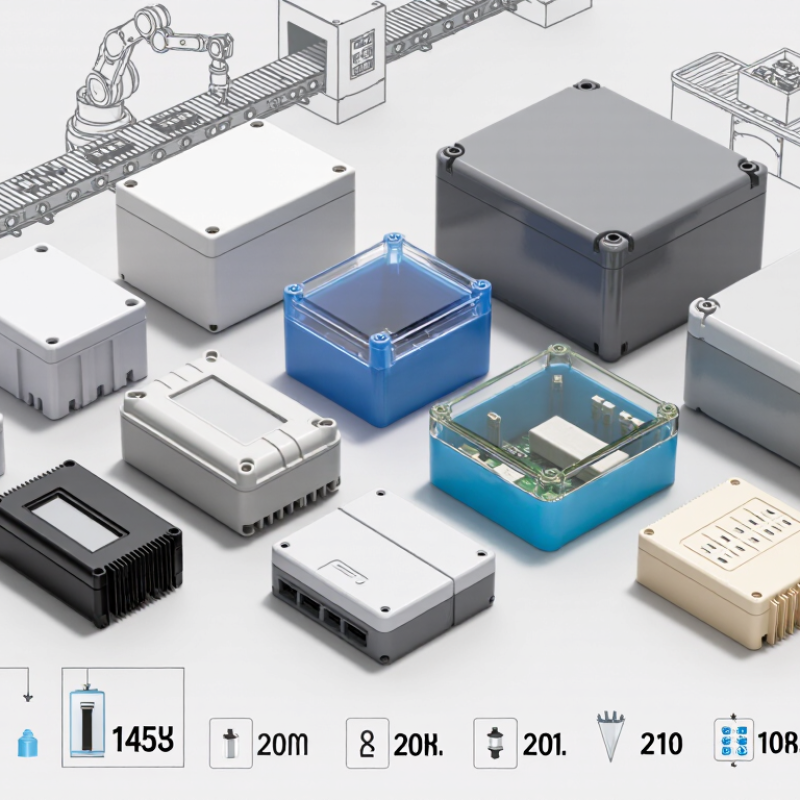
Top 10 Plastic Enclosure Manufacturers Worldwide?

How Plastic Enclosure Manufacturers Are Evaluated Worldwide

Worldwide enclosure manufacturers are evaluated through more than price or production volume. MarketsandMarkets estimated the global electrical enclosures market at about USD 7.5 billion in 2024, with continued growth toward 2029. This expansion increases pressure on manufacturers to prove consistency, not merely capacity. Auditors examine resin traceability, mold maintenance, dimensional control, and documented quality procedures. A reliable factory can show inspection records for wall thickness, thread accuracy, and gasket compression.

Material performance remains a decisive measure. IEC 60529 testing verifies resistance against dust and water through IP ratings. UL 94 testing also assesses plastic flammability behavior. These tests matter in humid workshops, outdoor cabinets, and crowded control panels.

The International Energy Agency’s energy efficiency reports highlight expanding electrification worldwide, which increases demand for durable protection around electrical components. Still, a certification label cannot replace practical validation. Designers should inspect samples after heat cycling, impact tests, and repeated screw installation.

Cost is important, but it can hide weaknesses. A low quotation may exclude tooling corrections, packaging protection, or future design changes. Sustainability also deserves scrutiny. PlasticsEurope reported that Europe recycled roughly 13.5 million tonnes of plastics in 2022, showing progress but leaving substantial room for improvement.

Manufacturers should disclose recycled content, scrap handling, and end-of-life options. In real purchasing work, delivery reliability can be harder to verify than laboratory performance. Some suppliers provide impressive samples, yet struggle with small-batch consistency. That uncomfortable gap deserves closer questioning.

Key Materials, Designs, and Applications in Plastic Enclosures

Top 10 Plastic Enclosure Manufacturers Worldwide?

Plastic enclosures protect electronics from dust, moisture, impact, and accidental contact. Common materials include ABS, polycarbonate, polypropylene, and glass-filled nylon. ABS offers easy machining and a clean surface finish. Polycarbonate performs better where impact resistance and visibility matter. Glass-filled nylon suits warmer, mechanically demanding environments, although it can absorb moisture and change dimensions slightly.

Design should follow the application, not fashion. Wall-mounted boxes need strong fixing points and accessible cable entries. Handheld housings require rounded edges, comfortable grip areas, and reliable screw bosses. Sealed designs often use gaskets, overlapping joints, and carefully controlled compression. Ventilated versions may need membranes to balance airflow and water resistance. In practical testing, weak corners and over-tightened screws remain frequent failure points. No enclosure is perfect.

Tips: Match the polymer to temperature, chemicals, UV exposure, and impact risk. Check wall thickness before adding threads or hinges. Leave space for connectors, wiring bends, and heat-producing components. Prototype the enclosure early. A drawing can hide awkward assembly problems. Engineers should also review flame performance, ingress protection, and recycling requirements with qualified testing laboratories. Small details matter.

Profiles of the Top 10 Plastic Enclosure Manufacturers

The top ten plastic enclosure manufacturers reflect a market shaped by electronics, automation, energy storage, and connected equipment. MarketsandMarkets’ 2024 Electrical Enclosures report forecasts approximately 6.4% annual growth through 2029. That demand favors suppliers with practical engineering, not attractive catalogs alone.

Profile one focuses on flame-retardant ABS housings for control panels. Profile two specializes in polycarbonate boxes for outdoor equipment. Profile three develops compact enclosures for sensors and industrial IoT devices. Others stand out through custom injection molding, transparent covers, EMI shielding, or medical-grade production controls. Several leading manufacturers support IP65 to IP68 testing under IEC 60529. A smaller group also designs around UL 50E and IEC 60670 requirements. Regional production remains important. Mordor Intelligence identifies Asia-Pacific as the fastest-growing area for electrical enclosure demand, supported by factory automation and infrastructure investment. Capability claims still require verification. Some product pages are vague about testing conditions.

Tips: Ask for material data sheets, test reports, wall-thickness drawings, and sample units. Check gasket compression after repeated opening. Confirm whether the quoted IP rating applies to the complete assembled enclosure. Do not assume a higher rating guarantees better field performance. A brittle hinge or poorly placed cable gland can undermine an excellent shell. Pricing also deserves scrutiny, because low tooling costs may conceal longer lead times or limited design revisions.

Global Manufacturing Strengths and Market Coverage

Evaluating the top 10 plastic enclosure manufacturers worldwide requires more than counting factory size. Strong suppliers combine material expertise, tooling control, quality testing, and dependable regional delivery. ABS suits cost-sensitive indoor equipment, while polycarbonate supports tougher industrial environments. Some facilities run injection molding, CNC machining, printing, and assembly under one roof. That arrangement can shorten revisions from weeks to days. Details matter. Wall thickness, gasket compression, heat behavior, and screw-boss strength often decide field performance.

Global coverage is not simply a map with many shipping destinations. Manufacturers with plants or qualified partners across Asia, Europe, and North America can reduce freight delays. Local engineering teams can also adapt cable entries, mounting patterns, and documentation for different customer requirements. Reliable producers publish inspection methods and maintain traceable samples from each production batch. Certifications may support market entry, but they do not replace practical testing. A sealed box may pass a laboratory test and still fail after repeated maintenance. This happens.

Market reach also depends on minimum order quantities, engineering response time, and after-sales support. One supplier may offer advanced molding but lack responsive regional service. Another may provide fast delivery with fewer customization options. A ranking is never perfectly stable; capacity changes with energy costs, tooling loads, and regional demand. That limitation should be stated clearly. Buyers should request samples and perform drop tests, temperature cycling, water ingress checks, and assembly trials. Real performance is learned on the workbench, not only in a spreadsheet.

How to Choose the Right Plastic Enclosure Manufacturer

Choosing a plastic enclosure manufacturer requires more than comparing unit prices. Grand View Research valued the global plastics market at about US$712.6 billion in 2023. That scale creates many capable suppliers, but capability varies sharply by application. Start with material selection. ABS suits economical indoor housings, while polycarbonate handles stronger impact demands. For outdoor equipment, ask about UV stability, sealing, and temperature cycling.

Ask for documented testing, not attractive samples. The enclosure should match the required IP rating under IEC 60529. Request test conditions, sample size, and retest intervals. UL 94 flammability results also matter near electrical components. MarketsandMarkets’ 2024 injection molding analysis identifies automation, repeatability, and process monitoring as major production priorities. Therefore, inspect the supplier’s tooling controls, resin traceability, and dimensional records. A clean factory tour helps. It does not prove long-term reliability.

Evaluate engineering support before signing a contract. A strong manufacturer reviews wall thickness, ribs, draft angles, screw bosses, and heat buildup during design-for-manufacturing checks. Ask how defects are handled, including warpage, sink marks, and color variation. Review pilot-run data before approving mass production. No scorecard is perfect. A prototype can pass while production still disappoints. Confirm minimum order quantities, spare-tool policies, lead times, and change-control procedures in writing. Choose the supplier that can explain failures clearly, not the one offering the lowest first quotation.

Copyright 2025 Fluidra S.A. | Created by BCM Marketing Agencia Privacy Policy Legal note | Cookie policy |

Technical cookies are strictly necessary for our website to work and you can navigate through it. These types of cookies are those that, for example, allow us to identify you, give you access to certain restricted parts of the page if necessary, or remember different options or services already selected by you, such as your privacy preferences. Therefore, they are activated by default, your authorization not being necessary in this regard. Through the configuration of your browser, you can block or alert the presence of this type of cookies, although such blocking will affect the proper functioning of the different functionalities of our website.


The analysis cookies allow us to study the navigation of the users of our website in general (for example, which sections of the page are the most visited, which services are used most and if they work correctly, etc.). From the statistical information on navigation on our website, we can improve both the operation of the page itself and the different services it offers. Therefore, these cookies do not have an advertising purpose, but only serve to make our website work better, adapting to our users in general. By activating them you will contribute to this continuous improvement. You can enable or disable these cookies by checking the corresponding box, being disabled by default.


Functionality cookies allow us to remember your preferences, to personalize certain characteristics and general options of our website, every time you access it (for example, the language in which the information is presented to you, the sections marked as favorites, your browser type, etc.) Therefore, this type of cookies does not have an advertising purpose, but by activating them you will improve the functionality of the website (for example, adapting to your type of browser) and the customization of it based on your preferences (for example, by presenting the information in the language that you have chosen in previous occasions), which will contribute to the ease, usability and comfort of our page during your navigation. You can enable or disable these cookies by checking the corresponding box, being disabled by default.


Advertising cookies allow us to manage the advertising spaces included in our website based on criteria such as the content shown or the frequency in which the ads are displayed. For example, if you have been shown the same ad several times on our website, and you have not shown a personal interest by clicking on it, it will not appear again. In summary, by activating this type of cookies, the advertising shown on our website will be more useful and diverse, and less repetitive. You can enable or disable these cookies by checking the corresponding box, being disabled by default.


Behavioral advertising cookies allow us to obtain information based on the observation of your browsing habits and behaviors on the web, in order to show you advertising content that best suits your personal tastes and interests. To understand it in a very simple way, we will give you a fictitious example: if your last searches on the web were related to suspense literature, we would show you advertising about suspense books. Therefore, activating this type of cookies, the advertising that we show you on our website will not be generic, but will be oriented to your searches, tastes and interests, therefore adjusting exclusively to you. You can enable or disable these cookies by checking the corresponding box, being disabled by default.
To understand it in a very simple way, we will give you a fictitious example: if your last searches on the web were related to suspense literature, we would show you advertising about suspense books. Therefore, activating this type of cookies, the advertising that we show you on our website will not be generic, but will be oriented to your searches, tastes and interests, therefore adjusting exclusively to you. You can enable or disable these cookies by checking the corresponding box, being disabled by default.

SAVE

We use our own and third-party cookies to ensure the proper functioning of the website and to analyse our services, improve your experience on our website and show you advertisements related to your interests according to profiling based on your browsing habits (e.g. websites visited). You can accept all cookies by clicking "ACCEPT" or set or reject them by clicking here. If you would like to know more about the use of cookies, please see our COOKIE POLICY.


ACCEPT ALL
Reject no essentials


