
Choosing among the Top 10 Flame Retardant Cable Manufacturers requires more than comparing product prices or catalog images. A dependable review should examine fire-test performance, material quality, production experience, certification records, and project support. These details matter when cables run through hospitals, tunnels, data centers, ships, or crowded commercial buildings. Smoke can fill a corridor quickly. A cable jacket must resist ignition, limit flame spread, and avoid creating excessive corrosive gases.
Dr. Richard Hull, a recognized fire-safety and flame-retardancy researcher, has emphasized: “Cable fire performance depends on the complete cable construction, not one material alone.” That principle guides this comparison. A serious manufacturer should explain its conductor design, insulation compound, shielding, bending radius, and test methods. Relevant evaluations may include IEC 60332 flame propagation, IEC 60754 halogen-acid gas testing, and IEC 61034 smoke density testing. However, certificates should be checked against the exact model, size, and production site. Marketing claims can be incomplete.
This introduction is not a perfect ranking. Public information differs between manufacturers, and regional certifications are not always directly comparable. Some suppliers publish detailed laboratory data; others provide only broad performance statements. That weakness deserves attention. The following list therefore considers technical credibility, manufacturing capacity, documented quality control, customization ability, and service reliability. It also recognizes practical experience, such as stable performance during installation, clear labeling, and consistent delivery. A Flame Retardant Cable is not valuable merely because it passes one test. It must perform as part of a real electrical system, under heat, pressure, movement, and time.
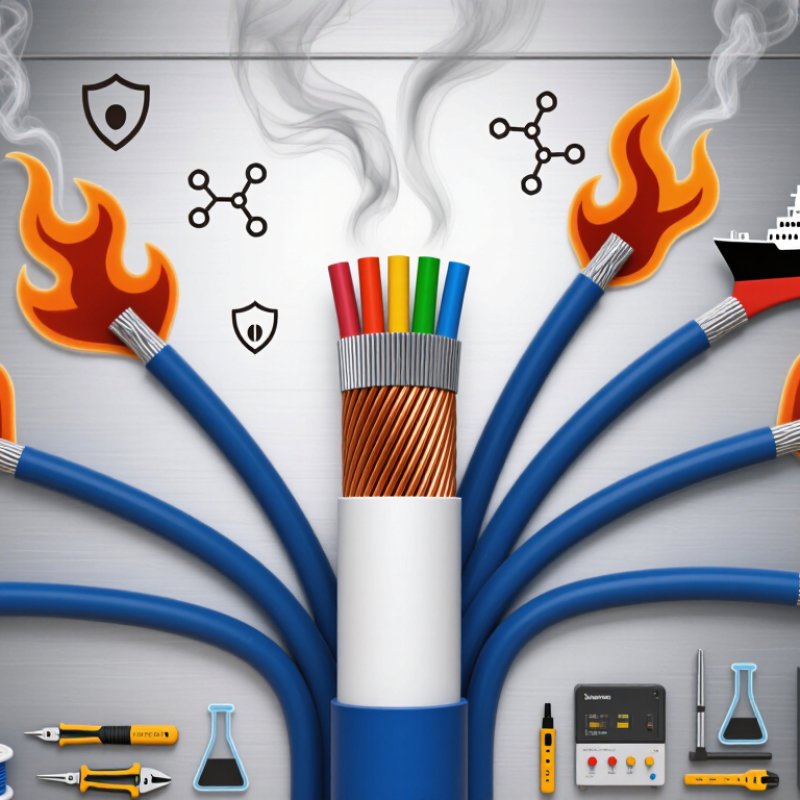
A flame retardant cable manufacturer is defined by evidence, not attractive product claims. The manufacturer should explain the cable’s conductor, insulation, sheath, and fire-performance rating in clear technical documents. IEC 60332-1-2 evaluates flame spread on a single vertical cable, while IEC 60332-3 examines grouped cables under more demanding conditions. These tests are not interchangeable. A reliable manufacturer reports the exact test method, sample arrangement, and certification scope.
Real-world risk makes this discipline important. The NFPA report Electrical Fires in Non-Home Structures, 2016–2020, recorded an estimated 37,910 fires involving electrical distribution and lighting equipment in the United States. These incidents caused approximately 295 civilian deaths, 1,100 injuries, and 1.2 billion dollars in direct property damage. Cable selection cannot remove every hazard. It can reduce flame propagation when designed correctly.
Manufacturing quality also defines credibility. Look for controlled compound mixing, conductor resistance checks, extrusion monitoring, spark testing, and batch traceability. Independent laboratory testing adds stronger assurance than an internal certificate alone. A capable supplier should also distinguish flame retardance from low smoke, low toxicity, and fire resistance. They are different performance goals. In my experience, technical teams sometimes choose a cable from a familiar specification without checking installation grouping or ventilation. That is a weakness worth admitting. A manufacturer that openly states limitations, retest intervals, and application boundaries usually deserves closer technical review.
| Rank | Evaluation Dimension | Verified Technical Benchmark | Why It Defines a Qualified Manufacturer | Recommended Evidence |
|---|---|---|---|---|
| 1 | Flame-Propagation Performance | Products should be tested against the applicable IEC 60332 series or an equivalent recognized national standard. IEC 60332-1-2 evaluates vertical flame propagation on a single insulated wire or cable. | A genuine flame-retardant cable manufacturer validates that the cable limits flame spread rather than relying only on the term “flame retardant.” | Independent test report, standard edition, cable construction, and test sample identification. |
| 2 | Low Smoke and Corrosive Gas Control | Where specified, low-smoke halogen-free cables are assessed using methods such as IEC 61034 for smoke density and IEC 60754 for halogen-acid gas emission and acidity or conductivity. | It demonstrates awareness that fire safety includes visibility, corrosive emissions, and protection of electronic equipment—not flame resistance alone. | Smoke-density results, halogen-gas results, material declaration, and product designation. |
| 3 | Circuit-Integrity Capability | For emergency or safety circuits, manufacturers should offer fire-resistant constructions tested to the relevant circuit-integrity requirements, such as IEC 60331, when required by the application. | Flame retardancy limits fire spread; fire resistance is intended to maintain circuit operation for a defined period under specified test conditions. | Declared survival time, voltage and conductor arrangement, mounting method, and full test report. |
| 4 | Material and Compound Traceability | Insulation, sheath, filler, screen, and fire-performance compounds should have controlled formulations, batch identification, and incoming-material inspection records. | Consistent compound control helps maintain repeatable flame, smoke, mechanical, and electrical performance across production batches. | Batch certificates, formulation control procedure, supplier qualification records, and material lot traceability. |
| 5 | Electrical Safety and Conductor Quality | Conductor resistance, insulation resistance, withstand voltage, dimensional properties, and marking should comply with the applicable cable product standard. | Fire performance cannot compensate for inadequate electrical insulation, incorrect conductor size, or poor manufacturing consistency. | Routine test records, conductor-resistance data, insulation tests, and calibrated equipment records. |
| 6 | Mechanical and Environmental Durability | The manufacturer should specify temperature rating, bending radius, tensile and elongation performance, oil or chemical resistance, UV suitability, and water-resistance limitations where applicable. | A cable’s fire behavior must remain reliable after installation stresses and exposure to the environment defined by its application. | Product datasheet, environmental test results, installation limits, and clearly stated operating temperature range. |
| 7 | Conformity Assessment and Certification | Applicable conformity documents should identify the exact product family, rated voltage, construction, testing scope, and certification or assessment basis. | A credible manufacturer connects each certificate to a defined product rather than presenting unrelated or broad corporate claims. | Current certificates, scope statements, certificate numbers, validity dates, and product cross-reference. |
| 8 | Production Quality Management | Manufacturing should use documented process controls for conductor stranding, insulation extrusion, screening, sheathing, spark testing, dimensional checks, and final inspection. | Process control reduces variation that could affect both electrical safety and fire-performance results. | Quality manual, inspection plan, nonconformance procedure, calibration certificates, and production records. |
| 9 | Application Engineering Support | Technical documentation should cover conductor material, insulation and sheath materials, voltage rating, temperature rating, installation method, bending radius, and applicable fire classification. | Correct cable selection depends on the complete installation context, not on a single flame-test label. | Complete datasheet, selection guide, installation instructions, technical drawings, and response procedure for engineering queries. |
| 10 | Supply Reliability and After-Sales Control | The supplier should maintain lot identification, inspection release, packaging controls, storage guidance, complaint handling, and corrective-action records. | Traceable delivery and effective corrective action help preserve compliance throughout the product’s commercial life. | Certificate of conformity, reel or batch records, warranty terms, complaint process, and corrective-action documentation. |
Note: The applicable test standard and acceptance criteria depend on the cable type, rated voltage, installation environment, building regulations, and project specification. Flame retardancy, low smoke, halogen-free performance, and fire resistance are distinct properties and should not be treated as interchangeable.

Cepex is the brand for the fluid handling market belonging to the Fluidra group. One of the leading european manufacturer of valves and fittings in thermoplastic materials.
Dedicated to the swimming pool, irrigation and industrial markets, we distribute our products worldwide with the Fluidra commercial network and presence in 46 countries with 136 sales branches.


