
What Is a Titanium Bar Used For?
FLUID HANDLING EXPERTS

Blog, all our news

What Is a Titanium Bar Used For?

A Titanium Bar is not a finished component by itself. It is versatile stock, cut and machined into parts for demanding environments. Engineers may choose titanium bars for aerospace fittings, chemical-processing equipment, marine hardware, and selected medical devices. The reason is practical: titanium alloys can combine low weight with useful strength and corrosion resistance. But the right choice depends on the grade, product condition, design, and service environment. “Titanium” alone is not a specification.

Materials expert Matthew J. Donachie, author of Titanium: A Technical Guide, offers a useful foundation for understanding the material. The following is an editorial paraphrase, not a verbatim quotation: “Select titanium by its alloy and working conditions, not by its name alone.” That distinction matters. A bar intended for machining may need different properties and documentation from one intended for a corrosive process line. Buyers should check material certificates, dimensions, surface condition, and applicable specifications with qualified suppliers. Small details matter.

This outline explores what titanium bars are, how their properties support different applications, and what to consider when selecting them. It also looks at machining and practical limits, including cost and the need for suitable fabrication expertise. Titanium can solve real engineering problems. It is not automatically the best answer. And one detail is easy to overlook: a material’s performance in service depends on the entire design, not just the bar.
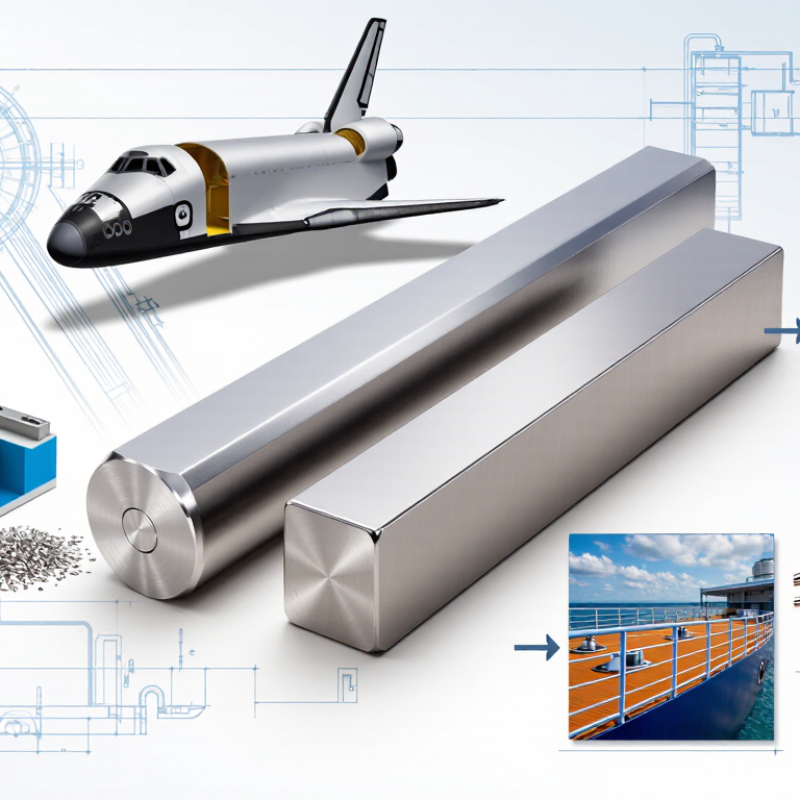
What Is a Titanium Bar Used For?

What Is a Titanium Bar?

What Is a Titanium Bar?

A titanium bar is a solid length of titanium or titanium alloy, supplied as stock for machining, forming, or fabrication. It may be round, square, or rectangular, depending on the specification and manufacturing process. ASTM B348/B348M covers titanium and titanium-alloy bars and billets, including requirements for chemical composition and mechanical properties. In practice, the grade and condition matter as much as the shape.

Titanium’s density is about 4.51 g/cm³, according to ASM Handbook, Volume 2: Properties and Selection: Nonferrous Alloys and Special-Purpose Materials. That is roughly 60% of the density of steel, though the comparison depends on the steel grade. A bar can therefore provide useful strength without the same weight as many steel parts. It also forms a stable oxide layer that helps it resist corrosion in many environments. Not everywhere, though.

Machinists often cut bars into shafts, fasteners, structural fittings, and components for chemical-processing or marine equipment. Medical-grade alloy bars can also become implant components after careful machining and finishing. The raw bar is not automatically suitable for every job: buyers must check alloy grade, diameter tolerance, surface condition, and the relevant test certificates. A shiny surface alone proves little. For a clear specification, ASTM B348/B348M and the supplier’s material test report are practical starting points.

What Is a Titanium Bar Used For? - What Is a Titanium Bar?

Application Common Bar Material Typical Components Why Titanium Is Used
Aerospace Ti-6Al-4V (Grade 5) Machined structural fittings, brackets, fasteners, and landing-gear components High strength relative to weight and useful performance at elevated temperatures compared with many aluminum alloys.
Medical devices Commercially pure titanium or Ti-6Al-4V ELI (Grade 23) Bone screws, plates, implant components, and surgical instruments Good corrosion resistance and biocompatibility when the specified alloy, processing, and surface finish are suitable for the device.
Chemical processing Commercially pure titanium, such as Grade 2 Valve stems, pump shafts, fittings, and parts exposed to selected process chemicals Resists corrosion in many oxidizing environments, including some chloride-containing applications; suitability depends on the exact chemistry and conditions.
Marine equipment Commercially pure titanium or selected titanium alloys Fasteners, shafts, and machined components for seawater service Strong resistance to seawater corrosion and a relatively low density compared with many corrosion-resistant metals.
Automotive and motorsport Ti-6Al-4V (Grade 5) Specialty fasteners, connecting-rod components, and suspension parts Can reduce component mass while providing high strength; cost and machining requirements generally limit use to selected parts.
Energy and industrial machinery Commercially pure titanium or an application-specific alloy Machined shafts, impeller parts, valve components, and equipment fittings Combines corrosion resistance with useful strength; alloy choice must match operating temperature, loads, and fluid conditions.

What is a titanium bar? It is solid titanium or titanium-alloy stock supplied in forms such as round, square, or flat bar, then cut or machined into parts. The appropriate grade depends on the required strength, corrosion resistance, manufacturing process, and applicable standards.

Key Properties That Make Titanium Bars Useful

Titanium bars are valued for combining relatively low weight with useful strength and strong corrosion resistance. The ASM Handbook reports a density of about 4.5 g/cm³ for titanium, roughly half that of steel. The NIST Chemistry WebBook lists its melting point near 1,668°C. These figures help explain its use in aircraft structures, marine fittings, and chemical-processing equipment. The bar’s actual performance still depends on its grade, processing, and service conditions. That distinction matters.

A thin, stable oxide film protects titanium from many corrosive environments, while its strength-to-weight ratio can reduce component mass. For Grade 5 bar, ASTM B348 specifies a minimum tensile strength of 895 MPa. That is a defined material requirement, not a guarantee for every titanium bar. Bar stock also suits machined parts, but titanium can be difficult to cut and may gall against tooling. It is not an effortless substitute for steel. Engineers must weigh those machining demands and higher material costs against corrosion resistance, mass, and expected service life.

What Is a Titanium Bar Used For?

Titanium bars are machined into components for aerospace, chemical processing, medical, and marine applications. At about 4.51 g/cm³, titanium is less dense than common steels while offering strong, durable performance and excellent corrosion resistance.

Approximate material densities; actual values vary by alloy and composition.

How Titanium Bars Are Made and Supplied

Titanium bars begin as sponge titanium, often blended with carefully measured alloying elements. The mixture is melted in a controlled vacuum or inert atmosphere to limit contamination. Once solidified, the ingot may be remelted to improve consistency. It is then forged or rolled into a bar. Details matter.

Processing continues with heat treatment, straightening, and surface finishing. Each step affects strength, ductility, and dimensional accuracy. A producer checks the bar’s chemistry and dimensions, then uses suitable inspection methods to look for internal or surface defects. Requirements vary by grade and application, so one inspection plan does not fit every order. Small process differences can matter; they are easy to underestimate.

Supply involves more than shipping metal. Buyers typically specify the grade, diameter or cross-section, length, and required condition, such as annealed or solution treated. Bars may arrive in standard lengths or be cut to size, with identification and test documents linked to the material. Clear records help receiving teams verify the order and maintain traceability. Still, paperwork cannot replace checking the delivered bar against its purchase requirements. A practical detail worth revisiting is packaging: scratches or mixed labels can create avoidable delays.

Common Applications of Titanium Bars

Titanium bars are valued for high strength, low weight, and corrosion resistance. In aircraft, they can be machined into fasteners, landing-gear parts, and engine components where steel may add unwanted mass. Boeing’s 2024 Commercial Market Outlook forecasts demand for 43,975 new commercial airplanes through 2043, signaling a substantial long-term need for aircraft materials. It does not mean every part uses titanium; designers weigh cost, load, and operating conditions.

Medical manufacturers use appropriately certified titanium bar stock for components such as bone screws and joint parts. Its strength and compatibility with the body make it useful, but the finished device still needs careful material control and machining. Chemical-processing plants also use titanium parts in equipment exposed to corrosive liquids, while marine applications benefit from resistance to seawater. The USGS 2024 Mineral Commodity Summaries estimated global titanium sponge production at about 300,000 tonnes in 2023, documenting the scale of the upstream material supply. A bar is only one step in that chain. Titanium is not always the better choice; high material and machining costs can outweigh weight savings.

Tips: Match the bar’s grade and dimensions to the part’s loads and environment. Check certification and traceability before machining. A shiny surface alone proves little. For critical components, confirm specifications with a qualified materials engineer.

How to Select a Titanium Bar for a Specific Use

Choosing a titanium bar starts with the job it must perform, not simply the highest strength listed on a datasheet. For wet, mildly corrosive environments, commercially pure Grade 2 may offer useful corrosion resistance and easier forming. For weight-sensitive parts that need greater strength, Grade 5, an alloy of titanium, aluminum, and vanadium, is often considered. Neither is automatically the better choice. The operating temperature, expected loads, exposure to chemicals, and joining method all affect suitability.

Check the bar’s diameter, straightness, tolerances, and surface condition against the finished part. A machined component may need extra stock for material removal; a close-fit assembly may demand tighter dimensional control. Ask for material certificates and confirm the specified grade and product condition before fabrication. Small details matter.

Also consider machining: titanium can generate heat at the cutting edge, so tooling and cutting parameters need careful control. It is easy to over-specify strength and overlook cost, availability, or fabrication limits. That trade-off deserves a second look. When requirements are uncertain, compare candidate grades with a qualified materials engineer and test a representative sample under realistic conditions.

Copyright 2025 Fluidra S.A. | Created by BCM Marketing Agencia Privacy Policy Legal note | Cookie policy |

Technical cookies are strictly necessary for our website to work and you can navigate through it. These types of cookies are those that, for example, allow us to identify you, give you access to certain restricted parts of the page if necessary, or remember different options or services already selected by you, such as your privacy preferences. Therefore, they are activated by default, your authorization not being necessary in this regard. Through the configuration of your browser, you can block or alert the presence of this type of cookies, although such blocking will affect the proper functioning of the different functionalities of our website.


The analysis cookies allow us to study the navigation of the users of our website in general (for example, which sections of the page are the most visited, which services are used most and if they work correctly, etc.). From the statistical information on navigation on our website, we can improve both the operation of the page itself and the different services it offers. Therefore, these cookies do not have an advertising purpose, but only serve to make our website work better, adapting to our users in general. By activating them you will contribute to this continuous improvement. You can enable or disable these cookies by checking the corresponding box, being disabled by default.


Functionality cookies allow us to remember your preferences, to personalize certain characteristics and general options of our website, every time you access it (for example, the language in which the information is presented to you, the sections marked as favorites, your browser type, etc.) Therefore, this type of cookies does not have an advertising purpose, but by activating them you will improve the functionality of the website (for example, adapting to your type of browser) and the customization of it based on your preferences (for example, by presenting the information in the language that you have chosen in previous occasions), which will contribute to the ease, usability and comfort of our page during your navigation. You can enable or disable these cookies by checking the corresponding box, being disabled by default.


Advertising cookies allow us to manage the advertising spaces included in our website based on criteria such as the content shown or the frequency in which the ads are displayed. For example, if you have been shown the same ad several times on our website, and you have not shown a personal interest by clicking on it, it will not appear again. In summary, by activating this type of cookies, the advertising shown on our website will be more useful and diverse, and less repetitive. You can enable or disable these cookies by checking the corresponding box, being disabled by default.


Behavioral advertising cookies allow us to obtain information based on the observation of your browsing habits and behaviors on the web, in order to show you advertising content that best suits your personal tastes and interests. To understand it in a very simple way, we will give you a fictitious example: if your last searches on the web were related to suspense literature, we would show you advertising about suspense books. Therefore, activating this type of cookies, the advertising that we show you on our website will not be generic, but will be oriented to your searches, tastes and interests, therefore adjusting exclusively to you. You can enable or disable these cookies by checking the corresponding box, being disabled by default.
To understand it in a very simple way, we will give you a fictitious example: if your last searches on the web were related to suspense literature, we would show you advertising about suspense books. Therefore, activating this type of cookies, the advertising that we show you on our website will not be generic, but will be oriented to your searches, tastes and interests, therefore adjusting exclusively to you. You can enable or disable these cookies by checking the corresponding box, being disabled by default.

SAVE

We use our own and third-party cookies to ensure the proper functioning of the website and to analyse our services, improve your experience on our website and show you advertisements related to your interests according to profiling based on your browsing habits (e.g. websites visited). You can accept all cookies by clicking "ACCEPT" or set or reject them by clicking here. If you would like to know more about the use of cookies, please see our COOKIE POLICY.


ACCEPT ALL
Reject no essentials


