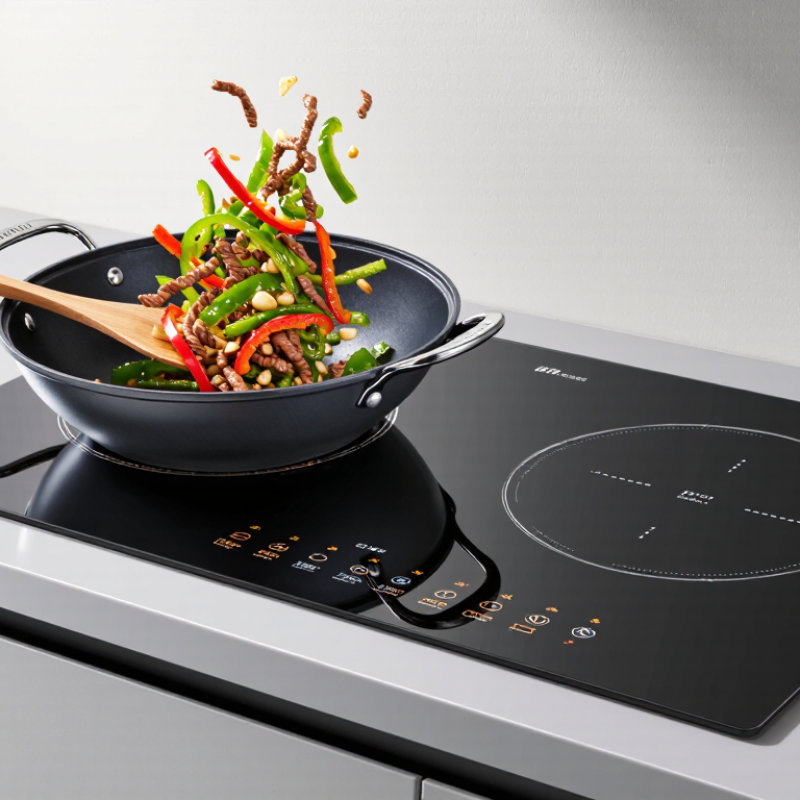
Choosing the right Wok Induction Hob can change how confidently you cook every day. A suitable model should heat quickly, respond accurately, and support the rounded base of a wok. However, specifications alone do not tell the whole story. Real performance depends on pan size, induction compatibility, kitchen ventilation, and your cooking habits.
This guide shares ten practical tips based on common kitchen testing principles and everyday cooking needs. We will examine power ratings, temperature control, cooking-zone dimensions, safety features, cleaning design, and electrical requirements. A powerful hob may sear beef quickly, but poor control can burn garlic within seconds. Small details matter.
Look closely.
You should also consider whether the surface holds a stable wok during vigorous tossing. Some compact hobs have strong heating but limited space around the cookware. Others include touch controls that become difficult to use with wet fingers. These weaknesses are easy to overlook in a showroom.
Reliable guidance requires more than repeating manufacturer claims. Check independent reviews, warranty terms, installation instructions, and user feedback from comparable kitchens. It is also wise to admit that no single Wok Induction Hob suits everyone. A professional cook may prioritise rapid recovery, while a home user may value quiet operation and easy cleaning.
The best choice balances performance, safety, durability, and realistic kitchen conditions. With these ten tips, you can compare models more carefully and avoid paying for features you may rarely use.
Define Wok Induction Hob Types and Cooking Requirements
10 Tips for Choosing the Best Wok Induction Hob
Define the hob type before comparing power ratings. A dedicated wok induction hob has a concave cooking zone that supports a round-bottom wok securely. It heats the center strongly and suits stir-frying, tossing, and quick sauce reduction. A flat induction hob works with a flat-bottom wok or a stable adapter ring. It offers more flexibility, but heat may spread less evenly. A portable single-zone unit fits small kitchens and outdoor cooking areas, although its controls and cooling system can feel limited.
Tip 1: Match the hob to your wok base.
Measure the contact area, not only the rim diameter.
Tip 2: Check real power and temperature control.
High wattage helps boiling, but gentle settings protect garlic, oil, and delicate vegetables. Too much power is wasteful.
Tip 3: Look for responsive controls,
because wok cooking changes every few seconds. Touch panels can be difficult with wet fingers.
Cooking requirements should guide installation decisions. Frequent family cooking needs a broad zone, stable pan support, and effective heat recovery after adding cold ingredients. Occasional users may prefer a compact design with simple cleaning. Confirm electrical capacity, ventilation space, child safety features, and overheat protection with a qualified installer. A smooth glass surface cleans quickly, but splashes can become stubborn if ignored.
I once underestimated handle clearance; the wok felt awkward beside a wall. Measure your counter carefully. Small details matter.
Check Induction Compatibility, Power, and Heating Performance
10 Tips for Choosing the Best Wok Induction Hob
Check Induction Compatibility, Power, and Heating Performance
Tip 1Confirm that your wok has a magnetic base. A simple magnet test helps.
Tip 2Choose a hob with a flat, stable induction zone. Round-bottom woks may wobble or heat unevenly.
Tip 3Compare rated power, not just attractive heating claims. Around 2,000 watts suits many home stir-fries, while larger cookware may need more.
Tip 4Look for adjustable power levels. Gentle heat protects garlic, scallions, and thin sauces from scorching.
Tip 5Check whether the hob maintains steady heat after reaching high temperature. Some models pulse power noticeably.
Tip 6Test the control response if possible. Precise touch controls make quick changes easier during stir-frying.
Tip 7Examine the cooking zone size against your wok’s base. A small zone can leave the sides surprisingly cool.
Tip 8Consider recovery speed after adding cold vegetables or meat. Strong induction performance should restore heat quickly.
Tip 9Inspect ventilation and surface clearance. Blocked airflow can reduce output and shorten service life.
Tip 10Read independent testing details, not only product descriptions. Look for measured boil times, temperature stability, and noise levels.
I once focused too much on maximum power. The food still cooked unevenly because the wok base was too narrow. That mistake changed my buying checklist.
Also, high power is not always better. A responsive hob with stable medium heat can produce cleaner, crisper stir-fries.
Leave room for uncertainty. Kitchen wiring, cookware thickness, and ingredient volume all affect real performance.
Compare Wok Size, Shape, Materials, and Temperature Control
Choosing a wok induction hob begins with the wok’s contact area, not its advertised diameter. A 30–36 centimetre wok may look spacious, but its flat base must match the induction coil. A round-bottom wok often heats unevenly without a compatible support ring. Flat-bottom designs sit more securely, although they lose some traditional tossing freedom. Check the hob’s usable cooking zone with a ruler.
Material matters. Cast iron and magnetic stainless steel usually respond well, while copper and aluminium need a magnetic base. Test the wok with a small magnet before purchasing. The U.S. Department of Energy’s Energy Saver guidance states that induction transfers about 85% of its energy to cookware, compared with roughly 75–80% for standard electric cooking. That efficiency still depends on good base contact. A thick base spreads heat, but it may react slowly when sauces begin to scorch.
Temperature control deserves careful inspection. Look for several power levels, responsive controls, and a low simmer setting. A displayed temperature is not always the food temperature. The U.S. Department of Energy also notes that induction adjusts heat faster than conventional electric cooking. In practical use, that response helps when stir-frying vegetables in short bursts. I would not rely on automatic presets alone. My first choice might be wrong if the sensor reads the pan centre while ingredients pile around the edges. Use a small batch of oil and observe recovery time after adding cold vegetables. That test reveals more than glossy specifications.
10 Tips for Choosing the Best Wok Induction Hob - Compare Wok Size, Shape, Materials, and Temperature Control
Material thermal conductivity is a useful comparison when choosing a wok. These approximate room-temperature values show how quickly heat can move through common wok materials; actual performance also depends on wok thickness, flat-base design, induction compatibility, and temperature control.
Buying note: Carbon steel offers a balance of fast heating, low weight, and durability. Cast iron stores heat well but is heavier. Stainless steel is corrosion-resistant but transfers heat more slowly unless it has a conductive core. For induction cooking, choose a wok with a flat, ferromagnetic base that matches the hob zone.
Evaluate Safety Features, Controls, Cleaning, and Energy Efficiency
10 Tips for Choosing the Best Wok Induction Hob
Safety should guide the first inspection, not glossy temperature claims. Look for pan detection, overheat protection, residual-heat indicators, and a reliable child lock. Controls must respond quickly, even with damp fingers. NFPA’s Home Structure Fires report identifies cooking equipment as a leading source of residential fires, so automatic shutoff deserves serious attention. Check the lock. Woks can become dangerously hot within minutes.
Cleaning affects daily usability more than many buyers expect. A flat glass surface leaves fewer grease traps around the cooking zone. However, smooth panels can still show oil film clearly under bright kitchen lighting. Use controls that are easy to wipe around, rather than raised buttons with narrow gaps. I would test the timer and power adjustment before buying. Touch controls sometimes feel slow, especially when steam covers the panel.
Energy efficiency is another practical measure. The U.S. Department of Energy reports that induction transfers about 85% of its energy to cookware, compared with roughly 32% for gas cooking. The figures are useful, not perfect. Real results depend on pan size, cookware material, cooking duration, and household electricity sources. Choose a hob with flexible power levels and a boost function you can disable. Very high power is convenient, but it can waste energy and scorch thin sauces. A lower setting often gives better control.
Assess Installation Needs, Durability, Warranty, and Overall Value
Choosing the best wok induction hob involves more than comparing prices. Start by checking your kitchen’s electrical capacity, counter depth, and ventilation space. A built-in model may require professional cutting and wiring. A portable unit needs a stable, heat-resistant surface.
Measure twice. Mistakes become expensive.
I once underestimated the clearance behind a cooking appliance, leaving little room for the power cable. A qualified installer can identify similar problems before delivery. Ask whether the hob needs a dedicated circuit, especially if other high-power appliances share the kitchen. Clear instructions and accessible service support also show that the manufacturer understands real installation conditions.
Durability depends on more than a smooth glass surface. Look for strong control panels, responsive temperature adjustment, and construction that feels stable under a heavy wok. The cooking zone should suit your usual pan size. A small zone may heat unevenly. Check cleaning instructions, because trapped grease can affect controls over time. Read the warranty carefully. Confirm its length, covered parts, labor conditions, and repair process. Keep the receipt and installation record. Small print matters.
Overall value includes energy efficiency, usable power levels, safety features, and expected service life. A cheaper hob may cost more if repairs are difficult or replacement parts are unavailable. Compare the full ownership cost, not only the purchase price. I would also check independent user feedback for repeated faults, while remembering that reviews can be incomplete. My own preference is reliable control over impressive maximum power, though that choice may not suit every kitchen.
Cepex is the brand for the fluid handling market belonging to the Fluidra group. One of the leading european manufacturer of valves and fittings in thermoplastic materials.
Dedicated to the swimming pool, irrigation and industrial markets, we distribute our products worldwide with the Fluidra commercial network and presence in 46 countries with 136 sales branches.
Your data will be processed by CEPEX S.A., with address at C. Lluís Companys, 51-53, 08400, Granollers (Barcelona), and C.I.F. nº A-08928707, to send you communications about our products based on your interests. You can consult more information about the processing of your data and how to exercise your rights as described in the Privacy Policy.
Technical cookies are strictly necessary for our website to work and you can navigate through it. These types of cookies are those that, for example, allow us to identify you, give you access to certain restricted parts of the page if necessary, or remember different options or services already selected by you, such as your privacy preferences. Therefore, they are activated by default, your authorization not being necessary in this regard. Through the configuration of your browser, you can block or alert the presence of this type of cookies, although such blocking will affect the proper functioning of the different functionalities of our website.
The analysis cookies allow us to study the navigation of the users of our website in general (for example, which sections of the page are the most visited, which services are used most and if they work correctly, etc.). From the statistical information on navigation on our website, we can improve both the operation of the page itself and the different services it offers. Therefore, these cookies do not have an advertising purpose, but only serve to make our website work better, adapting to our users in general. By activating them you will contribute to this continuous improvement. You can enable or disable these cookies by checking the corresponding box, being disabled by default.
Functionality cookies allow us to remember your preferences, to personalize certain characteristics and general options of our website, every time you access it (for example, the language in which the information is presented to you, the sections marked as favorites, your browser type, etc.) Therefore, this type of cookies does not have an advertising purpose, but by activating them you will improve the functionality of the website (for example, adapting to your type of browser) and the customization of it based on your preferences (for example, by presenting the information in the language that you have chosen in previous occasions), which will contribute to the ease, usability and comfort of our page during your navigation. You can enable or disable these cookies by checking the corresponding box, being disabled by default.
Advertising cookies allow us to manage the advertising spaces included in our website based on criteria such as the content shown or the frequency in which the ads are displayed. For example, if you have been shown the same ad several times on our website, and you have not shown a personal interest by clicking on it, it will not appear again. In summary, by activating this type of cookies, the advertising shown on our website will be more useful and diverse, and less repetitive. You can enable or disable these cookies by checking the corresponding box, being disabled by default.
Behavioral advertising cookies allow us to obtain information based on the observation of your browsing habits and behaviors on the web, in order to show you advertising content that best suits your personal tastes and interests. To understand it in a very simple way, we will give you a fictitious example: if your last searches on the web were related to suspense literature, we would show you advertising about suspense books. Therefore, activating this type of cookies, the advertising that we show you on our website will not be generic, but will be oriented to your searches, tastes and interests, therefore adjusting exclusively to you. You can enable or disable these cookies by checking the corresponding box, being disabled by default. To understand it in a very simple way, we will give you a fictitious example: if your last searches on the web were related to suspense literature, we would show you advertising about suspense books. Therefore, activating this type of cookies, the advertising that we show you on our website will not be generic, but will be oriented to your searches, tastes and interests, therefore adjusting exclusively to you. You can enable or disable these cookies by checking the corresponding box, being disabled by default.
We use our own and third-party cookies to ensure the proper functioning of the website and to analyse our services, improve your experience on our website and show you advertisements related to your interests according to profiling based on your browsing habits (e.g. websites visited). You can accept all cookies by clicking "ACCEPT" or set or reject them by clicking here. If you would like to know more about the use of cookies, please see our COOKIE POLICY.