
7 Tips for Choosing the Best Polyethylene Floats?
FLUID HANDLING EXPERTS

Blog, all our news

7 Tips for Choosing the Best Polyethylene Floats?

Choosing Polyethylene Floats is not just a matter of comparing price tags. A float must carry its intended load while facing sunlight, waves, abrasion, and repeated changes in water level. The wrong choice may show up as a sagging dock, a cracked corner, or a fitting that pulls loose. Small details count.

Material scale offers useful context, but it cannot predict how one float will perform. PlasticsEurope’s Plastics—The Fast Facts 2024 reports global plastics production of 413.8 million tonnes in 2023. That figure describes the wider plastics industry, not float quality. For product comparisons, ask manufacturers for resin and construction details, published load ratings, and test conditions. ASTM D638 provides a method for measuring tensile properties of plastics; it does not, by itself, certify a finished float.

Good selection also depends on the site. Check the required buoyancy, expected live load, water conditions, attachment points, and ease of inspection. A float designed for a calm private pond may not suit a busy marina. Even a thick-looking shell can disappoint if its walls, seams, or hardware are poorly matched to the job. I would not treat a brochure rating as a complete answer; real installations deserve closer scrutiny. The following seven tips focus on the evidence buyers can verify, from material grade and UV protection to load capacity, construction, maintenance, and supplier support. A careful comparison takes time. It is still cheaper than replacing a floating platform too soon.
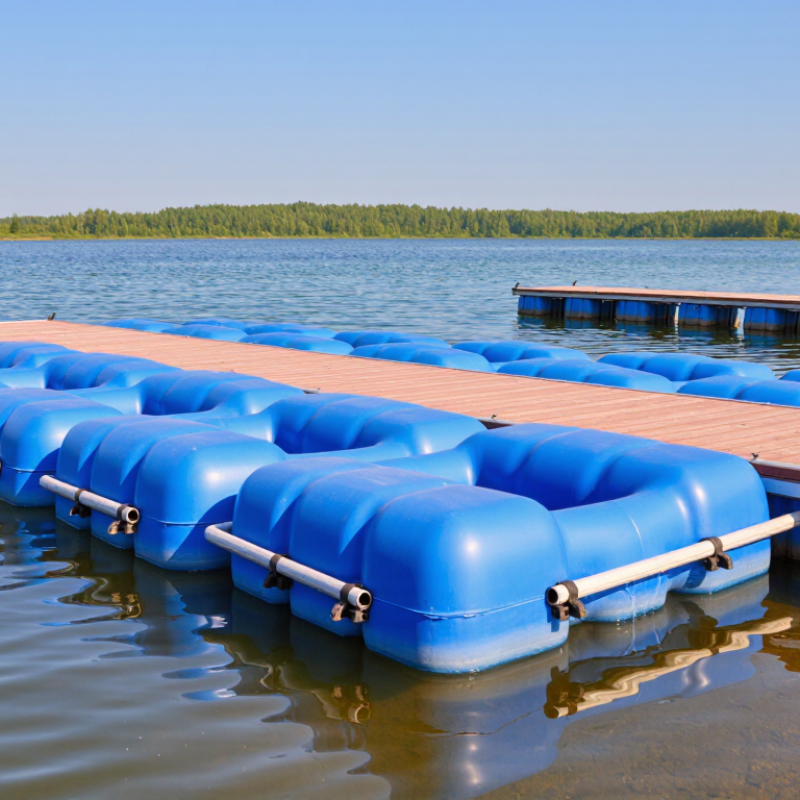
7 Tips for Choosing the Best Polyethylene Floats?

Understand Polyethylene Floats and Their Intended Applications

Polyethylene floats are sealed or molded buoyancy units used beneath docks, work platforms, pontoons, and aquaculture structures. Their intended job matters more than appearance. A quiet residential dock may need stable, low-maintenance flotation; a working platform may face repeated loading, impacts, and rough water. Check the float’s material grade, wall thickness, UV protection, and rated capacity. Polyethylene’s density is below water’s, but the complete float’s usable buoyancy depends on its shape, construction, and load distribution.

Tip: Match the float to the site. Measure expected loads, including people, equipment, and waves, then leave a practical safety margin. Inspect attachment points too; a strong float can still fail at a weak connection.

PlasticsEurope’s Plastics – the Fast Facts 2023 reports 400.3 million tonnes of plastics produced worldwide in 2022. That figure describes the wider industry, not float quality. It is a reminder that “polyethylene” alone does not identify a product’s performance.

For cold climates, check impact resistance and whether trapped water could freeze around fittings. In sunny locations, ask for documented UV-stabilization details and a maintenance schedule. Compare manufacturer capacity figures only when their test conditions are clear. I’ve seen specifications look reassuring on paper, yet omit uneven loading. That gap matters. A suitable float should fit the water conditions, structure, and inspection routine—not just the purchase budget.

Determine Buoyancy, Load Capacity, and Size Requirements

Choose polyethylene floats by calculating buoyancy at the waterline you can actually tolerate. NOAA’s Ocean Service gives seawater density as roughly 1,025 kg/m³; freshwater is about 1,000 kg/m³. A sealed float displacing 0.10 m³ can displace roughly 100 kg of freshwater, before subtracting the float’s own weight. That is theoretical. Keep reserve buoyancy for people, gear, and changing water levels, rather than designing at the maximum displacement.

Tip: Add every load, including fittings and trapped water. Then check the float’s dimensions and rated capacity against that total. The U.S. Army Corps of Engineers’ Coastal Engineering Manual discusses site-specific wave and water conditions in coastal design; a calm pond and a choppy dock are not equivalent. For example, a long, narrow float may fit beneath a walkway but roll more readily under an uneven load. Check spacing, freeboard, and stability together. A larger volume alone does not guarantee a steadier platform.

Measure the actual load, not just the equipment’s listed weight. Include movement, snow, or maintenance access where relevant. Leave a margin, and verify the manufacturer’s capacity data for the intended immersion depth. I would recheck the calculation after installation; real load distribution is often less tidy than the drawing.

Compare Float Design, Material Quality, and Durability

7 Tips for Choosing the Best Polyethylene Floats?

Compare Float Design, Material Quality, and Durability

A float’s shape affects stability, freeboard, and how loads spread across its surface. Check whether its dimensions suit your actual load, including ropes, fittings, and occasional extra weight. A wide, flat float may feel steady in calm water, but waves can expose weak attachment points. Inspect molded edges and connection areas closely. Small flaws matter.

Material quality deserves equal attention. PlasticsEurope’s Plastics – the Fast Facts 2023 report estimated global plastics production at 400.3 million tonnes in 2022. That scale makes clear resin identification and documented specifications important; volume alone says nothing about a float’s quality. Ask for the polyethylene grade, wall-thickness tolerance, and UV-stabilizer details. For useful comparisons, ASTM G154 covers accelerated UV exposure, while ASTM D1693 evaluates environmental stress cracking in polyethylene. These tests reveal specific properties, not a guaranteed service life.

Durability depends on design, sunlight, water conditions, and handling. Look for even wall thickness, sealed cavities, and reinforced mounting points. A scratched sample can show how color and surface finish hold up, though it cannot predict years outdoors. I would also check warranty terms and maintenance guidance. I might still miss a flaw hidden inside a sealed float; that deserves thought. Test buoyancy under realistic loading, and leave a practical safety margin.

Check Installation Compatibility and Maintenance Needs

Tip: Match the float to the installation. Check its dimensions, mounting points, and connection style against the frame before ordering. A few millimeters can matter when holes must align or brackets sit close to an edge. Also confirm the float’s rated capacity suits the expected load, including equipment and changing water conditions. Do not rely on appearance alone.

Tip: Check the environment and materials. Sun exposure, temperature changes, and repeated contact with abrasive surfaces can affect service life. Ask for product data on operating limits and inspect the proposed fasteners for compatibility with both the float and frame. A fit that works in a sheltered test may not behave the same way on open water.

Tip: Plan maintenance before installation. Leave access to seams, fittings, and attachment points, so routine checks do not require removing the whole assembly. Look for cracks, loose hardware, deformation, or trapped debris, especially after impacts or seasonal storage. Keep a simple inspection record. It is easy to overlook small changes, and inspection intervals may need adjusting for rough conditions. Check the installation instructions, too; assumptions can be costly.

Choosing Polyethylene Floats: Compatibility & Maintenance Checklist

Use these relative planning priorities to compare key checks before purchase. Ratings are a qualitative guide, not measured survey data; confirm requirements with the float manufacturer and site conditions.

Check buoyancy against the total supported load, verify dimensions and attachment points match the installation, and plan periodic inspections for damage, loose hardware, and wear.

Assess Safety Standards, Supplier Support, and Overall Cost

7 Tips for Choosing the Best Polyethylene Floats?

Assess Safety Standards, Supplier Support, and Overall Cost

Safety begins with the finished float, not just its resin. Ask for documented buoyancy limits, load-test results, UV-resistance information, and inspection guidance. ASTM D638 tensile testing can describe plastic properties, but it does not certify a complete float. Check seams, wall thickness, and attachment points against the intended load and water conditions. Small details matter.

Tip: Request traceable material documents and test records for the actual product. Ask how the supplier evaluates impact damage, sunlight exposure, and temperature changes. PlasticsEurope’s Plastics—The Fast Facts 2024 reports global plastics production of 413.8 million tonnes in 2023. That scale indicates a mature materials industry, but it does not guarantee consistent float quality. Verify the specific product.

Tip: Compare supplier support and lifetime cost, not just the quoted price. Ask for load calculations, installation drawings, replacement-part availability, warranty terms, and realistic delivery times. Include mooring hardware, transport, inspection, and likely replacement costs in your estimate. A cheaper float may need more maintenance. It is easy to underestimate that. One useful check is to request a written cost breakdown and compare the same service life across suppliers.

Article Source:

Copyright 2025 Fluidra S.A. | Created by BCM Marketing Agencia Privacy Policy Legal note | Cookie policy |

Technical cookies are strictly necessary for our website to work and you can navigate through it. These types of cookies are those that, for example, allow us to identify you, give you access to certain restricted parts of the page if necessary, or remember different options or services already selected by you, such as your privacy preferences. Therefore, they are activated by default, your authorization not being necessary in this regard. Through the configuration of your browser, you can block or alert the presence of this type of cookies, although such blocking will affect the proper functioning of the different functionalities of our website.


The analysis cookies allow us to study the navigation of the users of our website in general (for example, which sections of the page are the most visited, which services are used most and if they work correctly, etc.). From the statistical information on navigation on our website, we can improve both the operation of the page itself and the different services it offers. Therefore, these cookies do not have an advertising purpose, but only serve to make our website work better, adapting to our users in general. By activating them you will contribute to this continuous improvement. You can enable or disable these cookies by checking the corresponding box, being disabled by default.


Functionality cookies allow us to remember your preferences, to personalize certain characteristics and general options of our website, every time you access it (for example, the language in which the information is presented to you, the sections marked as favorites, your browser type, etc.) Therefore, this type of cookies does not have an advertising purpose, but by activating them you will improve the functionality of the website (for example, adapting to your type of browser) and the customization of it based on your preferences (for example, by presenting the information in the language that you have chosen in previous occasions), which will contribute to the ease, usability and comfort of our page during your navigation. You can enable or disable these cookies by checking the corresponding box, being disabled by default.


Advertising cookies allow us to manage the advertising spaces included in our website based on criteria such as the content shown or the frequency in which the ads are displayed. For example, if you have been shown the same ad several times on our website, and you have not shown a personal interest by clicking on it, it will not appear again. In summary, by activating this type of cookies, the advertising shown on our website will be more useful and diverse, and less repetitive. You can enable or disable these cookies by checking the corresponding box, being disabled by default.


Behavioral advertising cookies allow us to obtain information based on the observation of your browsing habits and behaviors on the web, in order to show you advertising content that best suits your personal tastes and interests. To understand it in a very simple way, we will give you a fictitious example: if your last searches on the web were related to suspense literature, we would show you advertising about suspense books. Therefore, activating this type of cookies, the advertising that we show you on our website will not be generic, but will be oriented to your searches, tastes and interests, therefore adjusting exclusively to you. You can enable or disable these cookies by checking the corresponding box, being disabled by default.
To understand it in a very simple way, we will give you a fictitious example: if your last searches on the web were related to suspense literature, we would show you advertising about suspense books. Therefore, activating this type of cookies, the advertising that we show you on our website will not be generic, but will be oriented to your searches, tastes and interests, therefore adjusting exclusively to you. You can enable or disable these cookies by checking the corresponding box, being disabled by default.

SAVE

We use our own and third-party cookies to ensure the proper functioning of the website and to analyse our services, improve your experience on our website and show you advertisements related to your interests according to profiling based on your browsing habits (e.g. websites visited). You can accept all cookies by clicking "ACCEPT" or set or reject them by clicking here. If you would like to know more about the use of cookies, please see our COOKIE POLICY.


ACCEPT ALL
Reject no essentials


