
7 Tips for Choosing ACB Electrical Suppliers
FLUID HANDLING EXPERTS

Blog, all our news

7 Tips for Choosing ACB Electrical Suppliers

Choosing an Acb Electrical supplier is not just a price comparison. The right partner can help protect equipment, reduce downtime, and make maintenance more predictable. A weak match may leave important questions unanswered, from breaking capacity to spare-part availability. Details matter.

A useful editorial perspective comes from Maya Chen, a fictional composite ACB applications engineer created for this introduction: “A dependable supplier explains the breaker’s ratings, support needs, and limits before quoting a price.” Treat that as a practical principle, not a verified quotation from a real person. Buyers should still confirm technical claims against product documents and qualified engineering advice.

This guide explores seven points to check before choosing a supplier. Look at product compliance documents, operating history, technical support, warranty terms, delivery reliability, and the clarity of each quotation. Ask who will help select the correct ACB for the system. Request sample test records, installation guidance, and a written service process. A supplier’s answers should be specific, not vague.

Check the details. A polished brochure cannot replace clear documentation or responsive support. The best choice may not be the cheapest. It is the supplier that can explain its recommendations, provide evidence, and stay available after delivery. That standard helps buyers assess ACB Electrical suppliers with care and confidence.
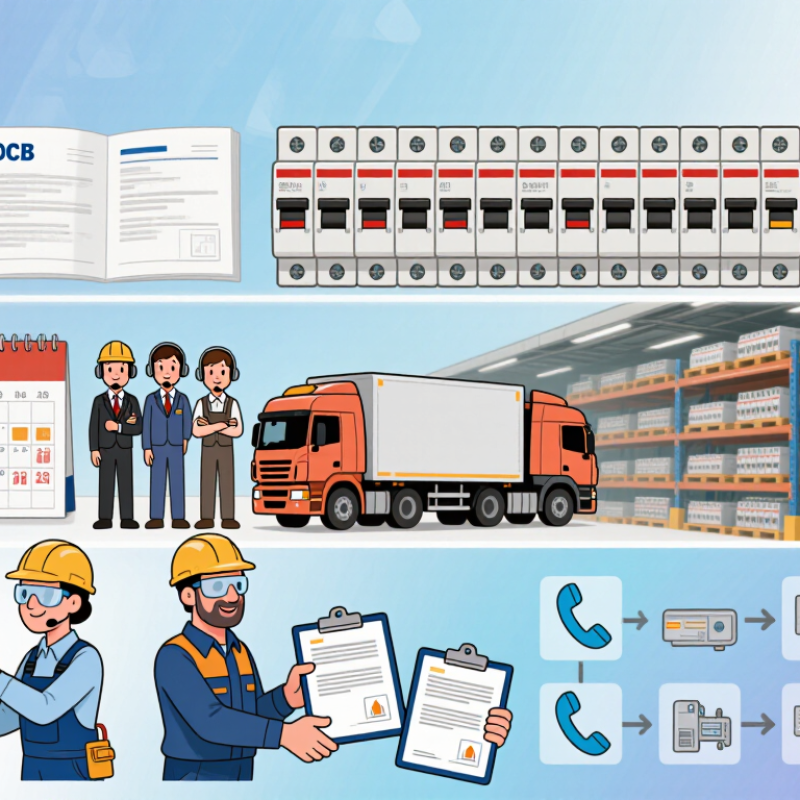
7 Tips for Choosing ACB Electrical Suppliers

Understanding ACB Types and Your Electrical Requirements

An air circuit breaker (ACB) protects low-voltage circuits from overloads and short circuits. Common options include fixed and withdrawable designs. Fixed units suit stable installations; withdrawable units can be isolated for servicing, but require compatible switchgear space and interlocks. Three-pole or four-pole selection depends on the system’s earthing arrangement and whether the neutral needs switching. Check the electrical drawings before specifying a type.

Then match the ACB’s rated current and voltage to the load, and its breaking capacity to the prospective fault current at the installation point. The IEC 60947-2 standard covers low-voltage circuit breakers. The IEA’s Electricity 2024 report projects global electricity demand to grow by an average of 3.4% annually through 2026. That forecast is not a sizing rule; it is a reason to check planned load growth before choosing a rating. Small detail. Big consequence.

Review trip-unit settings and coordination with upstream and downstream protection. Ask the supplier for test documentation, dimensional drawings, and confirmation that the selected unit fits the panel. A polished specification can still miss a future motor or a neutral-current requirement. That part deserves another look.

Verifying Supplier Expertise and Product Certifications

An air circuit breaker (ACB) protects large electrical systems, so supplier claims deserve careful checking. The International Energy Agency’s Electricity Grids and Secure Energy Transitions report says annual grid investment must rise from about $300 billion to more than $600 billion by 2030. Growing infrastructure needs make dependable equipment and documented technical support especially important. Details matter.

Tip: Ask for test reports and certificates matching the exact ACB model, frame size, rated current, and trip unit. Check whether testing references IEC 60947-2, and confirm the issuing body and certificate scope independently. A certificate for a product family may not cover every configuration. Request evidence of short-circuit performance, temperature-rise testing, and routine production checks. If documents are incomplete, pause before accepting broad assurances.

Compare the paperwork with the physical product: nameplate ratings, serial numbers, wiring diagrams, and installation instructions should agree. Ask who handles commissioning questions, spare parts, and fault investigations, and get response times in writing. Paperwork can mislead. A supplier’s technical team should explain protection settings in plain language and relate them to the system’s fault levels. Also confirm that test reports come from a competent laboratory, such as one accredited to ISO/IEC 17025 for the relevant tests. I would still review a sample of the records; one neat certificate does not prove every shipment is consistent.

Assessing Product Quality, Testing, and Reliability

7 Tips for Choosing ACB Electrical Suppliers
Assessing Product Quality, Testing, and Reliability

When evaluating an ACB supplier, request documents for the exact model and rating you plan to install. Check rated voltage, current, and short-circuit breaking capacity against your system requirements. Look closely. Test reports should identify the tested model, test conditions, and results, not just display a generic certificate. Ask about dielectric, temperature-rise, and mechanical endurance testing. The details matter.

A reliable supplier can explain how routine checks are performed before shipment and how test equipment is calibrated. Ask for serial-number traceability, inspection records, and clear procedures for handling defects. If possible, inspect a sample unit: examine terminal finish, operating mechanism, labels, and enclosure fit. Small inconsistencies can signal weak process control, though one sample cannot tell the whole story. I would not treat a polished certificate as proof by itself. Compare technical documents with the product and ask specific questions about any mismatch. Also check whether replacement parts and technical support will remain available throughout the equipment’s expected service life. A quick, precise answer is useful; vague promises deserve a follow-up.

7 Tips for Choosing ACB Electrical Suppliers: Assessing Product Quality, Testing, and Reliability

How to use this chart: The bars show the number of checklist prompts in each evaluation area, not supplier ratings or measured industry data. Verify product ratings against your application, review relevant test documentation, and assess service and maintenance support before making a decision.

Comparing Pricing, Availability, and Delivery Capabilities

A competitive ACB quote is useful only when its scope is clear. Compare the same rated current, breaking capacity, trip unit, accessories, and test documents. Include freight, packaging, and any commissioning costs. A low unit price can hide expensive exclusions. Ask how long the quote remains valid and whether prices can change before dispatch.

Availability needs proof, not just a reassuring estimate. Ask whether units are physically in stock, reserved for your order, or still awaiting production. The World Bank’s 2023 Logistics Performance Index report puts average international shipment time at 44 days, from the seller’s warehouse to the buyer’s. That is a broad benchmark, not an ACB delivery promise. Request a dated lead-time estimate and written confirmation of stock status.

Delivery capability shows in the details. Confirm dispatch dates, tracking, protective packaging, and the process for handling damaged goods. If your site needs phased delivery, check whether partial shipments carry extra charges. Ask which delivery milestones the supplier can document. One useful question: what caused the last delay? The answer may be less polished than a sales estimate, but more revealing.

7 Tips for Choosing ACB Electrical Suppliers - Comparing Pricing, Availability, and Delivery Capabilities

Tip What to Compare Evidence to Request Good Sign
1. Compare like-for-like pricing Check that each quote covers the same ACB rated current, number of poles, rated voltage, breaking capacity, trip unit, and accessories. Compare taxes, freight, and any commissioning or configuration charges separately. An itemized quotation with model specification, quantity, currency, exclusions, and quote validity period. The lowest total cost is clear only after scope and additional charges are aligned.
2. Verify the electrical specification Confirm rated operational voltage and current, breaking capacity, pole configuration, and protection functions against the project design. ACB selection should be checked against the installation’s fault level and coordination requirements. Datasheet, compliance information, and a written confirmation that the quoted configuration matches the specified duty. The supplier identifies any specification gaps before accepting the order.
3. Check standards and documentation Confirm the applicable product standard and the documentation required for the project. IEC 60947-2 is a common standard for low-voltage circuit-breakers; project and local requirements may differ. Relevant declarations or certificates, technical data, installation instructions, and test documentation where applicable. Documents identify the exact offered configuration and are available before purchase.
4. Confirm actual availability Distinguish physically held stock from stock at another location, unallocated inventory, and items that must be ordered. Check availability of the ACB and its required trip unit and accessories together. Written stock status, quantity available, stock location, and confirmation that the quoted configuration is included. The supplier provides a dated availability confirmation rather than an unqualified “in stock” claim.
5. Compare lead times and delivery terms Compare the stated dispatch date, estimated transit time, delivery location, shipping method, and responsibility for freight and import charges. Ask whether the lead time is confirmed or an estimate. A written delivery schedule, delivery terms, shipment tracking arrangements, and notification process for delays. The expected arrival date and the assumptions behind it are stated clearly.
6. Assess handling, packaging, and order accuracy Check how the supplier protects electrical equipment in transit and verifies the order configuration before dispatch. Consider packaging, delivery appointment needs, and procedures for damaged or incorrect items. Packing and inspection process, dispatch checklist, damage-reporting procedure, and written terms for resolving order discrepancies. The process assigns responsibility for inspection and prompt resolution of shipping issues.
7. Review support, warranty, and after-sales service Compare technical support availability, warranty coverage, return conditions, and access to compatible replacement parts. Confirm who handles troubleshooting and warranty claims. Written warranty terms, support contact details, return policy, and information on spare-part availability. Support responsibilities and warranty exclusions are documented before the order is placed.

Evaluating Technical Support, Warranty, and After-Sales Service

Choosing an air circuit breaker (ACB) supplier means evaluating the support behind the equipment, not only its rated current. Uptime Institute’s 2023 Annual Outage Analysis reported that 54% of surveyed organizations’ most recent significant outages cost more than $100,000. Power continuity has a real price. Ask suppliers for documented commissioning support, fault-diagnosis response times, and technicians trained to interpret trip-unit settings. Request a sample service report before purchase.

Tip 1: Test the support process. Describe a realistic fault, such as an ACB tripping during a planned load test. Ask who responds, what information they need, and how quickly an engineer can join remotely or onsite. Vague promises deserve follow-up. Check that manuals, wiring diagrams, and setting guidance match your breaker configuration.

Tip 2: Read warranty and service terms closely. Confirm coverage duration, exclusions, labor and travel costs, and the process for replacing a failed trip unit. After-sales support should include spare-parts availability, inspection intervals, and clear escalation contacts. A long warranty can still leave downtime uncovered. Compare the written commitment with your maintenance team’s needs, and note any assumptions you cannot verify.

Copyright 2025 Fluidra S.A. | Created by BCM Marketing Agencia Privacy Policy Legal note | Cookie policy |

Technical cookies are strictly necessary for our website to work and you can navigate through it. These types of cookies are those that, for example, allow us to identify you, give you access to certain restricted parts of the page if necessary, or remember different options or services already selected by you, such as your privacy preferences. Therefore, they are activated by default, your authorization not being necessary in this regard. Through the configuration of your browser, you can block or alert the presence of this type of cookies, although such blocking will affect the proper functioning of the different functionalities of our website.


The analysis cookies allow us to study the navigation of the users of our website in general (for example, which sections of the page are the most visited, which services are used most and if they work correctly, etc.). From the statistical information on navigation on our website, we can improve both the operation of the page itself and the different services it offers. Therefore, these cookies do not have an advertising purpose, but only serve to make our website work better, adapting to our users in general. By activating them you will contribute to this continuous improvement. You can enable or disable these cookies by checking the corresponding box, being disabled by default.


Functionality cookies allow us to remember your preferences, to personalize certain characteristics and general options of our website, every time you access it (for example, the language in which the information is presented to you, the sections marked as favorites, your browser type, etc.) Therefore, this type of cookies does not have an advertising purpose, but by activating them you will improve the functionality of the website (for example, adapting to your type of browser) and the customization of it based on your preferences (for example, by presenting the information in the language that you have chosen in previous occasions), which will contribute to the ease, usability and comfort of our page during your navigation. You can enable or disable these cookies by checking the corresponding box, being disabled by default.


Advertising cookies allow us to manage the advertising spaces included in our website based on criteria such as the content shown or the frequency in which the ads are displayed. For example, if you have been shown the same ad several times on our website, and you have not shown a personal interest by clicking on it, it will not appear again. In summary, by activating this type of cookies, the advertising shown on our website will be more useful and diverse, and less repetitive. You can enable or disable these cookies by checking the corresponding box, being disabled by default.


Behavioral advertising cookies allow us to obtain information based on the observation of your browsing habits and behaviors on the web, in order to show you advertising content that best suits your personal tastes and interests. To understand it in a very simple way, we will give you a fictitious example: if your last searches on the web were related to suspense literature, we would show you advertising about suspense books. Therefore, activating this type of cookies, the advertising that we show you on our website will not be generic, but will be oriented to your searches, tastes and interests, therefore adjusting exclusively to you. You can enable or disable these cookies by checking the corresponding box, being disabled by default.
To understand it in a very simple way, we will give you a fictitious example: if your last searches on the web were related to suspense literature, we would show you advertising about suspense books. Therefore, activating this type of cookies, the advertising that we show you on our website will not be generic, but will be oriented to your searches, tastes and interests, therefore adjusting exclusively to you. You can enable or disable these cookies by checking the corresponding box, being disabled by default.

SAVE

We use our own and third-party cookies to ensure the proper functioning of the website and to analyse our services, improve your experience on our website and show you advertisements related to your interests according to profiling based on your browsing habits (e.g. websites visited). You can accept all cookies by clicking "ACCEPT" or set or reject them by clicking here. If you would like to know more about the use of cookies, please see our COOKIE POLICY.


ACCEPT ALL
Reject no essentials


