
7 Tips for Choosing a 200kW Soft Starter
FLUID HANDLING EXPERTS

Blog, all our news

7 Tips for Choosing a 200kW Soft Starter

Choosing a 200kw Soft Starter is not simply a matter of matching a number on a motor nameplate. Actual selection depends on the motor’s full-load current, supply voltage, starting frequency, and driven load. A pump that starts with a full pipe behaves differently from a lightly loaded fan. Small details matter.

“Size the starter for the motor’s real operating conditions, not just its kilowatt rating,” says Daniel Mercer, a fictional motor-control specialist created for this introduction. This is an illustrative quotation, not a verified statement from a real expert. The principle is practical: check manufacturer data and have a qualified engineer review the application before purchase.

This guide covers seven useful checks. They include motor current, load inertia, required starting torque, and the limits of the power supply. It also looks at ramp settings, built-in protection, bypass arrangements, and the installation environment. Dust, heat, and a cramped control cabinet can affect performance. So can frequent starts.

There is no universal setting. A cautious current limit may reduce electrical stress, yet it can leave a heavy load struggling to accelerate. That trade-off deserves a closer look. The right 200kw Soft Starter should suit the motor, load, and operating cycle together—not just the headline rating. Verify technical claims against the product manual, and confirm that the selected unit meets the site’s electrical and thermal requirements.
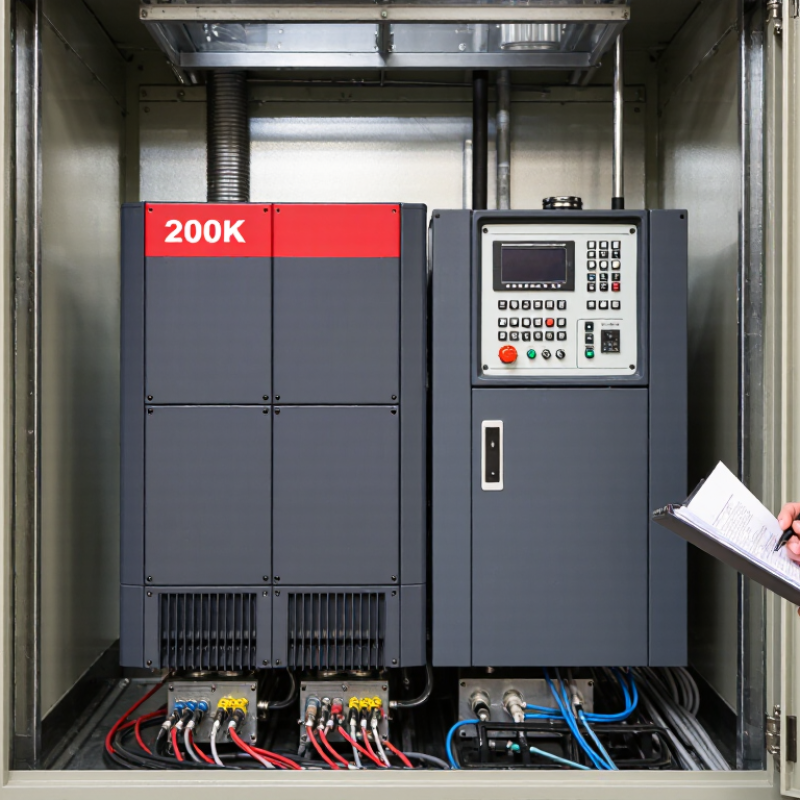
7 Tips for Choosing a 200kW Soft Starter

Understanding the Motor and Load Requirements

A 200kW rating is only a starting point. Check the motor nameplate for voltage, full-load current, rated speed, and duty. The starter must be selected for the motor’s actual current and starting conditions, not kilowatts alone. Record the driven load too: a centrifugal pump usually starts differently from a loaded conveyor or a high-inertia fan. Load matters.

The U.S. Department of Energy’s 2014 Improving Motor and Drive System Performance sourcebook estimates that motor-driven systems account for about 68% of electricity used in U.S. manufacturing. That makes matching the starter to the application more than a sizing exercise. Ask how much starting torque the load needs, how long acceleration takes, and how many starts occur each hour. A pump with a closed discharge valve may need less starting torque than one starting against a full system head; verify the operating sequence rather than assuming.

Also check the motor’s locked-rotor current and permissible start duration with the motor supplier or nameplate documentation. A soft starter can reduce inrush, but an overly gentle ramp may leave a loaded machine stalled and heating. Note ambient temperature, enclosure ventilation, and any repeated-start duty. I would not size from one catalogue line alone; real load data is often incomplete, and that uncertainty deserves a margin and a site check.

7 Tips for Choosing a 200 kW Soft Starter: Understand Motor and Load Requirements

Illustrative current-limit starting points for different load types. Values are planning examples, not universal settings; confirm that the motor can accelerate the actual load within the permitted starting time.

Motor-current estimate assumes a 400 V, three-phase supply, 0.90 power factor, and 95% efficiency, giving approximately 338 A full-load current. Actual motor nameplate current, load torque, inertia, supply conditions, and manufacturer guidance should determine the final selection.

Matching Soft Starter Ratings to Voltage and Current

7 Tips for Choosing a 200kW Soft Starter

Matching Soft Starter Ratings to Voltage and Current

A 200 kW label is only a starting point for selection. The required current depends on the motor’s rated voltage, efficiency, and power factor. Check the motor nameplate. Its full-load current is a more useful sizing reference than kilowatts alone. A 200 kW motor supplied at 400 V will draw more current than one supplied at 690 V, all else being equal. Confirm the starter’s rated operating voltage matches the supply and motor connection.

Compare the starter’s continuous current rating with the motor’s full-load current, then check its overload capability. A large pump may start gently but run for hours; a loaded conveyor may need a longer acceleration ramp. Starting frequency, ramp duration, ambient temperature, and enclosure ventilation can all reduce the usable rating. Read the manufacturer’s derating tables for the actual installation conditions. Small details matter.

Do not choose a unit by matching “200 kW” on two labels and stopping there. That shortcut can miss current limits or duty-cycle demands. Verify the supply voltage, phase, motor wiring, and protection settings with a qualified electrical professional. If the motor’s operating conditions are unclear, pause and confirm them before ordering. It is an easy detail to overlook.

Evaluating Starting Methods and Control Features

For a 200 kW motor, compare starting methods against the driven load, not just the nameplate. Direct-on-line starting is simple but can draw high inrush current and cause a sharp torque step. Star-delta reduces starting current, yet its changeover may produce a torque bump. A soft starter ramps motor voltage to limit electrical and mechanical stress. A variable-frequency drive adds speed control, but may be unnecessary when the motor only needs a controlled start and stop. Measure the load. A pump, conveyor, and loaded crusher do not need the same settings.

Check current limit, ramp time, kick-start, soft stop, bypass, and overload functions. For a 400 V, three-phase motor, 200 kW works out to roughly 340 A at assumed 95% efficiency and 0.88 power factor; use the motor nameplate for selection.

Set current limits with measured starting performance and the supply’s capacity in mind. Too-low limits can stall a high-inertia load. Too-long ramps can heat the motor.

The U.S. Department of Energy’s Improving Motor and Drive System Performance sourcebook estimates motor-driven systems use roughly 60% of U.S. industrial electricity, underscoring why the full motor system matters—not just the starter. That figure does not predict savings from a soft starter.

Review starts per hour, protection coordination, and site voltage dips. Some settings still need field adjustment; calculations alone are imperfect.

Checking Protection, Bypass, and Installation Needs

For a 200 kW soft starter, size protection from the motor nameplate, not the kilowatt figure alone. Full-load current changes with voltage, efficiency, and power factor. Set overload protection to the motor’s rated current and check that its trip class suits the actual acceleration time. Coordinate upstream short-circuit protection with the starter’s published ratings; overload protection does not replace it. Consider phase-loss and temperature monitoring where the motor and process require them. Small details matter.

A bypass contactor carries current after the motor reaches speed, reducing heat produced by the starter’s power electronics during normal running. Verify its continuous-current rating, switching duty, and interlocking. The starter should still detect faults when bypassed. U.S. Department of Energy’s 2014 Improving Motor and Drive System Performance sourcebook estimates that motor-driven systems use about 68% of electricity consumed in U.S. manufacturing. That makes operating conditions worth checking, not just purchase price.

Installation can expose weak assumptions. Record starts per hour, ramp duration, ambient temperature, enclosure rating, and available ventilation; these affect thermal sizing and service life. Check cable entry, grounding, clearances, and the panel’s short-circuit rating before mounting. A site may look cool in the morning, then run hot beside a furnace. I would verify the actual duty cycle during commissioning, because a tidy design sheet can still miss an unusually heavy start.

Comparing Environmental Fit, Support, and Total Cost

Choosing a 200kW soft starter starts with the site, not the catalog. Check the motor’s voltage, full-load current, start frequency, and driven load. A pump with a long acceleration ramp behaves differently from a loaded conveyor. Measure enclosure temperature and note dust, moisture, altitude, and ventilation. Heat buildup can shorten component life; a higher current rating alone will not fix poor airflow. Check the nameplate. Then compare the starter’s duty rating with actual starts per hour and its bypass arrangement.

Support deserves equal attention. Ask who can help with parameter setup, fault diagnosis, and replacement parts, and how quickly they respond. Response time matters. A clear wiring diagram and an accessible service contact can save hours during commissioning. Total cost also includes installation, protection devices, cabinet changes, and downtime risk. Request itemized quotes with the same scope. Cheap upfront is not always cheap. One weak assumption is treating the unit price as the project cost; it may leave out site work.

Tips: Match voltage and current; confirm duty and start frequency; inspect heat, dust, and moisture; verify commissioning support; check spare-part lead times; compare installation and downtime costs; leave margin only when the application justifies it.

7 Tips for Choosing a 200kW Soft Starter - Comparing Environmental Fit, Support, and Total Cost
Tip Selection Area What to Compare Practical Check for a 200kW Motor Why It Matters
1 Match the motor and supply Rated voltage, phase, frequency, motor full-load current, and connection arrangement. Use the motor nameplate and wiring diagram. As an illustration, a 200kW motor on a 400V three-phase supply may draw roughly 350–380A at rated load; confirm the actual nameplate current rather than sizing from kW alone. Current varies with voltage, efficiency, power factor, and motor design. A mismatch can cause nuisance trips or inadequate starting performance.
2 Check the starting duty Load inertia, required starting torque, starts per hour, start duration, and time between starts. Record the driven equipment and its usual operating sequence—for example, a loaded conveyor may need different starting performance from an unloaded pump. Compare the duty with the starter’s published ratings. Repeated or prolonged starts create heat in the starter and motor. A kW rating by itself does not establish suitability for every duty.
3 Assess the installation environment Ambient temperature, altitude, dust, moisture, corrosive substances, ventilation, and enclosure rating. Check the site’s maximum temperature and altitude against the manufacturer’s derating instructions. Confirm the enclosure rating fits the actual location; an enclosure rating does not replace suitable cooling or installation practices. Temperature and altitude can reduce available capacity, while dust and moisture can affect service life and reliability.
4 Review protection and bypass Motor overload protection, short-circuit coordination, phase-loss or imbalance protection, and bypass arrangement. Confirm which protections are built in and which must be provided separately. Where a bypass contactor is used, verify its rating, control sequence, and suitability for the intended operating duty. Correct coordination helps protect the motor, starter, and supply equipment. A bypass can reduce heat generated by the power electronics during normal running, but does not remove the need for correct protection.
5 Verify controls and integration Control voltage, start/stop inputs, fault outputs, communications, interlocks, and restart behavior after a power interruption. Compare the starter’s control terminals and communication options with the plant control system. Confirm how emergency stops, permissives, alarms, and local isolation will be handled. Compatible controls simplify commissioning and help ensure the motor starts only when the equipment is in a safe operating state.
6 Compare support and serviceability Technical assistance, commissioning guidance, documentation, warranty terms, repair options, and availability of replacement parts. Ask for written support hours, response arrangements, warranty conditions, and the process for obtaining a repair or replacement unit. Check that manuals and wiring information are available for the selected model. Clear support arrangements can reduce troubleshooting time and the impact of an unplanned outage.
7 Calculate total cost of ownership Purchase price, installation, panel changes, commissioning, cooling, maintenance, spare parts, and expected downtime. Compare equivalent configurations and include any required bypass contactor, protective devices, enclosure, wiring, and engineering work. Evaluate lifecycle cost using the site’s operating hours and service requirements. The lowest purchase price may not be the lowest overall cost if installation, operating conditions, support, or downtime differ.
Copyright 2025 Fluidra S.A. | Created by BCM Marketing Agencia Privacy Policy Legal note | Cookie policy |

Technical cookies are strictly necessary for our website to work and you can navigate through it. These types of cookies are those that, for example, allow us to identify you, give you access to certain restricted parts of the page if necessary, or remember different options or services already selected by you, such as your privacy preferences. Therefore, they are activated by default, your authorization not being necessary in this regard. Through the configuration of your browser, you can block or alert the presence of this type of cookies, although such blocking will affect the proper functioning of the different functionalities of our website.


The analysis cookies allow us to study the navigation of the users of our website in general (for example, which sections of the page are the most visited, which services are used most and if they work correctly, etc.). From the statistical information on navigation on our website, we can improve both the operation of the page itself and the different services it offers. Therefore, these cookies do not have an advertising purpose, but only serve to make our website work better, adapting to our users in general. By activating them you will contribute to this continuous improvement. You can enable or disable these cookies by checking the corresponding box, being disabled by default.


Functionality cookies allow us to remember your preferences, to personalize certain characteristics and general options of our website, every time you access it (for example, the language in which the information is presented to you, the sections marked as favorites, your browser type, etc.) Therefore, this type of cookies does not have an advertising purpose, but by activating them you will improve the functionality of the website (for example, adapting to your type of browser) and the customization of it based on your preferences (for example, by presenting the information in the language that you have chosen in previous occasions), which will contribute to the ease, usability and comfort of our page during your navigation. You can enable or disable these cookies by checking the corresponding box, being disabled by default.


Advertising cookies allow us to manage the advertising spaces included in our website based on criteria such as the content shown or the frequency in which the ads are displayed. For example, if you have been shown the same ad several times on our website, and you have not shown a personal interest by clicking on it, it will not appear again. In summary, by activating this type of cookies, the advertising shown on our website will be more useful and diverse, and less repetitive. You can enable or disable these cookies by checking the corresponding box, being disabled by default.


Behavioral advertising cookies allow us to obtain information based on the observation of your browsing habits and behaviors on the web, in order to show you advertising content that best suits your personal tastes and interests. To understand it in a very simple way, we will give you a fictitious example: if your last searches on the web were related to suspense literature, we would show you advertising about suspense books. Therefore, activating this type of cookies, the advertising that we show you on our website will not be generic, but will be oriented to your searches, tastes and interests, therefore adjusting exclusively to you. You can enable or disable these cookies by checking the corresponding box, being disabled by default.
To understand it in a very simple way, we will give you a fictitious example: if your last searches on the web were related to suspense literature, we would show you advertising about suspense books. Therefore, activating this type of cookies, the advertising that we show you on our website will not be generic, but will be oriented to your searches, tastes and interests, therefore adjusting exclusively to you. You can enable or disable these cookies by checking the corresponding box, being disabled by default.

SAVE

We use our own and third-party cookies to ensure the proper functioning of the website and to analyse our services, improve your experience on our website and show you advertisements related to your interests according to profiling based on your browsing habits (e.g. websites visited). You can accept all cookies by clicking "ACCEPT" or set or reject them by clicking here. If you would like to know more about the use of cookies, please see our COOKIE POLICY.


ACCEPT ALL
Reject no essentials


