
What Is Thermoforming Mold Assembly and How Does It Work?
FLUID HANDLING EXPERTS

Blog, all our news

What Is Thermoforming Mold Assembly and How Does It Work?

Thermoforming Mold Assembly is the coordinated system that shapes heated plastic sheets into accurate, repeatable products. It usually includes the mold, support frame, vacuum channels, cooling features, clamps, and alignment components. Together, these parts control how plastic stretches, settles, and cools.

The process begins when a plastic sheet reaches its forming temperature. A forming machine positions the sheet over or around the mold. Vacuum pressure, air pressure, or mechanical force then pulls the softened material against the mold surface. Cooling follows, allowing the part to retain its intended shape. Small details matter. A blocked vacuum port can leave wrinkles, thin walls, or incomplete corners.

In practical manufacturing, technicians check mold alignment, surface finish, vent placement, and temperature stability before production begins. They also review sample parts for warping, uneven thickness, and difficult release. These checks connect design theory with real factory conditions. A reliable Thermoforming Mold Assembly should support consistent results, efficient maintenance, and safe operation under documented procedures.

However, no assembly performs perfectly without adjustment. Material type, sheet thickness, heating time, and mold geometry can change the outcome. That is why experienced engineers often refine cooling channels or vent locations after trial runs. The first test may expose problems that drawings cannot show. Careful records make those lessons useful for future batches. This article explains the main components, working stages, design considerations, and inspection practices behind effective thermoforming mold assemblies.
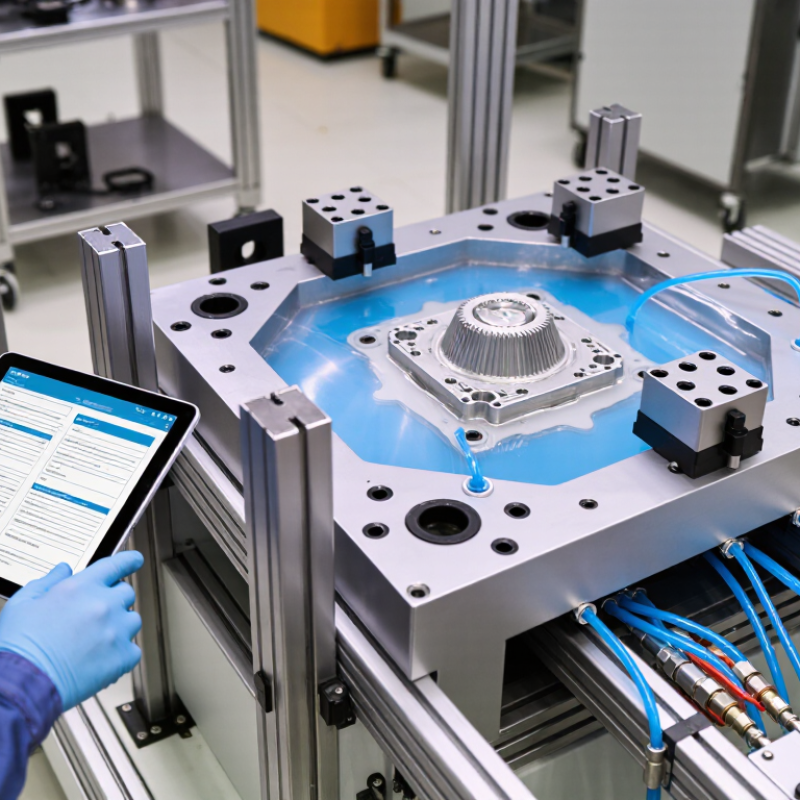
What Is Thermoforming Mold Assembly and How Does It Work?

Definition and Purpose of a Thermoforming Mold Assembly

A thermoforming mold assembly is the complete tooling system that shapes heated plastic sheet. It usually includes the mold, support frame, vacuum channels, cooling passages, and mounting components. Together, these parts create the final product geometry. The assembly may form trays, covers, panels, or containers. Its purpose is more than shaping plastic. It must control pressure, temperature, release, and dimensional stability during production.

The process begins when a heated sheet reaches its forming temperature. The sheet moves over the mold surface. Vacuum pressure then pulls the material against the mold. In some systems, air pressure or mechanical plugs improve material distribution. Cooling passages remove heat from the mold and formed part. The assembly then opens, allowing the product to release without distortion. Small vent locations matter. Poor venting can leave thin corners, wrinkles, or incomplete details.

A reliable assembly depends on accurate alignment and practical maintenance. Engineers check mold flatness, channel cleanliness, cooling uniformity, and release angles. Sharp corners often require special attention because plastic may stretch unevenly there. In practice, even a well-designed mold can need adjustment after trial production. Material behavior is not perfectly predictable. This is where production experience becomes valuable. Test parts reveal problems that drawings may not show. A careful review can improve cycle time, surface quality, and repeatability without adding unnecessary complexity.

Main Components and Their Functions

Thermoforming mold assembly is the working structure behind a heated plastic sheet. A 2024 market assessment by Grand View Research estimated the global thermoforming market at more than USD 16 billion in 2023. That scale reflects intense demand for repeatable molds, especially in packaging, medical products, and vehicle interiors.

The mold base supports every other component. It must resist vibration and maintain alignment during clamping. The cavity shapes the outside surface, while a plug assist helps push softened sheet material into deeper areas. Vacuum ports then remove trapped air and pull the sheet tightly against the cavity. Small vents matter. Without them, corners may show webbing, thin spots, or incomplete detail.

Cooling channels control temperature inside the mold assembly. Even cooling reduces warpage and shortens cycle time. A 2023 technical report from the Society of Plastics Engineers identifies temperature control and material distribution as major influences on thermoformed-part quality. Trim fixtures or registration pins guide the final cutting stage. They also protect dimensional accuracy across repeated cycles.

In practice, mold design is rarely perfect. Thin ribs can cool unevenly, and vent locations may need adjustment after testing. The Plastics Industry Association has reported that lightweighting remains a major processing priority, but thinner sheets leave less room for temperature errors. Experienced engineers therefore inspect first-off parts, measure wall thickness, and refine the assembly before full production.

Thermoforming Mold Assembly: Main Components and Functions

The mold body provides structural support, the forming surface defines the part geometry, vacuum ports draw the heated sheet against the mold, cooling channels remove heat, the trim ring supports edge finishing, and clamping hardware keeps the assembly accurately aligned during forming.

How a Thermoforming Mold Assembly Works

A thermoforming mold assembly is the working system that shapes heated plastic sheet into a product. It usually includes the mold body, support frame, vacuum ports, cooling channels, and trimming references. Grand View Research’s 2024 market analysis estimates the thermoforming market will expand at roughly 5% annually through 2030. That growth increases pressure on mold accuracy, cycle time, and material efficiency.

How a thermoforming mold assembly works

is fairly direct. A heating station softens the sheet until it becomes flexible, but not liquid. The forming machine then clamps the sheet over the mold. Vacuum pulls the softened plastic against the mold surface through small air passages. In pressure forming, compressed air adds force from above. This creates sharper corners and finer surface details. Cooling channels remove heat while the plastic remains under controlled pressure. After solidification, the mold opens, and ejector pins or air assist release the part.

A few millimeters matter.

During assembly, technicians align the mold, frame, vacuum manifold, and cooling connections carefully. Poor vent placement can leave webbing, thin corners, or trapped air. A 2023 packaging machinery report identified lightweighting and resource efficiency as major manufacturing priorities. Yet lighter parts can cool unevenly. This is where designs become imperfect. Engineers may optimize cycle speed, then discover more warpage during longer production runs. Practical validation still needs temperature mapping, sample measurements, and repeated tool adjustments.

Step-by-Step Thermoforming Process

What Is Thermoforming Mold Assembly and How Does It Work?

Step-by-Step Thermoforming Process

Thermoforming mold assembly begins with a prepared mold, support frame, heating system, and forming station. The mold may be aluminum, resin, or another heat-resistant material. Its surface must be clean and properly aligned. Small errors can leave marks, uneven walls, or weak corners.

The process starts by clamping a plastic sheet inside the forming frame. Heaters soften the sheet until it reaches a flexible, workable state. Heating must remain even across the sheet. Too little heat causes poor detail. Excessive heat can create sagging or thinning. This step is easy to underestimate.

The softened sheet moves over the mold. Vacuum pressure pulls it tightly against the mold surface, while air pressure may assist difficult shapes. Mold vents help remove trapped air from deep sections. Draft angles support clean release after cooling. Operators monitor pressure, temperature, and forming time during each cycle.

Cooling then hardens the formed part around the mold. The mold opens carefully, and ejector features may help release the product. Trimming removes the surrounding flange with a saw, router, or cutting tool. Inspectors check wall thickness, dimensions, surface quality, and edge consistency. A practical concern remains: settings that work for one sheet thickness may fail on another. Process records and trial adjustments improve repeatability without hiding early mistakes.

What Is Thermoforming Mold Assembly and How Does It Work? - Step-by-Step Thermoforming Process

Step Process Stage Main Assembly or Action How It Works Typical Parameters Key Quality Check
1 Part and Mold Planning Product drawing, material specification, mold layout The part geometry, draft angles, wall thickness targets, shrinkage allowance, and trimming method are defined before mold construction. Draft angle commonly about 1°–5°, depending on geometry, texture, and release direction The design allows part release without excessive deformation or sticking.
2 Mold Assembly Preparation Mold body, base plate, frames, seals, fasteners, and utility connections The mold body is secured to its base and connected to vacuum, cooling, heating, or pressure systems when required by the process. Flatness and alignment are typically checked in tenths of a millimeter for precision tooling. All interfaces are aligned, sealed, accessible, and free from contamination.
3 Sheet Loading Thermoplastic sheet or roll-fed web The plastic sheet is clamped in a frame and positioned so that sufficient material is available for forming and trimming. Common materials include ABS, HIPS, PETG, PVC, PP, PE, and PMMA; sheet thickness may range from below 1 mm to several millimeters. Correct material, thickness, orientation, and clamping tension are confirmed.
4 Sheet Heating Infrared or resistance heating zones Heating softens the thermoplastic until it reaches a forming condition. Independent zones help compensate for different material draw requirements. Many thermoplastics are formed within an approximate sheet temperature range of 120°C–200°C, depending on polymer grade and thickness. Sheet temperature is uniform enough to prevent sagging, blistering, scorching, or uneven wall thickness.
5 Mold Positioning Male mold, female mold, or matched mold set The mold moves into the forming area or the heated sheet is transferred over the mold, depending on the machine configuration. Positioning repeatability is commonly controlled to a fraction of a millimeter on automated equipment. The sheet is centered and the mold reaches the programmed forming position.
6 Pre-Stretching Plug assist or controlled air movement A plug or pre-blow step distributes material before final forming, reducing excessive thinning in deep or tall sections. Used when the part has a high draw ratio, deep cavities, or demanding wall-thickness requirements. Material distribution is balanced without plug marks, wrinkles, or premature cooling.
7 Forming Vacuum ports, compressed air, or matched mold pressure Vacuum removes air between the sheet and mold surface, while pressure forming or matched molds apply additional force for sharper details. Vacuum forming commonly uses a strong vacuum below atmospheric pressure; pressure forming may use compressed air up to several bar. The sheet fully contacts the mold, including corners, ribs, textures, and fine features.
8 Cooling and Solidification Cooling channels, air cooling, or mold temperature control The formed plastic cools against the mold until it becomes sufficiently rigid to retain its shape during demolding. Cooling time depends on polymer type, wall thickness, mold temperature, and part geometry. The part is stable enough to prevent warpage, shrinkage distortion, or surface deformation.
9 Demolding Ejector system, air ejection, or mold opening movement The mold releases the cooled part using draft, air assistance, mechanical ejection, or separation of matched mold halves. Release force should be minimized to avoid whitening, tearing, scratches, and deformation. The part exits cleanly and the mold surface remains undamaged.
10 Trimming and Finishing CNC router, die cutter, saw, punch, or manual finishing tool The formed part is separated from the surrounding web and receives holes, slots, edge finishing, or secondary assembly features. Trim tolerances depend on the tool, material, part size, and required fit. Edges are clean, dimensions meet the drawing, and no cracks or excessive burrs are present.
11 Inspection and Mold Maintenance Dimensional inspection, visual inspection, cleaning, and utility checks Finished parts are checked against specifications, while mold vents, vacuum lines, cooling passages, seals, and surfaces are cleaned and verified. Inspection may include wall thickness, dimensions, appearance, fit, leakage, and repeatability. The process remains stable and the mold is ready for the next production cycle.
Core Principle: Thermoforming heats a thermoplastic sheet until it becomes pliable, shapes it over or into a mold using vacuum, air pressure, mechanical assistance, or a combination of these methods, and then cools it so the part retains the mold-defined geometry.

Common Mold Designs and Industrial Applications

Thermoforming mold assembly combines a mold base, cavity or core, cooling channels, vents, and a trimming interface. The heated plastic sheet softens above its forming temperature. Vacuum, air pressure, or both then pull the sheet against the mold surface. Good assembly keeps temperature, pressure, and alignment stable.

Common designs include female molds, male molds, and matched molds. Female molds shape the outside surface accurately and suit trays, lids, and medical packaging. Male molds stretch material over a raised form, often supporting deeper automotive or appliance parts. Matched molds use two halves, improving detail and thickness control, but they cost more and require tighter alignment. Plug-assist systems reduce thinning in deep corners. Small vents matter. Trapped air can leave dull spots or incomplete details.

Industry data shows why these choices matter. Grand View Research estimated the global thermoformed plastics market at roughly US$15 billion in 2023, with growth near 5% annually through 2030. Smithers’ “The Future of Thermoforming to 2028” identifies packaging as the leading application, while transport, healthcare, and consumer products remain important. Food containers need fast cycles and clean release. Medical trays demand repeatable geometry and controlled surfaces. Vehicle panels need larger molds, stronger cooling, and careful trimming. Aluminum molds cool quickly, while epoxy tools can reduce initial cost. The trade-off is real. Lower tooling cost may increase maintenance, warpage, or replacement frequency. Reports also use different market boundaries, so their figures should not be treated as perfectly interchangeable.

Copyright 2025 Fluidra S.A. | Created by BCM Marketing Agencia Privacy Policy Legal note | Cookie policy |

Technical cookies are strictly necessary for our website to work and you can navigate through it. These types of cookies are those that, for example, allow us to identify you, give you access to certain restricted parts of the page if necessary, or remember different options or services already selected by you, such as your privacy preferences. Therefore, they are activated by default, your authorization not being necessary in this regard. Through the configuration of your browser, you can block or alert the presence of this type of cookies, although such blocking will affect the proper functioning of the different functionalities of our website.


The analysis cookies allow us to study the navigation of the users of our website in general (for example, which sections of the page are the most visited, which services are used most and if they work correctly, etc.). From the statistical information on navigation on our website, we can improve both the operation of the page itself and the different services it offers. Therefore, these cookies do not have an advertising purpose, but only serve to make our website work better, adapting to our users in general. By activating them you will contribute to this continuous improvement. You can enable or disable these cookies by checking the corresponding box, being disabled by default.


Functionality cookies allow us to remember your preferences, to personalize certain characteristics and general options of our website, every time you access it (for example, the language in which the information is presented to you, the sections marked as favorites, your browser type, etc.) Therefore, this type of cookies does not have an advertising purpose, but by activating them you will improve the functionality of the website (for example, adapting to your type of browser) and the customization of it based on your preferences (for example, by presenting the information in the language that you have chosen in previous occasions), which will contribute to the ease, usability and comfort of our page during your navigation. You can enable or disable these cookies by checking the corresponding box, being disabled by default.


Advertising cookies allow us to manage the advertising spaces included in our website based on criteria such as the content shown or the frequency in which the ads are displayed. For example, if you have been shown the same ad several times on our website, and you have not shown a personal interest by clicking on it, it will not appear again. In summary, by activating this type of cookies, the advertising shown on our website will be more useful and diverse, and less repetitive. You can enable or disable these cookies by checking the corresponding box, being disabled by default.


Behavioral advertising cookies allow us to obtain information based on the observation of your browsing habits and behaviors on the web, in order to show you advertising content that best suits your personal tastes and interests. To understand it in a very simple way, we will give you a fictitious example: if your last searches on the web were related to suspense literature, we would show you advertising about suspense books. Therefore, activating this type of cookies, the advertising that we show you on our website will not be generic, but will be oriented to your searches, tastes and interests, therefore adjusting exclusively to you. You can enable or disable these cookies by checking the corresponding box, being disabled by default.
To understand it in a very simple way, we will give you a fictitious example: if your last searches on the web were related to suspense literature, we would show you advertising about suspense books. Therefore, activating this type of cookies, the advertising that we show you on our website will not be generic, but will be oriented to your searches, tastes and interests, therefore adjusting exclusively to you. You can enable or disable these cookies by checking the corresponding box, being disabled by default.

SAVE

We use our own and third-party cookies to ensure the proper functioning of the website and to analyse our services, improve your experience on our website and show you advertisements related to your interests according to profiling based on your browsing habits (e.g. websites visited). You can accept all cookies by clicking "ACCEPT" or set or reject them by clicking here. If you would like to know more about the use of cookies, please see our COOKIE POLICY.


ACCEPT ALL
Reject no essentials


