
What Are Screw Nuts and What Types Are Available?
FLUID HANDLING EXPERTS

Blog, all our news

What Are Screw Nuts and What Types Are Available?

Screw Nuts are small threaded components, yet they control how securely many assemblies hold together. They work with bolts, screws, or threaded studs to create a removable joint. In a steel frame, a nut may endure vibration, weather, and repeated loading. In a home appliance, it may simply keep a thin panel aligned.

Industry data shows why these parts deserve closer attention. Grand View Research identifies automotive, construction, machinery, and aerospace as major demand sectors within the global fasteners market. Its market analysis also expects continued expansion through the decade, supported by infrastructure investment and industrial production. MarketsandMarkets similarly highlights rising demand for high-strength, corrosion-resistant, and lightweight fastening solutions. These reports often group nuts with broader fastener categories. That limitation matters.

Not every nut performs the same job. Hex nuts provide familiar, general-purpose clamping. Lock nuts resist loosening under vibration. Flange nuts spread load across a wider surface. Wing nuts allow tool-free adjustment, while cap nuts cover exposed threads. Nylon-insert nuts add friction, but heat can reduce their suitability. Material choices also matter. Zinc-plated steel may fit indoor equipment, while stainless steel better serves damp environments.

The right selection depends on thread size, pitch, load, temperature, installation access, and corrosion exposure. A small mismatch can damage threads or weaken the joint. This article examines what Screw Nuts are, how their designs differ, and where each type is most useful. The subject seems simple. Real-world selection is not.
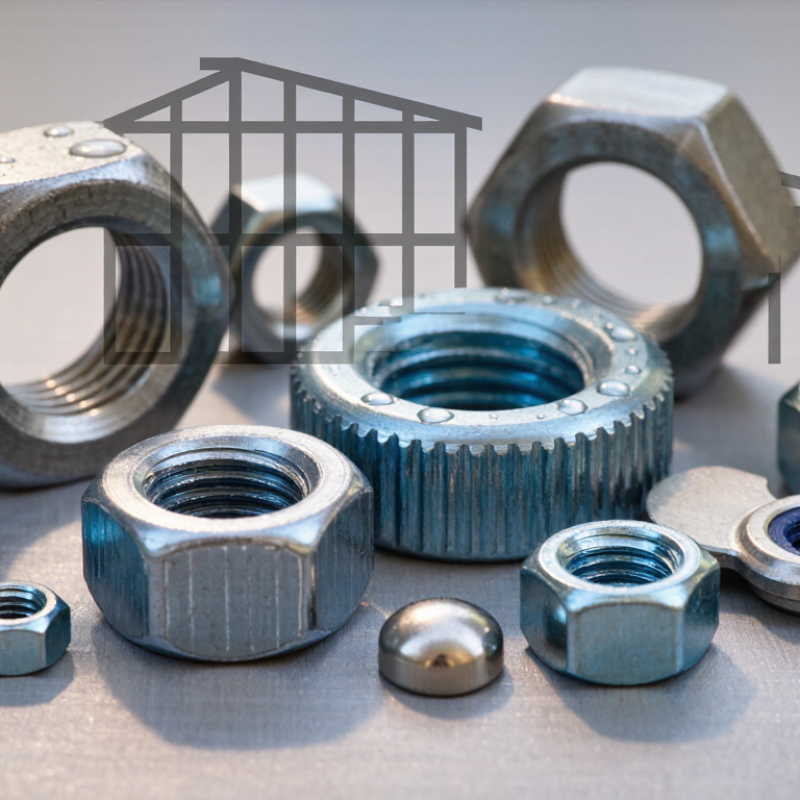
What Are Screw Nuts and What Types Are Available?

Define Screw Nuts Through ISO Metric Threads and ISO 898-2 Standards

Screw nuts are internally threaded fasteners that clamp against a bolt or screw. Their definition begins with the ISO metric thread system, not with appearance. ISO 68-1 specifies the basic 60-degree thread profile. ISO 261 lists preferred metric diameters from 1 to 100 mm. ISO 965-2 then controls tolerance limits, including common internal-thread class 6H. A nut can look correct yet fail if its pitch or tolerance is wrong.

ISO 898-2:2022 classifies nuts by mechanical properties and proof loads. Common classes include 5, 8, 10, and 12. Higher numbers generally indicate greater strength, but they do not automatically suit every bolt assembly. The required class depends on bolt grade, diameter, temperature, and applied load. In workshop inspections, thread engagement and surface damage often matter as much as the stamped class. Small errors remain expensive.

Available forms include hex nuts, lock nuts, flange nuts, cap nuts, and thin nuts. Hex nuts serve general fastening. Lock nuts resist loosening under vibration. Flange nuts spread pressure across a wider bearing area. Cap nuts protect exposed threads and reduce snagging. ISO 898-2 data should guide strength selection, while ISO 965 data should guide fit. A market analysis published in 2024 estimated the global industrial fasteners market above 80 billion US dollars, showing the scale of this ordinary component. That figure deserves caution because market boundaries differ between reports.

What Are Screw Nuts and What Types Are Available? — Defining Screw Nuts Through ISO Metric Threads and ISO 898-2 Standards
Category Dimension or Standard Typical Data Definition and Practical Use
Basic Definition Function Internally threaded fastener A screw nut engages with an externally threaded screw or bolt to create a removable clamping connection. Torque applied to the nut produces axial preload in the fastener assembly.
ISO Metric Thread Thread designation M10 × 1.5 M identifies an ISO metric thread, 10 is the nominal thread diameter in millimetres, and 1.5 is the thread pitch in millimetres.
ISO Metric Thread Coarse-pitch examples M6 × 1.0; M8 × 1.25; M10 × 1.5; M12 × 1.75; M16 × 2.0; M20 × 2.5 These are commonly used coarse-pitch ISO metric thread combinations. Coarse threads generally provide faster assembly and are less sensitive to minor contamination or damage.
ISO Metric Thread Fine-pitch examples M10 × 1.25; M12 × 1.5; M16 × 1.5; M20 × 1.5 Fine threads have a smaller pitch and provide more precise adjustment, a larger minor diameter, and improved resistance to loosening from vibration in some applications. The matching bolt and nut must have the same pitch.
Thread Fit Common ISO tolerance pairing 6H internal thread / 6g external thread ISO metric thread tolerance classes define the permitted dimensional variation. The internal nut thread and external bolt thread must be compatible; the exact tolerance class depends on the product specification.
Standard Hex Nut Common product standard ISO 4032 A regular hexagon nut with six external flats for installation using a wrench or socket. It is one of the most widely used general-purpose nut forms.
Thin Hex Nut Common product standards ISO 4035 and related thin-nut specifications A reduced-height hex nut used where installation space is limited or where it serves as a jam nut. Thin nuts should not automatically be substituted for full-height nuts in high-load joints.
High-Style Hex Nut Common product standard ISO 4033 A higher-profile hex nut that provides greater thread engagement than a standard-height nut. It is selected when additional engagement or a specific assembly geometry is required.
Flange Nut Construction Hex body with integral circular flange The flange distributes the clamping force over a larger bearing area and can reduce surface indentation. A serrated flange may also provide a limited anti-rotation effect, subject to the application and surface condition.
Prevailing-Torque Nut Construction All-metal or non-metal insert type This nut generates resistance to rotation that remains present when the joint is not under axial load. ISO 898-2 covers mechanical properties for applicable nuts, while prevailing-torque performance is evaluated by the relevant product or test requirements.
Cap or Acorn Nut Construction Closed end over the external thread The closed end protects the protruding bolt thread and improves appearance. The available internal depth must be sufficient for the bolt length and any washers used.
Cage or Captive Nut Construction Nut retained in a spring cage or carrier Used in panels, enclosures, and sheet-metal assemblies where the nut must remain positioned while the screw is installed from one side.
ISO 898-2 Scope Mechanical properties of nuts ISO 898-2 specifies mechanical and physical property requirements for carbon-steel and alloy-steel nuts used with ISO metric coarse and fine-pitch threads, within the dimensional limits defined by the standard.
Nut Property Class Common high-strength classes 5, 8, 10, 12 The property class indicates the mechanical performance level of the nut. Higher classes generally require higher proof-load capability, but the correct class must be selected together with the bolt class and joint design.
Nominal Proof-Stress Level Property-class reference Class 5: 500 MPa; Class 8: 800 MPa; Class 10: 1,000 MPa; Class 12: 1,200 MPa These figures represent the nominal property-class levels commonly associated with nut classification. The actual ISO 898-2 proof-load requirement is determined by thread size, pitch, nut geometry, and the applicable standard table.
Lower Property Classes Available designations 04, 05, 6, and 9 Lower or intermediate nut classes are available for suitable load requirements. They should be used only when their mechanical properties are compatible with the bolt, service load, tightening method, and safety requirements.
Typical Hex-Nut Dimensions Across-flats width and height M6: 10 mm / 5 mm; M8: 13 mm / 6.5 mm; M10: 16 mm / 8 mm; M12: 18 mm / 10 mm; M16: 24 mm / 13 mm; M20: 30 mm / 16 mm These are representative dimensions for standard ISO 4032-style hex nuts, listed as nominal thread size followed by approximate across-flats width and nut height. The applicable product standard and revision should always be checked for procurement.
Material Groups ISO 898-2 materials Carbon steel and alloy steel Steel grade, heat treatment, hardness, surface condition, and corrosion protection influence performance. Material selection should account for strength, temperature, corrosion exposure, and compatibility with the mating fastener.
Marking Identification Manufacturer mark plus property-class marking where required Property-class markings help identify mechanical performance. Marking requirements depend on nut size, class, and the applicable standard; unmarked nuts should not be assumed to meet a specified ISO 898-2 class.
Compatibility Check Selection requirements Same nominal diameter, same pitch, suitable tolerance, compatible strength class Before installation, verify the nut designation, thread pitch, thread fit, strength class, bearing surface, coating, and operating environment. A nut with the wrong pitch can damage the mating thread and fail to develop reliable preload.

Explain How Internal Threads Transfer Clamping Force in Bolted Joints

What Are Screw Nuts and What Types Are Available?

A screw nut is a threaded fastener with internal threads. It works with a bolt or threaded stud to create a clamped joint. When tightened, the bolt stretches slightly, while the nut moves along the external threads. This stretching produces preload, which presses the joined parts together. The internal thread is the contact path that transfers tightening force into the assembly. Small details matter. Poor thread fit can reduce holding strength.

Torque does not become clamping force directly. Some torque overcomes friction between the thread flanks and the nut’s bearing surface. The remaining energy stretches the bolt and compresses the joint. A flat bearing face helps distribute pressure against the material.

Damaged, dirty, or cross-threaded internal threads can interrupt this force path. In practical inspections, I check thread cleanliness, seating, and visible damage before tightening. It is easy to underestimate contamination.

Common nut types include standard hex nuts, thin nuts, flange nuts, lock nuts, and castellated nuts. Flange nuts spread pressure over a wider area. Lock nuts help resist loosening from vibration, but they do not correct poor preload. Castellated nuts require a matching locking feature and careful alignment. Material hardness and thread accuracy also affect performance. A tighter nut is not always a safer nut. Over-tightening may stretch the bolt permanently or crush softer joint materials. Even experienced technicians can misjudge friction, so verified torque methods remain important.

Classify Hex, Lock, Wing, Cap, Flange, and T-Nuts by Application

Screw nuts secure threaded fasteners, but their shapes serve different working conditions. The right choice depends on load, vibration, access, and surface protection.

Hex nuts are the standard option for general construction and machine assembly. They work well with bolts, washers, and common hand tools. Use a matching thread size and leave enough thread engagement beyond the nut.

Lock nuts suit assemblies exposed to vibration, such as brackets, frames, and moving equipment. Some use a nylon insert, while others rely on a metal locking feature. Check temperature limits before choosing an insert type.

Wing nuts are designed for frequent hand adjustment. They fit tool-free covers, inspection panels, and temporary fixtures, but they are not ideal for high-torque joints.

Cap nuts cover the exposed bolt end. They improve appearance, protect threads, and reduce sharp edges around equipment.

Flange nuts include a built-in bearing surface. This wider base spreads pressure across thin sheet metal and can reduce the need for a separate washer.

T-nuts install into wood panels or other board materials, providing reusable internal threads for fixtures and furniture.

The choice is not always obvious. A wing nut may seem convenient, yet vibration can loosen it. In workshop practice, fit, tightening torque, and thread condition should be checked together. A small trial assembly can reveal problems before full installation.

Compare Nut Strength Using ISO 898-2 Property Classes 04 Through 12

Screw nuts hold threaded joints together by clamping against a bolt or threaded stud. Their performance depends on more than outside shape. Material, thread size, lubrication, and installation torque all influence joint security. ISO 898-2 provides a practical system for comparing nut strength through property classes 04, 05, 5, 6, 8, 9, 10, and 12.

The class number relates to the nut’s proof-load capability. In general, class 04 suits lighter-duty fastening, while classes 8, 10, and 12 support higher loads when the joint design allows it. A class 8 nut is not automatically suitable for every class 8 bolt. Thread diameter, pitch, bolt length, and engagement remain important. The lower-strength component can limit the entire connection.

In a workshop, technicians should read the marking on the nut and check the relevant ISO 898-2 table. A torque wrench helps, but torque alone does not prove joint strength. Friction changes with surface finish and lubricant. That detail is often missed. Matching a nut to the bolt’s strength class is a safer practice than choosing by appearance. Thin nuts also require care because their load capacity may differ from regular-height nuts. Visual inspection can reveal damaged threads, but it cannot confirm proof strength. That shortcut can fail. For critical assemblies, material certificates, calibrated tools, and controlled installation records provide stronger evidence than assumptions.

What Are Screw Nuts and What Types Are Available?

Screw nuts are internally threaded fasteners used with bolts or screws to create a secure clamped joint. Common types include hex nuts, thin nuts, lock nuts, flange nuts, cap nuts, and slotted nuts. ISO 898-2 property classes identify the mechanical strength of metric nuts.

The chart compares the minimum proof stress of nut property classes 04 through 12. A higher proof stress indicates greater resistance to permanent deformation under load. Values shown are nominal minimum proof-stress levels in megapascals (MPa).

Match Nut Types with UNC, UNF, Metric, and Corrosion-Resistant Systems

What Are Screw Nuts and What Types Are Available?

Nut selection begins with thread compatibility. UNC threads use a coarse pitch and suit general assembly, vibration, and softer materials. UNF threads use finer pitches. They provide more adjustment and clamping control in limited spaces. ASME B1.1 defines these unified thread systems for inch-based applications.

Metric nuts follow ISO 261 thread dimensions. Property classes under ISO 898-2 help match nut strength with the bolt. A class 8 nut should not be paired casually with a much stronger bolt. The joint may fail unevenly. That detail is often missed in purchasing departments. Check thread diameter, pitch, clearance, and strength class before installation. A 2023 industrial fastener market assessment reported continued demand for metric and corrosion-resistant products, especially in transport and construction. The exact growth rate varies between analysts, so forecasts deserve caution.

Corrosion-resistant nuts need a complete system, not a shiny surface alone. Stainless steel nuts should match compatible stainless bolts and washers. Galvanized systems require compatible coatings and controlled tightening. The NACE IMPACT study estimated global corrosion costs near 2.5 trillion dollars annually, equal to about 3.4% of global economic output. That figure explains why material selection matters beyond appearance. Salt spray, moisture, temperature, and dissimilar metals can change the decision. ASTM F1941 and related coating practices provide useful guidance, but site exposure still requires engineering judgment. I have seen a correct thread paired with the wrong washer. The joint looked secure. It was not.

Copyright 2025 Fluidra S.A. | Created by BCM Marketing Agencia Privacy Policy Legal note | Cookie policy |

Technical cookies are strictly necessary for our website to work and you can navigate through it. These types of cookies are those that, for example, allow us to identify you, give you access to certain restricted parts of the page if necessary, or remember different options or services already selected by you, such as your privacy preferences. Therefore, they are activated by default, your authorization not being necessary in this regard. Through the configuration of your browser, you can block or alert the presence of this type of cookies, although such blocking will affect the proper functioning of the different functionalities of our website.


The analysis cookies allow us to study the navigation of the users of our website in general (for example, which sections of the page are the most visited, which services are used most and if they work correctly, etc.). From the statistical information on navigation on our website, we can improve both the operation of the page itself and the different services it offers. Therefore, these cookies do not have an advertising purpose, but only serve to make our website work better, adapting to our users in general. By activating them you will contribute to this continuous improvement. You can enable or disable these cookies by checking the corresponding box, being disabled by default.


Functionality cookies allow us to remember your preferences, to personalize certain characteristics and general options of our website, every time you access it (for example, the language in which the information is presented to you, the sections marked as favorites, your browser type, etc.) Therefore, this type of cookies does not have an advertising purpose, but by activating them you will improve the functionality of the website (for example, adapting to your type of browser) and the customization of it based on your preferences (for example, by presenting the information in the language that you have chosen in previous occasions), which will contribute to the ease, usability and comfort of our page during your navigation. You can enable or disable these cookies by checking the corresponding box, being disabled by default.


Advertising cookies allow us to manage the advertising spaces included in our website based on criteria such as the content shown or the frequency in which the ads are displayed. For example, if you have been shown the same ad several times on our website, and you have not shown a personal interest by clicking on it, it will not appear again. In summary, by activating this type of cookies, the advertising shown on our website will be more useful and diverse, and less repetitive. You can enable or disable these cookies by checking the corresponding box, being disabled by default.


Behavioral advertising cookies allow us to obtain information based on the observation of your browsing habits and behaviors on the web, in order to show you advertising content that best suits your personal tastes and interests. To understand it in a very simple way, we will give you a fictitious example: if your last searches on the web were related to suspense literature, we would show you advertising about suspense books. Therefore, activating this type of cookies, the advertising that we show you on our website will not be generic, but will be oriented to your searches, tastes and interests, therefore adjusting exclusively to you. You can enable or disable these cookies by checking the corresponding box, being disabled by default.
To understand it in a very simple way, we will give you a fictitious example: if your last searches on the web were related to suspense literature, we would show you advertising about suspense books. Therefore, activating this type of cookies, the advertising that we show you on our website will not be generic, but will be oriented to your searches, tastes and interests, therefore adjusting exclusively to you. You can enable or disable these cookies by checking the corresponding box, being disabled by default.

SAVE

We use our own and third-party cookies to ensure the proper functioning of the website and to analyse our services, improve your experience on our website and show you advertisements related to your interests according to profiling based on your browsing habits (e.g. websites visited). You can accept all cookies by clicking "ACCEPT" or set or reject them by clicking here. If you would like to know more about the use of cookies, please see our COOKIE POLICY.


ACCEPT ALL
Reject no essentials



