
Polymer extrusion industries are facing a major transition as manufacturers worldwide evaluate alternatives to traditional fluorinated polymer processing aids (PPAs).
For decades, fluorinated PPAs have been widely used to improve extrusion performance by reducing melt fracture, minimizing sharkskin defects, improving melt flow stability, and enhancing surface quality.
However, increasing attention toward PFAS substances, combined with growing sustainability expectations from global supply chains, is encouraging polymer manufacturers to reconsider conventional fluorinated processing technologies.
The key challenge is:
How can polymer processors replace fluorinated PPAs while maintaining extrusion efficiency, production stability, and product quality?
Chengdu SILIKE Technology Co., Ltd. developed the SILIMER series PFAS-Free Polymer Processing Additive as a fluorine-free processing solution designed to support polymer manufacturers transitioning away from traditional fluorinated PPAs.
SILIKE SILIMER fluorine-free alternatives technology can be evaluated for extrusion applications including: PE and PP film extrusion, multilayer packaging materials, pipe extrusion, fiber and monofilament production, wire and cable compounds…
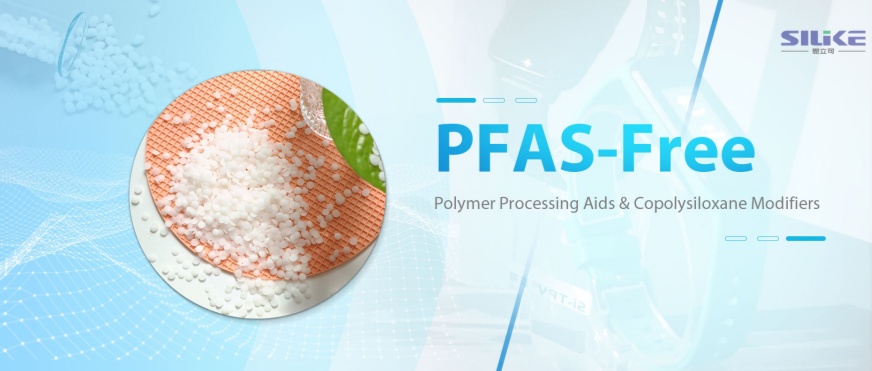
This article explains why manufacturers are replacing fluorinated PPAs, the technical challenges during transition, and how PFAS-free processing technologies support sustainable polymer manufacturing.
Polymer processing additives play an important role in extrusion performance.
During extrusion, polymer melts experience high shear forces when passing through dies. Without proper processing control, manufacturers may encounter melt fractures, sharkskin defects, unstable melt pressure, rough product surfaces, and die contamination.
Traditional fluorinated PPAs have been widely adopted because they can improve polymer melt behavior and reduce processing problems.
They are commonly used in polyethylene film production, polypropylene film extrusion, pipe manufacturing, fiber processing, and cable compounds.
However, the industry is changing.
Today, polymer manufacturers are evaluating additives not only based on performance but also considering regulatory trends, sustainability requirements, customer expectations, and supply chain transparency
This has accelerated demand for: PFAS-free polymer processing aids,fluorine-free extrusion technology, and eco-friendly additive solutions.
The future of polymer processing requires a balance between: High Manufacturing Performance + Sustainable Material Strategies
2. What Is a PFAS-Free Polymer Processing Aid?
A PFAS-free polymer processing aid is an advanced extrusion additive technology designed to improve polymer melt processing without the use of fluoropolymer-based components associated with PFAS concerns. During extrusion, these additives modify melt flow behavior and optimize the interaction between polymer melts and processing equipment, helping reduce common extrusion challenges such as melt fracture, sharkskin defects, surface irregularities, and unstable processing conditions. For polymer manufacturers evaluating alternatives to conventional fluorinated PPAs, PFAS-free processing technologies provide a practical approach to maintaining extrusion performance while supporting evolving material compliance requirements.
However, SILIKE’s SILIMER PFAS-Free Polymer Processing Aid series provides a fluorine-free solution designed to help polymer processors transition away from traditional fluorinated processing aids while maintaining stable extrusion performance and surface quality across various polymer applications.
Replacing fluorinated PPAs is not simply changing one additive for another.
Extrusion performance depends on many factors, including: polymer type, molecular structure, formulation design, processing temperature, extrusion equipment, and production speed.
A successful transition requires understanding the complete processing system.
At high extrusion speeds, polymer melts may experience elastic deformation.
This can create sharkskin defects, rough surfaces, and inconsistent appearance.
Manufacturers need PFAS-free alternatives that support stable melt-processing behavior while maintaining production efficiency.
Die build-up can affect production continuity, equipment cleaning frequency, and product consistency.
For high-volume extrusion operations, controlling die deposits is essential.
A suitable processing aid should help manufacturers achieve: cleaner extrusion operation, fewer interruptions, and improved production stability.
Different applications require different solutions.
For example: PE film extrusion, PP film production, cable compounds, and fiber extrusion have different processing requirements.
Performance depends on:
| Factor | Influence |
|---|---|
| Polymer type | Determines melt behavior |
| Processing temperature | Influences additive effectiveness |
| Filler content | Affects viscosity |
| Extrusion speed | Determines shear stress |
| Equipment design | Impacts processing stability |
Therefore, PFAS-free PPA selection should be based on application evaluation rather than a universal replacement approach.
| Evaluation Factor | Traditional Fluorinated PPA | PFAS-Free PPA Technology |
|---|---|---|
| Technology type | Fluoropolymer-based processing aid | Fluorine-free processing technology |
| Main function | Improve melt processing behavior | Support extrusion performance without fluorinated components |
| Melt fracture control | Widely used solution | Designed alternative solution |
| Die build-up reduction | Common benefit | Designed to support cleaner extrusion |
| Surface quality | Improved | Improved |
| Sustainability direction | Increasing evaluation | Supports fluorine-free transition |
| Application areas | Films, pipes, fibers, cables | Films, pipes, fibers, cables |
The objective of PFAS-free PPA technology is not simply additive replacement.
The goal is to maintain extrusion performance while supporting future material sustainability requirements.
Chengdu SILIKE Technology Co., Ltd. specializes in polymer additive technologies and sustainable material solutions.
The SILIMER series PFAS-Free Polymer Processing Additive was developed to help polymer processors evaluate alternatives to traditional fluorinated PPAs.

SILIMER Non-PFAS technology is designed to support:
Helping manufacturers optimize polymer melt processing behavior, like eliminating melt fracture (sharkskin).
♦ Reduced Surface Defects
Supporting smoother extrusion surfaces and improved appearance.
♦ Cleaner Processing Operation
Helping reduce issues related to die contamination.
Providing a fluorine-free option for companies reviewing additive systems.
PFAS-free processing technologies can be evaluated across multiple polymer applications.
Film manufacturers require: excellent surface quality, stable extrusion speed, consistent production.
Common challenges include: sharkskin defects, melt fracture, unstable melt flow
SILIMER PFAS-Free PPA technology can help support: smoother film surfaces, improved extrusion stability, consistent processing performance.
Applications include: PE blown film, LLDPE film, PP film extrusion, flexible packaging materials
For food packaging film applications, manufacturers can also explore: PFAS-Free Polymer Processing Aid for Food Packaging Films: A Sustainable Alternative to Fluorinated PPAs
Pipe manufacturers require: stable production, smooth surfaces, dimensional consistency
PFAS-free PPA technology can support: improved melt processing, reduced extrusion defects, enhanced surface appearance
Applications: PP-R pipes, PE pipes, industrial piping systems
Fiber applications require: stable spinning conditions, uniform filament quality, smooth surfaces
Potential applications: artificial turf, synthetic grass fibers, industrial monofilaments
SILIMER technology can help manufacturers evaluate solutions for: improved melt flow, reduced surface imperfections, stable production performance
Modern cable compounds often contain: flame retardants, mineral fillers, high additive loading
These formulations may create: high melt viscosity, surface roughness, extrusion instability
SILIMER PFAS-Free PPA solutions can help cable compound manufacturers improve: processing stability, surface quality, extrusion efficiency
Applications include: HFFR cables, LSZH compounds, EV charging cable materials
A successful transition usually includes four steps.
Evaluate: polymer type, existing additive system, extrusion parameters, product requirements
Consider: polymer compatibility, processing temperature, target improvements
Evaluate: extrusion stability, surface appearance, processing efficiency
Confirm: long-term stability, consistent quality, production reliability
8. Frequently Asked Questions About SILIMER PFAS-Free Polymer Processing Aids
8.1 Can PFAS-free PPAs maintain extrusion performance after replacing traditional fluorinated PPAs?
Yes. A properly selected PFAS-free polymer processing aid can help maintain extrusion performance by improving melt stability, reducing defects such as melt fracture and sharkskin, and supporting consistent surface quality. Actual performance depends on polymer type, formulation design, processing conditions, and application requirements.
8.2 Can PFAS-free PPA help reduce melt fracture and die build-up during extrusion?
PFAS-free PPA technology is designed to optimize polymer melt behavior and improve processing stability. Depending on the polymer system and extrusion conditions, it can help reduce common extrusion challenges such as melt fracture, surface irregularities, and die build-up.
8.3 Which SILIMER PFAS-free PPA is suitable for PE film extrusion?
For polyethylene film extrusion applications, SILIMER 9301 PFAS-free PPA masterbatch can be evaluated as a fluorine-free processing solution designed to support improved melt processing behavior, extrusion stability, and film surface quality.
8.4 Which SILIMER PFAS-free PPA is suitable for PP film extrusion?
For polypropylene film extrusion applications, SILIME 9406 PFAS-free PPA masterbatch can be evaluated as an alternative to traditional fluorinated PPAs, supporting improved melt flow behavior, extrusion consistency, and surface performance.
8.5 How should manufacturers select the right PFAS-free PPA grade?
The appropriate PFAS-free PPA grade depends on several factors, including:
♦ polymer type (PE, PP, mPE,mLLDPE, etc.)
♦ extrusion process
♦ processing temperature
♦ production speed
♦ target performance improvements
Technical evaluation is recommended to determine the most suitable solution for each application
8.6 How can companies evaluate SILIMER PFAS-free PPA technology?
Manufacturers can begin with an application assessment based on their current extrusion conditions, followed by laboratory testing and production validation. SILIKE provides technical support to help evaluate PFAS-free PPA solutions for different polymer processing applications.
The transition away from fluorinated PPAs represents an important development direction for the polymer industry.
Manufacturers increasingly need processing solutions that combine: sustainability, regulatory readiness, extrusion performance, and product quality.
Chengdu SILIKE Technology Co., Ltd.’s SILIMER PFAS-Free Polymer Processing Aid series provides a fluorine-free technology pathway for polymer processors seeking alternatives to traditional fluorinated PPAs.
By supporting improved extrusion stability, reduced defects, and enhanced surface quality, SILIKE’s SILIMER fluorine-free solutions technology helps manufacturers move toward the next generation of sustainable polymer processing.
Interested in evaluating PFAS-free polymer processing solutions?
SILIKE provides PFAS-free PPA recommendations, fluorinated PPA replacements, 100% PFAS-free additives, fluorine-free masterbatches, pure fluorine-free PPAs, and PTFE-free additives. polymer compatibility evaluation, extrusion optimization support, application testing assistance.
Phone: +86-28-83625089
Email:sale@rellytool.com
Website:www.siliketech.com

Cepex is the brand for the fluid handling market belonging to the Fluidra group. One of the leading european manufacturer of valves and fittings in thermoplastic materials.
Dedicated to the swimming pool, irrigation and industrial markets, we distribute our products worldwide with the Fluidra commercial network and presence in 46 countries with 136 sales branches.


