Why Are Plastic Valves Essential in Modern Industries?
FLUID HANDLING EXPERTS

Blog, all our news

Why Are Plastic Valves Essential in Modern Industries?

Plastic valves are crucial components in various modern industries. These valves play a significant role in controlling the flow of fluids and gases. Their lightweight design offers easy installation and maintenance. This accessibility often leads to improved efficiency in many operations. Industries such as chemical processing, food and beverage, and pharmaceuticals increasingly rely on plastic valves.

Their resistance to corrosion is a key advantage. While metal valves may deteriorate, plastic valves withstand harsh environments. However, concerns about durability occasionally arise. Some wonder if plastic valves can endure extreme conditions. Despite these doubts, ongoing advancements in material science boost their reliability.

The versatility of plastic valves surprises many. They are available in different shapes and sizes. These options allow customization for specific industrial needs. The reality is that not all plastic valves are created equal. Companies must choose wisely to ensure they meet their requirements. In the end, plastic valves represent a modern solution, yet they demand careful consideration.

Why Are Plastic Valves Essential in Modern Industries?

Significance of Plastic Valves in Fluid Control Systems Across Industries

Why Are Plastic Valves Essential in Modern Industries?

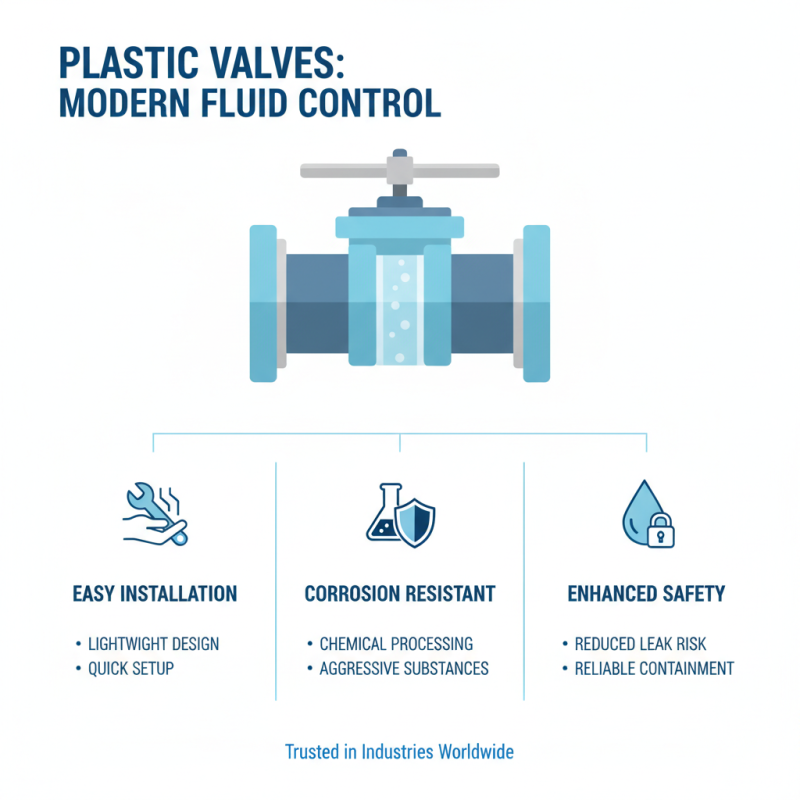
Plastic valves play a crucial role in modern fluid control systems. Their lightweight nature allows for easy installation across various industries. In chemical processing, for instance, plastic valves resist corrosion. This capability is vital when handling aggressive substances. As safety becomes increasingly important, these valves reduce the risk of leaks.

In water treatment facilities, plastic valves enhance efficiency. They can be adapted to different pressure levels and flow rates. This flexibility supports diverse applications, from municipal systems to industrial usage. However, some may question their durability compared to metal valves. While plastics are robust, they can wear down under extreme conditions. Regular inspection is needed to ensure they function effectively.

Further, the cost-effectiveness of plastic valves cannot be overlooked. They often require less maintenance, saving companies time and money. Yet, there is a perception that lower cost means lower quality. This belief may lead to hesitation in certain industries. Educating teams about the advantages of modern plastic materials is essential. The balance between performance and cost remains a key consideration in today's industrial landscape.

Global Market Trends: Growth of Plastic Valves in Industrial Applications

The global market for plastic valves is rapidly expanding. Many industries now rely on these valves for their operations. Plastic valves are lightweight and corrosion-resistant. They meet the demands of various environments, from water treatment plants to chemical processing facilities. These characteristics make plastic valves an attractive option for engineers.

Market trends indicate a significant uptick in the use of plastic valves. The automotive sector is embracing them due to their efficiency and lower weight. The chemical industry also benefits from their durability. However, challenges remain. Some may question how well these valves perform under extreme conditions. It’s crucial to evaluate both pros and cons.

Many companies are investing in research to improve these valves. Enhanced designs may lead to better performance. Innovators are looking for sustainable materials as well. The goal is to reduce environmental impact. Yet, the journey is not without obstacles. Balancing cost and efficiency remains a challenge for manufacturers.

Benefits of Plastic Valves: Cost, Corrosion Resistance, and Weight Reduction

Plastic valves play a crucial role in modern industries. Their benefits include cost savings, corrosion resistance, and weight reduction. According to a recent industry report, companies can save up to 30% in materials when switching from metal to plastic valves. This cost efficiency is particularly vital for industries facing tight budgets.

Corrosion resistance is another major advantage. Unlike metals, plastics do not corrode when exposed to harsh chemicals. A study showed that using plastic valves can extend the lifespan of piping systems by up to 40%. This longevity minimizes maintenance costs and enhances reliability. Many businesses have noted a decrease in downtime due to leaks or failures.

Weight reduction also benefits industries. Plastic valves are significantly lighter than their metal counterparts. This weight difference simplifies installation and reduces transportation costs. In logistics, for instance, lighter materials can lead to lower shipping fees. However, some companies still hesitate to fully embrace plastic, often fearing it may not handle high-pressure situations as well as metal. The balance of adopting newer materials while addressing these concerns remains a pressing issue.

Key Industries Using Plastic Valves: Chemical, Water Treatment, and Oil & Gas

Plastic valves play a crucial role in several industries today. In the chemical sector, they are favored for their corrosion resistance. They handle aggressive substances with ease. This capability reduces risks and enhances safety. The lightweight design helps with easier installation and maintenance.

Water treatment facilities also rely heavily on plastic valves. They efficiently manage flow rates and ensure system integrity. Their non-reactive nature ensures that the water treated remains pure. However, some facilities overlook the importance of regular checks. Regular maintenance can prevent costly interruptions.

In the oil and gas sector, plastic valves are increasingly common. They provide reliable sealing under high pressures. The ability to resist chemical erosion is vital. However, users should keep an eye on performance over time. Sometimes, wear and tear can go unnoticed, leading to failures.

**Tips:** Always evaluate the specific needs of each application. Not all plastic valves are the same. Regularly inspect valves for signs of damage or wear.

Why Are Plastic Valves Essential in Modern Industries?

This chart illustrates the percentage usage of plastic valves across key industries, highlighting their essential role in manufacturing, water treatment, and oil & gas sectors.

Emerging Technologies: Innovations in Plastic Valve Manufacturing and Design

Emerging technologies are transforming the manufacturing of plastic valves. Recent studies show a shift toward advanced materials that enhance durability. Innovations include lightweight composites and environmentally friendly polymers. These materials not only reduce production costs but improve performance metrics.

New design techniques are also significant. 3D printing technology allows for rapid prototyping. This method reduces material waste by up to 30%. Additionally, computer-aided design (CAD) streamlines the customization process, enabling manufacturers to meet specific industry needs. Industry reports indicate that plastic valve applications have surged by 25% in sectors like water treatment and pharmaceuticals.

However, these advancements come with challenges. The reliance on recent technologies may introduce quality control issues. Not all manufacturers can adapt quickly. Some struggle with the skill gap in utilizing advanced equipment. Industry experts emphasize the need for training and development to fully harness these innovations. The future of plastic valves depends on a well-prepared workforce.

Copyright 2025 Fluidra S.A. | Created by BCM Marketing Agencia Privacy Policy Legal note | Cookie policy |

Technical cookies are strictly necessary for our website to work and you can navigate through it. These types of cookies are those that, for example, allow us to identify you, give you access to certain restricted parts of the page if necessary, or remember different options or services already selected by you, such as your privacy preferences. Therefore, they are activated by default, your authorization not being necessary in this regard. Through the configuration of your browser, you can block or alert the presence of this type of cookies, although such blocking will affect the proper functioning of the different functionalities of our website.


The analysis cookies allow us to study the navigation of the users of our website in general (for example, which sections of the page are the most visited, which services are used most and if they work correctly, etc.). From the statistical information on navigation on our website, we can improve both the operation of the page itself and the different services it offers. Therefore, these cookies do not have an advertising purpose, but only serve to make our website work better, adapting to our users in general. By activating them you will contribute to this continuous improvement. You can enable or disable these cookies by checking the corresponding box, being disabled by default.


Functionality cookies allow us to remember your preferences, to personalize certain characteristics and general options of our website, every time you access it (for example, the language in which the information is presented to you, the sections marked as favorites, your browser type, etc.) Therefore, this type of cookies does not have an advertising purpose, but by activating them you will improve the functionality of the website (for example, adapting to your type of browser) and the customization of it based on your preferences (for example, by presenting the information in the language that you have chosen in previous occasions), which will contribute to the ease, usability and comfort of our page during your navigation. You can enable or disable these cookies by checking the corresponding box, being disabled by default.


Advertising cookies allow us to manage the advertising spaces included in our website based on criteria such as the content shown or the frequency in which the ads are displayed. For example, if you have been shown the same ad several times on our website, and you have not shown a personal interest by clicking on it, it will not appear again. In summary, by activating this type of cookies, the advertising shown on our website will be more useful and diverse, and less repetitive. You can enable or disable these cookies by checking the corresponding box, being disabled by default.


Behavioral advertising cookies allow us to obtain information based on the observation of your browsing habits and behaviors on the web, in order to show you advertising content that best suits your personal tastes and interests. To understand it in a very simple way, we will give you a fictitious example: if your last searches on the web were related to suspense literature, we would show you advertising about suspense books. Therefore, activating this type of cookies, the advertising that we show you on our website will not be generic, but will be oriented to your searches, tastes and interests, therefore adjusting exclusively to you. You can enable or disable these cookies by checking the corresponding box, being disabled by default.
To understand it in a very simple way, we will give you a fictitious example: if your last searches on the web were related to suspense literature, we would show you advertising about suspense books. Therefore, activating this type of cookies, the advertising that we show you on our website will not be generic, but will be oriented to your searches, tastes and interests, therefore adjusting exclusively to you. You can enable or disable these cookies by checking the corresponding box, being disabled by default.

SAVE

We use our own and third-party cookies to ensure the proper functioning of the website and to analyse our services, improve your experience on our website and show you advertisements related to your interests according to profiling based on your browsing habits (e.g. websites visited). You can accept all cookies by clicking "ACCEPT" or set or reject them by clicking here. If you would like to know more about the use of cookies, please see our COOKIE POLICY.


ACCEPT ALL
Reject no essentials