
What Are the Main Types of Laser Parts for Buyers?
FLUID HANDLING EXPERTS

Blog, all our news

What Are the Main Types of Laser Parts for Buyers?

Buying Laser Parts is not simply a matter of choosing the strongest component. The right choice depends on wavelength, power, duty cycle, machine design, and expected service life. A diode module may suit compact engraving equipment, while a CO2 laser tube may better support acrylic or wood cutting. Fiber laser sources often serve metal processing, but their supporting parts must match the source precisely.

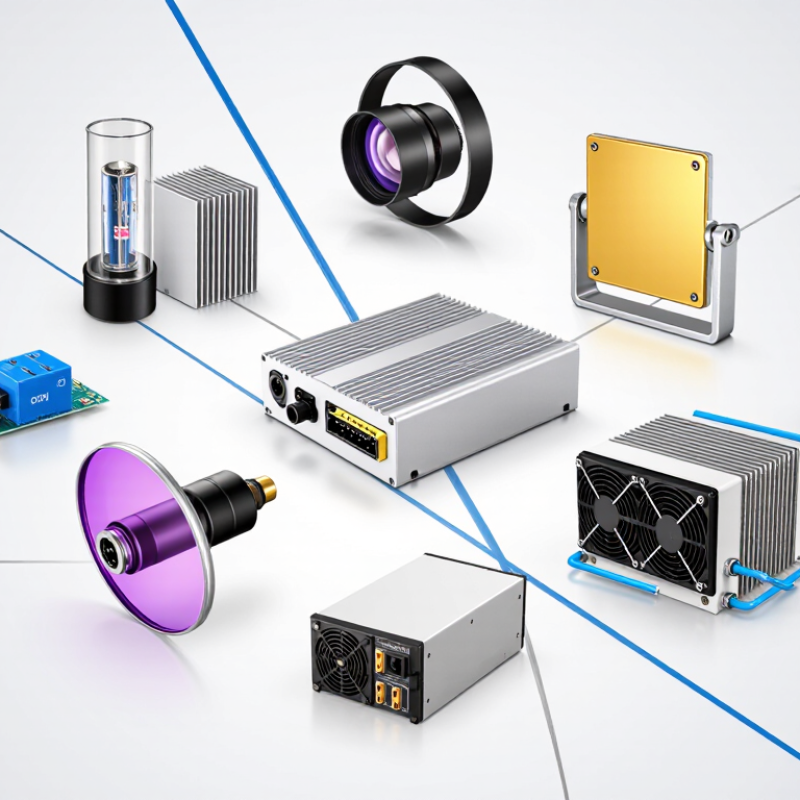
Theodore Maiman, the inventor of the first working laser, famously described it as “a solution looking for a problem.” That observation still matters for buyers. A powerful part can create new problems when its cooling, control, or optical requirements are ignored. Laser Parts usually fall into several practical groups: laser sources, focusing lenses, mirrors, beam expanders, protective windows, power supplies, cooling systems, motion components, and control electronics. Safety interlocks and extraction equipment also deserve attention.

Small details matter. A scratched protective window can distort a cutting path. Poor water circulation can shorten tube life. An incompatible lens may leave a blurred mark instead of a clean edge. Buyers should check thread sizes, connector types, coatings, operating temperatures, and supplier documentation before ordering. Experience helps, but it can also create overconfidence.

The categories overlap.

A reliable purchasing decision compares the complete system, not one impressive specification. Certification, traceable testing, replacement availability, and technical support provide stronger evidence than vague performance claims. Some specifications remain difficult to compare across brands. That uncertainty should be acknowledged, not hidden. Good Laser Parts purchasing is careful, specific, and willing to question convenient assumptions.
What Are the Main Types of Laser Parts for Buyers?

Laser Sources and Gain Components

Laser sources and gain components determine how a laser starts, amplifies, and maintains its beam. Buyers should examine these parts together, not as separate specifications. A pump source supplies energy to the gain medium. Common choices include diode arrays, electrical discharge systems, and flashlamps. Diode pumping usually offers better efficiency and control, while flashlamps can suit high-energy pulsed systems. The right choice depends on pulse width, operating temperature, and maintenance access.

The gain component is the material that amplifies light through stimulated emission. It may be a doped crystal, optical fiber, gas, or semiconductor structure. Each option affects wavelength, beam quality, cooling needs, and service life.

For example, a fiber gain medium can provide strong beam guidance and compact packaging. A crystal system may deliver high peak power but require careful alignment. Small details matter. Check absorption bands, emission wavelength, gain bandwidth, and damage thresholds.

In practical evaluations, I also inspect pump coupling and thermal management. A powerful source can underperform when heat distorts the gain medium. Look for stable output, clean connectors, compatible coatings, and accessible replacement parts. Higher power is not always better. It may increase cooling costs and shorten component life. Datasheets can also hide real operating limits. Ask for measured stability data, not only maximum ratings. I have seen buyers focus on output power and overlook noise, alignment drift, or service conditions. That mistake is easy to repeat.

Optical Parts for Beam Generation and Shaping

When buyers compare laser parts, optical components deserve close attention. They determine how light is generated, directed, and shaped. A gain medium produces amplification inside the laser cavity. Mirrors then provide feedback and help establish stable oscillation. For beam generation, buyers should check wavelength range, damage threshold, surface quality, and coating performance. These details affect output power and long-term reliability. A poorly matched optic can create stray reflections, heating, or unstable output. Small defects matter.

Beam shaping begins after generation. Lenses collimate divergent light and focus it onto a working plane. Beam expanders enlarge the beam diameter and can reduce divergence. Spatial filters remove unwanted intensity variations, although they may waste power. Cylindrical lenses correct different beam widths along two axes. This is useful for diode sources and line-shaped illumination. Apertures can clean the beam profile, but excessive restriction increases diffraction. The best choice depends on the application, not appearance alone. Measure the beam.

In practical purchasing, ask for test data rather than relying only on catalog values. Confirm clear aperture, focal length tolerance, coating band, and surface flatness. Mounting compatibility also matters; a perfect optic is useless if alignment is difficult. I have seen systems underperform because a lens was selected by diameter alone. That shortcut seems reasonable, but it ignores numerical aperture and working distance. Buyers should also consider contamination control and handling procedures. Even fingerprints can absorb energy and damage a coating. Some specifications remain uncertain until the complete optical path is tested. That is inconvenient, but honest evaluation prevents costly changes later.

Beam Delivery and Focusing Components

For buyers, beam delivery and focusing components determine how a laser behaves at the work surface. Mirrors, beam expanders, lenses, fiber couplers, and protective windows guide energy from the source. Each part affects spot size, direction, stability, or power density. A clean optical path is essential. Even a thin layer of dust can scatter light, create hot spots, and reduce process consistency. Match every component to the wavelength, power, beam diameter, and application.

Mirrors need suitable coatings and low surface distortion. Beam expanders enlarge the beam before focusing, often improving spot control and reducing edge errors. Focusing lenses then compress the beam into the required working distance. Flat-field lenses maintain a more consistent spot across scanning areas, while simple focusing assemblies suit fixed-position work. Fiber couplers demand careful alignment. A fraction of a millimeter can affect coupling efficiency. Request measured transmission, damage thresholds, focal length tolerance, and test conditions instead of relying only on catalog claims.

Installation details matter as much as specifications. Check thread sizes, cooling needs, sealing, and adjustment range before ordering. A suitable optic can still fail when its mount blocks airflow or shifts during cleaning. That is an easy mistake. It also deserves review. Keep inspection records and replace scratched optics early. A cheaper lens may become expensive when it increases rejects, downtime, or alignment work. Practical reliability matters more than an impressive specification sheet.

Main Types of Laser Parts: Beam Delivery and Focusing Components

Beam delivery systems commonly combine steering mirrors, focusing lenses or objectives, beam expanders, spatial filters, and fiber couplers. The chart shows the theoretical diffraction-limited Airy-disk diameter for a circular aperture at a fixed f-number of 4, calculated with d = 2.44λN.

Longer wavelengths produce a larger diffraction-limited spot under the same optical geometry. Actual focused spot size also depends on beam quality, lens aberrations, aperture filling, alignment, and the optical material’s transmission range.

Control, Detection, and Positioning Parts

Laser parts are easier to evaluate when buyers separate control, detection, and positioning functions. These parts determine how accurately a system reacts, measures, and moves.

Control parts include motion controllers, signal interfaces, and power regulation modules. They coordinate laser output with scanning speed, pulse timing, and safety feedback. MarketsandMarkets reported that the global laser technology market could reach about USD 31.8 billion by 2029, with automation and industrial processing supporting demand. That growth increases the need for stable control architecture, not merely higher output power. Buyers should check response time, communication protocols, thermal limits, and replacement access. A fast controller is still weak if its software settings confuse operators.

Detection parts measure beam intensity, position, wavelength, or process response. Photodiodes, power sensors, and optical detectors are common choices. A 2024 report from Fortune Business Insights valued the laser technology market at approximately USD 19.9 billion and projected strong long-term growth. However, market forecasts vary. I would not treat one figure as a purchasing promise. Sensor accuracy can change with heat, dust, calibration age, and reflected light. Ask for repeatability data, calibration procedures, and the stated measurement range.

Positioning parts include linear stages, galvanometric scanners, encoders, and alignment mounts. They control where the beam lands. Even a small mechanical error can create uneven edges on a fine workpiece. Buyers should compare travel range, resolution, backlash, vibration behavior, and load capacity. Test under real operating temperatures. A specification sheet may look perfect. Real alignment can still drift after hours of operation.

What Are the Main Types of Laser Parts for Buyers? - Control, Detection, and Positioning Parts
Part Category Component Type Main Function Typical Technical Parameters Common Applications Key Buyer Considerations
Control Parts Laser Diode Driver Supplies regulated current to a laser diode and helps maintain stable optical output. Constant-current operation; adjustable current limit; current stability commonly specified in mA or ppm; protection against overcurrent, overvoltage, and overheating. Laser modules, optical instruments, barcode systems, alignment tools, and laboratory sources. Match the driver to the diode's operating current, compliance voltage, modulation speed, noise level, and protection requirements.
Control Parts Temperature Controller Controls the temperature of a laser diode or optical assembly to stabilize wavelength and output power. Thermoelectric cooler control; thermistor or RTD input; temperature stability often specified in the millikelvin range; programmable heating and cooling limits. Wavelength-sensitive spectroscopy, interferometry, communications, metrology, and precision measurement. Check sensor compatibility, cooling capacity, temperature range, loop stability, and heat-sinking requirements.
Control Parts Laser Power Controller Regulates or maintains laser output power using feedback from a monitor photodiode or external detector. Closed-loop power control; selectable setpoint; response time from microseconds to milliseconds depending on design; analog or digital control interfaces. Material processing, imaging, microscopy, optical testing, and automated laser systems. Evaluate control bandwidth, feedback compatibility, dynamic range, settling time, and behavior during rapid power changes.
Control Parts Laser Modulator or Driver Varies laser intensity, pulse duration, or output timing for analog or digital operation. Modulation bandwidth may range from kHz to GHz depending on the device; pulse width, repetition rate, rise time, and impedance matching are important specifications. Data transmission, fluorescence instruments, laser marking, scanning, and time-resolved measurements. Confirm modulation format, maximum frequency, voltage or current drive method, signal integrity, and thermal load.
Detection Parts Photodiode Converts incident optical power into an electrical signal for monitoring or measurement. Silicon devices commonly cover approximately 400–1100 nm; InGaAs devices commonly cover approximately 900–1700 nm; responsivity is expressed in A/W. Laser monitoring, optical receivers, power meters, position sensors, and feedback loops. Select the material and wavelength range first, then compare active area, responsivity, dark current, speed, and saturation level.
Detection Parts Avalanche Photodiode Provides internal multiplication to improve sensitivity compared with a standard photodiode. Internal gain is commonly from several times to several tens of times; requires controlled bias voltage and generally has higher noise and temperature sensitivity than a standard photodiode. Low-light detection, optical communications, ranging, spectroscopy, and precision measurement. Consider gain stability, excess noise, bias control, wavelength response, temperature compensation, and maximum optical input.
Detection Parts Photodetector Module Combines a photodetector with amplification, filtering, or signal-conditioning electronics. May provide transimpedance output, selectable gain, AC or DC coupling, defined bandwidth, and calibrated or monitor-grade output. Optical laboratories, alignment systems, machine vision, spectroscopy, and automated inspection. Check output type, bandwidth, gain range, input noise, connector format, power supply, and electromagnetic compatibility.
Detection Parts Power Meter Sensor Measures average or pulsed optical power over a specified wavelength and power range. Typically specified by wavelength range, measurable power range, calibration uncertainty, detector aperture, and response time. Laser calibration, production testing, laboratory measurement, maintenance, and safety verification. Verify wavelength correction, sensor head range, continuous-wave or pulsed compatibility, aperture size, and calibration requirements.
Positioning Parts Linear Translation Stage Moves a laser, lens, mirror, sample, or detector along a controlled linear axis. Important specifications include travel range, minimum incremental motion, accuracy, repeatability, maximum speed, and load capacity. Beam alignment, microscopy, optical assembly, spectroscopy, and precision manufacturing. Choose manual or motorized operation and compare axis travel, stiffness, backlash, mounting pattern, and controller compatibility.
Positioning Parts Rotation Stage Rotates optical components or samples around a defined axis. Common parameters include angular range, graduations or encoder resolution, wobble, rotational accuracy, load capacity, and manual or motorized drive. Polarization measurements, crystal orientation, beam steering, optical testing, and sample analysis. Check clear aperture, angular resolution, axis height, locking method, center-of-rotation accuracy, and payload.
Positioning Parts Kinematic Mirror Mount Provides fine angular adjustment for directing and aligning a laser beam. Usually offers two-axis tip and tilt adjustment; specifications may include adjustment sensitivity, angular range, mirror diameter, stability, and optical clear aperture. Free-space beam alignment, interferometers, optical benches, imaging systems, and laboratory setups. Match the mount to mirror diameter and thickness; evaluate adjustment resolution, thermal stability, locking behavior, and mounting space.
Positioning Parts Beam Position Sensor Detects the location of a laser beam on a sensing surface and converts displacement into electrical data. Common sensor technologies include quadrant photodiodes and position-sensitive detectors; key parameters include active area, position resolution, bandwidth, linearity, and allowable optical power. Beam stabilization, alignment, optical tracking, vibration measurement, and automated calibration. Consider wavelength response, spot-size requirements, sensor geometry, calibration method, signal-conditioning electronics, and saturation limits.
Positioning Parts Optical Mount and Holder Secures lenses, mirrors, filters, laser modules, or detectors while maintaining their designed position. Typical specifications include compatible optic diameter, clear aperture, adjustment range, material, mounting thread, height, and environmental stability. Optical benches, laser modules, inspection equipment, research instruments, and production fixtures. Confirm optic dimensions, optical-axis height, mounting interface, adjustment needs, vibration resistance, and thermal expansion behavior.
Typical values and wavelength ranges are general industry reference points. Final selection should be based on the laser source, optical path, operating environment, required accuracy, and complete system specifications.

Power, Cooling, and Safety Components

When buyers compare laser parts, power components deserve close attention. A stable power supply delivers consistent energy to the laser source. Look for accurate output control, overload protection, and clean electrical connections. In my experience, poorly matched power units create uneven cutting and unexpected shutdowns. The cheapest option often becomes expensive through wasted material and service time.

Cooling components protect performance under continuous operation. Air cooling suits lower-power systems with moderate workloads. Water cooling is more suitable for higher heat loads and longer production cycles. A reliable setup needs a pump, reservoir, radiator, tubing, and temperature monitoring. Check flow rate and heat capacity against the machine’s actual power. Small leaks can damage nearby electronics. They also develop quietly. That detail is easy to overlook.

Safety components should never be treated as optional accessories. Common parts include interlock switches, emergency stops, protective enclosures, warning indicators, and suitable protective eyewear. The enclosure should block hazardous radiation while allowing safe observation of the work area. Interlocks must stop emission when a panel opens. Test them regularly, not only during installation. I have seen maintenance schedules become vague after a machine runs well for months. That is a weak habit. Buyers should also verify electrical ratings, replacement availability, installation instructions, and inspection records before purchase. Certified components are preferable, but certification alone does not replace correct installation or operator training.

Copyright 2025 Fluidra S.A. | Created by BCM Marketing Agencia Privacy Policy Legal note | Cookie policy |

Technical cookies are strictly necessary for our website to work and you can navigate through it. These types of cookies are those that, for example, allow us to identify you, give you access to certain restricted parts of the page if necessary, or remember different options or services already selected by you, such as your privacy preferences. Therefore, they are activated by default, your authorization not being necessary in this regard. Through the configuration of your browser, you can block or alert the presence of this type of cookies, although such blocking will affect the proper functioning of the different functionalities of our website.


The analysis cookies allow us to study the navigation of the users of our website in general (for example, which sections of the page are the most visited, which services are used most and if they work correctly, etc.). From the statistical information on navigation on our website, we can improve both the operation of the page itself and the different services it offers. Therefore, these cookies do not have an advertising purpose, but only serve to make our website work better, adapting to our users in general. By activating them you will contribute to this continuous improvement. You can enable or disable these cookies by checking the corresponding box, being disabled by default.


Functionality cookies allow us to remember your preferences, to personalize certain characteristics and general options of our website, every time you access it (for example, the language in which the information is presented to you, the sections marked as favorites, your browser type, etc.) Therefore, this type of cookies does not have an advertising purpose, but by activating them you will improve the functionality of the website (for example, adapting to your type of browser) and the customization of it based on your preferences (for example, by presenting the information in the language that you have chosen in previous occasions), which will contribute to the ease, usability and comfort of our page during your navigation. You can enable or disable these cookies by checking the corresponding box, being disabled by default.


Advertising cookies allow us to manage the advertising spaces included in our website based on criteria such as the content shown or the frequency in which the ads are displayed. For example, if you have been shown the same ad several times on our website, and you have not shown a personal interest by clicking on it, it will not appear again. In summary, by activating this type of cookies, the advertising shown on our website will be more useful and diverse, and less repetitive. You can enable or disable these cookies by checking the corresponding box, being disabled by default.


Behavioral advertising cookies allow us to obtain information based on the observation of your browsing habits and behaviors on the web, in order to show you advertising content that best suits your personal tastes and interests. To understand it in a very simple way, we will give you a fictitious example: if your last searches on the web were related to suspense literature, we would show you advertising about suspense books. Therefore, activating this type of cookies, the advertising that we show you on our website will not be generic, but will be oriented to your searches, tastes and interests, therefore adjusting exclusively to you. You can enable or disable these cookies by checking the corresponding box, being disabled by default.
To understand it in a very simple way, we will give you a fictitious example: if your last searches on the web were related to suspense literature, we would show you advertising about suspense books. Therefore, activating this type of cookies, the advertising that we show you on our website will not be generic, but will be oriented to your searches, tastes and interests, therefore adjusting exclusively to you. You can enable or disable these cookies by checking the corresponding box, being disabled by default.

SAVE

We use our own and third-party cookies to ensure the proper functioning of the website and to analyse our services, improve your experience on our website and show you advertisements related to your interests according to profiling based on your browsing habits (e.g. websites visited). You can accept all cookies by clicking "ACCEPT" or set or reject them by clicking here. If you would like to know more about the use of cookies, please see our COOKIE POLICY.


ACCEPT ALL
Reject no essentials


