
How to Choose the Right Rubber Pad for Your Needs?
FLUID HANDLING EXPERTS

Blog, all our news

How to Choose the Right Rubber Pad for Your Needs?

Choosing the right Rubber Pad starts with the job it must do. Will it absorb vibration beneath a machine, protect a work surface, or provide grip on a damp floor? These uses call for different compounds, thicknesses, and surface textures. A pad that feels firm in your hand may compress too much under a heavy load. Small details matter.

As an illustrative expert voice—not a verified quotation—rubber-materials specialist Elena Ward puts it this way: “Match the pad to the load, the environment, and the movement it must control.” Treat that as a starting point, not a guarantee. A real selection depends on the equipment, installation, and operating conditions.

Check the load, temperature range, exposure to oils or sunlight, and expected movement. Measure the available space, too. A few millimeters can change how a pad sits or performs. Compare natural rubber, neoprene, silicone, and other materials against those conditions, using manufacturer specifications where possible. If the application is critical, ask the supplier for test data or a sample.

There is no universal best pad. Even a well-chosen material can disappoint when its thickness or hardness is wrong. That part is easy to overlook. This guide outlines the practical checks that help narrow your options, flag assumptions, and make a more informed choice for your specific needs.
How to Choose the Right Rubber Pad for Your Needs?

Identify the Pad’s Purpose and Operating Conditions

Before choosing a rubber pad, define what it must do. Is it meant to reduce vibration, cushion impact, prevent slipping, or spread a load? A pad beneath a compressor faces steady weight and repeated vibration. A pad under a machine door may instead need to absorb brief impacts. Different jobs call for different hardness, thickness, and shape. Start with the job.

Then check the operating conditions. Note the load, contact area, movement, temperature range, and exposure to oil, water, dust, or cleaning products. Heat matters. A material that performs well indoors may harden or soften near a hot motor. Dust changes things. Grit trapped beneath a pad can scratch a floor or cause uneven support.

Hardness alone is not enough. A very firm pad may limit movement but transmit more vibration; a softer one may compress too far under a heavy load. Measure the equipment’s weight and footprint, then check how much compression the pad can tolerate. For moving machinery, consider shear forces as well as downward pressure. A tidy specification sheet cannot capture every installation detail, so verify the fit under realistic conditions. Check for rocking, excess compression, and unwanted movement after the pad is installed.

Compare Rubber Materials and Pad Designs

Rubber pads differ most in chemical resistance, temperature tolerance, and firmness. Natural rubber offers strong rebound and grip, making it useful beneath vibrating equipment. Nitrile rubber suits contact with oils, while EPDM handles outdoor moisture and weathering. Silicone tolerates higher temperatures, but its lower tear strength can be a drawback around sharp edges. Trade-offs matter. The International Rubber Study Group’s Rubber Statistical Bulletin reports global natural-rubber production at roughly 14.8 million tonnes in 2023; that supply figure gives industry context, not a performance guarantee for any pad. Check grade-specific test data.

Design matters just as much. A solid pad spreads a steady load; ribs or grooves can improve grip and help water escape. A thick, soft pad may damp vibration, but it can also compress unevenly beneath a heavy machine. ASTM D2240 measures durometer hardness, and ASTM D395 evaluates compression set—useful comparison points when reviewing test reports. Match hardness and thickness to the real load, floor surface, and temperature. A chart alone can mislead. Measure the equipment foot and inspect the floor; small gaps can concentrate pressure. Even careful selection needs a recheck after installation.

Determine the Required Size, Shape, and Thickness

Measure the area that will actually touch the floor, frame, or equipment. For a machine foot, include the full footprint, not just the bolt or stem. Leave enough room for the pad to sit flat without hanging over an edge. If the surface is uneven, a paper template can reveal awkward corners before you cut or order anything. It is a small step, but easy to skip.

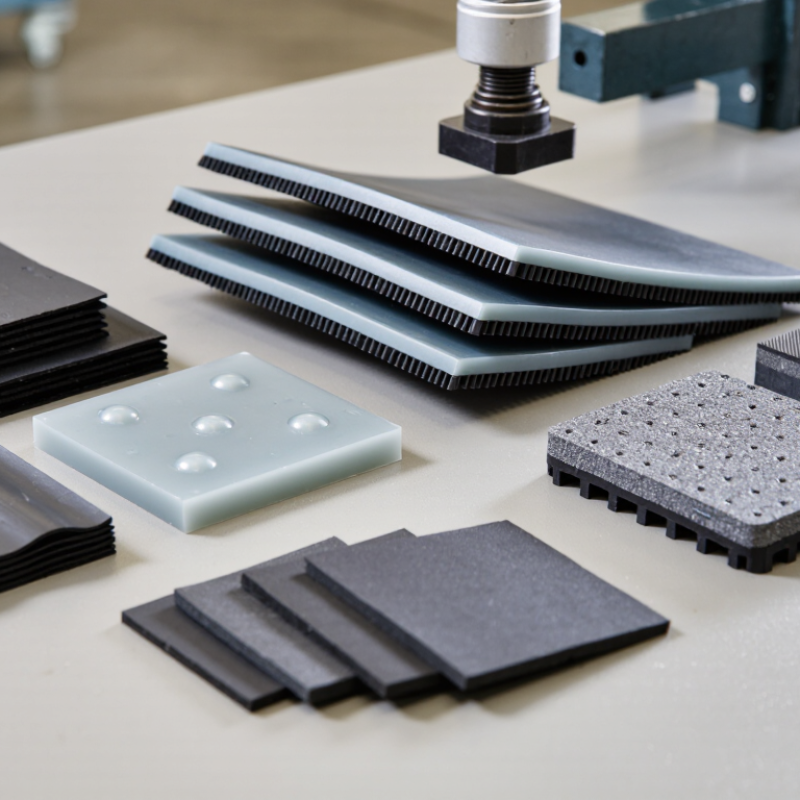
Choose a shape that matches the contact point and allows the pad to stay in place. Round pads suit many feet, while rectangular pieces can cover rails or broad panels. Check whether holes, slots, or trimmed edges are needed. Thickness depends on the job: a thin pad may limit added height, while a thicker one can provide more cushioning but may compress or shift under load. Compare the pad’s stated load capacity with the equipment’s weight, and consider whether that weight is spread evenly. A common sizing mistake is choosing thickness by appearance alone. Measure the available clearance, then check the fit with the equipment off the pad if practical. Real surfaces are rarely perfectly level, so allow for small differences and recheck after installation.

Check Load Capacity, Grip, and Environmental Resistance

How to Choose the Right Rubber Pad for Your Needs?

Start with the load each pad must carry, not the machine’s total weight alone. Divide the operating load across the supports, then account for uneven floors, vibration, and shifting. For example, a 400 kg machine on four pads places about 981 N on each under equal loading. A twofold design allowance raises the target to roughly 1.96 kN per pad. This is only an estimate; real load distribution is rarely perfect. Ask for compression-deflection results from an ASTM D575 test report, and compare them with the pad’s actual contact area and expected deformation.

Grip depends on both rubber and the surface beneath it. Smooth concrete, oily steel, and dusty tile can produce very different results, even with the same pad. Request measured friction data for conditions close to your installation, including wet or contaminated surfaces if relevant. A dry lab result may not predict performance on a damp factory floor. Test a sample in place. Small details matter.

Check environmental resistance against the materials the pad will encounter. ASTM D471 test reports can show how oils or other liquids affect rubber properties; ASTM D1149 evaluates ozone-related cracking. Compare the reported changes with your service conditions, temperature, and exposure time. A pad that grips well today may harden or swell later. I would not choose from a generic “oil-resistant” label alone; ask for test conditions and measured results.

Match the Pad’s Specifications to Installation Needs

A rubber pad should be chosen for the job it will perform, not just its shape. Start with the load: a machine’s weight, vibration, and movement all affect the pad’s required thickness and hardness. A pad that is too soft may compress unevenly; one that is too hard may transfer more vibration than expected. Small details matter.

Measure the installation area carefully, including bolt spacing and clearance beneath the equipment. Check the surface, too. A smooth concrete floor, a painted steel frame, and a damp workshop can call for different friction and material properties. If the pad may contact oil, heat, or cleaning fluids, verify that its compound is rated for those conditions. Fit matters.

Think about how the pad will be secured. A loose pad can shift during operation, while an oversized one may interfere with nearby parts. I would not rely on a catalog load rating alone; actual performance depends on contact area and how the load is distributed. Test a sample under realistic conditions when possible. Observe compression, movement, and wear after installation. There is some uncertainty here. Real floors are rarely perfectly level, and that can change the result.

Article Source:

Copyright 2025 Fluidra S.A. | Created by BCM Marketing Agencia Privacy Policy Legal note | Cookie policy |

Technical cookies are strictly necessary for our website to work and you can navigate through it. These types of cookies are those that, for example, allow us to identify you, give you access to certain restricted parts of the page if necessary, or remember different options or services already selected by you, such as your privacy preferences. Therefore, they are activated by default, your authorization not being necessary in this regard. Through the configuration of your browser, you can block or alert the presence of this type of cookies, although such blocking will affect the proper functioning of the different functionalities of our website.


The analysis cookies allow us to study the navigation of the users of our website in general (for example, which sections of the page are the most visited, which services are used most and if they work correctly, etc.). From the statistical information on navigation on our website, we can improve both the operation of the page itself and the different services it offers. Therefore, these cookies do not have an advertising purpose, but only serve to make our website work better, adapting to our users in general. By activating them you will contribute to this continuous improvement. You can enable or disable these cookies by checking the corresponding box, being disabled by default.


Functionality cookies allow us to remember your preferences, to personalize certain characteristics and general options of our website, every time you access it (for example, the language in which the information is presented to you, the sections marked as favorites, your browser type, etc.) Therefore, this type of cookies does not have an advertising purpose, but by activating them you will improve the functionality of the website (for example, adapting to your type of browser) and the customization of it based on your preferences (for example, by presenting the information in the language that you have chosen in previous occasions), which will contribute to the ease, usability and comfort of our page during your navigation. You can enable or disable these cookies by checking the corresponding box, being disabled by default.


Advertising cookies allow us to manage the advertising spaces included in our website based on criteria such as the content shown or the frequency in which the ads are displayed. For example, if you have been shown the same ad several times on our website, and you have not shown a personal interest by clicking on it, it will not appear again. In summary, by activating this type of cookies, the advertising shown on our website will be more useful and diverse, and less repetitive. You can enable or disable these cookies by checking the corresponding box, being disabled by default.


Behavioral advertising cookies allow us to obtain information based on the observation of your browsing habits and behaviors on the web, in order to show you advertising content that best suits your personal tastes and interests. To understand it in a very simple way, we will give you a fictitious example: if your last searches on the web were related to suspense literature, we would show you advertising about suspense books. Therefore, activating this type of cookies, the advertising that we show you on our website will not be generic, but will be oriented to your searches, tastes and interests, therefore adjusting exclusively to you. You can enable or disable these cookies by checking the corresponding box, being disabled by default.
To understand it in a very simple way, we will give you a fictitious example: if your last searches on the web were related to suspense literature, we would show you advertising about suspense books. Therefore, activating this type of cookies, the advertising that we show you on our website will not be generic, but will be oriented to your searches, tastes and interests, therefore adjusting exclusively to you. You can enable or disable these cookies by checking the corresponding box, being disabled by default.

SAVE

We use our own and third-party cookies to ensure the proper functioning of the website and to analyse our services, improve your experience on our website and show you advertisements related to your interests according to profiling based on your browsing habits (e.g. websites visited). You can accept all cookies by clicking "ACCEPT" or set or reject them by clicking here. If you would like to know more about the use of cookies, please see our COOKIE POLICY.


ACCEPT ALL
Reject no essentials


