
How to Choose the Right Nylon Ring Nut for Your Needs?
FLUID HANDLING EXPERTS

Blog, all our news

How to Choose the Right Nylon Ring Nut for Your Needs?

Choosing the right Nylon Ring Nut is more than matching a diameter to a bolt. The nut must suit the thread, load, temperature, moisture, and installation method. A small mismatch can cause loose joints, damaged threads, or premature cracking. The details matter.

In practical assembly work, I check the thread standard before reviewing price or appearance. Metric and imperial threads are not interchangeable. I also compare the nut’s internal size with the bolt’s actual dimensions. Nylon behaves differently from steel. It is lightweight, electrically insulating, and resistant to many chemicals. However, excessive heat can reduce its strength. Always review the manufacturer’s temperature range and technical data.

Consider the working environment carefully. A nylon ring nut used inside a dry control cabinet may need different performance from one exposed to vibration, oil, or outdoor moisture. Hand tightening may be suitable for light-duty parts, while controlled torque is safer for repeatable assembly. Do not assume a tighter nut is a better nut. Over-tightening can deform the ring or strip the threads.

Supplier quality also deserves attention. Reliable manufacturers should provide material information, dimensional drawings, and inspection details. When possible, test a small batch under real conditions. Check thread engagement, holding force, and removal behavior after repeated cycles. A clean specification can still miss an important detail. I have seen apparently suitable fasteners fail because the application temperature was overlooked. That mistake is easy to prevent. Choose with evidence, not only appearance.
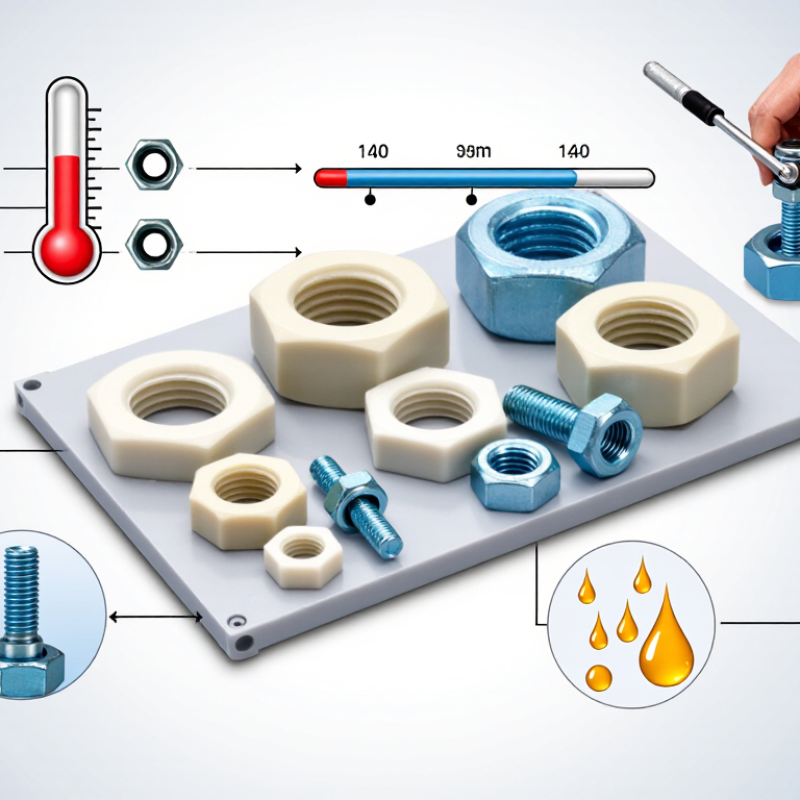
How to Choose the Right Nylon Ring Nut for Your Needs?

Define Nylon Insert Ring Nut Types Using ISO 2320 and ISO 7040 Standards

Choosing the right nylon ring nut starts with understanding its standard, not just its appearance. ISO 7040 defines prevailing torque hexagon nuts with a non-metallic insert, commonly called nylon insert nuts. It covers essential dimensions, thread details, and selected property classes for style 1 nuts.

ISO 2320 focuses on performance. It specifies how prevailing torque, tightening behavior, and temperature-related requirements should be evaluated. A nut may fit the bolt perfectly yet fail to provide reliable resistance against loosening. Do not guess. Check the nut’s thread size, property class, insert condition, and intended temperature range before installation.

In practical use, inspect the nylon ring for cuts, deformation, or contamination. A clean insert should create noticeable resistance when the nut passes the bolt thread. However, resistance alone does not prove compliance. Test conditions, reuse, lubrication, and installation speed can change the result. A common mistake is treating ISO 7040 as a complete performance guarantee; it mainly identifies the product type and dimensional framework. ISO 2320 provides the performance basis, but actual service conditions still matter. For vibrating machinery, outdoor equipment, or warm assemblies, compare the required load and temperature with documented test data. The standard is not the whole decision.

Match Thread Size and Pitch with ISO Metric or ASME Inch Specifications

How to Choose the Right Nylon Ring Nut for Your Needs?

Thread matching is the first quality check. Confirm the nominal diameter, pitch, and thread standard before selecting a nylon ring nut. ISO metric threads use millimetres, such as M6 × 1.0. ASME inch threads use diameter and threads per inch, such as 1/4-20 UNC. These are not interchangeable, although their diameters appear similar. A 1/4-20 thread has a 1.27 mm pitch, while M6 × 1.0 uses a 1.00 mm pitch. Small mismatch, big trouble.

ISO 965-1 defines metric thread tolerances, while ASME B1.1 covers Unified inch screw threads. Check both the nut and mating bolt against the correct specification. Use a thread pitch gauge, caliper, and the supplier’s inspection report. Do not rely on visual comparison. A fine-thread choice, such as M8 × 1.0 or 1/4-28 UNF, may suit limited adjustment space, but only when the bolt matches exactly. Check it twice.

Market data also deserves caution. Grand View Research estimated the global fasteners market at about 95.2 billion dollars in 2023. Other 2024 analyses report different totals because product categories vary. That inconsistency matters. It shows why a market label cannot replace dimensional verification. In practical assembly work, I would record the thread designation, standard, tolerance, and gauge result before ordering. I might still miss an application-specific issue, especially where heat, chemicals, or repeated tightening affect nylon performance.

Compare PA6 and PA66 Temperature Ratings, Commonly Up to 120°C

How to Choose the Right Nylon Ring Nut for Your Needs?

Choosing a nylon ring nut begins with temperature, not thread size alone. PA6 and PA66 ring nuts are often rated near 120°C, but that figure needs careful interpretation. A datasheet may describe continuous service, short exposure, or testing without mechanical load. These conditions are not interchangeable. PA66 usually retains strength better at elevated temperatures than PA6. However, moisture changes the comparison. Dry nylon can feel rigid, while humid nylon may become tougher but less dimensionally stable.

In practical assembly work, check the hottest contact surface, not only the surrounding air. A motor housing at 90°C can transfer heat directly into the nut. When the ring nut maintains preload, creep becomes important. Sustained heat can relax the threads, even below 120°C. PA6 may suit moderate temperatures and less demanding clamping. PA66 can be a better choice near the upper operating range, especially where stiffness matters. Still, the exact grade controls performance. The material name alone is not enough.

Compare the supplier’s continuous temperature rating, moisture condition, torque guidance, and thread tolerance. Leave a temperature margin when vibration, pressure, or repeated heating is present. I have seen installers treat 120°C as a working target. That is a mistake worth avoiding. A small assembly test can reveal thread loosening, distortion, or difficult removal before full production. Temperature records from the actual equipment are more useful than guesses.

How to Choose the Right Nylon Ring Nut for Your Needs?

Temperature performance is an important selection factor for nylon ring nuts. PA66 generally provides better heat resistance than PA6, while both materials may reach approximately 120°C in suitable application-specific grades.

Typical continuous-use values are approximate reference points: PA6 is commonly rated around 80°C, while PA66 is commonly rated around 100°C. Actual limits depend on load, exposure time, moisture, design, and the specific material grade.

Check Proof Load and Torque Requirements Under ISO 898-2 and ASTM F594

How to Choose the Right Nylon Ring Nut for Your Needs?

A nylon ring nut needs more than a matching thread size. Check its proof load, prevailing torque, temperature range, and material grade. Under ISO 898-2, proof load verifies whether a steel nut can withstand a specified axial force without permanent thread damage. This value depends on the nut property class, thread diameter, and pitch. ASTM F594 provides requirements for stainless steel nuts, including strength and material conditions. Do not treat these standards as interchangeable. The wrong reference can create false confidence.

Torque requires closer attention. Installation torque seats the nut, while prevailing torque measures resistance from the nylon ring. These values change with lubrication, surface finish, reuse, temperature, and tightening speed. A dry nut on a clean M8 bolt may behave differently from the same nut after storage in a warm workshop. Use the supplier’s tested torque range, then confirm it with calibrated equipment. Record the first-run torque and the removal torque separately. The numbers should not be assumed to match.

I have seen installers rely on a general torque chart. That shortcut caused inconsistent clamping. It was convenient, but not dependable. Confirm the bolt grade, nut standard, coating, and nylon temperature limit before selection. Request lot-specific test data when the joint affects safety or repeated maintenance. A small error in thread engagement can also distort proof-load results. That detail is easy to miss.

Verify Chemical Resistance, Reusability, and ISO 2320 Locking Performance

Choosing the right nylon ring nut begins with its working environment, not thread size alone. Identify contact with oils, fuels, acids, cleaning agents, moisture, and ultraviolet light. Nylon resists many common substances, but strong solvents and prolonged heat can cause swelling, brittleness, or loss of grip. Create a simple chemical compatibility chart before ordering. A short immersion test can expose problems that a catalog table misses.

Reusability requires realistic testing. Each installation compresses the nylon ring and reduces prevailing torque. Heat, vibration, and cross-threading accelerate this change. Follow the stated reuse limit, if available, and measure torque during trial assembly. Inspect the insert for cuts, flattening, contamination, or pulled threads. It may still look acceptable.

Do not assume ISO 2320 automatically covers every nylon-insert nut. The standard is commonly associated with prevailing-torque all-metal nuts, so confirm the manufacturer’s declared scope and test method. Request locking-performance data for the actual size, material, temperature, and installation condition. Test both new and reused nuts. An overlooked detail is washer thickness; it can alter clamping behavior and make a good locking test misleading. Document the torque readings instead of relying on hand feel.

Copyright 2025 Fluidra S.A. | Created by BCM Marketing Agencia Privacy Policy Legal note | Cookie policy |

Technical cookies are strictly necessary for our website to work and you can navigate through it. These types of cookies are those that, for example, allow us to identify you, give you access to certain restricted parts of the page if necessary, or remember different options or services already selected by you, such as your privacy preferences. Therefore, they are activated by default, your authorization not being necessary in this regard. Through the configuration of your browser, you can block or alert the presence of this type of cookies, although such blocking will affect the proper functioning of the different functionalities of our website.


The analysis cookies allow us to study the navigation of the users of our website in general (for example, which sections of the page are the most visited, which services are used most and if they work correctly, etc.). From the statistical information on navigation on our website, we can improve both the operation of the page itself and the different services it offers. Therefore, these cookies do not have an advertising purpose, but only serve to make our website work better, adapting to our users in general. By activating them you will contribute to this continuous improvement. You can enable or disable these cookies by checking the corresponding box, being disabled by default.


Functionality cookies allow us to remember your preferences, to personalize certain characteristics and general options of our website, every time you access it (for example, the language in which the information is presented to you, the sections marked as favorites, your browser type, etc.) Therefore, this type of cookies does not have an advertising purpose, but by activating them you will improve the functionality of the website (for example, adapting to your type of browser) and the customization of it based on your preferences (for example, by presenting the information in the language that you have chosen in previous occasions), which will contribute to the ease, usability and comfort of our page during your navigation. You can enable or disable these cookies by checking the corresponding box, being disabled by default.


Advertising cookies allow us to manage the advertising spaces included in our website based on criteria such as the content shown or the frequency in which the ads are displayed. For example, if you have been shown the same ad several times on our website, and you have not shown a personal interest by clicking on it, it will not appear again. In summary, by activating this type of cookies, the advertising shown on our website will be more useful and diverse, and less repetitive. You can enable or disable these cookies by checking the corresponding box, being disabled by default.


Behavioral advertising cookies allow us to obtain information based on the observation of your browsing habits and behaviors on the web, in order to show you advertising content that best suits your personal tastes and interests. To understand it in a very simple way, we will give you a fictitious example: if your last searches on the web were related to suspense literature, we would show you advertising about suspense books. Therefore, activating this type of cookies, the advertising that we show you on our website will not be generic, but will be oriented to your searches, tastes and interests, therefore adjusting exclusively to you. You can enable or disable these cookies by checking the corresponding box, being disabled by default.
To understand it in a very simple way, we will give you a fictitious example: if your last searches on the web were related to suspense literature, we would show you advertising about suspense books. Therefore, activating this type of cookies, the advertising that we show you on our website will not be generic, but will be oriented to your searches, tastes and interests, therefore adjusting exclusively to you. You can enable or disable these cookies by checking the corresponding box, being disabled by default.

SAVE

We use our own and third-party cookies to ensure the proper functioning of the website and to analyse our services, improve your experience on our website and show you advertisements related to your interests according to profiling based on your browsing habits (e.g. websites visited). You can accept all cookies by clicking "ACCEPT" or set or reject them by clicking here. If you would like to know more about the use of cookies, please see our COOKIE POLICY.


ACCEPT ALL
Reject no essentials


