
How to Choose the Right Brushless Motor
FLUID HANDLING EXPERTS

Blog, all our news

How to Choose the Right Brushless Motor

Choosing a brushless motor is not a matter of buying the highest-rated unit. It is about matching the motor, controller, and load to the work they must perform. The International Energy Agency’s Global EV Outlook 2024 reports nearly 14 million electric car sales in 2023, about 18% of global car sales. That growth reflects a broader shift toward electric drive systems, where motor selection affects efficiency, heat, noise, and service life.

Start with the load. A small wheel, pump, or fan each demands a different torque-speed profile. Record the required continuous and peak torque, operating speed, supply voltage, and available cooling. Then check the controller’s current limits and the motor’s mounting dimensions. A motor can look perfect on a datasheet and still overheat inside a cramped enclosure. It happens.

R. Krishnan, author of Electric Motor Drives: Modeling, Analysis, and Control, is a recognized authority on motor-drive systems. His work underscores an important selection principle: evaluate the motor and its drive together, rather than treating the motor as a standalone component. In this guide, we apply that principle to compare outrunner and inrunner designs, assess torque and efficiency ratings, and identify the specifications that matter in real operating conditions. You will also see where the data leaves room for judgment; published ratings do not always predict performance in your exact setup.
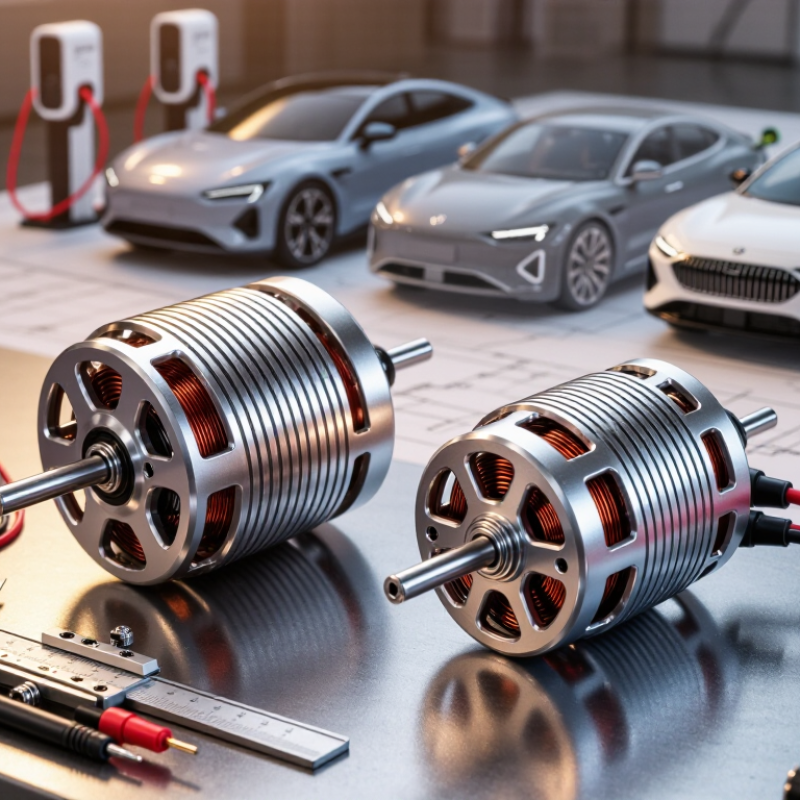
How to Choose the Right Brushless Motor

Define the Load Point with Mechanical Power: P = Tω

How to Choose the Right Brushless Motor
Define the Load Point with Mechanical Power: P = Tω

Choosing a brushless motor begins with the load point, not a catalog’s largest wattage. Mechanical power links torque and angular speed: P = Tω. Here, P is shaft power in watts, T is torque in newton-metres, and ω is speed in radians per second. For speed stated in rpm, convert it with ω = 2π × rpm / 60. For example, 0.20 N·m at 3,000 rpm is about 63 W. That figure describes output at that specific operating point.

Estimate the torque the machine needs while running, including friction and resistance from its working material. A small conveyor may need little torque when empty, then surge as a heavy item starts moving. Not the whole story. The motor must provide the required torque at the target speed without exceeding current, temperature, or controller limits. Check its torque-speed curve and duty cycle, not only peak power. Electrical input will exceed shaft output because components lose energy. Add a sensible margin, but do not inflate it blindly; oversized motors can cost more and behave poorly under light loads. Load estimates are imperfect. Verify the operating point under representative conditions before choosing a motor.

Match Motor Kv to Supply Voltage: No-Load RPM ≈ Kv × V

Kv describes a motor’s approximate no-load speed per volt, measured in revolutions per minute per volt. Multiply Kv by the voltage at the motor terminals for a useful first estimate. For example, a 900 Kv motor on an 11.1 V supply gives roughly 9,990 rpm with no load. A quick estimate. The number is not a speed guarantee.

Under load, the motor usually turns slower. Winding resistance, battery voltage sag, and the driven load all affect actual RPM. A propeller, for instance, can change current draw sharply as its size or pitch changes. Check the motor’s voltage and current limits, and use the battery’s fully charged voltage when checking maximum theoretical RPM. A 3-cell lithium battery marked 11.1 V can reach 12.6 V when fully charged, so nominal voltage alone may understate the no-load speed.

Match Kv and voltage to the speed your application needs, then verify the setup with a suitable controller and measured current. Kv is not a torque rating; lower-Kv motors often suit higher-voltage setups, but the whole system matters. That neat formula is useful, yet it leaves out heat and real load. Treat it as a starting point, not the final answer.

How to Choose the Right Brushless Motor - Match Motor Kv to Supply Voltage: No-Load RPM ≈ Kv × V
Motor Kv Supply Voltage Estimated No-Load RPM Typical Selection Consideration
100 Kv 12 V 1,200 RPM Low-speed applications that benefit from higher torque per amp, often paired with suitable gearing.
300 Kv 24 V 7,200 RPM A moderate-speed setup; check that the motor, controller, and load are compatible with the operating current.
500 Kv 36 V 18,000 RPM Higher voltage and moderate Kv can provide substantial speed; verify mechanical speed limits and cooling.
1,000 Kv 11.1 V 11,100 RPM A common nominal voltage for a 3-cell lithium-polymer battery; confirm the controller’s supported voltage range.
1,700 Kv 14.8 V 25,160 RPM A higher-speed combination using the nominal voltage of a 4-cell lithium-polymer battery; check propeller or rotor limits.
2,300 Kv 11.1 V 25,530 RPM High Kv can deliver high unloaded speed at modest voltage; ensure the motor and driven parts are rated for the RPM.

Estimate: No-load RPM ≈ motor Kv × supply voltage. For example, a 1,000 Kv motor at 11.1 V gives approximately 11,100 RPM with no load.

Important: These are theoretical estimates. Actual speed under load is lower and depends on battery voltage, current, motor design, controller settings, cooling, and the driven load. Use the battery’s operating voltage and check all component ratings before selecting a motor.

Check Continuous and Peak Current Against the Required Duty Cycle

A brushless motor must survive the real duty cycle, not just a brief peak on a specification sheet.

The U.S. Department of Energy’s industrial motor systems assessment estimated that motor systems use about 68% of U.S. manufacturing electricity. That makes correct sizing relevant to both reliability and energy use.

Record the load current during acceleration, steady running, braking, and pauses. A conveyor carrying heavy boxes may draw high current at startup, then run steadily for minutes.

Check continuous current against the motor’s thermal limit and the drive’s continuous output rating. For repeating loads, estimate cycle RMS current: square each current level, weight it by its duration, average the results, then take the square root.

It is easy to overlook brief overloads. Compare peak current and its duration with both motor and drive limits; a high peak rating may only apply for seconds.

IEC 60034-1 defines motor duty types, including intermittent and periodic operation, which helps describe these cycles consistently. Also verify whether the listed current is phase current or supply current; they are not interchangeable.

A measured test under the actual load is often more useful than a tidy spreadsheet—and may reveal assumptions worth revisiting.

Convert Kv to Torque Constant: Kt = 60 ÷ (2π × Kv)

Kv describes a motor’s approximate no-load speed per volt, while Kt describes torque per ampere. With Kv in rpm/V, convert using Kt = 60 ÷ (2π × Kv). The result is in newton-metres per ampere under the matching motor and current conventions. The relationship is inverse: a lower Kv generally means more torque per ampere. Keep the units consistent.

For example, a motor rated at 1,000 rpm/V has an estimated Kt of 0.00955 Nm/A. At 10 A, that suggests about 0.0955 Nm of torque in ideal conditions. Real output can differ because of heating, winding resistance, magnetic saturation, and measurement methods. Datasheets may use phase or line values, or peak and RMS current. Check those definitions before comparing motors. A calculation can look precise and still rest on mismatched data.

Tips: Write down the Kv units and current convention beside your result. Then compare estimated torque with the motor’s continuous rating, not just a brief peak figure. If the shaft speed drops under load, revisit your assumptions. It is easy to overlook cooling and duty cycle; I would double-check both before choosing a motor.

Verify Thermal Limits, Controller Compatibility, and Mounting Dimensions

A brushless motor may fit the frame and still run too hot. Check its continuous thermal rating, not only its brief peak rating. Peak figures can describe seconds of operation, while a real machine may run for hours. Heat depends on load, speed, airflow, and ambient temperature. Leave margin for warm enclosures or repeated starts. After a representative run, measure the motor case, remembering that it may stay cooler than the windings. That difference is easy to overlook.

Check that the controller matches the motor’s voltage range and required phase current. Confirm whether both use compatible position sensors, or whether the controller supports sensorless operation. A motor can spin freely on a bench yet struggle during a loaded start. Check startup behavior under real load. Then compare the motor drawing with your mounting plate: bolt pattern, pilot diameter, shaft size, and available clearance all matter. Frame labels are not enough. A few millimeters can spoil the fit.

Tips: Run a short test, then inspect temperature, vibration, and connector warmth. Keep notes on load and test duration. If one measurement seems odd, repeat it; a quick check can be misleading. I would not treat a cool outer case as proof that the motor is safe.

How to Choose the Right Brushless Motor: Thermal Limits, Controller Compatibility, and Mounting Dimensions

The example compares steady-state winding temperatures with insulation-class limits: Class F is rated to 155°C and Class H to 180°C. The temperatures shown are illustrative readings, not specifications for particular motors. Compare readings taken under the same load and ambient conditions, and leave an adequate thermal margin. Before choosing a motor, also confirm that its voltage and current requirements match the controller and that its mounting pattern and shaft dimensions fit the application.

Article Source:

Copyright 2025 Fluidra S.A. | Created by BCM Marketing Agencia Privacy Policy Legal note | Cookie policy |

Technical cookies are strictly necessary for our website to work and you can navigate through it. These types of cookies are those that, for example, allow us to identify you, give you access to certain restricted parts of the page if necessary, or remember different options or services already selected by you, such as your privacy preferences. Therefore, they are activated by default, your authorization not being necessary in this regard. Through the configuration of your browser, you can block or alert the presence of this type of cookies, although such blocking will affect the proper functioning of the different functionalities of our website.


The analysis cookies allow us to study the navigation of the users of our website in general (for example, which sections of the page are the most visited, which services are used most and if they work correctly, etc.). From the statistical information on navigation on our website, we can improve both the operation of the page itself and the different services it offers. Therefore, these cookies do not have an advertising purpose, but only serve to make our website work better, adapting to our users in general. By activating them you will contribute to this continuous improvement. You can enable or disable these cookies by checking the corresponding box, being disabled by default.


Functionality cookies allow us to remember your preferences, to personalize certain characteristics and general options of our website, every time you access it (for example, the language in which the information is presented to you, the sections marked as favorites, your browser type, etc.) Therefore, this type of cookies does not have an advertising purpose, but by activating them you will improve the functionality of the website (for example, adapting to your type of browser) and the customization of it based on your preferences (for example, by presenting the information in the language that you have chosen in previous occasions), which will contribute to the ease, usability and comfort of our page during your navigation. You can enable or disable these cookies by checking the corresponding box, being disabled by default.


Advertising cookies allow us to manage the advertising spaces included in our website based on criteria such as the content shown or the frequency in which the ads are displayed. For example, if you have been shown the same ad several times on our website, and you have not shown a personal interest by clicking on it, it will not appear again. In summary, by activating this type of cookies, the advertising shown on our website will be more useful and diverse, and less repetitive. You can enable or disable these cookies by checking the corresponding box, being disabled by default.


Behavioral advertising cookies allow us to obtain information based on the observation of your browsing habits and behaviors on the web, in order to show you advertising content that best suits your personal tastes and interests. To understand it in a very simple way, we will give you a fictitious example: if your last searches on the web were related to suspense literature, we would show you advertising about suspense books. Therefore, activating this type of cookies, the advertising that we show you on our website will not be generic, but will be oriented to your searches, tastes and interests, therefore adjusting exclusively to you. You can enable or disable these cookies by checking the corresponding box, being disabled by default.
To understand it in a very simple way, we will give you a fictitious example: if your last searches on the web were related to suspense literature, we would show you advertising about suspense books. Therefore, activating this type of cookies, the advertising that we show you on our website will not be generic, but will be oriented to your searches, tastes and interests, therefore adjusting exclusively to you. You can enable or disable these cookies by checking the corresponding box, being disabled by default.

SAVE

We use our own and third-party cookies to ensure the proper functioning of the website and to analyse our services, improve your experience on our website and show you advertisements related to your interests according to profiling based on your browsing habits (e.g. websites visited). You can accept all cookies by clicking "ACCEPT" or set or reject them by clicking here. If you would like to know more about the use of cookies, please see our COOKIE POLICY.


ACCEPT ALL
Reject no essentials


