
How to Choose the Best Entertainment Projector?
FLUID HANDLING EXPERTS

Blog, all our news

How to Choose the Best Entertainment Projector?

Choosing the right Entertainment Projector can transform an ordinary room into a lively home cinema. Yet, the brightest model is not always the best choice. Screen size, viewing distance, room lighting, sound, and installation space all affect the final experience.

A practical evaluation should begin with the room itself. Measure the distance from the projector to the wall or screen. Check whether sunlight reaches the viewing area. In a dim bedroom, 1,500 to 2,500 ANSI lumens may be comfortable. A brighter living room may require more. Resolution also matters. Full HD suits many films and games, while 4K provides sharper detail on larger screens. However, resolution alone cannot fix poor contrast or weak content quality.

Small details often decide satisfaction. Look for low fan noise, reliable autofocus, keystone correction, suitable HDMI ports, and built-in streaming support. Test the projector near your seating area if possible. A specification sheet cannot show every distraction, especially during quiet scenes. Some models promise impressive colors but appear overly cool or dull after setup. That deserves honest attention.

No projector performs perfectly in every room. I have seen affordable models create a better experience than expensive units after careful placement. Still, personal preferences can distort judgment. Gamers may value low input lag, while movie viewers may prefer accurate colors and deeper blacks. This guide examines these trade-offs clearly, helping you choose an Entertainment Projector that fits your space, habits, and realistic budget. Expect useful comparisons, but leave room for your own eyes.
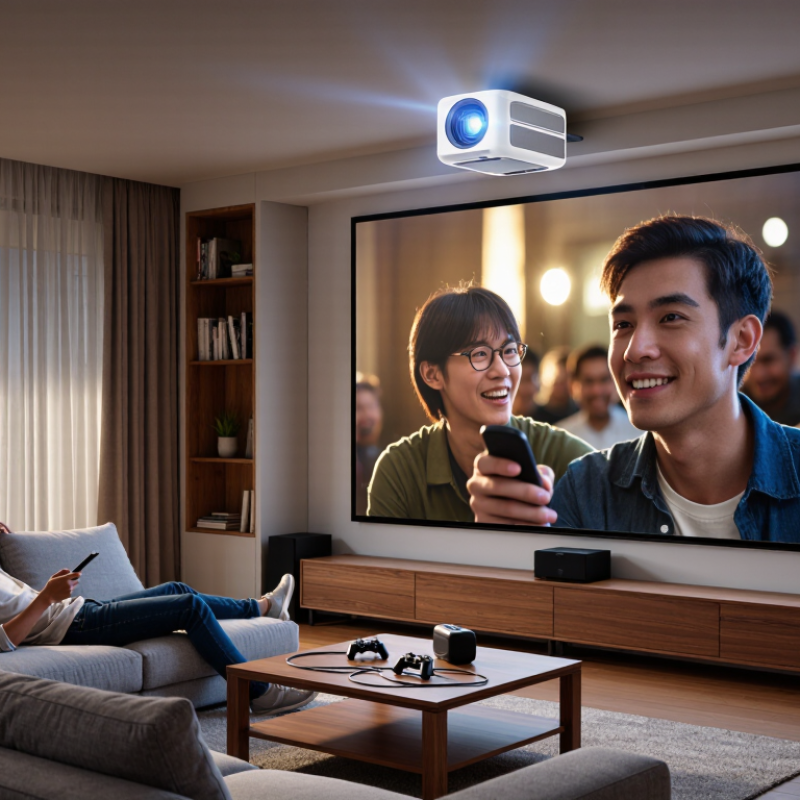
How to Choose the Best Entertainment Projector?

Define Your Entertainment Needs and Viewing Environment

Choosing the best entertainment projector starts with an honest description of your viewing habits. Do you watch films at night, follow sports with friends, or play games in a bright living room? Each activity needs different brightness, motion handling, and sound support. Measure the wall or screen area before shopping. A large image can feel impressive, yet it may overwhelm a small room. In my own testing, sitting too close made fast scenes tiring, even when the picture looked sharp. Room comfort matters as much as specifications.

Tips: Check the room during your usual viewing hours. Close curtains, switch on nearby lamps, and observe how much light reaches the wall. Dark rooms usually reveal better contrast, while brighter spaces need stronger light output and careful screen placement. Leave room behind the projector for ventilation. Keep the lens level with the screen when possible. Test subtitles and shadow details, not only colorful demo footage. A projector can look excellent in a store and disappointing at home.

Think about your daily setup. If cables cross a walkway, the system may become annoying quickly. Built-in speakers are convenient, but separate speakers often create clearer dialogue. For gaming, check input delay and connection options. For shared family viewing, simple controls may matter more than advanced image adjustments. Be realistic about maintenance, too. Dust, lamp aging, or a loose mount can change performance over time. I still find it easy to overvalue brightness numbers and ignore how often I will actually use the projector.

Compare Projector Resolution, Brightness, and Contrast

Choosing an entertainment projector starts with matching resolution, brightness, and contrast to your room.

A 4K projector displays 3840 × 2160 pixels, creating cleaner subtitles and sharper game textures than 1080p. However, resolution alone cannot rescue a weak optical system.

The International Organization for Standardization’s ISO/IEC 21118 standard defines methods for measuring projector brightness, helping shoppers compare published lumen figures more reliably.

Room light changes everything.

For a dark room, 1,500–2,500 ISO lumens may produce a comfortable 100-inch image. A living room with open curtains often needs around 3,000–4,000 ISO lumens. These figures are practical starting points, not universal rules.

A 2024 report from the Consumer Technology Association shows continued growth in large-screen home entertainment, but bigger images also reveal uneven brightness and poor black levels.

I have found that a bright picture can still look flat.

Contrast controls shadow detail, especially in night scenes.

Look for credible native contrast measurements, not only dynamic contrast claims. SMPTE guidance for cinema environments emphasizes controlled black levels and stable luminance, which also matters at home.

HDR support can add brighter highlights, but only when the projector has enough contrast and color control.

Sometimes, a well-calibrated 1080p model looks more natural than an inexpensive 4K unit. That is an inconvenient truth.

Consider screen size, viewing distance, window light, and actual test measurements before trusting a specification sheet.

Choose the Right Projection Technology and Image Size

Choosing an entertainment projector starts with projection technology, not screen size. Digital light processing usually delivers crisp motion and compact designs. Three-panel liquid-crystal systems can provide strong color brightness. Liquid-crystal-on-silicon systems often produce smoother contrast, but they usually cost more. Laser light sources offer steady brightness and quick startup. Lamp models may cost less, yet brightness declines over time. Grand View Research estimated the global projector market at about 11.7 billion US dollars in 2023, with continued growth through 2030. That growth makes specifications harder to compare. I would trust calibrated brightness, measured under ISO 21118, rather than promotional numbers alone.

Image size must match viewing distance and room light. The Society of Motion Picture and Television Engineers recommends roughly a 30-degree horizontal viewing angle for cinema-style viewing. At three meters, that suggests an image about 1.6 meters wide, or approximately 72 inches diagonally in a 16:9 format. A larger image is not automatically better. I once tested a 120-inch picture in a short room. It looked dramatic, but subtitles made my eyes travel constantly. That was uncomfortable.

For bright living rooms, choose higher measured brightness and strong light rejection. For dark rooms, prioritize contrast and accurate color. Check throw ratio before buying. A projector with a 1.5:1 ratio needs about 4.5 meters for a three-meter-wide image. Lens shift helps placement. Digital keystone correction can reduce edge sharpness. My own mistake was treating screen size as the main specification. Room geometry mattered more.

Evaluate Connectivity, Sound, and Smart Features

Choosing an entertainment projector means testing its connections, sound, and smart functions in your actual room. Deloitte’s 2024 Digital Media Trends survey found that 92% of U.S. households subscribe to at least one paid streaming service. Therefore, app access and reliable streaming matter as much as image quality.

Check for HDMI with audio return support, USB playback, Bluetooth, and dual-band Wi-Fi. Wi-Fi Alliance data describes Wi-Fi 6 as offering up to four times more network capacity and up to 75% lower latency than earlier generations. That advantage appears when several devices share one router. I once ignored this detail. The picture stuttered during a family film night. Wired Ethernet remains the safer choice for long movies.

Sound is often the weak point. A built-in speaker may handle dialogue, but action scenes can sound thin and harsh. Look for adjustable equalization, clear dialogue modes, and a proper output for external speakers. The ITU-R BS.1770 loudness standard supports consistent audio measurement, but manufacturers do not always describe output levels consistently. Listen before buying, if possible. Smart features also deserve scrutiny. Test the remote from the back row, check loading speed, and confirm regular security updates. Automatic brightness control can be convenient, yet it sometimes changes the picture distractingly. Privacy settings may feel boring, but microphone access and viewing-history controls should be easy to find.

How to Choose the Best Entertainment Projector?

Compare practical connectivity, audio, and smart-feature requirements before choosing a projector for movies, gaming, and streaming.

HDMI 2.0 supports up to 18 Gbps, while HDMI 2.1 supports up to 48 Gbps. Wi-Fi 6 has a theoretical maximum aggregate throughput of 9.6 Gbps, compared with 3.5 Gbps for Wi-Fi 5. Bluetooth Classic commonly provides up to 3 Mbps of theoretical data rate. These figures describe interface capacity rather than guaranteed real-world performance.

Check Installation Options, Durability, and Overall Value

Choosing an entertainment projector begins with the room, not the specification sheet. Measure the throw distance from the mounting point to the screen. A short-throw model can reduce shadows in a small living room, while a ceiling-mounted unit keeps cables away from children and pets. Check vertical and horizontal lens shift before buying. Digital keystone correction is convenient, but heavy correction can soften fine details.

Durability deserves equal attention. Look for a sealed optical engine, washable filters, and a published operating temperature range. LED or laser illumination usually reduces maintenance compared with traditional lamps. The U.S. Environmental Protection Agency reports that LED lighting uses at least 75% less energy and lasts up to 25 times longer than incandescent lighting. That figure is not projector-specific, so it should not be treated as a guaranteed service life. Real performance depends on ventilation, dust, and daily usage.

Overall value includes installation, replacement parts, electricity, and sound equipment. AVIXA’s 2024 Industry Outlook and Trends Analysis valued the global professional audiovisual market at roughly 332 billion dollars, showing how quickly installation standards are evolving. Ask an installer to calculate total ownership costs over five years, not just the purchase price. I once underestimated ceiling reinforcement and cable routing; the projector was affordable, but the room was not. Check warranty exclusions carefully. A bright image is useful, but a quiet, serviceable system may deliver more enjoyment over time.

How to Choose the Best Entertainment Projector? - Check Installation Options, Durability, and Overall Value
Projector Profile Best Use Typical Brightness Recommended Screen Size Installation Options Light Source and Expected Life Throw Ratio Gaming Suitability Common Connectivity Typical Noise Level Durability Considerations Overall Value
Compact LED Full HD Bedrooms, apartments, casual movie nights, and occasional travel 500–1,000 ANSI lumens 80–120 inches in a dark room Tabletop placement; some models support ceiling mounting and tripod use LED; approximately 20,000–30,000 hours of light-source life About 1.2:1–1.6:1 Good for casual gaming; look for input lag below 40 ms HDMI, USB media playback, wireless casting on selected models Approximately 25–35 dB Low heat output and no lamp replacement; compact housings may have limited dust protection High for flexible, low-maintenance use
Home-Cinema 4K-Compatible Dedicated movie rooms and large-screen streaming in controlled lighting 1,500–2,500 ANSI lumens 100–150 inches with light control Ceiling, rear-shelf, or tabletop installation; lens shift is useful for permanent setups Laser or LED; approximately 20,000–30,000 hours for laser or solid-state light sources About 1.3:1–2.1:1 Very good for console gaming when a low-latency mode is available HDMI with HDCP support, eARC or optical audio on selected models, USB, Ethernet or Wi-Fi Approximately 22–32 dB in standard mode Sealed or well-filtered designs reduce dust-related maintenance; stable ventilation is essential High for image quality and long-term ownership
Short-Throw Full HD Living rooms where the projector must sit close to the wall or screen 2,000–3,500 ANSI lumens 80–120 inches from roughly 0.4–1.0 m away Low cabinet or media-console placement; requires a flat wall or precisely installed screen Laser or lamp; laser models commonly provide about 20,000 hours, while lamps often provide 3,000–6,000 hours About 0.25:1–0.8:1 Good when input lag is below 30 ms; geometry must be aligned carefully HDMI, USB, digital audio output, and wireless features depending on configuration Approximately 28–38 dB Less vulnerable to accidental obstruction than long-throw placement, but dust and ventilation remain important High where room depth is limited
Long-Throw Lamp Home Theater Large dedicated rooms, controlled lighting, and buyers seeking a lower initial cost 1,500–3,000 ANSI lumens 100–180 inches depending on lens and room distance Ceiling or rear-shelf mounting; requires accurate lens placement and cable routing High-pressure lamp; commonly 3,000–6,000 hours in normal mode and shorter in high-brightness mode About 1.3:1–2.2:1 Good if a dedicated game mode keeps input lag below 35 ms HDMI, component or legacy inputs on some units, USB service ports, and external audio connections Approximately 25–35 dB Lamp replacement is a recurring cost; filters, ventilation, and cool-down procedures affect service life Good initial value; higher long-term maintenance
Bright-Room Entertainment Projector Family rooms, sports viewing, daytime use, and occasional outdoor entertainment 3,000–5,000 ANSI lumens 100–150 inches with ambient-light control Tabletop, ceiling, or rear-shelf placement; a brighter screen can improve daytime contrast Laser or lamp; laser typically offers about 20,000 hours, while lamps usually require periodic replacement About 1.2:1–2.0:1 Acceptable to good; verify the specified low-latency mode before purchase HDMI, USB, Ethernet or Wi-Fi, audio output, and streaming support on selected models Approximately 28–40 dB Higher brightness produces more heat; allow clear airflow and avoid enclosed cabinets High for daytime flexibility, moderate for dark-room contrast
Portable Battery Projector Travel, camping, small gatherings, and temporary indoor setups 100–500 ANSI lumens 40–80 inches in a dark environment Tripod or tabletop placement; automatic focus and keystone correction are common LED; approximately 20,000–30,000 hours of light-source life About 1.2:1–1.5:1 Suitable for casual gaming; brightness and battery life limit extended sessions HDMI, USB-C or USB-A, wireless casting, and built-in speakers on many models Approximately 25–35 dB Battery capacity declines over time; protect the unit from moisture, impact, and blocked vents High for portability; limited for large-screen performance
Buying guidance: ANSI lumens are more useful for comparison than marketing brightness claims. For the best image quality, use a darker room, choose a screen size that matches the projector’s brightness, and confirm throw distance, mounting clearance, input lag, replacement-part cost, and warranty terms before installation.
Copyright 2025 Fluidra S.A. | Created by BCM Marketing Agencia Privacy Policy Legal note | Cookie policy |

Technical cookies are strictly necessary for our website to work and you can navigate through it. These types of cookies are those that, for example, allow us to identify you, give you access to certain restricted parts of the page if necessary, or remember different options or services already selected by you, such as your privacy preferences. Therefore, they are activated by default, your authorization not being necessary in this regard. Through the configuration of your browser, you can block or alert the presence of this type of cookies, although such blocking will affect the proper functioning of the different functionalities of our website.


The analysis cookies allow us to study the navigation of the users of our website in general (for example, which sections of the page are the most visited, which services are used most and if they work correctly, etc.). From the statistical information on navigation on our website, we can improve both the operation of the page itself and the different services it offers. Therefore, these cookies do not have an advertising purpose, but only serve to make our website work better, adapting to our users in general. By activating them you will contribute to this continuous improvement. You can enable or disable these cookies by checking the corresponding box, being disabled by default.


Functionality cookies allow us to remember your preferences, to personalize certain characteristics and general options of our website, every time you access it (for example, the language in which the information is presented to you, the sections marked as favorites, your browser type, etc.) Therefore, this type of cookies does not have an advertising purpose, but by activating them you will improve the functionality of the website (for example, adapting to your type of browser) and the customization of it based on your preferences (for example, by presenting the information in the language that you have chosen in previous occasions), which will contribute to the ease, usability and comfort of our page during your navigation. You can enable or disable these cookies by checking the corresponding box, being disabled by default.


Advertising cookies allow us to manage the advertising spaces included in our website based on criteria such as the content shown or the frequency in which the ads are displayed. For example, if you have been shown the same ad several times on our website, and you have not shown a personal interest by clicking on it, it will not appear again. In summary, by activating this type of cookies, the advertising shown on our website will be more useful and diverse, and less repetitive. You can enable or disable these cookies by checking the corresponding box, being disabled by default.


Behavioral advertising cookies allow us to obtain information based on the observation of your browsing habits and behaviors on the web, in order to show you advertising content that best suits your personal tastes and interests. To understand it in a very simple way, we will give you a fictitious example: if your last searches on the web were related to suspense literature, we would show you advertising about suspense books. Therefore, activating this type of cookies, the advertising that we show you on our website will not be generic, but will be oriented to your searches, tastes and interests, therefore adjusting exclusively to you. You can enable or disable these cookies by checking the corresponding box, being disabled by default.
To understand it in a very simple way, we will give you a fictitious example: if your last searches on the web were related to suspense literature, we would show you advertising about suspense books. Therefore, activating this type of cookies, the advertising that we show you on our website will not be generic, but will be oriented to your searches, tastes and interests, therefore adjusting exclusively to you. You can enable or disable these cookies by checking the corresponding box, being disabled by default.

SAVE

We use our own and third-party cookies to ensure the proper functioning of the website and to analyse our services, improve your experience on our website and show you advertisements related to your interests according to profiling based on your browsing habits (e.g. websites visited). You can accept all cookies by clicking "ACCEPT" or set or reject them by clicking here. If you would like to know more about the use of cookies, please see our COOKIE POLICY.


ACCEPT ALL
Reject no essentials


