
How to Choose HDPE Welding Equipment for Your Project?
FLUID HANDLING EXPERTS

Blog, all our news

How to Choose HDPE Welding Equipment for Your Project?

Choosing Hdpe Welding Equipment is not a brand-only decision. It affects joint quality, installation speed, and the reliability of a buried pipeline. Small details matter: pipe diameter, wall thickness, jobsite power, and the space available around each joint.

The scale of infrastructure work makes careful selection important. The U.S. Environmental Protection Agency’s 2023 Drinking Water Infrastructure Needs Survey and Assessment estimated $625 billion in drinking water infrastructure needs over 20 years. That figure covers broad system needs, not HDPE projects alone. Still, it shows why durable construction and sound installation practices deserve attention. For HDPE work, equipment should match the required fusion method and the pipe manufacturer’s specifications. A machine sized for small service lines may not suit large-diameter mainline work.

Look beyond the headline price. Check the machine’s diameter range, clamping system, heating-plate control, data logging, and availability of trained support. On a windy site, stable temperature control can matter. So can a generator that handles the equipment’s power demand. Relevant guidance from the Plastics Pipe Institute and applicable ASTM fusion standards can help teams define sound procedures; confirm the current requirements for each project. No single machine is best for every crew. And specifications can look better on paper than they feel in the field. The practical choice balances verified performance, operator experience, service access, and the conditions crews will actually face.
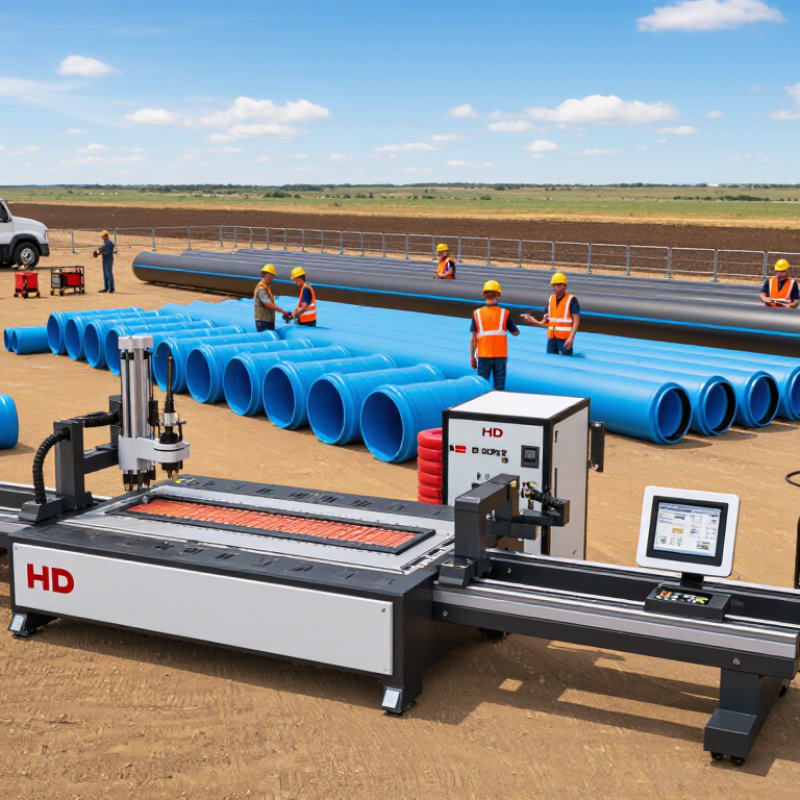
How to Choose HDPE Welding Equipment for Your Project?

Define the Project’s HDPE Welding Requirements

How to Choose HDPE Welding Equipment for Your Project?

Define the Project’s HDPE Welding Requirements

Start with the pipe, not the machine. Record its outside diameter, wall thickness, material grade, and pressure rating. Also note whether the joint will be made by butt fusion, socket fusion, or electrofusion. These methods require different tools and preparation. The Plastics Pipe Institute’s Handbook of PE Pipe explains that fusion procedures depend on pipe dimensions, material, and jointing method. ASTM F2620 likewise provides established practices for heat-fusion joining of polyethylene pipe and fittings. Check the project specification against the applicable procedure before selecting equipment. A mismatch can compromise joint quality, even when the machine appears suitable.

Write down what remains uncertain. Pipe markings can be hard to read, and site conditions change. That is normal, but guessing is not a plan. Verify material compatibility, required data logging, and maintenance needs with the project engineer or qualified fusion technician. Then choose equipment that meets the documented requirements, rather than buying for an assumed future job.

Compare Welding Methods for the Pipe or Sheet

How to Choose HDPE Welding Equipment for Your Project?

Compare Welding Methods for the Pipe or Sheet

For HDPE pipe, butt fusion joins prepared pipe ends with a heated plate and controlled pressure. It suits straight runs where a fusion machine can hold both sections firmly. Check the machine’s capacity against pipe diameter and wall thickness. A small alignment error can weaken the joint, even when the bead looks tidy. Electrofusion is useful in confined spaces or for repairs. It uses a fitting with embedded heating coils, but the pipe surface must be scraped and cleaned carefully. That preparation takes time. Do not skip it.

HDPE sheet work calls for different equipment. Hot-air welding uses a heated gas stream and a compatible filler rod, often for seams or corners. Extrusion welding feeds molten material into a joint and can create a larger weld on thick sheet. The right choice depends on sheet thickness, joint shape, access, and expected load. Test a sample when possible; I have seen settings that worked on one sheet behave poorly on another. Small differences matter.

Tips: Match the method to the material and joint, not just the tool price. Keep surfaces clean and dry, and follow the equipment maker’s temperature and pressure guidance. Record settings and inspect a test weld before production. If the seam looks uneven, pause and check alignment, heat, and preparation.

Match Equipment Type to Material and Joint Design

HDPE welding equipment should match both the pipe material and the joint design. For straight pipe sections with compatible diameters and wall thicknesses, a butt fusion machine can heat and press the prepared ends together. Its clamps must hold the pipe firmly without distorting it. Check the machine’s capacity before choosing; a unit sized for small service lines may not handle large, thick-walled pipe.

Electrofusion fittings can suit repairs or tight work areas where moving long pipe sections is difficult. This method needs a compatible control unit, clean pipe surfaces, and careful alignment. For smaller fittings, socket fusion tools may be practical, but they are not a substitute for equipment designed for larger joints. Follow the fitting and equipment instructions, and verify temperature and timing requirements for the specific material. Small details matter.

Tips: Confirm pipe diameter, wall thickness, and joint type before selecting equipment. Check power access and workspace, too. A cramped trench can make alignment harder than expected. Keep scraping and cleaning tools close at hand, and inspect a sample joint when conditions change. It is tempting to focus only on machine size; I have seen that overlook access and preparation. That can lead to avoidable rework.

How to Choose HDPE Welding Equipment for Your Project? — Match Equipment Type to Material and Joint Design

Equipment Type Typical HDPE Material or Workpiece Best-Suited Joint Design Typical Application Key Selection Considerations Important Limitations
Butt fusion machine Pressure pipe and fittings made from compatible HDPE grades, commonly PE80 or PE100 End-to-end butt joint between pipes or compatible molded fittings Water, gas, sewage, and industrial piping installations Match the machine’s capacity to the pipe outside diameter, wall thickness or SDR, and required clamping force. Choose a frame suited to site access and pipe-handling conditions. Requires aligned, clean, properly prepared pipe ends and a controlled heating and joining cycle. The joint design is not suited to every fitting geometry.
Electrofusion control unit and clamps Electrofusion-compatible HDPE pipe and fittings with embedded electrical heating elements Socket or saddle fusion using an electrofusion fitting Pipe repairs, service connections, and installations where a butt fusion machine is impractical Check that the control unit supports the fitting’s input method and operating requirements. Use the correct scraper, alignment clamps, and fitting-specific fusion parameters. Requires compatible fittings, careful oxide-layer removal, clean surfaces, and secure alignment. Fusion parameters must follow the fitting instructions.
Socket fusion tool Small-diameter HDPE pipe and compatible socket fittings Pipe-to-fitting socket joint Small-bore plumbing, process lines, and some utility connections Select dies that match the pipe and fitting dimensions. Consider the required range of sizes and whether the work is performed in a workshop or on site. Manual alignment and insertion depth are important. It is generally intended for smaller pipe sizes and is not a substitute for large-diameter butt fusion.
Hand extrusion welder HDPE sheet, plate, or fabricated components of compatible material Fillet, corner, or groove weld on prepared surfaces Tank fabrication, ducting, liners, and repair or assembly of sheet components Match the filler rod to the base material. Consider welding position, access, material thickness, preheating requirements, and the desired bead profile. Surface preparation and operator technique strongly affect weld quality. It is not normally used to make standard pipe-to-pipe butt-fusion joints.
Hot wedge or hot-air wedge welder HDPE geomembrane and large thermoplastic sheets Continuous overlap seam, commonly with one or two parallel tracks Landfill liners, ponds, reservoirs, and containment systems Choose a machine suited to sheet thickness, seam layout, slope, and site conditions. Confirm that the test and inspection method fits the seam design. Requires consistent sheet overlap, clean surfaces, and controlled travel speed and heat. It is designed for sheet seams rather than pipe fittings.
Hot-air welder HDPE sheet and fabricated components, typically for localized welding tasks Small seams, tacking, edge preparation, and detail work Repairs, corners, penetrations, and areas inaccessible to larger welding equipment Consider nozzle shape, airflow and temperature control, material thickness, and access to the weld area. Use compatible filler where the weld design requires it. Manual travel speed and pressure can vary, so long production seams may be less consistent than seams made with a suitable automatic welder.

Selection note: These are general application guidelines, not universal operating limits. Confirm material compatibility, joint design, equipment capacity, and welding procedure against the pipe or sheet specifications, fitting instructions, and applicable project standards.

Check Capacity, Power, Controls, and Safety Features

How to Choose HDPE Welding Equipment for Your Project?

Check capacity, power, controls, and safety features against the pipe sizes and site conditions. A machine rated for the correct diameter range helps maintain even alignment and pressure. For butt fusion, ASTM F2620 gives a heater-plate surface temperature range of 204–232°C (400–450°F). Choose equipment with a readable temperature display and stable control within that range. Undersized generators can cause voltage drops, while long extension cords may further reduce power. Check the tool’s electrical requirements before work begins.

Controls should make pressure, temperature, and timing easy to monitor, even with gloves on. Look for clear gauges, secure clamps, and a carriage that moves smoothly without jerking. The Plastics Pipe Institute’s Handbook of Polyethylene Pipe describes established fusion procedures, but the right settings still depend on pipe dimensions and the approved procedure. I still double-check readings against the procedure; displays can drift. Small detail. For safety, inspect cables, hot-plate handles, guards, and emergency shutoffs. A clean, dry work area also reduces trip and burn risks.

Tips: Match machine capacity to the largest pipe planned, then confirm it can handle the smallest. Test generator output under load, not just at idle. Keep a temperature check tool nearby, and record readings before joining. Don’t rush the setup.

How to Choose HDPE Welding Equipment for Your Project

Check the machine’s pipe-size capacity first, then confirm its power supply, controls, and safety features suit your jobsite.

Representative capacity examples: compact machines commonly handle pipe up to about 160 mm, mid-range machines up to about 315 mm, and large machines up to about 630 mm. Actual ranges vary by model. Verify the required pipe diameter and wall thickness, available electrical supply, temperature and pressure controls, and safeguards against hot surfaces and pinch points before selecting equipment.

Assess Portability, Maintenance, and Operating Costs

How to Choose HDPE Welding Equipment for Your Project?

Assess Portability, Maintenance, and Operating Costs

Portability matters when crews move between roadside trenches, pump stations, and remote pipe runs. Compare the machine’s weight, lifting points, and case dimensions with your vehicle and site access. A compact unit may save setup time, but undersized clamps can make alignment harder on larger pipe. That trade-off is easy to overlook. Check the full operating range, not just the headline pipe diameter.

Maintenance affects uptime as much as purchase price. Ask how often the unit needs calibration, whether replacement parts are readily available, and how quickly technicians can inspect heaters, hydraulic lines, and data logs. The Plastic Pipe Institute’s guidance on polyethylene pipe joining emphasizes controlled procedures and properly maintained equipment; follow the machine manual and keep calibration records. For energy budgeting, the U.S. Energy Information Administration reported an average U.S. industrial electricity price of about 8.14 cents per kilowatt-hour in 2023. Treat this as a broad benchmark, not your site’s tariff. Heating time, generator fuel, labor, and transport may cost more than the electricity itself.

Tips: Before buying, record one typical workday: pipe sizes, weld count, travel distance, generator use, and cleaning time. Compare those notes with rental and service quotes. A spreadsheet helps. Still, estimates can miss weather delays and awkward site access, so leave room for uncertainty.

Copyright 2025 Fluidra S.A. | Created by BCM Marketing Agencia Privacy Policy Legal note | Cookie policy |

Technical cookies are strictly necessary for our website to work and you can navigate through it. These types of cookies are those that, for example, allow us to identify you, give you access to certain restricted parts of the page if necessary, or remember different options or services already selected by you, such as your privacy preferences. Therefore, they are activated by default, your authorization not being necessary in this regard. Through the configuration of your browser, you can block or alert the presence of this type of cookies, although such blocking will affect the proper functioning of the different functionalities of our website.


The analysis cookies allow us to study the navigation of the users of our website in general (for example, which sections of the page are the most visited, which services are used most and if they work correctly, etc.). From the statistical information on navigation on our website, we can improve both the operation of the page itself and the different services it offers. Therefore, these cookies do not have an advertising purpose, but only serve to make our website work better, adapting to our users in general. By activating them you will contribute to this continuous improvement. You can enable or disable these cookies by checking the corresponding box, being disabled by default.


Functionality cookies allow us to remember your preferences, to personalize certain characteristics and general options of our website, every time you access it (for example, the language in which the information is presented to you, the sections marked as favorites, your browser type, etc.) Therefore, this type of cookies does not have an advertising purpose, but by activating them you will improve the functionality of the website (for example, adapting to your type of browser) and the customization of it based on your preferences (for example, by presenting the information in the language that you have chosen in previous occasions), which will contribute to the ease, usability and comfort of our page during your navigation. You can enable or disable these cookies by checking the corresponding box, being disabled by default.


Advertising cookies allow us to manage the advertising spaces included in our website based on criteria such as the content shown or the frequency in which the ads are displayed. For example, if you have been shown the same ad several times on our website, and you have not shown a personal interest by clicking on it, it will not appear again. In summary, by activating this type of cookies, the advertising shown on our website will be more useful and diverse, and less repetitive. You can enable or disable these cookies by checking the corresponding box, being disabled by default.


Behavioral advertising cookies allow us to obtain information based on the observation of your browsing habits and behaviors on the web, in order to show you advertising content that best suits your personal tastes and interests. To understand it in a very simple way, we will give you a fictitious example: if your last searches on the web were related to suspense literature, we would show you advertising about suspense books. Therefore, activating this type of cookies, the advertising that we show you on our website will not be generic, but will be oriented to your searches, tastes and interests, therefore adjusting exclusively to you. You can enable or disable these cookies by checking the corresponding box, being disabled by default.
To understand it in a very simple way, we will give you a fictitious example: if your last searches on the web were related to suspense literature, we would show you advertising about suspense books. Therefore, activating this type of cookies, the advertising that we show you on our website will not be generic, but will be oriented to your searches, tastes and interests, therefore adjusting exclusively to you. You can enable or disable these cookies by checking the corresponding box, being disabled by default.

SAVE

We use our own and third-party cookies to ensure the proper functioning of the website and to analyse our services, improve your experience on our website and show you advertisements related to your interests according to profiling based on your browsing habits (e.g. websites visited). You can accept all cookies by clicking "ACCEPT" or set or reject them by clicking here. If you would like to know more about the use of cookies, please see our COOKIE POLICY.


ACCEPT ALL
Reject no essentials


