What Are Geothermal Wells and How Do They Work?
FLUID HANDLING EXPERTS

Blog, all our news

What Are Geothermal Wells and How Do They Work?

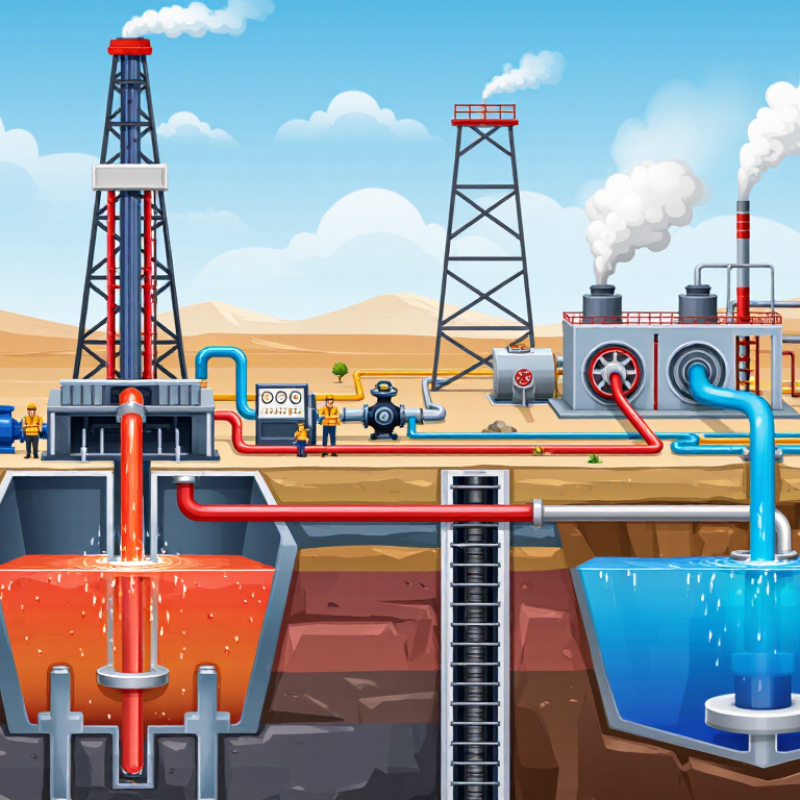
Geothermal Wells turn heat beneath our feet into usable energy, often through a carefully balanced underground circuit. A production well reaches hot rock, natural steam, or heated water. Pumps bring that fluid to the surface. A turbine, heat exchanger, or district-heating network then captures its energy. Cooler water returns through an injection well, helping maintain reservoir pressure.

The process sounds simple. It is not.

Well design depends on temperature, depth, rock permeability, chemistry, and local groundwater conditions. Engineers may drill several kilometers into the Earth, then install steel casing and cement to protect the wellbore. In shallow geothermal systems, closed-loop pipes circulate fluid underground without extracting groundwater. Deep systems may use naturally permeable reservoirs or carefully engineered fractures.

Industry data shows why this technology matters. The International Energy Agency’s 2024 report, The Future of Geothermal Energy, estimates geothermal could supply up to 15% of global electricity-demand growth by 2050. That pathway could represent almost 800 gigawatts of global capacity. The report also emphasizes drilling innovation, because well construction remains one of geothermal energy’s largest costs.

IRENA’s Renewable Capacity Statistics 2024 recorded roughly 15 gigawatts of installed geothermal power capacity worldwide. That figure is modest beside solar and wind. Yet geothermal plants can operate continuously, providing firm low-carbon power when weather conditions change.

There are uncertainties. Reservoir performance can decline, and drilling results are never guaranteed. Better exploration data may reduce those risks, but no report removes them entirely. Understanding Geothermal Wells requires examining both their impressive reliability and their demanding underground realities.

What Are Geothermal Wells and How Do They Work?

What Geothermal Wells Are: Boreholes Reaching 1–5 Kilometers Underground

Geothermal wells are deep boreholes drilled into the Earth, commonly reaching 1–5 kilometers underground. At these depths, surrounding rock can hold significant natural heat. Drilling crews create a narrow pathway through soil, sediment, and hard rock. Steel casing then supports the borehole and helps protect shallow groundwater from the circulating fluid.

A geothermal system usually uses two wells. The production well brings hot water or steam toward the surface. A second injection well returns cooler water underground. This repeated movement transfers heat from deep rock to a heat exchanger or power facility. In a heating system, the hot fluid may warm buildings directly. In a power system, it can create steam that turns a turbine.

Temperature, pressure, rock fractures, and water chemistry all affect performance. Field engineers measure these conditions during drilling and testing. Small changes in pressure can reveal blocked pathways or unwanted fluid movement. The process is technical, but the principle is simple. Heat rises through controlled circulation.

A deep well is not automatically a productive well. Some rock formations contain heat but allow little fluid flow. Others may cool faster than expected. This is where early forecasts can fail. Careful geological surveys, strong casing, and long-term monitoring remain essential. The underground system is powerful, but it is never perfectly predictable.

How Earth’s 25–30°C/km Geothermal Gradient Heats Subsurface Fluids

What Are Geothermal Wells and How Do They Work?

Earth becomes warmer with depth. In many regions, the geothermal gradient averages 25–30°C per kilometer. This means rock two kilometers underground may be roughly 50–60°C warmer than the surface. However, local geology can change this estimate significantly. Groundwater movement, rock type, and volcanic activity all affect underground temperatures.

A geothermal well reaches hot rock or naturally heated water below ground. Production wells bring thermal fluid upward through insulated pipes. The heat can warm buildings, greenhouses, or industrial water systems. After use, injection wells return cooled fluid to the reservoir. This helps maintain pressure and reduce surface water loss. In closed-loop systems, a separate fluid circulates through buried pipes and absorbs heat from surrounding rock.

The gradient does not guarantee a useful resource. A simple temperature calculation can mislead. A deep well may encounter dry rock, weak permeability, or unsuitable chemistry. Reliable projects therefore combine geological surveys, temperature logs, pressure tests, and careful drilling records. These measurements reveal whether heat can move efficiently through the formation.

Tips: Treat 25–30°C/km as a regional guide, not a promise. Check the local gradient before estimating well depth. Monitor flow rate, temperature, and pressure over time. Small changes may reveal scaling, leakage, or declining reservoir performance. Field data matters more than a neat formula.

How Wells Intersect Reservoirs Above 150°C for Heat and Power Production

What Are Geothermal Wells and How Do They Work?

A geothermal well is a carefully engineered pathway into hot rock and circulating underground fluids. In high-temperature fields, reservoirs often exceed 150°C. At this depth, pressure keeps water liquid, even above its normal boiling point. Drilling crews use temperature logs, seismic surveys, and geological samples to locate permeable zones. The target is not simply hot rock. It must also contain connected fractures or pores.

A production well reaches the reservoir through steel casing and cemented sections. Perforated intervals allow hot fluid to enter while protecting weaker formations. As pressure falls near the surface, part of the water can flash into steam. Steam then drives a turbine to produce electricity. Remaining hot brine may support direct heating or return through an injection well. Reinjection helps maintain pressure and reduces surface disposal risks.

The reservoir rarely behaves like a perfect underground tank. Fractures can close, redirect flow, or connect unexpectedly. Engineers monitor pressure, chemistry, flow rate, and temperature throughout operation. Scale and corrosion may also damage equipment, especially when minerals precipitate from cooling brine. Small changes matter. A reliable model still needs field evidence. One difficult lesson is that a well can reach temperatures above 150°C yet produce too little fluid for commercial power. Heat alone is not enough. Permeability, pressure, chemistry, and long-term recharge determine whether the well performs as expected.

How Drilling, Casing, and Cementing Protect Wells Under Extreme Pressure

Geothermal wells reach hot rock, fluids, and reservoirs hidden beneath the surface. Drilling creates a narrow path through unstable formations, often under high temperature and pressure. The International Energy Agency reports that drilling can represent roughly 30–50% of geothermal project costs. Small construction errors can therefore become expensive safety problems.

Steel casing supports the borehole and separates pressure zones. Crews lower casing into the drilled hole, then pump cement into the space between steel and rock. The cement forms a hydraulic seal. It helps prevent fluid migration, protects groundwater, and keeps pressure inside the designed flow path. Temperature changes can expand steel and weaken cement bonds. That detail is easy to underestimate.

Engineers test cement placement, pressure resistance, and casing integrity before production begins. The U.S. Department of Energy’s GeoVision analysis identifies drilling and well construction as major barriers to wider geothermal deployment. A well may survive extreme conditions for decades, but “survive” is not the same as “perform perfectly.” Cement quality can vary along the hole, especially near fractures or lost-circulation zones. That uncertainty demands acoustic logs, pressure tests, and careful monitoring during operation. Field experience still matters. Models cannot see every crack.

What Are Geothermal Wells and How Do They Work? - How Drilling, Casing, and Cementing Protect Wells Under Extreme Pressure
Well Component or Stage Typical Data or Range Primary Purpose How It Protects the Well Important Design Considerations
Geothermal Reservoir Common production temperatures are approximately 150–350°C; some high-temperature resources exceed 350°C. Provides naturally heated water or steam for direct use or electricity generation. Reservoir evaluation identifies the temperature, pressure, permeability, and fluid chemistry that the well must withstand. Temperature and chemistry can vary significantly with depth and geological formation.
Well Type Production wells extract hot fluid; injection wells return cooled water or separated brine to the reservoir. Maintains fluid circulation between the surface system and the underground reservoir. Separating production and injection functions helps control pressure and supports long-term reservoir management. Well locations are selected using geological, geophysical, temperature, and pressure data.
Drilling Process Well depth commonly ranges from about 1,000 to 4,000 m, depending on the resource and geology. Creates a controlled pathway through overburden and into the geothermal reservoir. Drilling-fluid circulation removes rock cuttings, cools the bit, and helps balance formation pressure. Lost circulation, fractured rock, high temperature, and unstable formations can complicate drilling.
Conductor Pipe Often installed at shallow depth, commonly around 10–50 m, although local conditions determine the final depth. Stabilizes near-surface ground and provides an initial guide for deeper drilling. Helps prevent loose formations from collapsing into the upper part of the well. Design depends on soil strength, groundwater conditions, and the planned well diameter.
Surface Casing Frequently set from roughly 100–800 m below ground, depending on geology and aquifer protection needs. Supports shallow formations and isolates freshwater zones. Creates a pressure-resistant barrier between the wellbore and surrounding formations. The casing shoe is placed below protected groundwater zones and competent formations where possible.
Intermediate Casing May be installed at one or more depths between surface casing and the production interval. Isolates unstable formations, lost-circulation zones, or sections with different pressure regimes. Allows drilling to continue safely without exposing previously drilled sections to excessive pressure or temperature changes. Not every well requires the same number of casing strings; the program is determined by geology and pressure windows.
Production Casing Common production casing sizes are often approximately 177–244 mm outside diameter, subject to well design. Provides the main structural conduit for production or injection operations. Contains high-temperature fluids and maintains well integrity during circulation, shut-in, and maintenance operations. Material strength, corrosion resistance, thermal expansion, and connection design are critical.
Casing Material Steel casing is widely used; wall thickness and grade are selected for the expected loads. Supports the wellbore and withstands mechanical and pressure loads. Resists collapse from external formation pressure and rupture from internal fluid pressure. Geothermal brines may contain chlorides, carbon dioxide, hydrogen sulfide, and other corrosive constituents.
Cementing Cement is pumped into the annulus between the casing and the wellbore; the cement column may extend from the casing shoe toward the surface. Anchors the casing and seals the space outside it. Provides zonal isolation, limits fluid migration, and transfers some loads from the casing to the surrounding formation. The cement system must tolerate high temperature, pressure, thermal cycling, and chemical exposure.
Cement Design Slurry density is commonly selected within a pressure-safe range, often approximately 1.4–2.2 g/cm³, depending on the job. Balances formation pressure while avoiding excessive hydrostatic pressure that could fracture weak formations. Correct density and rheology help prevent formation influx and reduce the risk of lost circulation during placement. Laboratory testing is used to evaluate thickening time, compressive strength, fluid loss, and high-temperature performance.
Cement Setting Initial compressive strength requirements vary by design; many operations target at least several MPa before drilling ahead. Allows the cement sheath to support casing and provide a reliable seal. Testing confirms that the cement has hardened sufficiently before pressure testing or further drilling. Strength development can be affected by temperature, water-to-cement ratio, additives, and curing conditions.
Pressure Control Hydrostatic pressure increases by approximately 0.098 bar per metre of water depth, before accounting for fluid density differences. Keeps formation fluids from entering the well uncontrollably. Drilling fluids, casing, cement, and surface pressure-control equipment work together to maintain a safe pressure balance. The operating window between formation pressure and fracture pressure can be narrow in some formations.
Blowout Preventer Installed during appropriate drilling phases; equipment ratings are selected according to the expected pressure environment. Controls unexpected formation-fluid influx during drilling and well-control operations. Can close around tubulars or seal the wellbore when normal circulation cannot control pressure. High temperature, steam, corrosive fluids, testing frequency, and emergency procedures influence system selection.
Wellhead Installed at the surface and designed to support casing strings and provide pressure-control connections. Supports the well structure and connects the well to production, injection, and monitoring equipment. Provides controlled access to the annulus and helps contain pressure during operation. Thermal movement, vibration, corrosion, and pressure cycling must be considered.
Thermal Expansion Steel expands by roughly 12 × 10⁻⁶ per °C for each metre of length, although actual behavior depends on the material and temperature profile. Accounts for changes in casing length and stress as the well heats and cools. Proper design reduces the risk of casing deformation, connection damage, and cement-sheath failure. Start-up, shutdown, injection, and production cycles can create repeated thermal stresses.
Well Integrity Testing Includes casing pressure tests, cement evaluation, temperature surveys, caliper logs, and leak or injectivity tests. Verifies that barriers and flow paths perform as designed. Detects leaks, poor cement bonding, casing damage, or unwanted communication between formations. Testing methods and acceptance criteria should be defined before drilling and adapted to the well design.
Main Operational Risks Lost circulation, wellbore instability, scaling, corrosion, high temperature, steam entry, and induced seismicity. Represents the principal technical challenges in drilling and operating geothermal wells. Risk controls include staged drilling, pressure monitoring, corrosion management, robust barriers, and planned well-control responses. Risk levels depend on reservoir pressure, rock fractures, fluid chemistry, temperature, and local geological conditions.
Barrier Philosophy A well is generally designed with multiple independent barriers, including drilling fluid, casing, cement, wellhead equipment, and tested valves. Prevents uncontrolled movement of formation fluids between the reservoir, wellbore, and surface. If one barrier becomes ineffective, another barrier can provide protection while corrective action is taken. Barrier status should be monitored, documented, and reassessed throughout the well life cycle.
Typical values are indicative engineering ranges rather than universal specifications. Actual geothermal-well designs depend on local geology, formation pressure, temperature, fluid chemistry, regulations, and detailed engineering analysis.

How Production and Injection Wells Sustain Geothermal Flow for Decades

Geothermal wells reach hot rock and fluids beneath the ground. A production well brings heated water or steam to the surface. There, heat exchangers or turbines convert underground heat into useful energy. Afterward, the cooled fluid does not become waste. An injection well sends it back into the reservoir.

This paired system helps sustain geothermal flow for decades. At a working site, pumps, valves, and pressure gauges operate continuously. Engineers track temperature, flow rate, pressure, and chemical changes. They may also use tracer tests to observe how quickly injected water moves underground. Good spacing between wells reduces the risk of cooled water reaching a production well too soon.

The process is not perfectly predictable. Rock fractures vary, and underground pathways can shift over time. Minerals may form scale inside pipes, while corrosive fluids can damage equipment. Regular sampling and well maintenance help identify these problems early. Operators may adjust injection rates when reservoir pressure falls or temperatures change. A stable field requires restraint, not maximum extraction. Removing heat faster than the reservoir can recover may weaken future output. Careful monitoring turns production and injection wells into a managed underground circulation system. Small warning signs matter.

Copyright 2025 Fluidra S.A. | Created by BCM Marketing Agencia Privacy Policy Legal note | Cookie policy |

Technical cookies are strictly necessary for our website to work and you can navigate through it. These types of cookies are those that, for example, allow us to identify you, give you access to certain restricted parts of the page if necessary, or remember different options or services already selected by you, such as your privacy preferences. Therefore, they are activated by default, your authorization not being necessary in this regard. Through the configuration of your browser, you can block or alert the presence of this type of cookies, although such blocking will affect the proper functioning of the different functionalities of our website.


The analysis cookies allow us to study the navigation of the users of our website in general (for example, which sections of the page are the most visited, which services are used most and if they work correctly, etc.). From the statistical information on navigation on our website, we can improve both the operation of the page itself and the different services it offers. Therefore, these cookies do not have an advertising purpose, but only serve to make our website work better, adapting to our users in general. By activating them you will contribute to this continuous improvement. You can enable or disable these cookies by checking the corresponding box, being disabled by default.


Functionality cookies allow us to remember your preferences, to personalize certain characteristics and general options of our website, every time you access it (for example, the language in which the information is presented to you, the sections marked as favorites, your browser type, etc.) Therefore, this type of cookies does not have an advertising purpose, but by activating them you will improve the functionality of the website (for example, adapting to your type of browser) and the customization of it based on your preferences (for example, by presenting the information in the language that you have chosen in previous occasions), which will contribute to the ease, usability and comfort of our page during your navigation. You can enable or disable these cookies by checking the corresponding box, being disabled by default.


Advertising cookies allow us to manage the advertising spaces included in our website based on criteria such as the content shown or the frequency in which the ads are displayed. For example, if you have been shown the same ad several times on our website, and you have not shown a personal interest by clicking on it, it will not appear again. In summary, by activating this type of cookies, the advertising shown on our website will be more useful and diverse, and less repetitive. You can enable or disable these cookies by checking the corresponding box, being disabled by default.


Behavioral advertising cookies allow us to obtain information based on the observation of your browsing habits and behaviors on the web, in order to show you advertising content that best suits your personal tastes and interests. To understand it in a very simple way, we will give you a fictitious example: if your last searches on the web were related to suspense literature, we would show you advertising about suspense books. Therefore, activating this type of cookies, the advertising that we show you on our website will not be generic, but will be oriented to your searches, tastes and interests, therefore adjusting exclusively to you. You can enable or disable these cookies by checking the corresponding box, being disabled by default.
To understand it in a very simple way, we will give you a fictitious example: if your last searches on the web were related to suspense literature, we would show you advertising about suspense books. Therefore, activating this type of cookies, the advertising that we show you on our website will not be generic, but will be oriented to your searches, tastes and interests, therefore adjusting exclusively to you. You can enable or disable these cookies by checking the corresponding box, being disabled by default.

SAVE

We use our own and third-party cookies to ensure the proper functioning of the website and to analyse our services, improve your experience on our website and show you advertisements related to your interests according to profiling based on your browsing habits (e.g. websites visited). You can accept all cookies by clicking "ACCEPT" or set or reject them by clicking here. If you would like to know more about the use of cookies, please see our COOKIE POLICY.


ACCEPT ALL
Reject no essentials