
What Is a Fiber Laser Diode and How Does It Work?
FLUID HANDLING EXPERTS

Blog, all our news

What Is a Fiber Laser Diode and How Does It Work?

A Fiber Laser Diode sits at the meeting point of semiconductor engineering and precision photonics. The term can describe a diode that pumps light into an optical fiber, or a compact laser source coupled directly to fiber. That distinction matters. Many explanations blur it.

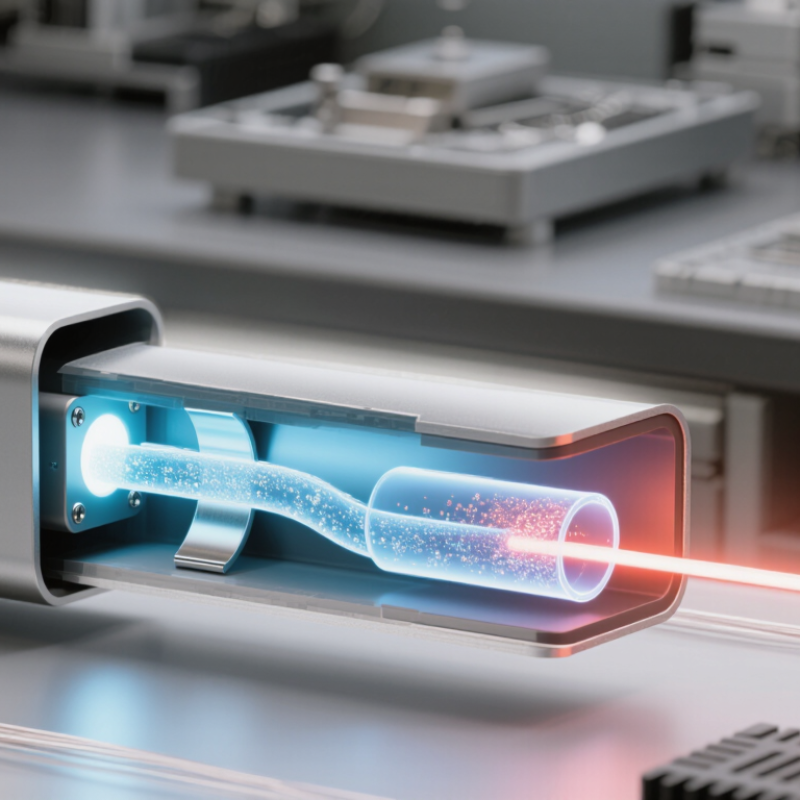
Valentin Gapontsev, a pioneer of high-power fiber lasers, is often credited with saying, “The future of lasers is in fiber.” His view reflects a practical advantage. A Fiber Laser Diode can deliver concentrated optical energy through a thin, flexible waveguide. Inside a typical system, a semiconductor diode produces pump light. The doped fiber absorbs that light and excites its rare-earth ions. As the ions return to a lower energy state, they release photons. Stimulated emission strengthens those photons. Fiber Bragg gratings, mirrors, or another optical cavity then shape the beam.

The process sounds neat. Real systems are less perfect. Heat, coupling loss, fiber bending, and connector contamination can reduce performance. Engineers must also balance output power, wavelength, beam quality, and service life. A carefully aligned diode may still underperform in a poorly designed module.

This article explains how a Fiber Laser Diode works, from electrical input to optical output. It also examines common architectures, key materials, efficiency limits, and industrial applications. You will see what happens inside the fiber. More importantly, you will see why small design choices can change the final beam.
What Is a Fiber Laser Diode and How Does It Work?

What Is a Fiber Laser Diode?

A fiber laser diode is usually a semiconductor pump source connected to an optical fiber. It is not the complete fiber laser. The diode converts electrical energy into light, often near 915 or 976 nanometers. That light enters a doped fiber, where ytterbium or erbium ions amplify it. Mirrors or fiber Bragg gratings then form the laser cavity. The output can be narrow, stable, and highly directional.

The term is slightly misleading. A diode may be fiber-coupled, while the laser gain medium remains inside the fiber. This design improves beam delivery and removes heat from the active region. According to MarketsandMarkets’ 2024 Fiber Lasers Market report, the sector is projected to grow from about 7 billion dollars in 2024 to more than 10 billion dollars by 2029. Yole Group’s 2024 laser diode industry analysis also identifies industrial processing and communications as major demand areas. Real performance still depends on coupling loss, cooling, wavelength stability, and fiber quality.

Tips: Check the diode’s operating wavelength, optical power, coupling type, and temperature range. A higher-power diode is not automatically better. In practice, poor alignment can waste valuable light, and published efficiency figures may reflect ideal laboratory conditions. That detail is easy to overlook.

How a Fiber Laser Diode Produces and Amplifies Light

What Is a Fiber Laser Diode and How Does It Work?

A fiber laser diode usually refers to a semiconductor diode that pumps a fiber laser. Inside the diode, electrical current crosses a p-n junction and releases photons. These photons enter a rare-earth-doped fiber, often containing ytterbium or erbium ions. The doped ions absorb pump light and move to higher energy levels. They then release matching photons through stimulated emission. Mirrors, or fiber Bragg gratings, keep selected light traveling through the fiber. Each pass adds more identical photons. The result is a narrow, bright, and highly directional beam.

The process is efficient, but not perfectly simple. Pump wavelength, fiber length, cooling, and alignment all affect output power. A small temperature rise can shift diode wavelength and reduce absorption. Grand View Research valued the global fiber laser market at about USD 4.4 billion in 2023 and projected strong growth through 2030. This demand reflects industrial cutting, sensing, medical equipment, and communications. Yole Group’s 2024 laser market analysis also identifies higher-power fiber systems as a continuing development area. Numbers vary between reports. Market definitions are not always identical.

Tips: Match the pump wavelength with the dopant’s absorption band. Check coupling losses at every interface. Keep the diode cool. Measure beam quality, not power alone. A powerful beam can still be poorly focused. Always verify safety limits against IEC 60825-1 before testing.

What Is a Fiber Laser Diode and How Does It Work? - How a Fiber Laser Diode Produces and Amplifies Light

Dimension Typical Value or Characteristic How It Relates to Light Production and Amplification
Basic Definition Semiconductor laser source coupled to an optical fiber A fiber laser diode uses a semiconductor junction to generate pump light and couples that light into a fiber-based gain medium or delivery fiber.
Electrical-to-Optical Conversion Typically about 30%–60% for the pump diode Electrical current is converted into optical energy through carrier recombination in the semiconductor active region. The exact efficiency depends on wavelength, temperature, drive current, and device design.
Common Pump Wavelengths 915 nm, 940 nm, and 976 nm These near-infrared wavelengths are commonly used to pump rare-earth-doped fibers, especially ytterbium-doped fiber, which can produce laser output near 1 micrometer.
Semiconductor Active Region Quantum-well or multiple-quantum-well structure The active region confines electrons and holes so that their recombination produces photons. Quantum-well structures improve carrier confinement and optical gain.
Emission Mechanism Stimulated emission Photons stimulate excited carriers to emit additional photons with the same wavelength, phase, direction, and polarization characteristics.
Optical Feedback Reflective semiconductor cavity or fiber Bragg gratings Reflective elements provide feedback so selected light passes repeatedly through the gain region, allowing coherent laser oscillation and wavelength selection.
Fiber Gain Medium Rare-earth-doped silica fiber Dopants such as ytterbium, erbium, or thulium absorb pump light and store energy in excited states. The stored energy is released as the signal passes through the fiber.
Pump Absorption Distributed along the doped fiber length The fiber gradually absorbs pump photons, reducing unused pump power and creating a long interaction path for efficient energy transfer to the laser signal.
Signal Amplification Gain increases as the signal travels through the active fiber Stimulated emission adds photons to the signal. In an amplifier, the input signal is strengthened without requiring a resonant laser cavity around the entire gain section.
Typical Output Wavelength Range Approximately 0.9–2.1 micrometers, depending on the dopant The operating wavelength is determined mainly by the rare-earth ion and the energy-level transitions available in the doped fiber.
Beam Quality Often near single-mode or diffraction-limited The fiber waveguide restricts the allowed spatial modes, which can produce a low-divergence beam that is easy to focus and suitable for precision applications.
Fiber Core Diameter Commonly about 6–30 µm for single-mode designs A small core supports controlled modal propagation. High-power systems may use larger or specially designed cores to reduce nonlinear and damage-related limitations.
Typical Operating Mode Continuous-wave or pulsed operation Continuous-wave systems emit a relatively steady beam, while pulsed systems store and release energy to produce short pulses with higher peak power.
Wall-Plug Efficiency Often approximately 20%–40% for complete fiber laser systems System efficiency includes pump-diode conversion, coupling, quantum-defect losses, splice losses, thermal losses, and electrical control overhead.
Thermal Management Heat sinking, conduction cooling, and temperature monitoring Unused electrical energy and quantum-defect energy become heat. Temperature control helps maintain wavelength stability, output power, and component lifetime.
Main Advantages High efficiency, compact format, good beam quality, and flexible routing The fiber geometry provides a large surface-area-to-volume ratio for cooling, strong light confinement, and reliable alignment compared with many bulk-optical architectures.
Common Applications Material processing, sensing, communications, medicine, and research The combination of controllable wavelength, scalable power, and high beam quality supports cutting, welding, marking, optical amplification, spectroscopy, and sensing.

Key Components Inside a Fiber Laser Diode

What Is a Fiber Laser Diode and How Does It Work?

A fiber laser diode is a semiconductor light source that sends concentrated optical energy into a fiber. It commonly pumps a fiber laser system. Inside the diode, an active semiconductor layer sits between two cladding layers. Electrical current enters through contacts and excites electrons in the active region. When electrons release energy, they produce photons. The photons travel between two reflective facets, creating stimulated emission and a narrow laser beam.

Key Components Inside a Fiber Laser Diode

The active layer controls the emitted wavelength and optical power. Its material composition affects efficiency, stability, and operating temperature. The cladding layers guide light and confine the electrical current near the active region. One facet reflects most light, while the other allows controlled output. This arrangement forms the tiny optical cavity. It is small, but alignment matters greatly.

A heat sink removes heat from the diode package. Excess temperature can shift the wavelength and shorten service life. Coupling optics then focus the beam into a fiber core, often only a few micrometers wide. A protective window helps shield the optical path from dust and moisture. In real installations, perfect coupling is difficult. Tiny angular errors can reduce output. My practical view is that thermal control and clean alignment deserve equal attention, although engineers sometimes prioritize power figures too quickly. Monitoring photodiodes may track output changes during operation, improving reliability and maintenance decisions.

Common Types and Operating Wavelengths

What Is a Fiber Laser Diode and How Does It Work?

A fiber laser diode is a semiconductor light source connected to an optical fiber. It converts electrical current into concentrated light. The fiber guides this light with low loss and protects the beam from rough alignment changes. In many systems, the diode pumps a doped fiber, where the light becomes stronger through stimulated emission. Output power depends on current, heat control, fiber coupling, and optical feedback. Small details matter.

Common types include Fabry–Perot diodes, distributed-feedback diodes, and vertical-cavity surface-emitting lasers. Fabry–Perot designs offer broad spectral output and practical power. Distributed-feedback designs provide narrow linewidth and stable wavelengths. Vertical-cavity devices are compact and often suit short-distance links.

Typical operating wavelengths include 780–850 nanometers for sensing and short fiber communication, 915–980 nanometers for fiber-laser pumping, and 1310 or 1550 nanometers for telecommunications. Many industrial fiber lasers produce output near 1030–1080 nanometers after pumping.

Tips: Match the diode wavelength with the fiber’s absorption range. Check coupling efficiency, thermal resistance, and allowable drive current before installation. Keep end faces clean; dust can create heating and permanent damage. Wavelength labels can be confusing, especially when pump and output values differ. I have found that testing the actual spectrum is safer than trusting a catalog line alone. Temperature changes may shift performance slightly. That small shift is easy to overlook.

Applications, Benefits, and Limitations of Fiber Laser Diodes

What Is a Fiber Laser Diode and How Does It Work?

A fiber laser diode is a semiconductor light source coupled to an optical fiber. It converts electrical energy into concentrated laser light. In many systems, the diode pumps a rare-earth-doped fiber, which amplifies the light through stimulated emission. The fiber then guides the beam with low transmission loss. Alignment matters greatly. A tiny coupling error can reduce output power.

Applications, Benefits, and Limitations of Fiber Laser Diodes

Manufacturers use these devices for metal marking, precision cutting, welding, and engraving. Their stable beam delivery also supports medical instruments, optical sensors, and telecommunications equipment. In a workshop, one compact source can send light through several meters of fiber. That flexibility simplifies machine layout and protects the beam path from dust.

The main benefits are efficiency, compact size, and reliable operation. Fiber delivery allows remote processing in narrow or difficult spaces. The beam can also produce fine marks with controlled heat input. However, performance depends on cooling, alignment, and fiber handling. Excessive bending may increase loss or damage the cable. Contamination at the connector can burn the end face. High optical power demands proper shielding and trained operation.

Heat remains a practical concern. Even efficient diodes release waste energy, so poor thermal design can shorten service life. Some systems also show beam irregularities during current changes. Engineers often overlook this during early testing. That assumption can fail. Real production conditions include vibration, dust, and changing temperatures, not just clean laboratory measurements.

What Is a Fiber Laser Diode and How Does It Work?

Fiber laser diodes act as pump sources: they convert electrical energy into optical energy that excites rare-earth ions inside a doped optical fiber. The required pump wavelength depends on the gain medium. Ytterbium-doped fibers are commonly pumped near 915–976 nm, while erbium-doped fibers are commonly pumped near 980 or 1480 nm. Fiber lasers are valued for high beam quality, compact construction, and efficient heat management, but their performance is limited by pump-power handling, thermal load, nonlinear effects, and the available gain bandwidth.

Copyright 2025 Fluidra S.A. | Created by BCM Marketing Agencia Privacy Policy Legal note | Cookie policy |

Technical cookies are strictly necessary for our website to work and you can navigate through it. These types of cookies are those that, for example, allow us to identify you, give you access to certain restricted parts of the page if necessary, or remember different options or services already selected by you, such as your privacy preferences. Therefore, they are activated by default, your authorization not being necessary in this regard. Through the configuration of your browser, you can block or alert the presence of this type of cookies, although such blocking will affect the proper functioning of the different functionalities of our website.


The analysis cookies allow us to study the navigation of the users of our website in general (for example, which sections of the page are the most visited, which services are used most and if they work correctly, etc.). From the statistical information on navigation on our website, we can improve both the operation of the page itself and the different services it offers. Therefore, these cookies do not have an advertising purpose, but only serve to make our website work better, adapting to our users in general. By activating them you will contribute to this continuous improvement. You can enable or disable these cookies by checking the corresponding box, being disabled by default.


Functionality cookies allow us to remember your preferences, to personalize certain characteristics and general options of our website, every time you access it (for example, the language in which the information is presented to you, the sections marked as favorites, your browser type, etc.) Therefore, this type of cookies does not have an advertising purpose, but by activating them you will improve the functionality of the website (for example, adapting to your type of browser) and the customization of it based on your preferences (for example, by presenting the information in the language that you have chosen in previous occasions), which will contribute to the ease, usability and comfort of our page during your navigation. You can enable or disable these cookies by checking the corresponding box, being disabled by default.


Advertising cookies allow us to manage the advertising spaces included in our website based on criteria such as the content shown or the frequency in which the ads are displayed. For example, if you have been shown the same ad several times on our website, and you have not shown a personal interest by clicking on it, it will not appear again. In summary, by activating this type of cookies, the advertising shown on our website will be more useful and diverse, and less repetitive. You can enable or disable these cookies by checking the corresponding box, being disabled by default.


Behavioral advertising cookies allow us to obtain information based on the observation of your browsing habits and behaviors on the web, in order to show you advertising content that best suits your personal tastes and interests. To understand it in a very simple way, we will give you a fictitious example: if your last searches on the web were related to suspense literature, we would show you advertising about suspense books. Therefore, activating this type of cookies, the advertising that we show you on our website will not be generic, but will be oriented to your searches, tastes and interests, therefore adjusting exclusively to you. You can enable or disable these cookies by checking the corresponding box, being disabled by default.
To understand it in a very simple way, we will give you a fictitious example: if your last searches on the web were related to suspense literature, we would show you advertising about suspense books. Therefore, activating this type of cookies, the advertising that we show you on our website will not be generic, but will be oriented to your searches, tastes and interests, therefore adjusting exclusively to you. You can enable or disable these cookies by checking the corresponding box, being disabled by default.

SAVE

We use our own and third-party cookies to ensure the proper functioning of the website and to analyse our services, improve your experience on our website and show you advertisements related to your interests according to profiling based on your browsing habits (e.g. websites visited). You can accept all cookies by clicking "ACCEPT" or set or reject them by clicking here. If you would like to know more about the use of cookies, please see our COOKIE POLICY.


ACCEPT ALL
Reject no essentials


