
7 Parchment Paper Envelope Buying Tips
FLUID HANDLING EXPERTS

Blog, all our news

7 Parchment Paper Envelope Buying Tips

Choosing a Parchment Paper Envelope is about more than finding a warm, textured surface. Size, paper weight, closure strength, and print quality all affect how it performs. A flap that lifts during handling can spoil an otherwise polished presentation. Small details matter.

The U.S. Census Bureau’s Quarterly Retail E-Commerce Sales report estimated 2024 U.S. e-commerce sales at $1.193 trillion, up 8.1% from 2023. Online orders create a practical need for mail-ready packaging, though not every envelope suits every product or shipping route. Buyers should check the supplier’s dimensions, material specifications, and sample quality rather than relying on photographs alone. Feel the paper. Test the closure.

Environmental claims also deserve careful reading. The American Forest & Paper Association publishes annual paper-recycling data, but actual acceptance depends on local collection programs and the envelope’s components. A window, adhesive strip, or decorative finish may affect sorting. That distinction is easy to miss. The tips ahead examine paper weight, envelope size, finish, closure, customization, quantity, and supplier transparency. They are useful checkpoints, not guarantees; a sample can still reveal issues that a specification sheet cannot. When comparing options, ask for clear product details and test the envelope with the actual contents before placing a large order.
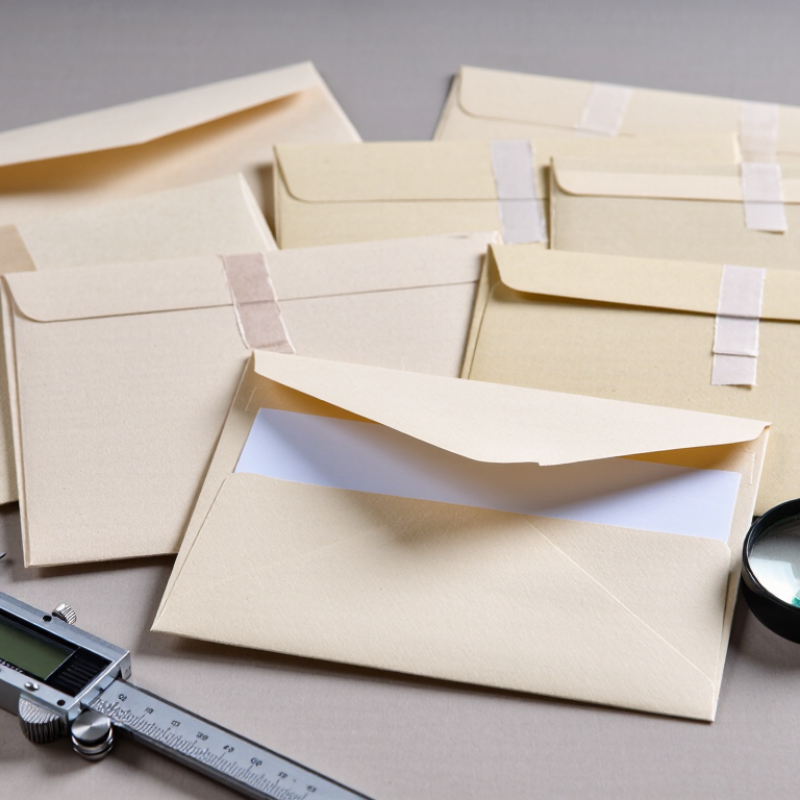
7 Parchment Paper Envelope Buying Tips

Define the Use and Match the Envelope to ISO 269 Sizes, Such as C6 (114 × 162 mm)

Before choosing a parchment paper envelope, identify what it will hold and how it will travel. A single invitation needs less room than a folded card with an insert. Measure the item after folding, not while it lies flat. Measure twice.

Use ISO 269 sizes as a starting point. A C6 envelope measures 114 × 162 mm externally and is commonly suited to an A6 sheet measuring 105 × 148 mm. The nominal difference does not equal usable space: seams, folds, and paper thickness reduce the interior slightly. A stiff parchment stock may also resist opening wide, especially around a bulky card.

Check the actual envelope and insert together before ordering a large quantity. Slide in a sample, close the flap, and look for curled corners or pressure marks. If the piece contains several layers, allow extra room rather than relying on the size label alone. A size chart is useful, but it cannot account for every paper texture or finish. That small mismatch can be easy to overlook. For unusually thick stationery, test one finished envelope through the intended mailing process; a snug fit may look tidy on a desk but prove awkward in handling.

Compare Paper Weight in g/m² Using the ISO 536 Grammage Method

7 Parchment Paper Envelope Buying Tips

Compare Paper Weight in g/m² Using the ISO 536 Grammage Method

When comparing parchment paper envelopes, check grammage in grams per square metre (g/m²). ISO 536 describes how to determine paper and board grammage: weigh a sample with a known area, then express its mass per square metre. This gives you a consistent basis for comparing paper weights across suppliers. Ask whether the stated value was measured using ISO 536, and whether it represents a typical result or a guaranteed specification.

A higher grammage often means more material, but it does not automatically mean a stronger or stiffer envelope. Fibre type, coating, moisture, and construction also affect handling. That matters. A lightweight sample may feel flimsy when empty, yet work well for a small insert; a heavier one may fold poorly around a tight gusset. Compare samples at the same dimensions, and check the supplier’s stated tolerance and batch consistency. Grammage is useful, but it is not the whole story. I would not choose from the number alone; feel the paper, fold it, and test it with the contents you plan to mail.

Check Opacity, Thickness, and Print Compatibility Before Ordering

7 Parchment Paper Envelope Buying Tips

Parchment paper envelopes can look delicate, but appearance alone won’t tell you how they perform. Check opacity by placing a handwritten address or dark card inside. If the contents show through too clearly, a pale envelope may feel less private. Thickness matters, too. A flimsy sheet can crease around a small card, while a heavier one may resist folding neatly. Ask for the paper weight and, if possible, order a sample before choosing a large quantity.

Tips: Hold a sample against a window. Slide in the exact card you plan to mail. Press along the flap and corners to see whether the paper wrinkles or splits. These quick checks reveal more than a product photo.

Print compatibility depends on both the paper surface and your printer. Look for clear guidance on inkjet or laser use, then test one envelope before printing a full batch. Ink may feather on an absorbent finish, and textured paper can feed unevenly. Keep important text away from folds and edges. One small test can save a stack of misprints. Still, printer settings vary, so a successful sample may not behave exactly the same in a longer run.

Verify Fiber Sourcing and Recyclability Against FSC and EN 643 Criteria

When comparing parchment paper envelopes, check what “parchment” means in the product specification. The term may describe a treated or coated paper, not a guarantee of easy recycling. FSC certification can help verify responsible forest sourcing when the claim is valid and covers the relevant paper through the supply chain. Ask for the certificate details and confirm the supplier’s chain-of-custody scope. FSC sourcing does not, by itself, prove recyclability.

Tip: Ask the seller for the envelope’s fiber composition, coating details, and written recycling guidance. EN 643 classifies recovered paper and board grades in Europe; it does not certify a finished envelope as recyclable. If a supplier mentions EN 643, clarify whether the reference concerns recovered fiber inputs or the material expected after collection. Small print matters. A label alone is not proof.

Look closely at the envelope’s surface and construction. A glossy finish, grease-resistant treatment, plastic window, or mixed-material lining may affect sorting and recycling. Ask whether local paper recyclers accept that specific construction, since acceptance can vary by facility. This check is easy to skip when packaging looks like ordinary paper. It is also where product claims can feel less clear than they should. Verify the details before ordering in bulk.

Compare Sample Quality, Order Quantities, and Cost per Usable Envelope

A low unit price can hide weak folds, uneven coating, or unusable rejects. Request samples from the production material, not just a color card. Fold each envelope along its crease, slide in your actual card, and check whether corners split or the flap springs open. Feel the surface, too. A sample is only a screening tool; one perfect piece cannot prove that an entire shipment will match.

Compare order quantities against realistic use, storage space, and the cost of reordering. A large carton may reduce the quoted price, but only if the envelopes stay clean and usable before you need them. Ask suppliers to state pack size, setup fees, freight, and their process for handling defects. Then calculate total landed cost divided by usable envelopes, not the advertised quantity. Small difference. Big impact.

Include waste in your estimate. The U.S. Environmental Protection Agency’s 2018 Advancing Sustainable Materials Management report found a 68.2% recycling rate for paper and paperboard overall; that figure is not specific to envelopes. It does reinforce the value of avoiding excess stock and checking local acceptance before choosing coatings or mixed materials. I would test a modest batch first, even when the arithmetic favors bulk. It can feel overly cautious. Sometimes that saves money.

Copyright 2025 Fluidra S.A. | Created by BCM Marketing Agencia Privacy Policy Legal note | Cookie policy |

Technical cookies are strictly necessary for our website to work and you can navigate through it. These types of cookies are those that, for example, allow us to identify you, give you access to certain restricted parts of the page if necessary, or remember different options or services already selected by you, such as your privacy preferences. Therefore, they are activated by default, your authorization not being necessary in this regard. Through the configuration of your browser, you can block or alert the presence of this type of cookies, although such blocking will affect the proper functioning of the different functionalities of our website.


The analysis cookies allow us to study the navigation of the users of our website in general (for example, which sections of the page are the most visited, which services are used most and if they work correctly, etc.). From the statistical information on navigation on our website, we can improve both the operation of the page itself and the different services it offers. Therefore, these cookies do not have an advertising purpose, but only serve to make our website work better, adapting to our users in general. By activating them you will contribute to this continuous improvement. You can enable or disable these cookies by checking the corresponding box, being disabled by default.


Functionality cookies allow us to remember your preferences, to personalize certain characteristics and general options of our website, every time you access it (for example, the language in which the information is presented to you, the sections marked as favorites, your browser type, etc.) Therefore, this type of cookies does not have an advertising purpose, but by activating them you will improve the functionality of the website (for example, adapting to your type of browser) and the customization of it based on your preferences (for example, by presenting the information in the language that you have chosen in previous occasions), which will contribute to the ease, usability and comfort of our page during your navigation. You can enable or disable these cookies by checking the corresponding box, being disabled by default.


Advertising cookies allow us to manage the advertising spaces included in our website based on criteria such as the content shown or the frequency in which the ads are displayed. For example, if you have been shown the same ad several times on our website, and you have not shown a personal interest by clicking on it, it will not appear again. In summary, by activating this type of cookies, the advertising shown on our website will be more useful and diverse, and less repetitive. You can enable or disable these cookies by checking the corresponding box, being disabled by default.


Behavioral advertising cookies allow us to obtain information based on the observation of your browsing habits and behaviors on the web, in order to show you advertising content that best suits your personal tastes and interests. To understand it in a very simple way, we will give you a fictitious example: if your last searches on the web were related to suspense literature, we would show you advertising about suspense books. Therefore, activating this type of cookies, the advertising that we show you on our website will not be generic, but will be oriented to your searches, tastes and interests, therefore adjusting exclusively to you. You can enable or disable these cookies by checking the corresponding box, being disabled by default.
To understand it in a very simple way, we will give you a fictitious example: if your last searches on the web were related to suspense literature, we would show you advertising about suspense books. Therefore, activating this type of cookies, the advertising that we show you on our website will not be generic, but will be oriented to your searches, tastes and interests, therefore adjusting exclusively to you. You can enable or disable these cookies by checking the corresponding box, being disabled by default.

SAVE

We use our own and third-party cookies to ensure the proper functioning of the website and to analyse our services, improve your experience on our website and show you advertisements related to your interests according to profiling based on your browsing habits (e.g. websites visited). You can accept all cookies by clicking "ACCEPT" or set or reject them by clicking here. If you would like to know more about the use of cookies, please see our COOKIE POLICY.


ACCEPT ALL
Reject no essentials


