
What Is a Core Drilling Rig and How Does It Work?
FLUID HANDLING EXPERTS

Blog, all our news

What Is a Core Drilling Rig and How Does It Work?

A Core Drilling Rig cuts a narrow cylinder from rock, concrete, or another hard material. The recovered sample is called a core. Unlike a machine that simply breaks and removes material, a core rig can preserve a record of what lies below the surface. That difference matters on a construction site, at a mineral exploration project, or during a materials investigation.

The basic action is straightforward. A motor turns a hollow drill barrel fitted with a diamond-impregnated bit. The bit grinds a circular path while water or another suitable flushing medium helps cool the cutting face and carry away debris. The rock cylinder remains inside the barrel until the operator retrieves it. Simple in principle. Not effortless in practice. Bit choice, feed pressure, rotation speed, and ground conditions all affect the sample. A cracked core can be useful, but it may also leave important questions unanswered.

Because no verifiable expert quotation was supplied, the following line is illustrative, not a real person’s documented statement: fictional drilling engineer Alex Morgan might say, “A clean core begins with steady control, not brute force.” It captures a practical lesson, but it is not a substitute for a manufacturer’s instructions or an experienced operator’s judgment. In the sections ahead, we’ll look at rig components, the drilling cycle, common applications, and factors that influence performance. Even experienced crews can misread changing ground. That deserves attention.
What Is a Core Drilling Rig and How Does It Work?

What a Core Drilling Rig Is and What It Is Used For

A core drilling rig is a machine that cuts a narrow, cylindrical sample from rock, concrete, or other hard material. A hollow drill bit grinds around the sample rather than pulverizing its center. The resulting cylinder, called a core, can reveal layers, cracks, and changes in material that a surface inspection may miss. It is a focused tool. Not a general-purpose excavator.

Geologists use core samples to examine underground formations and assess mineral resources. Engineers may drill into rock before designing foundations, tunnels, or retaining structures. In concrete, carefully planned core drilling can help evaluate thickness and material condition. The sample is measured, labeled, and logged, since its depth and orientation can affect interpretation. Small details matter.

During drilling, the rig applies steady rotation and pressure. Water commonly cools the bit and carries cuttings away; the operator adjusts feed and speed to suit the material. A sudden change in resistance can signal a fracture, but it is not proof by itself. That distinction is easy to overlook. Results depend on proper equipment setup, safe access, and skilled handling, and a core only represents the small area sampled. Teams should plan around buried services and structural requirements before drilling.

The Main Components of a Core Drilling Rig

What Is a Core Drilling Rig and How Does It Work?

The Main Components of a Core Drilling Rig

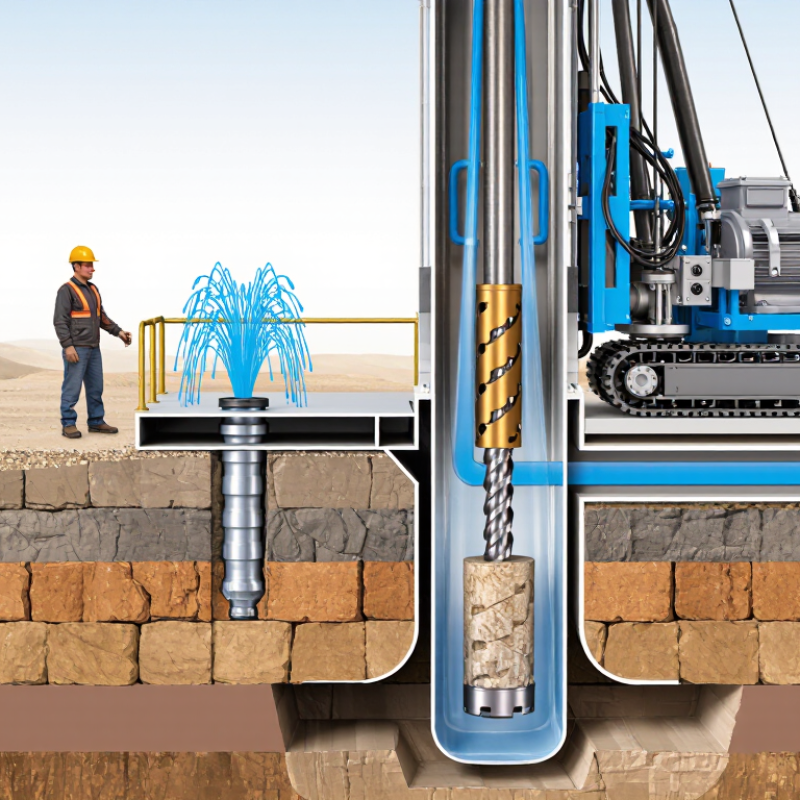
A core drilling rig uses a rotating bit to cut a cylindrical sample from rock. Its mast supports the drill string, while the rotation head turns the rods at a controlled speed. The feed system advances the bit; the pump sends fluid down the rods to cool the bit and carry cuttings away. Inside the drill string, a core barrel receives the intact sample. Small parts matter. A worn seal or loose connection can reduce fluid flow and damage recovery, sometimes before the operator notices.

The USGS Mineral Commodity Summaries 2024 covers about 90 mineral commodities. That breadth reflects the range of resources geologists assess, though the report is not a rig-performance study. For reliable samples, operators monitor core recovery, drilling pressure, fluid returns, and changes in rock hardness. A sudden pressure shift may signal a blocked passage or fractured ground. Read the core carefully. Not every break happened underground; handling can create fractures too.

Tips: Check rod connections, hoses, and fluid levels before drilling. Keep a simple log of depth, pressure, and recovery. Small inconsistencies are easy to overlook, and that is worth reflecting on during a shift.

How a Core Drilling Rig Extracts a Core Sample

A core drilling rig cuts a narrow cylinder from rock instead of grinding the entire hole into chips. Its hollow drill string rotates a diamond-set bit, while circulating fluid cools the bit and carries loose cuttings upward. The intact cylinder enters an inner tube. At the end of a drilling run, a core catcher grips it as the barrel is retrieved. With wireline systems, crews can recover the inner tube without pulling the full drill string each time. That saves time, but it does not remove the need for careful handling.

The process is measured, not guessed. ASTM D2113-14(2020), a standard practice for rock core drilling and sampling, describes procedures for obtaining and handling core samples. One useful field measure is core recovery: recovered core length divided by drilled interval. A 1.5-meter run yielding 1.35 meters gives 90% recovery. Simple arithmetic. Yet that figure can hide broken or washed-away sections, so crews also record fractures, depth, and changes in rock type. Core is laid in marked trays, photographed, and logged before transport. A damp, fractured piece can shift or crumble during handling. Even a neat tray may conceal missing ground. That is why recovery percentage should be read alongside the physical condition of the sample.

Common Types of Core Drilling Rigs and Their Uses

Surface core rigs are common in mineral exploration. They drill vertically or at an angle, bringing up cylindrical rock samples for inspection. Wireline systems retrieve the inner tube without pulling every drill rod, saving time on deep holes. The USGS Mineral Commodity Summaries 2025 estimates global copper mine production reached 23 million metric tons in 2024. That scale helps explain continued exploration, but it does not determine which rig a site needs.

Underground rigs are compact enough for mine tunnels and can drill angled holes where surface access is limited. Geotechnical rigs collect samples for foundation, slope, and infrastructure studies; portable models suit remote sites with narrow access. Some jobs need a small footprint more than high drilling speed. Small rigs matter. The IEA’s 2021 report projects that mineral demand for clean-energy technologies could quadruple by 2040 under its sustainable-development scenario. That projection is broader than core drilling, so it should not be read as a rig-demand forecast.

Choice depends on rock hardness, target depth, sample quality, and available water. A wireline setup may improve recovery time, while a compact underground rig may reach a target that surface equipment cannot. There is no perfect setup. Even experienced crews can misjudge fractured ground; poor core recovery can weaken the evidence, so sample condition and drilling records matter as much as rig capacity.

Safety Measures and Factors That Affect Drilling Performance

A core drilling rig rotates a hollow diamond bit to cut a clean cylindrical opening. Safe setup matters as much as the cut. Before drilling, check the bit, guard, cables, water connections, and the rig’s anchorage. Keep bystanders clear, and secure the core so it cannot fall when released. Water helps control dust and cool the bit, but wet floors and electrical equipment create hazards; manage cables and use suitable electrical protection. The U.S. Bureau of Labor Statistics recorded 1,069 fatal work injuries in construction in 2022, a reminder that routine site tasks still demand careful controls (Census of Fatal Occupational Injuries, 2022). OSHA’s silica standard sets an eight-hour permissible exposure limit of 50 micrograms per cubic meter. Measure exposure and apply required controls rather than assuming water alone is enough (29 CFR 1926.1153).

Drilling performance depends on concrete hardness, aggregate, embedded steel, bit condition, feed pressure, speed, and water flow. Too much pressure can stall the rig or wear the bit unevenly; too little may polish the bit without advancing. Watch the slurry and listen for changes in the motor’s pitch. A sudden slowdown may indicate reinforcement or a worn bit, not simply weak equipment. Keep water flowing enough to carry debris, while avoiding a slick work area. These details are easy to misjudge: a drilling estimate made from drawings can miss dense aggregate or hidden steel. Verify conditions where practical, then adjust the setup gradually.

Article Source:

Copyright 2025 Fluidra S.A. | Created by BCM Marketing Agencia Privacy Policy Legal note | Cookie policy |

Technical cookies are strictly necessary for our website to work and you can navigate through it. These types of cookies are those that, for example, allow us to identify you, give you access to certain restricted parts of the page if necessary, or remember different options or services already selected by you, such as your privacy preferences. Therefore, they are activated by default, your authorization not being necessary in this regard. Through the configuration of your browser, you can block or alert the presence of this type of cookies, although such blocking will affect the proper functioning of the different functionalities of our website.


The analysis cookies allow us to study the navigation of the users of our website in general (for example, which sections of the page are the most visited, which services are used most and if they work correctly, etc.). From the statistical information on navigation on our website, we can improve both the operation of the page itself and the different services it offers. Therefore, these cookies do not have an advertising purpose, but only serve to make our website work better, adapting to our users in general. By activating them you will contribute to this continuous improvement. You can enable or disable these cookies by checking the corresponding box, being disabled by default.


Functionality cookies allow us to remember your preferences, to personalize certain characteristics and general options of our website, every time you access it (for example, the language in which the information is presented to you, the sections marked as favorites, your browser type, etc.) Therefore, this type of cookies does not have an advertising purpose, but by activating them you will improve the functionality of the website (for example, adapting to your type of browser) and the customization of it based on your preferences (for example, by presenting the information in the language that you have chosen in previous occasions), which will contribute to the ease, usability and comfort of our page during your navigation. You can enable or disable these cookies by checking the corresponding box, being disabled by default.


Advertising cookies allow us to manage the advertising spaces included in our website based on criteria such as the content shown or the frequency in which the ads are displayed. For example, if you have been shown the same ad several times on our website, and you have not shown a personal interest by clicking on it, it will not appear again. In summary, by activating this type of cookies, the advertising shown on our website will be more useful and diverse, and less repetitive. You can enable or disable these cookies by checking the corresponding box, being disabled by default.


Behavioral advertising cookies allow us to obtain information based on the observation of your browsing habits and behaviors on the web, in order to show you advertising content that best suits your personal tastes and interests. To understand it in a very simple way, we will give you a fictitious example: if your last searches on the web were related to suspense literature, we would show you advertising about suspense books. Therefore, activating this type of cookies, the advertising that we show you on our website will not be generic, but will be oriented to your searches, tastes and interests, therefore adjusting exclusively to you. You can enable or disable these cookies by checking the corresponding box, being disabled by default.
To understand it in a very simple way, we will give you a fictitious example: if your last searches on the web were related to suspense literature, we would show you advertising about suspense books. Therefore, activating this type of cookies, the advertising that we show you on our website will not be generic, but will be oriented to your searches, tastes and interests, therefore adjusting exclusively to you. You can enable or disable these cookies by checking the corresponding box, being disabled by default.

SAVE

We use our own and third-party cookies to ensure the proper functioning of the website and to analyse our services, improve your experience on our website and show you advertisements related to your interests according to profiling based on your browsing habits (e.g. websites visited). You can accept all cookies by clicking "ACCEPT" or set or reject them by clicking here. If you would like to know more about the use of cookies, please see our COOKIE POLICY.


ACCEPT ALL
Reject no essentials


