Why Choose CNC Machining Centers for Your Business?
FLUID HANDLING EXPERTS

Blog, all our news

Why Choose CNC Machining Centers for Your Business?

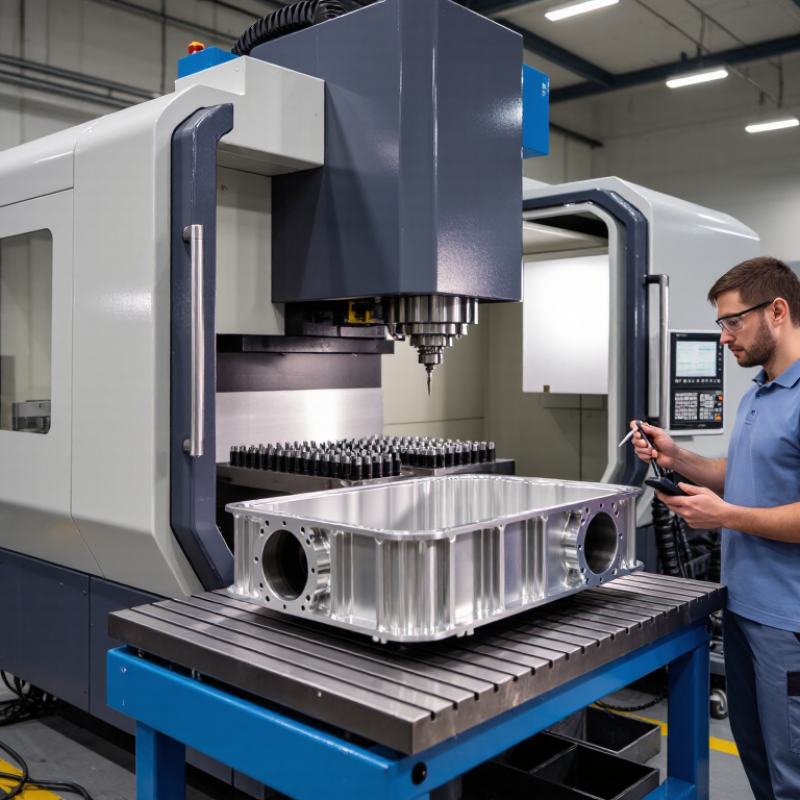
Choosing Cnc Machining Centers can change how a shop handles complex parts, tight tolerances, and shifting order volumes. One setup can combine milling, drilling, and tapping, reducing the time parts spend moving between machines. Picture an aluminum housing leaving the worktable with its mounting holes and machined faces aligned. Fewer handoffs can mean fewer opportunities for error. Not every shop needs that capability.

CNC applications engineer Martin Keller puts the decision this way: “A machine earns its place when it makes good parts consistently, not just quickly.” That principle matters more than a long list of features. A buyer should compare spindle speed, tool capacity, axis travel, control usability, and service support against actual jobs. Review representative part drawings, cycle-time estimates, and expected annual volumes. Then ask operators to assess setup access and everyday maintenance. Small details matter.

There is a trade-off. A capable machine can sit underused if programming skills, workholding, or demand fall short. I would not treat automation as an instant fix; that assumption deserves a second look. The strongest case comes from measurable bottlenecks: repeated setups, growing queues, or tolerances that vary across batches. Start with the parts already on the schedule. Compare current labor, scrap, and lead times with realistic machine estimates. A careful evaluation helps determine whether a machining center will improve throughput, consistency, and flexibility—or simply add cost and complexity.
Why Choose CNC Machining Centers for Your Business?

What Defines a CNC Machining Center: Axes, Spindle, Tool Changer, and Control

Why Choose CNC Machining Centers for Your Business?

What Defines a CNC Machining Center: Axes, Spindle, Tool Changer, and Control

A CNC machining center combines coordinated axes, a rotating spindle, an automatic tool changer, and a programmed control system. The axes determine how the cutting tool and workpiece move. A three-axis machine handles many flat parts, while additional axes can reach angled surfaces with fewer setups. More axes are not automatically better. They can add programming and setup demands.

The spindle holds and rotates the cutting tool, so its speed, power, and rigidity should match the materials and operations involved. For example, milling a broad aluminum plate calls for different cutting conditions than drilling small holes in steel. Watch for vibration and heat; both can affect surface finish and tool life. Small details count.

A tool changer moves between operations without requiring manual tool swaps. Its capacity and change time matter most when a part needs many tools or repeated production runs. The control translates the machining program into machine movements and lets operators adjust feeds, offsets, and tool data. A clear interface can reduce setup errors, but it cannot replace sound training or careful checks. In practice, choosing a center means balancing part size, tolerances, workflow, and operator skill. Some shops focus too heavily on speed and overlook setup time. That trade-off deserves a closer look.

How 3-, 4-, and 5-Axis Designs Expand Part Geometry and Reduce Setups

A three-axis machining center moves a cutting tool along X, Y, and Z. It suits flat plates, pockets, and many prismatic parts. A vise holds the workpiece while the spindle reaches exposed faces. Simple geometry can often be completed in one setup. That keeps programming and fixturing manageable. But a deep cavity may require a longer tool, which can flex and leave marks.

Add a rotary axis, and a four-axis machine can turn the part during cutting. This helps produce holes or features around a cylindrical body without repeated manual indexing. Five-axis machines tilt and rotate the tool or workpiece, reaching angled faces and compound surfaces in fewer setups. A small impeller, for example, may need several orientations on a three-axis machine, but fewer on a five-axis system. Fewer pauses. Less reclamping can reduce alignment errors, though it does not guarantee accuracy; tool condition and setup still matter. More axes also bring added programming and inspection demands. It is not magic. For a simple bracket, that extra capability may be unnecessary, and the best choice depends on the part’s geometry, batch size, and tolerance needs.

Why Choose CNC Machining Centers for Your Business? — How 3-, 4-, and 5-Axis Designs Expand Part Geometry and Reduce Setups

Comparison 3-Axis Machining Center 4-Axis Machining Center 5-Axis Machining Center
Axis movement Three linear axes (X, Y, and Z) move the cutting tool or workpiece. Three linear axes plus one rotary axis, commonly used to turn the workpiece around a single axis. Three linear axes plus two rotary axes, allowing the tool or workpiece to approach from more directions.
Typical access Best suited to features accessible from one main direction at a time. Can machine multiple sides of a part by rotating it, subject to fixture and machine access. Can reach many angled faces and complex contours in one setup; access still depends on machine configuration and part geometry.
Part geometry Flat surfaces, pockets, slots, drilled holes, and prismatic parts. Parts with features around a central axis, such as indexed holes, slots, or features on several sides. Complex angled surfaces, compound curves, impellers, molds, and parts with features on multiple faces.
Setup potential Parts needing machining on several faces often require repositioning and re-clamping. Rotary indexing can reduce repositioning for features around the rotary axis. Simultaneous or indexed positioning can reduce re-clamping for many multi-face parts.
Accuracy considerations Fewer rotary axes can simplify programming and workholding for straightforward parts. Fewer setups can help limit errors introduced during repeated part repositioning. Fewer setups can help maintain relationships between features, but machine calibration, fixturing, and programming remain important.
Tool access and cutting Tool orientation is generally fixed relative to the workpiece during cutting. Rotating the workpiece can present different faces to a fixed-orientation tool. Tilting the tool or workpiece can improve access and allow shorter tools in some applications.
Programming and operation Generally the simplest option to program and operate for basic geometries. Requires rotary-axis programming and suitable workholding; indexed operations are common. Often requires more advanced CAM programming, collision checking, and operator expertise.
Best-fit business need Cost-effective production of simpler parts and work that can be completed from a limited number of directions. Efficient machining of parts that benefit from rotary indexing without requiring full multi-directional tool motion. Producing complex parts where broader tool access and fewer setups can justify higher equipment and programming demands.

Note: The number of axes alone does not determine achievable accuracy, cycle time, or setup count. Results depend on part geometry, machine configuration, tooling, workholding, programming, and production requirements.

What Xometry’s ±0.005-Inch Standard Tolerance Means for Part Quality

A ±0.005-inch tolerance allows a feature to vary by five thousandths of an inch on either side of its target. That creates a total tolerance band of 0.010 inch, or 0.254 millimeters. The conversion follows NIST’s exact inch-to-millimeter definition. For a 1.000-inch hole, the permitted range is 0.995 to 1.005 inches. Small numbers. Real consequences. A shaft near the upper limit may bind in a mating bore, even when both parts meet their individual dimensions.

ASME Y14.5-2018 explains how geometric dimensioning and tolerancing communicates design intent. A general ±0.005-inch tolerance does not control every concern, such as flatness, position, or alignment. Those may need separate callouts. In practice, machinists consider material, tool wear, part geometry, and how the workpiece is clamped. Thin walls can shift during cutting; a second setup can also introduce variation. Measurement matters too: calipers may not resolve a tight feature as reliably as a suitable micrometer or bore gauge. The tolerance is useful, but it is not a promise that every geometry is equally easy to hold. It is worth checking critical mating features against the drawing and the inspection method before production begins.

Why Choose CNC Machining Centers? Understanding a ±0.005-Inch Tolerance

A ±0.005-inch tolerance means a feature may be up to 0.005 inch above or below its nominal dimension, giving a total tolerance range of 0.010 inch. The chart shows how that same one-sided allowance compares with different nominal sizes. These percentages are illustrative calculations, not measurements of machining performance.

How Automation Affects Throughput, Labor Needs, and Repeatability

A CNC machining center can keep cutting while an operator loads another fixture or checks finished parts. An automatic tool changer, pallet system, and probing cycle reduce pauses between jobs.

Deloitte and MAPI’s 2024 Smart Manufacturing Survey reported 10–20% production-output improvements and 7–20% employee-productivity gains among surveyed manufacturers.

These are reported ranges, not guaranteed results. A shop should treat them as benchmarks, not a promise. Small batches, poor tool-life data, or frequent setup changes can erase gains quickly.

Automation also changes labor needs rather than simply removing them. Operators spend less time tending each spindle and more time preparing fixtures, checking offsets, and diagnosing alarms. On a night shift, that difference matters.

Repeatability improves when the machine follows the same tool path and probing routine across parts, reducing variation from manual repositioning. But it is not automatic perfection: a worn tool, thermal drift, or a misplaced datum can repeat the same error all night.

CNC centers work best when staff verify the first article, monitor tool wear, and keep setup notes current. The awkward truth is that automation can make a weak process faster, too.

Why CNC Investment Matters in a $101.22B Market (Grand View Research, 2023)

Grand View Research estimated the global CNC machine market at $101.22 billion in 2023. That figure signals substantial demand for precise, repeatable production. It does not guarantee that every shop will benefit from buying a machining center. That matters.

For a business, the investment case is practical: compare machine cost with expected workload, labor, setup time, and scrap. A center that completes multiple operations in one setup may reduce handling and keep dimensions consistent. On the shop floor, that can mean fewer part transfers and less time checking alignment. But the gains depend on skilled operators, suitable programming, and steady orders. A large market cannot supply those conditions for you.

Before committing, review actual job data. Track cycle times, changeovers, tolerances, and how often existing equipment sits idle. A machine can sit idle, too. Consider tooling, maintenance, training, and floor space alongside the purchase price. The market estimate also needs context: reports define categories and time periods differently, so confirm what the $101.22 billion includes before using it in a forecast. I would not treat one headline number as a business plan. The right investment should fit the parts your customers order, not just the size of the industry.

Copyright 2025 Fluidra S.A. | Created by BCM Marketing Agencia Privacy Policy Legal note | Cookie policy |

Technical cookies are strictly necessary for our website to work and you can navigate through it. These types of cookies are those that, for example, allow us to identify you, give you access to certain restricted parts of the page if necessary, or remember different options or services already selected by you, such as your privacy preferences. Therefore, they are activated by default, your authorization not being necessary in this regard. Through the configuration of your browser, you can block or alert the presence of this type of cookies, although such blocking will affect the proper functioning of the different functionalities of our website.


The analysis cookies allow us to study the navigation of the users of our website in general (for example, which sections of the page are the most visited, which services are used most and if they work correctly, etc.). From the statistical information on navigation on our website, we can improve both the operation of the page itself and the different services it offers. Therefore, these cookies do not have an advertising purpose, but only serve to make our website work better, adapting to our users in general. By activating them you will contribute to this continuous improvement. You can enable or disable these cookies by checking the corresponding box, being disabled by default.


Functionality cookies allow us to remember your preferences, to personalize certain characteristics and general options of our website, every time you access it (for example, the language in which the information is presented to you, the sections marked as favorites, your browser type, etc.) Therefore, this type of cookies does not have an advertising purpose, but by activating them you will improve the functionality of the website (for example, adapting to your type of browser) and the customization of it based on your preferences (for example, by presenting the information in the language that you have chosen in previous occasions), which will contribute to the ease, usability and comfort of our page during your navigation. You can enable or disable these cookies by checking the corresponding box, being disabled by default.


Advertising cookies allow us to manage the advertising spaces included in our website based on criteria such as the content shown or the frequency in which the ads are displayed. For example, if you have been shown the same ad several times on our website, and you have not shown a personal interest by clicking on it, it will not appear again. In summary, by activating this type of cookies, the advertising shown on our website will be more useful and diverse, and less repetitive. You can enable or disable these cookies by checking the corresponding box, being disabled by default.


Behavioral advertising cookies allow us to obtain information based on the observation of your browsing habits and behaviors on the web, in order to show you advertising content that best suits your personal tastes and interests. To understand it in a very simple way, we will give you a fictitious example: if your last searches on the web were related to suspense literature, we would show you advertising about suspense books. Therefore, activating this type of cookies, the advertising that we show you on our website will not be generic, but will be oriented to your searches, tastes and interests, therefore adjusting exclusively to you. You can enable or disable these cookies by checking the corresponding box, being disabled by default.
To understand it in a very simple way, we will give you a fictitious example: if your last searches on the web were related to suspense literature, we would show you advertising about suspense books. Therefore, activating this type of cookies, the advertising that we show you on our website will not be generic, but will be oriented to your searches, tastes and interests, therefore adjusting exclusively to you. You can enable or disable these cookies by checking the corresponding box, being disabled by default.

SAVE

We use our own and third-party cookies to ensure the proper functioning of the website and to analyse our services, improve your experience on our website and show you advertisements related to your interests according to profiling based on your browsing habits (e.g. websites visited). You can accept all cookies by clicking "ACCEPT" or set or reject them by clicking here. If you would like to know more about the use of cookies, please see our COOKIE POLICY.


ACCEPT ALL
Reject no essentials