
How to Choose the Right Switching Power Supply for Your Needs?
FLUID HANDLING EXPERTS

Blog, all our news

How to Choose the Right Switching Power Supply for Your Needs?

Selecting the right Switching Power Supply is crucial for various applications. A suitable power supply ensures that your devices operate efficiently and safely. There are many options available, making the choice challenging for users. Factors like voltage, current, size, and purpose can affect your decision.

Understanding your specific needs is vital. What devices are you powering? Is the application demanding or simple? Consider how much power is required. Sometimes, users tend to underestimate their needs, which can lead to poor performance.

Be mindful of the quality and reliability of the Switching Power Supply. Not all products are created equal. A lower-priced option may save money initially but could result in issues later on. Research various brands and read reviews. It is important to reflect on your experience when choosing. What have others faced? Knowing this could help you avoid common pitfalls.
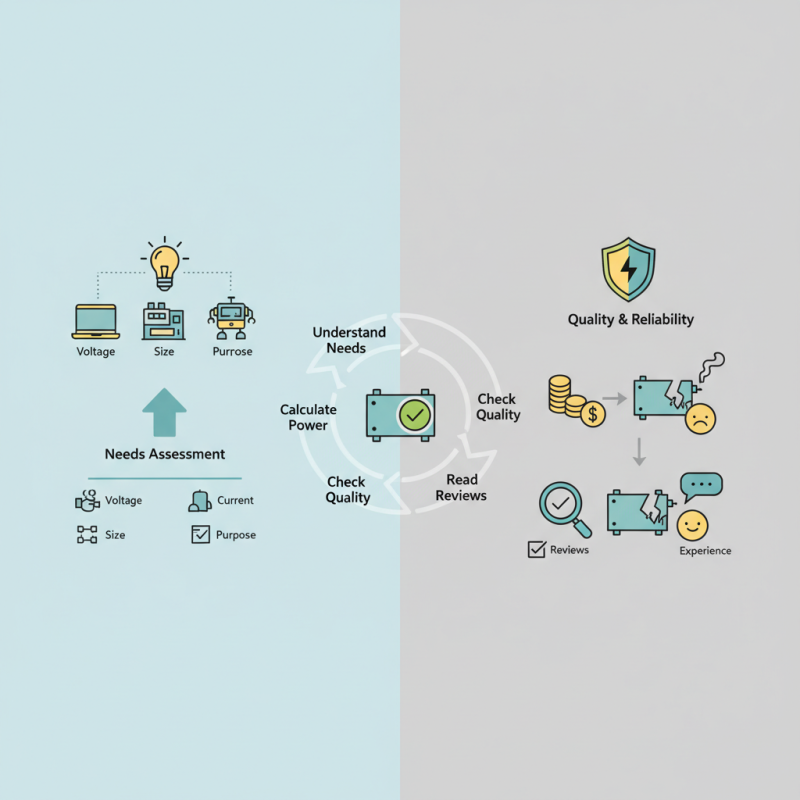
How to Choose the Right Switching Power Supply for Your Needs?

Identifying Your Power Requirements for Switching Power Supply

Choosing the right switching power supply (SPS) begins with identifying your power requirements. Consider the specific voltage and current needs. Most devices require a certain voltage, usually between 3V and 48V. Current requirements can vary widely, with many electronic components drawing between 1A and 10A. According to a recent industry report, about 30% of power supply failures stem from mismatched specifications.

Evaluate the load characteristics of your application. Resistive loads are straightforward, while inductive or capacitive loads may cause spikes. Understand whether your application requires continuous or peak power. Peak demand can sometimes be three times higher than average use. This discrepancy can lead to overheating or early failure.

Tips: Always account for a margin in your calculations. Add around 20% to your estimated power needs to ensure reliability. Monitor the efficiency ratings of your SPS. A rating above 85% is recommended for optimal performance. Don't overlook connectivity options either; ensure compatibility with your system’s configuration. Choosing the right SPS isn't just about numbers. It's also about understanding your unique needs and potential pitfalls.

Understanding Different Types of Switching Power Supplies Available

When selecting a switching power supply, understanding the different types is crucial. There are several categories based on their functions and applications. For instance, you have buck converters, which efficiently step down voltage. These are popular for battery-operated devices. Then, there are boost converters that increase voltage for applications needing more power.

Tips: Always check the input voltage range. It should match your source. Also, consider your device load. A mismatch can lead to inefficiencies.

Another type is the flyback converter. It’s great for isolated outputs, commonly used in adapters. Each type has unique benefits. Make sure to align your choice with the specific requirements of your project.

Tips: Don’t overlook the thermal performance. Heat can affect lifespan. Ensure there’s proper ventilation or heat sinking.

Make sure to reflect on the efficiency ratings as well. Higher efficiency means lower energy loss and better performance. Sometimes, people ignore these ratings, leading to wasted energy.

Evaluating Efficiency Ratings and Heat Dissipation Needs

Choosing the right switching power supply involves more than just selecting a model. One crucial factor is the efficiency rating. An efficient power supply converts input power to output power effectively. A high efficiency means less energy wasted as heat. This can lead to substantial cost savings. Consider power supplies with ratings above 80%.

Heat dissipation is equally important. High temperatures can damage components over time. Look for power supplies with good thermal management features. Some models include built-in fans or heat sinks. These features help maintain optimal temperatures during operation. However, not all designs handle heat well. Always read reviews and specifications carefully.

It's also vital to consider your specific needs. Will the power supply be used continuously or intermittently? Continuous use can increase heat buildup. Evaluate your environment too. A dusty area may require more frequent maintenance. These factors all play a role in ensuring your power supply operates effectively. Reflect on these aspects before making a decision.

Assessing Voltage and Current Specifications for Compatibility

When selecting a switching power supply, voltage and current specifications play a critical role. Understanding these specifications ensures the power supply meets your system's needs. According to industry reports, a mismatch in voltage can lead to underperformance or damage. Many devices require specific voltage levels, often ranging from 3.3V to 48V. This is essential for components like microcontrollers and sensors.

Current ratings are equally important. They dictate how much power your device can draw safely. Reports indicate that using a power supply rated lower than your device's requirements can lead to overheating. Devices often have a planned maximum current draw. For example, a component rated at 2A should ideally be paired with a supply offering at least 2.5A to allow a buffer.

Relying solely on nominal values may be misleading. Manufacturers may advertise peak values that aren't sustainable. It's wise to consider load transients. These can cause sudden demand spikes. Ignoring this could result in system instability. Reflect on your specific application needs. Assessing voltage and current specs isn't just about matching numbers; it's about ensuring reliability in real-world conditions.

How to Choose the Right Switching Power Supply for Your Needs? - Assessing Voltage and Current Specifications for Compatibility

Power Supply Type Voltage Output (V) Current Rating (A) Efficiency (%) Size (mm)
Compact Switching Power Supply 12 5 85 100 x 60 x 30
Programmable Power Supply 24 10 90 150 x 100 x 50
High-Power Switching Power Supply 48 20 92 200 x 120 x 60
Miniature Power Supply 5 2 80 80 x 50 x 25
Industrial Power Supply 36 15 87 250 x 150 x 75

Comparing Features: Regulation, Protection, and Form Factor Options

When selecting a switching power supply, the three key features to examine are regulation, protection, and form factor. Proper regulation ensures stable output. A reliable power supply can maintain voltage variations within 1% under varying loads. According to recent industry reports, systems lacking adequate regulation may experience fluctuations that damage sensitive components over time. Users should avoid models with poor regulation capabilities.

Protection mechanisms are vital. Over-voltage, over-current, and short circuit protections safeguard devices against potential damage. Up to 20% of power supplies fail due to insufficient protective features. Investing in a power supply with robust protections is crucial for long-term reliability. Ensuring the chosen model complies with industry safety standards adds another layer of security.

Form factor options can impact installation and usability. Compact sizes may appeal to space-constrained environments. However, these often sacrifice cooling efficiency. Designs that prioritize low-profile dimensions may heat up quickly. It’s essential to balance size with adequate ventilation. Consider the thermal load and airflow to prevent overheating. Making the right choice means weighing the trade-offs in functionality and design.

Copyright 2025 Fluidra S.A. | Created by BCM Marketing Agencia Privacy Policy Legal note | Cookie policy |

Technical cookies are strictly necessary for our website to work and you can navigate through it. These types of cookies are those that, for example, allow us to identify you, give you access to certain restricted parts of the page if necessary, or remember different options or services already selected by you, such as your privacy preferences. Therefore, they are activated by default, your authorization not being necessary in this regard. Through the configuration of your browser, you can block or alert the presence of this type of cookies, although such blocking will affect the proper functioning of the different functionalities of our website.


The analysis cookies allow us to study the navigation of the users of our website in general (for example, which sections of the page are the most visited, which services are used most and if they work correctly, etc.). From the statistical information on navigation on our website, we can improve both the operation of the page itself and the different services it offers. Therefore, these cookies do not have an advertising purpose, but only serve to make our website work better, adapting to our users in general. By activating them you will contribute to this continuous improvement. You can enable or disable these cookies by checking the corresponding box, being disabled by default.


Functionality cookies allow us to remember your preferences, to personalize certain characteristics and general options of our website, every time you access it (for example, the language in which the information is presented to you, the sections marked as favorites, your browser type, etc.) Therefore, this type of cookies does not have an advertising purpose, but by activating them you will improve the functionality of the website (for example, adapting to your type of browser) and the customization of it based on your preferences (for example, by presenting the information in the language that you have chosen in previous occasions), which will contribute to the ease, usability and comfort of our page during your navigation. You can enable or disable these cookies by checking the corresponding box, being disabled by default.


Advertising cookies allow us to manage the advertising spaces included in our website based on criteria such as the content shown or the frequency in which the ads are displayed. For example, if you have been shown the same ad several times on our website, and you have not shown a personal interest by clicking on it, it will not appear again. In summary, by activating this type of cookies, the advertising shown on our website will be more useful and diverse, and less repetitive. You can enable or disable these cookies by checking the corresponding box, being disabled by default.


Behavioral advertising cookies allow us to obtain information based on the observation of your browsing habits and behaviors on the web, in order to show you advertising content that best suits your personal tastes and interests. To understand it in a very simple way, we will give you a fictitious example: if your last searches on the web were related to suspense literature, we would show you advertising about suspense books. Therefore, activating this type of cookies, the advertising that we show you on our website will not be generic, but will be oriented to your searches, tastes and interests, therefore adjusting exclusively to you. You can enable or disable these cookies by checking the corresponding box, being disabled by default.
To understand it in a very simple way, we will give you a fictitious example: if your last searches on the web were related to suspense literature, we would show you advertising about suspense books. Therefore, activating this type of cookies, the advertising that we show you on our website will not be generic, but will be oriented to your searches, tastes and interests, therefore adjusting exclusively to you. You can enable or disable these cookies by checking the corresponding box, being disabled by default.

SAVE

We use our own and third-party cookies to ensure the proper functioning of the website and to analyse our services, improve your experience on our website and show you advertisements related to your interests according to profiling based on your browsing habits (e.g. websites visited). You can accept all cookies by clicking "ACCEPT" or set or reject them by clicking here. If you would like to know more about the use of cookies, please see our COOKIE POLICY.


ACCEPT ALL
Reject no essentials


