
How to Choose the Right Radial Lead Capacitor
FLUID HANDLING EXPERTS

Blog, all our news

How to Choose the Right Radial Lead Capacitor

Choosing the right radial lead capacitor can affect far more than whether it fits the circuit board. Capacitance, rated voltage, temperature range, and ripple-current capability all shape how reliably it performs. The term Lead Radial Capacitor describes its lead arrangement, not its internal construction. That distinction matters. A radial electrolytic part and a radial film part may look similar in a catalog, yet serve very different circuit needs.

Start with the circuit’s operating conditions and the manufacturer’s datasheet. Check the required capacitance and allow sensible voltage margin, while avoiding assumptions that a higher rating always means a better choice. For power-supply filtering, compare ripple-current ratings and equivalent series resistance where relevant. For timing or signal paths, leakage, tolerance, and dielectric behavior may deserve closer attention. Then measure the available footprint. A capacitor that clears the schematic but touches a heatsink is not a good fit. Small detail, big consequence.

Temperature and service life also count. A warm enclosure can shorten the useful life of some electrolytic capacitors, so compare lifetime ratings at the stated temperature. Confirm polarity before installation, and verify lead spacing against the board. These checks are practical, but not infallible; real operating conditions can differ from bench estimates. A little uncertainty is worth admitting. This guide explains how to weigh the key specifications, compare suitable options, and avoid choices based only on price or appearance.
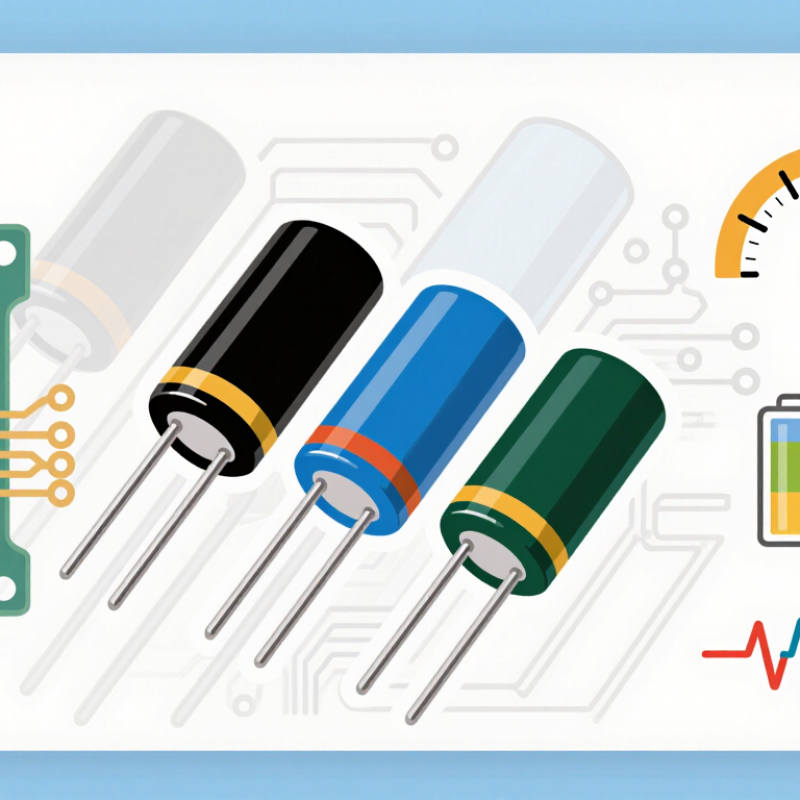
How to Choose the Right Radial Lead Capacitor

Understanding the Construction and Function of Radial Lead Capacitors

A radial lead capacitor has both wire leads extending from one end of its body. This layout fits many through-hole circuit boards, where the leads pass through drilled pads and are soldered underneath. Inside, conductive plates or foils are separated by a dielectric material. The exact construction depends on the capacitor type: an electrolytic design may use a wound element and electrolyte, while a film design uses thin plastic layers. The outer sleeve protects the component and often carries its key ratings.

Its job is to store and release electrical charge. In a power supply, it may smooth voltage changes; in a signal circuit, it can help block direct current while passing changing signals. The role depends on the circuit, not just the shape. That detail matters. A radial body does not tell you whether the part is polarized, or how it will behave at high frequency.

When choosing one, compare capacitance, rated voltage, temperature range, and physical dimensions with the circuit and board layout. Check lead spacing too; a few millimeters can make assembly awkward. For ripple-heavy power circuits, review ripple-current and equivalent-series-resistance ratings in the datasheet. Small parts still vary. It is easy to focus on capacitance alone, but that can miss heat, space, or lifetime concerns. A quick fit check on the board is useful, though it cannot replace checking the electrical ratings.

Identifying the Circuit’s Capacitance and Voltage Requirements

Before choosing a radial lead capacitor, identify the capacitance the circuit actually needs. Check the schematic, component specifications, or a reliable circuit calculation rather than guessing from the old part alone. In a timing circuit, capacitance affects the interval; in a filter, it influences ripple and response. Load, signal frequency, and operating temperature can also matter. A quick measurement can help, but an in-circuit reading may be misleading.

Tips: Record the required capacitance, tolerance, and operating conditions. Compare the part’s datasheet with the circuit’s needs. Keep notes; small details are easy to miss.

Next, determine the highest voltage the capacitor will experience, including realistic startup peaks or transients. Choose a rated voltage above that level, and follow the manufacturer’s derating guidance for the specific capacitor type. More voltage margin can improve reliability, but it does not replace checking temperature, ripple current, or polarity. For polarized capacitors, confirm the positive and negative connections before installation. I have seen voltage estimates based only on the normal reading; that can overlook brief surges. Check the actual circuit conditions, and revisit your assumptions if measurements disagree.

Comparing Tolerance, Temperature Range, and Electrical Performance

Choosing the right radial lead capacitor means matching its specifications to the circuit, not just its printed capacitance. Tolerance shows how far the actual value may vary. A 10 µF part with ±20% tolerance may measure between 8 and 12 µF. That difference can affect timing, filtering, or signal response. Tight tolerance is useful when the circuit depends on a predictable value. For general smoothing, a wider tolerance may be acceptable.

Temperature range matters when the capacitor sits near a warm power component or in an unheated enclosure. Check the operating limits and capacitance change across that range. Then compare rated voltage, ripple current, and equivalent series resistance (ESR) with the circuit’s demands. A capacitor can meet its voltage rating and still run hot under ripple current. It is easy to overlook that detail. Also confirm lead spacing and body size before fitting it to a board.

Tips: Read the full datasheet, not only the value printed on the sleeve. Compare specifications at the expected temperature and operating frequency. Leave sensible voltage margin, and check ripple current against the circuit load. If the circuit behavior is uncertain, measure it under realistic conditions. That extra check may catch a mismatch before assembly.

Checking Lead Spacing, Dimensions, and Mounting Compatibility

A radial capacitor can fit its holes and still sit badly. Measure lead pitch from centre to centre, not from the outside edges. Common through-hole pitches include 2.5, 5.0, and 7.5 mm, but verify the exact drawing for each part. A small mismatch can pull leads sideways, tilt the body, or stress the seal. Measure twice. I still find this easy to overlook when comparing parts by capacitance alone.

Check body diameter, height, and lead length against the board layout and nearby components. Leave room for the capacitor body, solder fillets, and any tool used during assembly. IPC-2221B, Table 6-1, gives conductor-clearance values by voltage category; lead pitch itself does not establish safe electrical clearance. For dimensions and mounting, use the capacitor’s mechanical drawing and the PCB footprint together. IEC 60384-1 provides a framework for fixed-capacitor specifications, but the relevant detail specification supplies the part-specific limits. One imperfect check is measuring a sample against the board before ordering a large quantity. It catches awkward fit, though it cannot replace the drawing.

Verifying Safety Ratings and Operating Conditions

A radial lead capacitor can look suitable on paper and still be unsafe in its actual circuit. Check the datasheet’s rated voltage, temperature range, ripple-current limit, and intended application. A DC voltage rating does not establish suitability for an AC line position. If the part connects across line and neutral, or from line to earth, verify its safety class and approval markings for that exact position. Do not infer these from appearance.

The markings matter.

Then compare real operating conditions with the specified limits. A warm enclosure, frequent voltage spikes, or heavy ripple can shorten service life. Allow for the manufacturer’s derating guidance, and check the capacitor’s maximum temperature and expected lifetime at the measured temperature.

For polarized electrolytic types, confirm polarity and ripple limits; for any type, ensure the lead spacing and body fit the board without strain. Keep clearances appropriate to the circuit.

A quick visual check is not enough.

I would recheck the datasheet against the actual circuit, especially when a design runs near its limits. That step is easy to skip. It is also easy to regret.

Copyright 2025 Fluidra S.A. | Created by BCM Marketing Agencia Privacy Policy Legal note | Cookie policy |

Technical cookies are strictly necessary for our website to work and you can navigate through it. These types of cookies are those that, for example, allow us to identify you, give you access to certain restricted parts of the page if necessary, or remember different options or services already selected by you, such as your privacy preferences. Therefore, they are activated by default, your authorization not being necessary in this regard. Through the configuration of your browser, you can block or alert the presence of this type of cookies, although such blocking will affect the proper functioning of the different functionalities of our website.


The analysis cookies allow us to study the navigation of the users of our website in general (for example, which sections of the page are the most visited, which services are used most and if they work correctly, etc.). From the statistical information on navigation on our website, we can improve both the operation of the page itself and the different services it offers. Therefore, these cookies do not have an advertising purpose, but only serve to make our website work better, adapting to our users in general. By activating them you will contribute to this continuous improvement. You can enable or disable these cookies by checking the corresponding box, being disabled by default.


Functionality cookies allow us to remember your preferences, to personalize certain characteristics and general options of our website, every time you access it (for example, the language in which the information is presented to you, the sections marked as favorites, your browser type, etc.) Therefore, this type of cookies does not have an advertising purpose, but by activating them you will improve the functionality of the website (for example, adapting to your type of browser) and the customization of it based on your preferences (for example, by presenting the information in the language that you have chosen in previous occasions), which will contribute to the ease, usability and comfort of our page during your navigation. You can enable or disable these cookies by checking the corresponding box, being disabled by default.


Advertising cookies allow us to manage the advertising spaces included in our website based on criteria such as the content shown or the frequency in which the ads are displayed. For example, if you have been shown the same ad several times on our website, and you have not shown a personal interest by clicking on it, it will not appear again. In summary, by activating this type of cookies, the advertising shown on our website will be more useful and diverse, and less repetitive. You can enable or disable these cookies by checking the corresponding box, being disabled by default.


Behavioral advertising cookies allow us to obtain information based on the observation of your browsing habits and behaviors on the web, in order to show you advertising content that best suits your personal tastes and interests. To understand it in a very simple way, we will give you a fictitious example: if your last searches on the web were related to suspense literature, we would show you advertising about suspense books. Therefore, activating this type of cookies, the advertising that we show you on our website will not be generic, but will be oriented to your searches, tastes and interests, therefore adjusting exclusively to you. You can enable or disable these cookies by checking the corresponding box, being disabled by default.
To understand it in a very simple way, we will give you a fictitious example: if your last searches on the web were related to suspense literature, we would show you advertising about suspense books. Therefore, activating this type of cookies, the advertising that we show you on our website will not be generic, but will be oriented to your searches, tastes and interests, therefore adjusting exclusively to you. You can enable or disable these cookies by checking the corresponding box, being disabled by default.

SAVE

We use our own and third-party cookies to ensure the proper functioning of the website and to analyse our services, improve your experience on our website and show you advertisements related to your interests according to profiling based on your browsing habits (e.g. websites visited). You can accept all cookies by clicking "ACCEPT" or set or reject them by clicking here. If you would like to know more about the use of cookies, please see our COOKIE POLICY.


ACCEPT ALL
Reject no essentials


