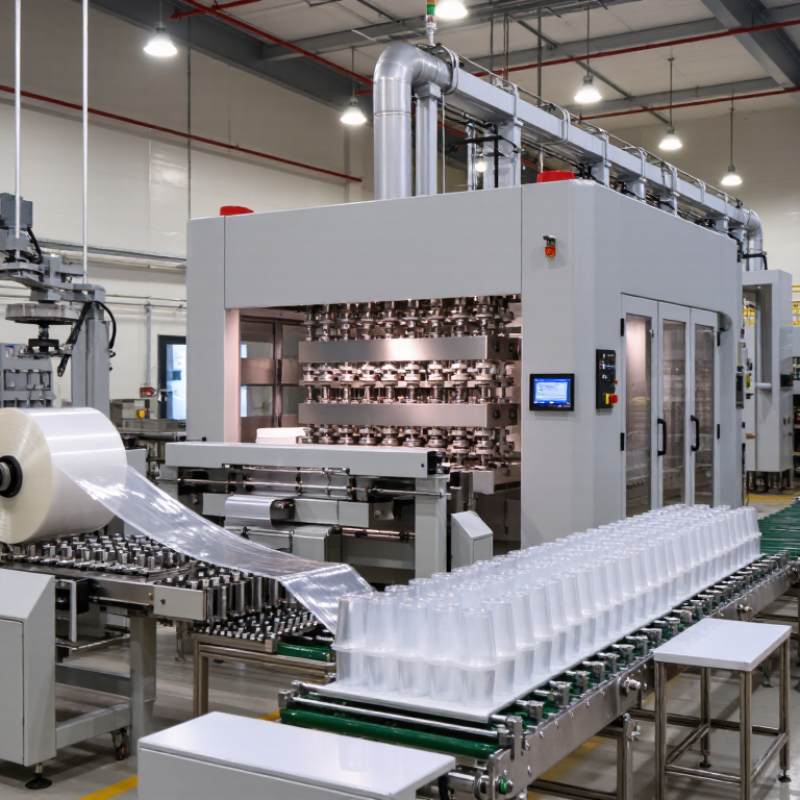
Choosing a Plastic Cup Making Machine is not simply a matter of comparing speed, price, or advertising claims. It is a production decision involving forming accuracy, material waste, energy use, automation, maintenance, and product safety. A machine that produces 50,000 cups per hour may still be unsuitable if its heating zones create uneven walls or frequent trimming defects.
Recent reports from Smithers and Grand View Research show continued growth in thermoformed packaging, driven by foodservice demand, lightweight designs, and automated manufacturing. Their findings also highlight rising pressure to reduce material consumption and improve operational efficiency. These trends make machine selection more technical than ever.
Experienced manufacturers often inspect the details that brochures hide. Watch the sheet path. Check the heater response. Ask for real samples.
Thermoforming specialist Dr. Peter Unger has emphasized that “process stability is the foundation of consistent thermoforming quality.” This principle deserves attention, although every quotation and report should be verified against its original source before publication. In practice, buyers should examine forming depth, cycle consistency, mold-change time, energy monitoring, and after-sales support. A small temperature fluctuation can create thin corners, cloudy surfaces, or weak rims.
The following ten tips provide a practical framework for evaluating a Plastic Cup Making Machine. They focus on measurable performance, long-term reliability, and the realities of daily factory operation. Some assumptions may need reconsideration, especially when recycled or thinner materials are introduced.
Before choosing a plastic cup making machine, define the product and production brief clearly. Record cup diameter, height, volume, wall thickness, rim design, and permitted weight variation. A one-page specification helps suppliers recommend forming area, mold layout, heating zones, and trimming capacity. Small details matter.
PlasticsEurope’s Plastics—The Facts 2023 reports that packaging represented 39.5% of European plastics demand in 2022. This scale shows why consistent dimensions and material efficiency deserve early attention.
Set a realistic output target using annual demand, working days, shifts, changeovers, and planned maintenance. Do not rely on theoretical cycle speed alone. Include rejected cups and startup waste. Smithers’ The Future of Thermoforming to 2028 highlights automation and material efficiency as important development areas. Your brief should therefore state acceptable scrap rates, inspection needs, and labor availability. A common mistake is choosing a machine for peak speed, then discovering that mold changes reduce daily output.
Define the material before discussing machine specifications. PET, PP, and recycled-content blends can require different heating profiles, forming temperatures, and cooling times. If recycled material is planned, test its consistency with the intended cup design. Food-contact production also requires documented material compliance and traceability. Energy consumption should be measured per thousand cups, not only by installed power. The calculation will not be perfect. Leave room for operator learning, seasonal demand, and process adjustments. Reliable suppliers should receive sample sheets, drawings, target quantities, and quality limits before quoting.
Compare Forming Methods and Machine Configurations
10 Tips for Choosing a Plastic Cup Making Machine
Thermoforming and injection molding create cups in different ways. Thermoforming heats plastic sheet, then shapes it over a mold with vacuum or pressure. It suits thin cups, fast cycles, and lower tooling costs. Injection molding uses melted pellets and a closed mold. It produces precise rims, thicker walls, and consistent dimensions. However, molds and maintenance usually cost more.
Configuration matters as much as forming method. An inline thermoforming machine can heat, form, trim, and stack cups continuously. Check its heating zones carefully. Uneven temperature may create cloudy walls or weak rims. A rotary system can reduce floor space and support repeated production, but changeovers may feel less convenient. Servo-driven movement can improve timing and reduce wasted material. Still, a well-adjusted pneumatic system may be sufficient for simpler products.
I have seen buyers focus on maximum speed and overlook mold changes. That mistake becomes expensive. Ask for cycle data using your actual cup size, material, and wall thickness. Inspect the trim collection, stacker access, and heater maintenance points. A machine that runs quickly but stops often is not productive. Also review cooling capacity, compressed-air demand, operator access, and spare-part availability. The best configuration is not always the most advanced one. A smaller machine may offer better control during early production, though future capacity can become a problem. Test sample cups under real conditions, including stacking, sealing, and transport. Consider food-contact requirements and documented quality procedures before approving the purchase.
Evaluate Material Compatibility and Cup Quality
Choosing a plastic cup making machine begins with material compatibility, not production speed. Different plastics soften, stretch, and cool at different temperatures. Polypropylene needs stable heating and controlled forming pressure. PET may require careful temperature control to prevent haze or uneven walls. Compostable materials can behave unpredictably during forming. Test them before approving any machine.
Cup quality depends on more than appearance. Check wall thickness at the rim, base, and sidewall. Uneven thickness can cause cracking during stacking or filling. Inspect the cup’s clarity, roundness, trimming, and sealing edge under normal factory lighting. Small defects often appear after cooling. They may not be visible immediately. Ask for samples made from your actual resin, color, and thickness. A sample made from another material proves very little.
Measure production consistency over several hours, not only during a short demonstration. Record heating temperature, forming pressure, cycle time, scrap rate, and energy use. Experienced technicians also examine mold cooling and material feeding stability. One overlooked cooling channel can distort hundreds of cups. I once saw an attractive trial fail after continuous operation. The machine was capable, but the process settings were incomplete. Leave room for adjustment. Reliable equipment should support repeatable testing, clear maintenance access, and practical quality controls.
Assess Automation, Speed, Energy Use, and Maintenance
10 Tips for Choosing a Plastic Cup Making Machine
Assess Automation, Speed, Energy Use, and Maintenance
Choosing a plastic cup making machine requires more than comparing hourly output. Start by matching automation with your labor plan. Automatic sheet feeding, stacking, and quality inspection can reduce handling errors. However, excessive automation may increase training time and repair costs. Keep the process practical. During a factory assessment, record cycle time, changeover duration, rejected cups, and operator movements.
Speed must be measured under real production conditions. Ask for output data using your intended material, cup size, wall thickness, and mold. A high-speed machine can lose its advantage during frequent mold changes. The International Energy Agency reported that industry used about 37% of global final energy in 2022. Therefore, compare energy per thousand acceptable cups, not only installed motor power. Check heater zoning, insulation, servo efficiency, and standby consumption. Small losses accumulate.
Maintenance often decides whether output targets survive a busy month. The U.S. Department of Energy notes that compressed-air leaks can waste 20% to 30% of compressor output. Inspect pneumatic lines, filters, sensors, and lubrication points before purchase. Request spare-part lead times and fault-history records. A clear maintenance dashboard helps, but it cannot replace trained technicians. I would also test cleaning access around heaters and forming tools. This detail is easy to overlook. It should not be. A cheaper machine may appear efficient, yet repeated stoppages can quietly erase its initial savings.
10 Tips for Choosing a Plastic Cup Making Machine - Assess Automation, Speed, Energy Use, and Maintenance
No.
Evaluation Dimension
What to Assess
Practical Screening Data
Questions to Ask the Supplier
Priority
1
Production Capacity
Match the machine's output with the required daily volume, cup size, wall thickness, and forming cycle.
Typical screening range: approximately 30–120 cups per minute for small to medium thermoformed cups. Actual output depends on cavities, material, cup dimensions, and cycle time.
Is the quoted output based on finished, inspected cups or only theoretical cycles? What output is achievable with our exact cup design?
Critical
2
Automation Level
Check whether sheet feeding, heating, forming, trimming, stacking, counting, and scrap collection are manual, semi-automatic, or automatic.
Recommended for continuous production: automatic in-line forming, trimming, stacking, and counting. Automatic functions can reduce handling labor and variation between batches.
Which operations still require an operator? Can the machine stop automatically when material, air pressure, or stack capacity is abnormal?
High
3
Cycle Speed and Stability
Evaluate cycle time, repeatability, acceleration, and performance during long production runs rather than only the maximum speed.
Useful benchmark: compare rated cycles per minute with tested sustained output over at least 2–4 hours. A stable machine should maintain consistent forming and stacking without frequent stops.
Can you provide a continuous-run test using the intended resin, sheet thickness, mold, and cup geometry?
Critical
4
Energy Consumption
Review heater zones, servo drives, cooling systems, compressed-air demand, and the difference between installed power and actual operating consumption.
Planning range: many thermoforming lines operate around 0.20–0.60 kWh per kilogram of processed plastic, but the result varies significantly with heater efficiency, material, thickness, and utilization.
What is the measured kWh per kilogram or per 1,000 cups under our production conditions? Is the figure measured at full load or during idle operation?
High
5
Material Compatibility
Confirm suitability for the planned resin and sheet structure, including PP, PET, PS, PLA, recycled content, and multilayer sheets where applicable.
Check operating limits: material thickness, sheet width, forming temperature, heating profile, and maximum recycled-content percentage supported by the process.
Which materials have been successfully tested? Are separate heating recipes or molds required for different materials?
Critical
6
Changeover Flexibility
Assess mold replacement, recipe storage, trim-tool adjustment, stacking changes, and cleaning requirements when switching cup sizes.
Good target: repeatable recipe-based setup with clearly documented changeover steps. Changeover time should be measured using the actual molds and tools, not an empty-machine demonstration.
How long does a normal cup-size change take? Which components must be replaced, and can one operator complete the procedure safely?
High
7
Product Quality Control
Inspect wall-thickness distribution, rim integrity, dimensions, transparency or appearance, trimming accuracy, and stack consistency.
Suggested controls: temperature monitoring by zone, pressure and vacuum alarms, automatic fault detection, sample inspection, and documented dimensional tolerances for the finished cup.
Which quality parameters are monitored automatically? Can the system identify incomplete forming, web breaks, temperature deviations, or mis-stacked cups?
Critical
8
Maintenance Accessibility
Review access to heaters, filters, pneumatic parts, lubrication points, sensors, mold components, and electrical cabinets.
Practical target: routine inspection points should be accessible without removing major guards. Preventive maintenance intervals should be clearly listed by operating hours or production cycles.
Which parts require daily, weekly, monthly, and annual service? Are maintenance procedures and exploded spare-part drawings included?
High
9
Utilities and Factory Requirements
Verify electrical load, compressed-air quality and pressure, cooling-water requirements, ventilation, floor space, and material-handling access.
Common utility checks: compressed air is often required at approximately 6–8 bar, while exact flow, voltage, cooling capacity, and installed power depend on the machine configuration.
What are the actual air-flow, cooling-water, electrical, ventilation, and foundation requirements? Are utility consumption figures measured or estimated?
Minimum review: documented risk controls, accessible emergency stops, guarded moving parts, operator training, preventive-maintenance plans, and a spare-parts list covering at least the first operating year.
What is included in installation and training? What is the response process for breakdowns, and which wear parts should be kept in stock?
Critical
Note: The numerical ranges are general industry planning benchmarks for plastic cup thermoforming equipment, not guaranteed machine specifications. Final values should be confirmed through a production trial using the intended material, mold, cup design, and operating conditions.
Review Safety Features, Supplier Support, and Total Cost
When I assess a plastic cup making machine, safety receives more attention than speed. I check fixed guards, door interlocks, emergency stops, and clear warning labels. Temperature alarms should react before overheated material damages equipment or creates unsafe conditions. Electrical cabinets need organized wiring, reliable grounding, and accessible maintenance switches. Ask for test records and operating instructions. Small details matter.
Supplier support can determine whether production recovers quickly after a fault. I request installation guidance, operator training, spare-parts lists, and realistic response times. Remote troubleshooting is useful, but it cannot replace skilled on-site service. Ask who handles repairs after the sale. Fast help matters. I once underestimated training needs, and minor setup errors caused unnecessary rejected cups. That experience changed my evaluation process.
Total cost extends beyond the purchase price. Calculate tooling, freight, installation, electricity, compressed air, labor, maintenance, and expected material waste. A machine with a lower price may consume more energy or require expensive molds. Request a written estimate for routine replacement parts and annual servicing. Check production samples under realistic conditions, not only showroom settings. Leave room for surprises. No estimate is perfect, and suppliers may overlook hidden costs. A careful comparison should include downtime, scrap rates, and future capacity needs before any purchase decision.
Cepex is the brand for the fluid handling market belonging to the Fluidra group. One of the leading european manufacturer of valves and fittings in thermoplastic materials.
Dedicated to the swimming pool, irrigation and industrial markets, we distribute our products worldwide with the Fluidra commercial network and presence in 46 countries with 136 sales branches.
Your data will be processed by CEPEX S.A., with address at C. Lluís Companys, 51-53, 08400, Granollers (Barcelona), and C.I.F. nº A-08928707, to send you communications about our products based on your interests. You can consult more information about the processing of your data and how to exercise your rights as described in the Privacy Policy.
Technical cookies are strictly necessary for our website to work and you can navigate through it. These types of cookies are those that, for example, allow us to identify you, give you access to certain restricted parts of the page if necessary, or remember different options or services already selected by you, such as your privacy preferences. Therefore, they are activated by default, your authorization not being necessary in this regard. Through the configuration of your browser, you can block or alert the presence of this type of cookies, although such blocking will affect the proper functioning of the different functionalities of our website.
The analysis cookies allow us to study the navigation of the users of our website in general (for example, which sections of the page are the most visited, which services are used most and if they work correctly, etc.). From the statistical information on navigation on our website, we can improve both the operation of the page itself and the different services it offers. Therefore, these cookies do not have an advertising purpose, but only serve to make our website work better, adapting to our users in general. By activating them you will contribute to this continuous improvement. You can enable or disable these cookies by checking the corresponding box, being disabled by default.
Functionality cookies allow us to remember your preferences, to personalize certain characteristics and general options of our website, every time you access it (for example, the language in which the information is presented to you, the sections marked as favorites, your browser type, etc.) Therefore, this type of cookies does not have an advertising purpose, but by activating them you will improve the functionality of the website (for example, adapting to your type of browser) and the customization of it based on your preferences (for example, by presenting the information in the language that you have chosen in previous occasions), which will contribute to the ease, usability and comfort of our page during your navigation. You can enable or disable these cookies by checking the corresponding box, being disabled by default.
Advertising cookies allow us to manage the advertising spaces included in our website based on criteria such as the content shown or the frequency in which the ads are displayed. For example, if you have been shown the same ad several times on our website, and you have not shown a personal interest by clicking on it, it will not appear again. In summary, by activating this type of cookies, the advertising shown on our website will be more useful and diverse, and less repetitive. You can enable or disable these cookies by checking the corresponding box, being disabled by default.
Behavioral advertising cookies allow us to obtain information based on the observation of your browsing habits and behaviors on the web, in order to show you advertising content that best suits your personal tastes and interests. To understand it in a very simple way, we will give you a fictitious example: if your last searches on the web were related to suspense literature, we would show you advertising about suspense books. Therefore, activating this type of cookies, the advertising that we show you on our website will not be generic, but will be oriented to your searches, tastes and interests, therefore adjusting exclusively to you. You can enable or disable these cookies by checking the corresponding box, being disabled by default. To understand it in a very simple way, we will give you a fictitious example: if your last searches on the web were related to suspense literature, we would show you advertising about suspense books. Therefore, activating this type of cookies, the advertising that we show you on our website will not be generic, but will be oriented to your searches, tastes and interests, therefore adjusting exclusively to you. You can enable or disable these cookies by checking the corresponding box, being disabled by default.
We use our own and third-party cookies to ensure the proper functioning of the website and to analyse our services, improve your experience on our website and show you advertisements related to your interests according to profiling based on your browsing habits (e.g. websites visited). You can accept all cookies by clicking "ACCEPT" or set or reject them by clicking here. If you would like to know more about the use of cookies, please see our COOKIE POLICY.