
How to Choose the Right Litz Wire for Your Application?
FLUID HANDLING EXPERTS

Blog, all our news

How to Choose the Right Litz Wire for Your Application?

Choosing the right litz wire starts with the conditions inside your application, not the product label. Operating frequency, current, winding shape, and thermal limits all matter. At high frequencies, carefully insulated, individually stranded conductors can help reduce losses caused by skin and proximity effects. But more strands do not automatically mean better performance. Strand diameter, bundle construction, and the finished wire’s dimensions must suit the magnetic field and available winding space.

Charles R. Sullivan’s published research on litz-wire winding design offers a useful principle, paraphrased here: “Match strand size and bundle construction to frequency and winding geometry; strand count alone is not enough.” That distinction matters. A compact transformer with tight turns may need different wire from a flexible coil carrying the same current. Check insulation requirements, operating temperature, bend radius, termination method, and the manufacturer’s electrical data. Ask for test information when a design depends on a specific loss or temperature target. Small details count. A beautiful calculation can still miss how a real winding is assembled. That is worth admitting. Before committing to production, compare candidate wires in a representative winding and measure temperature rise under realistic operating conditions. The right choice balances electrical performance, fit, reliability, and cost—and sometimes the first selection needs revision.
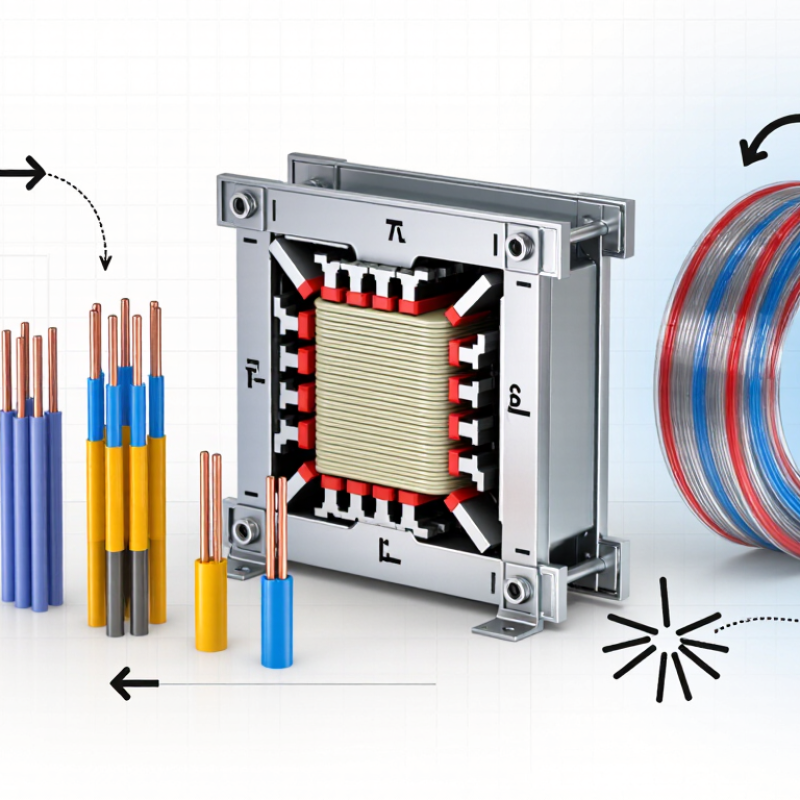
How to Choose the Right Litz Wire for Your Application?

Identify the Electrical and Environmental Requirements of Your Application

Before choosing Litz wire, document the application’s operating frequency, RMS current, voltage, and duty cycle. Frequency matters. At 100 kHz, copper skin depth is about 0.21 mm at 20°C, based on copper’s electrical resistivity. Strands near or below this diameter can help limit skin-effect losses, but they do not eliminate proximity losses. Bundle geometry, winding spacing, and switching harmonics matter too. Treat the calculation as a starting point, not a final specification.

Next, define the real thermal and environmental limits. IEC 60085 assigns 155°C to thermal Class F and 180°C to Class H insulation; these are insulation-class limits, not recommended winding temperatures. Include ambient temperature, cooling conditions, and measured hotspot rise when setting a design target. Check exposure to moisture, oil, vibration, and abrasion, then specify suitable strand insulation and any outer jacket. IEC 60529 defines enclosure IP ratings, but an enclosure rating does not automatically protect the wire inside it. A common blind spot is assuming a room-temperature resistance test predicts high-frequency performance. It does not. Validate the selected construction under representative load and temperature, and revisit the assumptions if the measured loss or hotspot differs from the estimate.

How to Choose the Right Litz Wire for Your Application?

Identify the Electrical and Environmental Requirements of Your Application

Copper skin depth decreases as frequency rises. Use these approximate values at 20°C as an electrical screening reference when considering strand diameter; final Litz wire selection should also account for current, winding geometry, insulation, operating temperature, flexibility, and exposure to moisture or chemicals.

Match Litz Wire Construction to Frequency and Current Demands

Litz wire construction should follow the frequency and current profile of the application, not just a catalog description. At higher frequencies, skin and proximity effects can push current toward strand surfaces and increase AC resistance. Many individually insulated, transposed fine strands can help distribute current through the bundle. Strand diameter is often selected with skin depth in mind, but that estimate is only a starting point. Coil geometry and nearby conductors matter too.

Current demand sets another constraint: the total copper area must carry the required RMS current without excessive temperature rise. A fine-strand bundle may suit a high-frequency transformer, while a design with greater current may need more strands or a larger overall conductor. More strands are not automatically better. They can increase bundle size, insulation volume, and termination difficulty. Heat matters. Check the winding space, cooling conditions, and allowable losses together.

For a practical selection, compare candidate constructions at the actual operating frequency and current, then verify temperature rise in the finished winding. A short sample test can reveal problems that a resistance calculation misses, especially at joints and lead-outs. It is easy to focus on strand count and overlook termination quality; that judgment deserves a second look. Measurements under realistic conditions are more useful than assuming the finest available wire will perform best.

Select Strand Size, Strand Count, and Bundle Geometry

Choosing Litz wire starts with the frequency your winding will actually see. At higher frequencies, current crowds toward each strand’s surface, increasing resistance and heat. Select strand diameter with skin depth in mind, then check the manufacturer’s loss data at your operating frequency. Thinner strands can reduce this effect, but they also add insulation and manufacturing complexity. There is a trade-off.

Strand count sets the total copper area, which affects current capacity, resistance, and how much wire fits in the winding window. Compare the required current with the conductor area and expected temperature rise, not strand count alone. More strands may improve flexibility, but they do not automatically make a winding more efficient. Keep it practical. Leave room for insulation and bend radius, especially around a small bobbin or tight terminal.

Bundle geometry matters, too. A well-transposed construction repeatedly changes each strand’s position, helping strands share exposure to magnetic fields. Concentric, bunched, and other layouts can behave differently under proximity effects and may pack unevenly in a coil. Check the construction details and dimensions before ordering. A calculation can miss real winding constraints. When possible, test a sample in a representative coil and measure loss and temperature at the intended frequency. Then adjust strand size, count, or geometry; the first choice may not be the best one.

How to Choose the Right Litz Wire for Your Application? - Select Strand Size, Strand Count, and Bundle Geometry

Illustrative starting points for selecting a litz-wire construction. Confirm the final design against operating frequency, temperature rise, winding space, and electrical requirements.
Example construction Individual strand diameter Strand count Approx. bare-copper area Illustrative bundle geometry Indicative frequency range Potential application Selection considerations
50 × 0.20 mm 0.20 mm 50 1.57 mm² 5 sub-bundles × 10 strands 20–50 kHz Medium-frequency transformer or inductor windings A larger strand can be a practical choice at lower frequencies. Check whether the finished bundle fits the winding window.
100 × 0.10 mm 0.10 mm 100 0.79 mm² 10 sub-bundles × 10 strands 50–150 kHz Switch-mode power-supply transformers and resonant inductors A finer strand can help reduce skin-effect losses as frequency rises; the total copper area is lower than in some larger-strand options.
200 × 0.10 mm 0.10 mm 200 1.57 mm² 10 sub-bundles × 20 strands 50–150 kHz Higher-current transformer or inductor windings More strands increase copper area while retaining the same strand diameter. Check bundle diameter, insulation build, and bend radius.
400 × 0.08 mm 0.08 mm 400 2.01 mm² 20 sub-bundles × 20 strands 150–500 kHz High-frequency resonant converters and compact magnetic components The fine strands may suit higher-frequency service, but a larger strand count can make the finished bundle harder to terminate and handle.
600 × 0.05 mm 0.05 mm 600 1.18 mm² 10 sub-bundles × 60 strands 500 kHz–1 MHz Higher-frequency inductors and specialized compact windings Very fine strands can be useful at high frequency, but do not assume they guarantee low AC loss. Proximity effects, winding layout, and termination quality matter.

Construction notation lists strand count × strand diameter. In the bundle-geometry column, the multiplication sign describes an illustrative grouping of strands into sub-bundles; actual twist, transposition, insulation, and finished dimensions depend on the specified construction. Copper areas are approximate and exclude strand insulation. Frequency ranges are selection examples, not universal limits: copper skin depth is about 0.21 mm at 100 kHz, 0.093 mm at 500 kHz, and 0.066 mm at 1 MHz at approximately 20°C. Final selection should account for proximity effect, waveform, current, cooling, allowable temperature rise, and winding geometry.

Choose Insulation and Termination Options for Your Operating Conditions

How to Choose the Right Litz Wire for Your Application?

Choose insulation and termination options around the conditions the wire will actually face. A winding in a warm motor may need different insulation from a flexible lead near moving parts. Check operating temperature, voltage, abrasion, moisture, and exposure to oils or cleaning fluids. Don’t rely on the insulation label alone. The complete assembly matters.

Keep it practical. If the wire bends repeatedly, a stiff outer jacket can shorten service life. For tight winding spaces, measure the finished bundle, not just the bare conductor. I would also check how insulation affects heat transfer; this detail is easy to overlook. Small clearances matter.

Termination deserves equal attention. Litz strands have individual coatings, so the selected process must make reliable electrical contact across the bundle. Soldering, crimping, or welding may suit different wire constructions and production methods. Confirm that the process removes or penetrates strand insulation without damaging the conductor. Poor contact can create a hot spot. Ask for process guidance, then inspect sample joints and test them under the expected current and temperature. Specifications help, but real operating conditions can still surprise you.

Compare Performance, Manufacturability, and Cost Before Specifying a Wire

How to Choose the Right Litz Wire for Your Application?

Compare Performance, Manufacturability, and Cost Before Specifying a Wire

Litz wire can reduce skin-effect and proximity-effect losses in high-frequency windings, but the best choice depends on your operating conditions. Define frequency, current, temperature, and available winding space before comparing constructions. More strands do not automatically mean better performance. Strand diameter, insulation thickness, and the finished bundle all affect resistance, flexibility, and heat removal. A coil that runs cool in a short test may behave differently after hours under load.

Manufacturability matters just as much. Fine-strand wire can be flexible, yet it may take longer to strip, terminate, or wind consistently. Check whether the finished wire fits the winding window and whether its ends can be prepared reliably with your process. Request sample lengths for a trial winding, then inspect for damaged strands, uneven coverage, and troublesome connections. I have seen specifications focus on electrical targets while overlooking termination time. That gap can quietly raise production costs.

Tips: Compare total cost, not just price per metre. Include expected losses, scrap, handling time, and termination effort. Ask suppliers for strand count, strand diameter, overall dimensions, and test conditions. Verify results in your own assembly. Small samples can mislead. Keep a little margin for manufacturing variation, but avoid paying for performance your design cannot use.

Article Source:

Copyright 2025 Fluidra S.A. | Created by BCM Marketing Agencia Privacy Policy Legal note | Cookie policy |

Technical cookies are strictly necessary for our website to work and you can navigate through it. These types of cookies are those that, for example, allow us to identify you, give you access to certain restricted parts of the page if necessary, or remember different options or services already selected by you, such as your privacy preferences. Therefore, they are activated by default, your authorization not being necessary in this regard. Through the configuration of your browser, you can block or alert the presence of this type of cookies, although such blocking will affect the proper functioning of the different functionalities of our website.


The analysis cookies allow us to study the navigation of the users of our website in general (for example, which sections of the page are the most visited, which services are used most and if they work correctly, etc.). From the statistical information on navigation on our website, we can improve both the operation of the page itself and the different services it offers. Therefore, these cookies do not have an advertising purpose, but only serve to make our website work better, adapting to our users in general. By activating them you will contribute to this continuous improvement. You can enable or disable these cookies by checking the corresponding box, being disabled by default.


Functionality cookies allow us to remember your preferences, to personalize certain characteristics and general options of our website, every time you access it (for example, the language in which the information is presented to you, the sections marked as favorites, your browser type, etc.) Therefore, this type of cookies does not have an advertising purpose, but by activating them you will improve the functionality of the website (for example, adapting to your type of browser) and the customization of it based on your preferences (for example, by presenting the information in the language that you have chosen in previous occasions), which will contribute to the ease, usability and comfort of our page during your navigation. You can enable or disable these cookies by checking the corresponding box, being disabled by default.


Advertising cookies allow us to manage the advertising spaces included in our website based on criteria such as the content shown or the frequency in which the ads are displayed. For example, if you have been shown the same ad several times on our website, and you have not shown a personal interest by clicking on it, it will not appear again. In summary, by activating this type of cookies, the advertising shown on our website will be more useful and diverse, and less repetitive. You can enable or disable these cookies by checking the corresponding box, being disabled by default.


Behavioral advertising cookies allow us to obtain information based on the observation of your browsing habits and behaviors on the web, in order to show you advertising content that best suits your personal tastes and interests. To understand it in a very simple way, we will give you a fictitious example: if your last searches on the web were related to suspense literature, we would show you advertising about suspense books. Therefore, activating this type of cookies, the advertising that we show you on our website will not be generic, but will be oriented to your searches, tastes and interests, therefore adjusting exclusively to you. You can enable or disable these cookies by checking the corresponding box, being disabled by default.
To understand it in a very simple way, we will give you a fictitious example: if your last searches on the web were related to suspense literature, we would show you advertising about suspense books. Therefore, activating this type of cookies, the advertising that we show you on our website will not be generic, but will be oriented to your searches, tastes and interests, therefore adjusting exclusively to you. You can enable or disable these cookies by checking the corresponding box, being disabled by default.

SAVE

We use our own and third-party cookies to ensure the proper functioning of the website and to analyse our services, improve your experience on our website and show you advertisements related to your interests according to profiling based on your browsing habits (e.g. websites visited). You can accept all cookies by clicking "ACCEPT" or set or reject them by clicking here. If you would like to know more about the use of cookies, please see our COOKIE POLICY.


ACCEPT ALL
Reject no essentials


